Pepto-bismol (Bismuth) as a possible antibiotic for CFS/FM/IBS?

  • A reader forward me a link to Bismuth for IBD and IBS-D study from Australia (2013 Full Text) which states:
    “Bismuth has antidiarrheal, antibacterial, and anti-inflammatory properties…Bismuth is minimally absorbed and so has negligible potential for toxicity in patients with normal renal function. Any absorbed bismuth is mostly excreted in urine unless renal function is severely impaired…. Although many of these disease entities are known to have spontaneous remissions and relapses, it seems unlikely that the unremitting diarrhea in some of our study patients lasting for months to years, despite being on standard treatment, would suddenly settle in its natural course when bismuth was initiated. “
  • They used oral colloidal bismuth subcitrate (CBS) – used in De-nol and Pylera
    • Pepto-bismol is bismuth salicylate.

So what more do we know about bismuth?


Bottom Line

We see above that 2.1 g/day of Pepto-bismol (BSS) appears to be the minimal effective dosage for altering the risk of traveler’s diarrhea (and thus effective protection against some bacteria shifts).

There appears to be significant evidence that it may reduce some symptoms of CFS/FM/IBS in a subset of patients and thus should be discussed with you medical professional. The duration of many studies appear to be approximately 4 weeks.

As always, consult with your medical professional before adding or changing medications.

Probiotic Enemas

Another reader have had good results from Symbioflor-1 with Symbioflor-2, but not taken in the usual way. A reader messaged me with an approach that he found on another site and the results.

21 MARCH

Ken Ive found this web site (http://www.noma-complementary-medicine.co.uk/probiotics.aspx)  uses symbioflor 2 as enema, its a homeopathic therapy
maybe people not tolerating it by drinking could tolerate it in this way at much higher doses (the really useful)
Rectal Applications (only when prescribed) Mix about 2 tablespoons of cool water with about half a tablespoon of Symbioflor II in a clean glass, put this mixture in an enema syringe and administer it rectally. It is recommended that the enema should only be given after a stool has been passed. After it has been given the bowel movement should be held back for about 15 minutes if possible. The length of time for which Symbioflor II should be used depends on the individual and their response to treatment. In the context of microbiological therapy the treatment plan provides for the use of Pro-Symbioflor, Symbioflor I, Symbioflor II and Symbioflor Antigen in stages, in the average case (see literature of the Arbeitskreis fiir Mikrobiologische Therapie e.V. Postfach i58o, D6348 Herborn Dill)”
I think its key what symbioflor does….colon defensins up up!, kill  ourselves the infection without antibiotics
 

22 MARCH

I’ve started with the symbioflor enemas today. I can tolerate much more amount of it without the burning feeling due to the chloride and magnesium in it;
I got sleepy when put it. I think a sign of it was making effect. I will keep you informed. probably i will up the dose.
  • Today put 70 drops in the syringe.
I am taking one capsule of neem with meals (hours separated from E.coli)…However, after some hours i got cold hands…maybe inmune reaction cause e.coli being killed neem?  ..
I saw your last report enE.Coli and Enterococcus taken together cause a bigger effect than E.Coli alone. (i.e. Symbioflor-2 and Symbioflor-1 taken together, or Mutaflor with Bioflorin)” what do you mean..that Symbioflor 1 helps to grow more effectively e.coli?

27 MARCH

Ken, myreport:
It has been 5 days with symbioflor 2 enemas.
So far so good
  • Bloarting decreasing
  • Perfect stools, dark coloures
Ive been taking 80 drops in enema
However one side effect. I freezeing with cold hands soon after. Maybe cause the probioitic is getting down my blood pressure

1 APRIL

hmmm..Started one week ago with symbioflor 2 enemas, same benefits and no counter indications (low blood temperature when increasing doses and anxiety at mega doses (80-100 groups at one shot). But don’t know if its due to poor methylation (im digging into this thx to … 😊 ), the effect of too much serotonin due to high intake of e.coli…die off and not handling it well..
i have not been retest but , in terms of gut symptoms, I’ve been the best in 10 years since i got sick…Im right now with 4 mutaflor before sleep (only gives me the best effect at this hour)..and the symbioflor 2 enemas…
also i am able to deal with H2S , hydrogen sulfide, if taking enteric coated alkaline the first thing in meals…No signals of burping H2S (even when eating carbs)

 The liquid nature of these probiotics simplifies their use in enemas. The German site listed is for a professional group of MDs in Germany and Austria that have been active since 1953. This site contains a list of probiotics available in those countries that the group uses .
Some of those listed on this site, like Symbioflor-1, Symbioflor2,  Symbiolact B (Bifidobacterium bifidum, Bifidobacterium animalis subsp lactis) is available from Paul’sMart- Europe. P.S. We have ordered from them for delivery to the US with no problems (with US Customs — so far).

KyberKompakt — Chronic Lyme Diagnosis

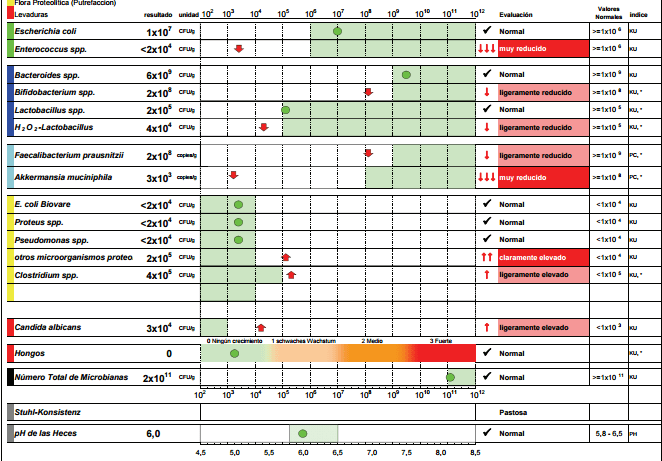
A reader who just received a chronic Lyme diagnosis forwarded his KyberKompakt results (done in Spain).  Prior to doing this test he was on Prescript Assist and Equilibrium for  two months.

For reference, see other reports shared — Nov, 2016, Feb 2017Mar 2017

  • E. Coli is low normal range.
  • Entercoccus spp is very low
  • Other proteolytic microorganisms – High
  • Bifidobacterium spp low
  • H202 Lactobacillus low
  • Faecalibacterium prausnitzii low
  • Akkermansia muciniphila low
  • Candida albicans high
  • Lactobacillus spp — low normal

All of these 4 reports have the same pattern for almost all.  Variation are one below the bottom of the normal range, and another is at the bottom of the normal range. Entercoccus spp is the exception with 3 being very low and 1 being very high.

Compare to the other 3 results, this patient had:

  • Highest Bifidobacterium
  • Highest E.Coli
  • 2nd highest Lactobacillus

While there is no direct evidence that this is caused by Prescript Assist and Equilibrium (i.e. we would need to have a before lab results), I favor this as an explanation of the better results.

k1

k2

The patient is about to start with Symbioflor-1 (Enterococcus faecalis) in the hope of raising the low Enterococcus faecalis. Since the E.Coli is in the low normal range, I would suggest discussing taking Symbioflor-2 with Symbioflor-1 with their medical professional. The two appears to amplify each other.

The high other proteolytic microorganisms (Proteolysis is the breakdown of proteins into smaller polypeptides or amino acids [wikipedia]) is likely causing a shift of metabolities (chemicals) which cause symptoms and cascade elsewhere in the body. Neem and Tulsi may be reasonable supplements to experiment with to reduce those.

Concerning low  Akkermansia muciniphila there is just over 100 articles on PubMed. This increases with a high fat diet with Capsaicin (Chili peppers!)  [2017]. It is not available as a probiotic (but being considered) [2016]

Hmm…. Rhubarb and pomegranate pie with chili peppers!!/?!!

Histamines and Antibiotics

There is a subset of CFS/IBS/FM patients that are histamine sensitive.  The probable cause according to the model is overgrowth of histamine producing bacteria, for example, some (not all) strains of Escherichia coli ,Lactobacillus sp., Proteus morganii, Proteus sp. , Pseudomonas reptilivora and Streptococcus sp.   With CFS we see massive overgrown of bacteroidetes — the species that tag-team to cause this to happen, vary from patient to patient.

A reader asked about antibiotics and histamine interactions. That is a good question which I have not attempted to research and very relevant if you have a MD willing to prescribe antibiotics AND have histamine issues.

Drug allergy syndrome may be connected to the drug impact on histamines. “When oral tolerance tests were performed, only doxycycline was tolerated whereas levofloxacin, clarithromycin, nimesulide and tramadol caused mild urticaria [ hives]” [2007]

  • Fosfomycin Tromethamine  – “…suppressed the release of histamine in a dose-dependent manner…We concluded that some antibiotics, particularly fosfomycin, have the capacity to suppress histamine release mediated by various secretagogues, suggesting they may possess an anti-allergic property as well as a bactericidal activity. ” [1987]
  • Polymyxin B  ( derived from the bacterium Bacillus polymyxa.) “…suppressed the release of histamine in a dose-dependent manner. ” [1987]

Tetracyclines

  • Tetracyclines reduces histamines [2005]
  • Minocycline reduces histamine [2011]
    • “…suppressed the release of histamine in a dose-dependent manner. ” [1987]
  • Doxycycline reduces histamine [2014]

Macrolides

Beta-lactams

  • “beta-lactams and aminoglycosides, none had the capacity to enhance antigen-induced histamine release,” [1987]

Aminoglycosides

  • “beta-lactams and aminoglycosides, none had the capacity to enhance antigen-induced histamine release,” [1987]

Cephalosporin

  • Cefaclor etc – appears to increase histamine [2015]

Penicillin


Fluoroquinolones

  • “levofloxacin…  induces histamine release from the connective tissue-type mast cells distributed mainly in the liver, somewhat in the cutaneous tissue, through the activation of pertussis toxin-sensitive G proteins.” [2001]

Bottom Line

This is an incomplete list but does cover some common families of antibiotics. If there are additional ones that you wish be to research, just add a comment to this post!

Two of the families of antibiotics (tetracycles and macrolides) that inhibits histamine release are very important in Dr. Jadin’s protocol.

A Microbiome test from Italy

it

A reader forwarded the above test and ask for comments. It is a nice test for the brain fogged because information is presented with graphics and reference controls (CTRL) patients results

it2

The first chart illustrates what many studies report, a major shift of the ratio of bacteroidetes to firmicutes. “patients presented … a decrease in several Firmicutes populations.” [2013][Full Text] This is the general pattern seen with CFS and IBS patients at the highest level. The breakdown under this is where things change with symptoms. Biodiversity decreasing or being normal appears to vary according to how it is calculated.

  • “in the stool samples there was a higher relative abundance of Bacteroidetes and lower abundance of Firmicutes observed in ME/CFS patients compared to healthy controls.” [2015]
  • “IBD patients have increased bacteroides, adherent or invasive Escherichia coli, and enterococci, and reduced Bifidobacteria and Lactobacillus species”.[40][Medscape]

CFS is one step towards UC and Crohn’s Disease.. “In chronic fatigue syndrome patients they found bacterial profiles with less diversity. This is similar to those seen in people with two bowel diseases: Crohn’s disease and ulcerative colitis, the researchers said.

The second chart show several families that are overgrowths. This is followed by a chart looking at specific elements. Notice that often one column is 0 and the other is not, that is, what is normal is not there and what is usually not found, is there.[Cornell University]

it3it4

So what should be consider for treatment? It is clear that we want to increase Firmicutes. There are more than 270 genera in it, some of these are LactobacillusBacillusClostridiumStaphylococcus.   The bottom line is that there are no available probiotics for most of these.

There appear to be some relationships to work from:

  • Taking Lactobacillus, increases Lactobacillus and decreases E.Coli and Bifidobacteria in general [2012]
  • Taking Bifidobacteria, increases Lactobacillus and Bifidobacteria, decreases E.Coli slightly [2012]
  • Taking E. Coli, increases Lactobacillus and Bifidobacteria [2016]
  • E.Coli and Enterococcus probiotics taken together cause a bigger effect than E.Coli alone. (i.e. Symbioflor-2 and Symbioflor-1 taken together, or Mutaflor with Bioflorin)

Bacteria inhibit or encourages other families of bacteria. The relationships are complex and poorly understood — hence we need to both research and hope for data; if no data, experiment on ourselves (taking notes and sharing results — such as in the last post)
