Update on Irritable Bowel Syndrome – 2016 news

I thought it would be good to review some of the hundreds of studies published on PubMed in 2016 to see if anything especially interesting has been published.

  • “During life, the numbers of bifidobacteria decrease from up to 90% of the total colon microbiota in vaginally delivered breast-fed infants to <5% in the colon of adults and they decrease even more in that of elderly as well as in patients with certain disorders such as antibiotic-associated diarrhea, inflammatory bowel disease, irritable bowel syndrome, obesity, allergies, and regressive autism.” [2016]
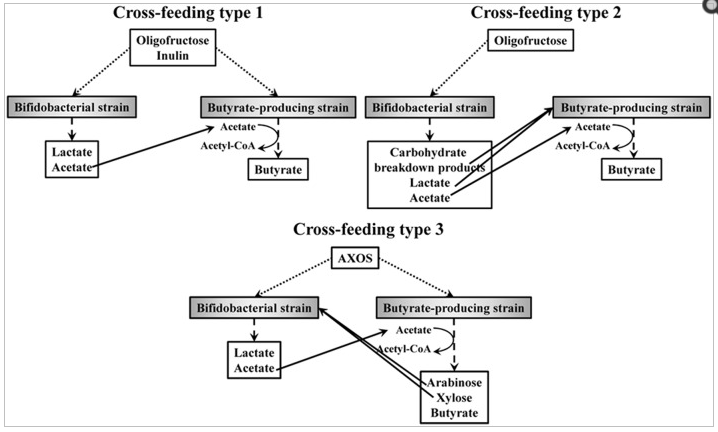
    • ” Butyrate is an essential metabolite in the human colon, as it is the preferred energy source for the colon epithelial cells, contributes to the maintenance of the gut barrier functions, and has immunomodulatory and anti-inflammatory properties. It has been shown that the butyrogenic effects of ITF and AXOS are the result of cross-feeding interactions between bifidobacteria and butyrate-producing colon bacteria, such as Faecalibacterium prausnitzii (clostridial cluster IV) and Anaerostipes, Eubacterium, and Roseburia species (clostridial cluster XIVa). These kinds of interactions possibly favor the co-existence of bifidobacterial strains with other bifidobacteria and with butyrate-producing colon bacteria in the human colon.” – hence Clostridium butyricum (Miyarisan) probiotics may be a very significant factor.
    • AXOS => arabinoxylan-oligosaccharides
    • but
  • “Low-FODMAP rye bread helps IBS patients to control their symptoms and reduces gastrointestinal gas accumulation.” [2016] I have been a long time advocate of 100% rye bread (with zero wheat flour in it) – 100% rye bread  encourage biodiversity, [2012].
  • “a newly emerging condition termed non-celiac gluten (or wheat) sensitivity[NCGS/NCWS] is now well established in the clinical practice. Notably, patients with NCGS/NCWS have symptoms that mimic those present in irritable bowel syndrome.” [2016] – IBS does not mean wheat (or gluten) sensitivity. Many “gluten sensitive” individuals are actually wheat sensitive only.
  • “Using strict criteria as recommended for IBS studies, about one third of patients with IBS-D or IBS-M are wheat sensitive, with a similar proportion in both IBS types. ” [2016]
  • “Of 1074 patients (44.1%) who responded to open-label rifaximin, 382 (35.6%) did not relapse, whereas 692 (64.4%) did; of these, 636 were randomly assigned to receive repeat treatment with rifaximin (n=328) or placebo (n=308). The percentage of responders was significantly greater with rifaximin than placebo (38.1% vs 31.5%, P=.03). The percentage of responders for abdominal pain (50.6% vs 42.2%, P=.018) was significantly greater with rifaximin than placebo, but not stool consistency (51.8% vs 50.0%, P=.42).” [2016] So Rifaximin helps about 1/3 of IBS patients – but this amounts to actually just 7%  (38% improved with Rifaximin, and 31% improved with a placebo — 38% – 31% = 7%) … so real odds is closer to 1/14.
  • More than every tenth Dane have irritable bowel syndrome. The condition is diagnosed by a positive strategy including fulfilment of the Rome III criteria, absence of alarm symptoms, and if needed a few paraclinical tests. Currently, there is no cure of the disorder. Treatment is recommended on a symptom-based approach targeting the dominating symptom/symptoms. If symptoms are reduced, the quality of life is considerably improved.” [2016]
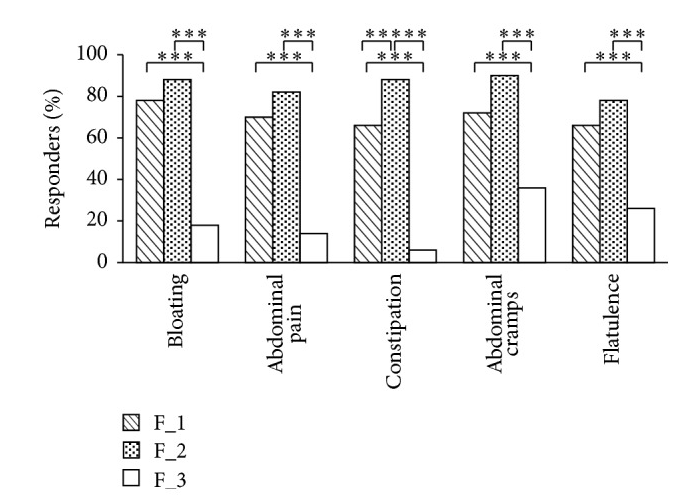
  • “Multispecies probiotic supplementations are effective in IBS-C subjects and induce a different assessment in the composition of intestinal microbiota” [2016]
    • “it is known that the level of bifidobacteria and lactobacilli species is lower in IBS patients compared to healthy persons [28, 29] and several studies show that the supplementation of them, or mixtures including species of these genera, is effective in alleviating symptoms of IBS. Moreover, the selected strains were already known for their effect on intestinal cell lines as previously reported [19].”
    • Mixture F_1: 5 × 10⁹ CFU L. acidophilus , 5 × 10⁹ CFU L. reuteri (30 mg as lyophilized), – 10 Billion CFU
    • Mixture F_2:  5 × 10⁹ CFU L. plantarum, 5 × 10⁹ CFU L. rhamnosus , 5 × 10⁹ CFU B. animalis subsp. lactis – 15 Billion CFU  BEST – see posts on L.Rhamnosus 
    • Mixture F_3:  390 mg inulin (almost a Placebo)
  • mix
  • “self-reported anxiety and depression provide a twofold risk for IBS onset.” [2016]
  • “Species richness, but not community diversity, differentiated all IBS patients from Healthy Controls.” [2016]

Probiotics: Lactobacillus rhamnosus – a MCS probiotic?

My last post on lactobacillus rhamnosus was back in 2012, I recently found some new interesting articles on PubMed, so time for an update. Over the weekend, I had a run to Canada to pick up a supply of Mutaflor for my wife (Crohn’s Disease) and spotted Jamieson probiotic for traveler’s diarrhea. They were 10 billion CFU of Lactobacillus Rhamnosus GG per capsule. Culturelle is the same strain and dosage — except for one thing, the wife did not react to Culturelle like she did to Jamieson’s!!! Jamieson’s had a much stronger effect and was 40% cheaper per capsules.  I suspect that the Jamieson’s was a lot fresher (i.e. less time since manufacture) than Culturelle.

I have always found that probiotic intended to treat traveller’s diarrhea tend to be good candidate probiotic (if there is research backing it).

Latest Articles on Lactobacillus Rhamnosus

A CFS patients Stool Test

A reader forwarder to me their results from DOCTOR’S DATA STOOL TEST, and this is my comment  on things to consider (and, of course, consult with your knowledgeable medical professional before taking any action). Tests change every few years and I like to see the latest report. They have been active on herbs and probiotic for a year, with just minor improvement.

As expected:

expected

E.Coli is better than is typically seen, I suspect Mutaflor or Symbioflor-2 supplementation. Symbioflor-2 is my first choice for two reasons:

  • Studies found that it does take up residency
  • Can be ordered for shipment to the US via Amazon.de (i.e. availability)

Mutaflor would be a secondary choice (much harder to order from the US)


The NG for Enterococcus spp, suggests that a enterococcus probiotic should be used (the more species, the better).

The E.Coli-Enterococcus Marriage

A reader on my enterococcus probiotics post commented:

“E.coli and enterococcus appear to have a symbiotic relationship too! This makes sense.”

So, as is my habit, I decided to determine if this is true, false, or unknown.

The chart below showed that they appear to support each other [2008] and thus may be, and should be, taken together for best effect.

ee

  • E. coli was correlated with enterococci in southern Lake Michigan beaches[2003]
  • “This study demonstrated that there was a synergistic effect on virulence when an association of enterococci and E. coli”[2008]

Don’t forget me! Biofilm breakers

You may wish to take the above with herbs and supplements that isted in my biofilm breaker post and the post on biofilm breaker probiotics. Why is this important? It expose the residue infections to the two probiotics so they can be dislodged.

 Bacteria in Imbalance

imb

These are bacteria with larger than normal volumes. They have no explicit issue linked to them, however they could help to support bad bacteria, or needed to sustain them.

For example, gamma hemolytic strep is associated with “pediatric autoimmune neuropsychiatric disorder associated with streptococcus (PANDAS).” [2015], which hints at it being involved with neurological symptoms of CFS.

The rest of his lab reports were marked normal on the report. You may wish to look at another readers report from 2014 here which contains further suggestions.

  • A mushroom extract that may help, see this post.
  • Tulsi may also help, see this post
  • Zingerone (related to ginger but not in raw ginger) “The results of the present study revealed the anti-quorum sensing activity of zingerone targeting ligand-receptor interaction, hence proposing zingerone as a suitable anti-virulent drug candidate against P. aeruginosa infections” [2015]
  • P. Aeruginosa is associated with IBS, this post, as well as higher histamine levels, in this post.

Bottom Line

First try E.Coli+ enterococcus probiotics + biofilm breakers, then rotate to Tulsi and Zingerone (only product that I could locate is this one on Amazon).


Enterococcus Probiotics

Some CFS patients are very low in Enterococcus, my next post will look at the lab results on a CFS patient that shared his results with me.

“Species from the genus Enterococcus have been used as probiotic for humans or animals, although this genus is not considered “generally recognized as safe” .[2001]..

  • “Furthermore, E. faecium has experimentally been shown to have a high colonization potential, especially if administered in connection with treatment with antimicrobial agents [15].”

“Enterococcus strains have been used as supplement for the food and feed such as poultry and swine to replace the use of sub-lethal antibiotics in the feeds. Many studies have been conducted to evaluate the effect of probiotic strains of this genus (mainly E. faecium)….Some strains are resistant to many antibiotics and possess virulence factors such as adhesins and haemolysin, often located on pathogenicity islands or plasmids.” [2013]

“Pulse-field gel electrophoresis showed that the sixteen isolates (from commercial Korean Probiotics) tested in this study are originated from three strains.” [2008]

Single Family (Only Enterococcus)

Bioflorin – Enterococcus faecium SF 68

Reviewed in early post.

  • “Enterococcus faecium SF 68 (sensitive to penicillin, tetracycline, virginiamicin and tylosin, but resistant to streptomycin)” [1994]
  • “An antagonistic activity of Enterococcus faecium SF 68 towards Plesiomonas shigelloides, Aeromonas sp., enteropathogenic Escherichia coli and Yersinia enterocolitica has been studied and demonstrated.’ [1990]
  • “Fingerprints identical to the ingested probiotic strains were recovered from fecal samples of 4/7 volunteers after one week of Mutaflor, from 4/6 after taking Bioflorin” [2007]

Symbioflor-1

From the makers of Symbioflor-2, contains a strain of Enterococcus faecalis. [Package Insert]. It is unlikely to take up residence, so should be viewed as a catalyst-probiotic (one that may help others during the short time that it is there).

Multistrains

Multi-Strain-PROBIOTIC-InnovixLabs-Broad-Spectrum

Contains Enterococcus faecium SD-5843 – no studies

130 Tablets New Biofermin S Tablet By Biofermin

Japanese Product.

Three-Lac

Enterococcus faecalis

Integrative Therapeutics – Enterogenic Concentrate

Enterococcus faecium

 Enterococcus Faecium SGEf 01,  – No studies

Also in Cat and Dog Probiotics

I will not touch the question of using Vet probiotics by humans.


Bottom Line

  • Bioflorin is the first choice because it has a good chance of persisting (likely depends on what it has to deal with… a boxing match).
  • Symbioflor-1 is the second choice — simple because it has been studied and results published
  • For all of the rest, there is no clear winner, but I am bias for Bioferimin (from my experience with other Japanese produced probiotics). According to their site, 1/3 of the probiotic is enterococcus[source]. It is also the easiest to obtain in the US because it is sold on Amazon (and appear to ship from Japan). It also appear to be multiple tablets for a “adult dosage”, so it is possible to slowly introduce it easily
  • Taking with herbs or even selected antibiotics appear to increase it success (i.e. knock out the opposition, and it will move in)

Viruses, Retrovirus and Chronic Fatigue Syndrome

A reader asked about retroviruses – these are virus that which  reproduces its RNA the opposite way of normal viruses (i.e. Retro). Antiretroviral drugs are medications for the treatment of this type on infection. Retroviruses are best known in connection with HIV infections.

The XMRV Hype

Due to lab errors, a lot of money and time was spent trying to show that XMRV (RV for retrovirus) was associated with CFS/ME. The titles of many recent studies say it all:

The last study had a bit wider scope on other virus associated with CFS/ME “We fail to demonstrate a difference in HERV-K18 envtranscripts, HHV-6 viral copy number, and HHV-7 viral copy number between CFS patients and healthy controls. Our data do not support the hypothesis of reactivation of HHV-6 or HHV-7 in CFS.” which is echoed in some studies:

And there are other older studies who speculateHHV-6 and HHV-7 may be involved in the pathogenesis of CFS and reactivation of both viruses may provoke changes in the phenotype of circulating lymphocytes.”[2006] and “These findings suggest that the amount of HHV-6 and HHV-7 reactivation can be an objective biomarker for fatigue.” [2007] “Parvovirus B19 may be involved in the pathogenesis of CFS, at least for a subset of patients.” [2009]

Anti-viral Drugs — works by side effects???

On the flip side, an antiviral drugs such as Valacyclovir have positive results on a subset of ME/CFS patients . “We concluded that the 16 CFS patients (included in both phases of this study) with EBV-persistent infection (EBV single-virus subset) are improved after 6 months of continuous pharmacokinetic dosing with valacyclovir.” [2002] [2007] Patients with multiple viruses did not benefit – even when one was EBV.

My  model of CFS is that it is a microbiome dysfunction, a major shift of bacteria types and volumes in the person. I was unable to find any studies on how antivirals shifts (or do not shift) the microbiome by the use of antiviral drugs. Drugs intended for one purpose often are later to have other consequences — for example, a drug  intended for the treatment of various cardiovascular disorders… is commonly known as Viagra.

Bottom Line

IMHO, retrovirus and virus are red-herrings in CFS/ME. They have been heavily studied “and found wanting” as explanations and models for treatment. Virus may become reactivated as a side effect of the bacteria shift is a small subset of CFS/ME patients, but it is not a global answer.