What does antibiotics/herb X kill?

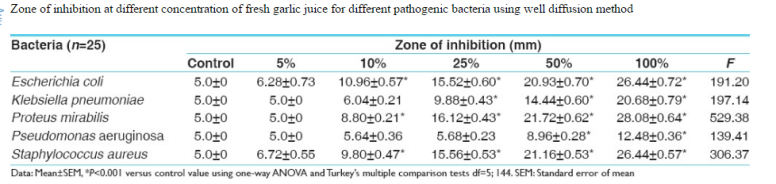
A reader asked “My question is, do you have any source where it shows which strain does the allicin(garlic) kill?”

I will answer this question by showing the steps that I took to answer it.

  1. https://www.wikipedia.org/ and enter the name – you want to get the various brand names that it may have. In this case it is easy: {garlic,allicin}
  2. Go to PubMed. and start with a wide search:
    1. (garlic OR allicin) and bacteria
  3. My results had over 600 hits.
  4. Start scanning the titles and making notes, I usually add the Uri to the article for future reference, often the title is enough, sometimes opening the links will get good details.

General Results

Specific Results

If you want to know if it will impact Lactobacillus bacteria (i.e. probiotics):

(garlic OR allicin) and lactobacillus

which returned 37 hits.

  • “The inhibition zones of the different concentrations of garlic extract were not significantly different for S. mutans, S. sanguis, and S. salivarius. For P. aeruginosa and lactobacillus spp. the inhibition zones of 5%, 10% and 20% concentrations were not significantly different from one another,” Antibacterial effect of different concentrations of garlic (Allium sativum) extract on dental plaque bacteria.
  • Effect of garlic powder on the growth of commensal bacteria from the gastrointestinal tract. “While for most bacteria the antimicrobial effect was transient, the lactobacilli showed a degree of resistance to garlic, indicating that its consumption may favour the growth of these beneficial bacterial species in the gut. Garlic intake has the potential to temporarily modulate the gut microbiota.”
  • “The impact of these extracts on the growth of selected probiotic bacteria (Lactobacillus reuteri, Lactobacillus rhamnosus, Bifidobacteria lactis) and pathogenic bacteria (Escherichia coli 0157:H7 and Escherichia coli LF82) was assessed using a standard minimum inhibitory concentration method. The results showed that aqueous extractions of garlic and black peppercorns significantly enhanced the growth of one strain of probiotic bacteria (L. reuteri) whilst inhibiting both pathogenic strains of E. coli at a 1:50 dilution.” In vitro effects of food extracts on selected probiotic and pathogenic bacteria.

No results can happen

Since   is high in CFS and is also associated with histamine production,  I tried the following search:

(garlic OR allicin) and Morganella

There were no results.

August Review of News on Probiotics

I follow a few groups that deal with probiotics in general. This is my periodic extract of interesting random notes, sometime with slightly off the wall comments (to get people thinking!”

  • “humans harboring a type of Staphylococcus bacterium-S. lugdunensis-in their noses have a lower abundance of S. aureus, the kind that can cause nasty infections.” [Scientific American]  “First we had shyte transplants, now we are heading to nose goobers transplants!”. Actually only 20% were found to have this bacteria. Coming soon — nasal probiotic sprays!
  • “Nail-Biters, Thumb-Suckers Have Fewer Allergies … “The findings support the ‘hygiene hypothesis,’ which suggests that being exposed to microbes as a child reduces your risk of developing allergies….  a set of articles published this month in Perspectives in Public Health takes issue with the idea that modern ideals of cleanliness are harming our health, arguing that this view hinders efforts to combat the rise in allergies and chronic inflammatory diseases. “[the Scientist]
  • “Kids often acquire cavity-causing bacteria from non-family members, researchers report at the American Society for Microbiology annual meeting.” [The Scientist]
  • “Food that travels faster through the gut results in bacteria producing less harmful by-products in the digestive system, resulting in a healthier gut environment, according to a study…. diet rich in fiber and plenty of water” [Nature]
  • “Vitamin D3 may increase bacterial richness in the upper gastrointestinal tract and reduce opportunistic pathogens, says a new study from Austria.” [European Journal of Nutrition]
  • “Certain food additives may interfere with your gut bacteria, causing changes that boost inflammation in the intestines and potentially promote the development of some chronic diseases, a new study suggests. In the study, researchers looked at ingredients called emulsifiers, which are added to many processed foods, including ice cream and peanut butter,”[Transactional Microbiome]
  • “While there is some evidence from previous reviews that probiotic interventions may benefit those with disease-associated imbalances of the gut microbiota, there is little evidence of an effect in healthy individuals.” [Genome Medicine]
  • “Intestinal bacteria that can boost bravery or trigger multiple sclerosis: An increasing body of research results confirms the importance of the “gut-brain axis” for neurology and indicates that the triggers for a number of neurological diseases may be located in the digestive tract.” [European Academy of Neurology]
  • “Metagenomic profiling revealed that the low-dose chemical exposure resulted in significant changes in the overall bacterial composition, but in adolescent rats only. Specifically, the individual taxon relative abundance for Bacteroidetes (Prevotella) was increased while the relative abundance of Firmicutes (Bacilli)was reduced in all treated rats compared to controls. Increased abundance was observed for Elusimicrobiain DEP and MPB groups, Betaproteobacteria in MPB and MIX groups, and Deltaproteobacteria in TCS group. Surprisingly, these differences diminished by adulthood (PND 181) despite continuous exposure, suggesting that exposure to the environmental chemicals produced a more profound effect on the gut microbiome in adolescents.” [Microbiome]
  • “Probiotic strain Lactobacillus gasseri activates ‘multiple actions’ that may work in synergy to prevent obesity, Japanese research in rats has suggested.” [British Journal of Nutrition]
  • Frailty (old age) was associated with species and genus abundance. Species more abundant with frailty included Eubacterium dolichum and Eggerthella lenta. Also, Faecalibacterium prausnitzii was less abundant in frailer individuals.” [Gut Microbiota]
  • “Mice raised under specific pathogen-free conditions in a lab do not model the natural exposure of animals and humans to environmental commensals and pathogens. Now, two studies show that exposing mice to their natural environment, or infecting them with specific pathogens, results in an immune system that better resembles that of adult humans.” [Nature] — i.e. many studies with mice may yield  misleading or even false results.
  • “The absence of one specific bacterial species[Lactobacillus Reuteri] in the gut is associated with the development of social behaviour that falls within a range of autism spectrum disorders (ASDs), according to a study in mice.” [Economist]
  • “Primates, Gut Microbes Evolved Together” [The Scientist] “When the researchers compared the phylogenetic trees of hominids to the trees of the bacterial species from the fecal samples, they found that both trees reflected the same evolutionary branching. In other words, most of the bacterial species in humans were not found in the ape samples. The researchers saw that for two of the three bacterial families, species were clearly present only in one modern day hominid, suggesting a distinct co-evolution for two of the three bacterial families with their hosts.” This echo my belief that your personal DNA and your personal gut bacteria have evolved together.
  •  “This study demonstrated that increased intestinal permeability [leaky gut] may be induced by bacteriophages that affect the microbiota.” [Gut Pathogens] The ” bacteriophage cocktail was active againstStaphylococcus spp., Streptococcus spp., Proteus spp., Pseudomonas spp., E. coli, K. pneumonia, andSalmonella spp”; i.e. the body response to the above infections (creating bacteriophages) may induce leaky guts in some as a side effect. Removal of those infections would stop the production of bacteriophages  and thus could heal leaky guts.
  • “We further showed that there were 7 (3 negative and 4 positive correlation) OTUs significantly correlated with all the three types of cognitive abilities, at the order level, including Bacteroidales, Clostridiales, Desulfovibrionales,..” [Journal of Alzheimer’s Disease]
  • “found that inducing strokes in mice altered the animals’ gut microbiota, triggering an immune response that traveled back to the brain and worsened the severity of the lesions.” [The Scientist]
  • “Compared with untreated mice, adult mice treated with antibiotics showed significantly fewer newly formed brain cells (i.e. reduced neurogenesis) in the hippocampus region of the brain, and subsequently their memory also deteriorated ..it has been previously reported that antibiotic-induced gut dysbiosis may lead to impaired cognition in mice, little is known about the link between the brain, the local and systemic immune system, and the gut microbiota. ” [Gut Microbiota]
  • In “the healthy control group. Bacteroides, Proteobacteria, and Actinobacteria increased in level, whereas that of Firmicutes was reduced in major depressive disorder groups compared with the healthy control group.” [Gut Microbiota]
  • intestinal microbiota changes promote a pro-inflammatory environment in systemic lupus erythematosus SLE patients…it has been found that enriching SLE gut microbiota with two Clostridia strains (Ruminococcus obeum DSM25238 and Blautia coccoides DSM935) along with Bifidobacterium bifidum LMG13195, which have a Treg-inducing function, reduced the Th17/Th1 balance and prevented Th over-activation. [Gut Microbiota]


Clinical Guide to Probiotic Products in US

It is interesting to note that Mutaflor (E.Coli Nissle 1917) is included in the list.

These lists studied probiotics for various conditions and the degree of evidence supporting the conditions that they help.

  • Infections diarrhea aka ID
  • Antibiotic associated diarrhea – Prevention aka AAD
  • Clostridium Difficile associtaed diarreha – Prevention aka CDAD
  • Traveler’s diarrhea aka TD
  • Constipation aka C
  • Functional abdominal pain aka FAP
  • Irritable bowel syndrome aka IBS
  • Ulcerative colitis – Adjunct to standard therapy aka IBD-UC
  • Inflammatory bowel disease – Pouchitis aka IBD-P
  • Heliobacter pylori – Adjunct to standard eradication therapy aka HP
  • Oral health aka OH
  • Reduction of LDL and total cholesterol aka LDL-C
  • Common infectious disease aka CID

With the degree of evidence supporting their use.

Guides are available for:

There is also, “A Gastroenterologist’s Guide to Probiotics” with an audio pod cast.


Recommendations From Surveys

I work off a model. The model suggests things that are likely to help and in many cases did help me (and others).  Surveys help determine what is the best items for the common CFSer. It changes choices from opinion and theory to evidence based recommendations.

According to the survey results to date (Warning sample size are small, please add your own experiences!):

  1. Herbs
  2. Probiotics
  3. Antibiotics

80% or better chance of improvement

  • Take the probiotic General Biotics Equilibrium. 100% improved, no one got worst
  • Get Tinidazole prescribed, again 100% improved,
  • Get a Macrolide antibiotic prescribed,  88% improved, no one got worst
  • Take the herb Neem (make sure enough capsules), 80% improved, no one got worst

No Adverse Effects

Odds below are odds of improvement

  • Get Metronidazole/Flagyl prescribed, 75%
  • L Plantarum 229V probiotics, 50%
  • Herb Thyme 50%
  • Align probiotics, 46%

Odds of getting better than worst

  • Probiotic L.Reuteri  6:1
  • Licorice  5:1
  • Olive Leaf  4:1
  • Oregano 4:1
  • Probiotic Mutaflor  3:1
  • Probiotic Culturelle  3:1
  • Probiotic Yakult  3:1
  • Antibiotic Doxycline  2:1
  • Antibiotic Fluoroquinolene  2:1
  • Antibiotic Minocycline  1.5:1
  • Wormwood  1:1 ( a coin flip!)

AVOID

Odds are less than 1:1, better chance of getting worst than better

  • Herb Cinnamon
  • Herb Ginger
  • Antibiotic Rifampicin
  • Antibiotic Penicillin
  • Antibiotic Sulfonamides


What should be in the ideal microbiome test for CFS

This morning I got an email from Cort Johnson(health rising) putting me in contact with someone working with some microbiome testing firms for  microbiome testing with CFS. The issue was discussing what to test for. I thought in addition to an email response, a public post would be wise — in case I have missed any studies that readers may know about.

This is based on current knowledge and studies on PubMed. Additional items may be discovered in time. Low or High is relative to healthy controls in some patient populations. A recent 2016 studies that associated bacteria to symptoms found that gender was a significant factor in the response[2016]. This may be a factor in why CFS impacts females more than males.

This list may bring home to many people that we are not dealing with a single bacteria (infection) but a shift of an entire population, a challenging scenario to treat!

Items Found to be Low

Items Found to be High

As a graphic from this article

40168_2016_171_fig5_html

 Additional Suspect Bacteria

Gluten Sensitivity is common with a large subset of CFS patients. My earlier post, listed the observed shifts there. I  have reproduce the table below:

With Glutten /Celiac Issues
Increase Decrease
Bacteroides Akkermansia muciniphila
Actinobacteria Bacteroides-Prevotella
Atopobium Bifidobacterium
bacterial diversity Bifidobacterium adolescentis
Bacteroides-Prevotella Bifidobacterium bifidum 
Bifidobacterium Bifidobacterium catenulatum
Bifidobacterium adolescentis Bifidobacterium lactis
Bifidobacterium Bifidum Bifidobacterium diversity
Bifidobacterium breve Clostridium coccoides
Bifidobacterium dentium Deinicoccus-Thermus
Clostridium Haemophilus spp.
Clostridium histolyticum Lactobacillus casei
Clostridium lituseburense Lactobacillus paracasei
Enterococcus, Lactobacillus Rhamnosus
Escherichia coli Lactobacillus sakei
Eubacterium rectale-Clostridium coccoides Lactobacillus zeae
Faecalibacterium prausnitzii Lactobacillus 
Firmicutes Lactobacillus-Bifidobacterium/Bacteroides-Prevotellaratio RATIO
Fusobacteria Neisseria spp.
Lactobacillus Porphyromonas
Lactobacillus Brevis Proteobacteria
Lactobacillus curvatus Proteobacteria
Lactobacillus delbrueckii bulgaricus Staphylococcus 
Lactobacillus frementum Staphylococcus-Micrococcus
Lactobacillus gasseri
Lactobacillus paracasei
Lactobacillus plantarium
Lactobacillus Rhamnosus
Lactobacillus Rossiae
Lactobacillus and Bifidobacterium groups greater diversity
Leuconostoc carnosum
Leuconostoc mesenteroides
Methylobacterium spp.
Mycobacterium spp.
Staphylococcus
sulfate-reducing bacteria

.