Constipation in IBS/CFS/FM

On Friday I was messaged by a reader that have had extreme constipation. I have not done a post on constipation yet, but I do have a case report from another reader that had severe constant constipation, no longer has it (nor needing to take any drugs for it)

“Dec 24, 2015 started with:

  • Prescript Assist
  • L. Casei  – 4 capsules per day or (Yakult etc)
  • 15 mg gum arabic

January 9, 2016 – constipation effectively gone.

Remember oats, fruits, vegetables and whole grains”

Probiotics

Moving on to PubMed, remember some probiotics can increase constipationit is not just probiotics, but the right ones!

There are no studies on Prescript Assist and constipation. Prescript Assist is well studied for IBS and found effective.

Herbs

Unusual Finding

In reviewing the literature for this post, I came across this — an article that found that rhubarb effectiveness can be increased up to 2000 fold by taking with a multidrug pump inhibitor. Bacteria has “pump” that pushes out toxins — which can often be the antibiotics trying to kill it. By slowing or stopping these pumps — the bacteria succumbs to the antibiotic (be it prescription or herbal)

  • Multidrug pump inhibitors uncover remarkable activity of plant antimicrobials.[2002] “It is possible that the apparent ineffectiveness of plant antimicrobials is largely due to the permeability barrier. ….The results show that the activities of the majority of plant antimicrobials were considerably greater against the gram-positive bacteria Staphylococcus aureus and Bacillus megaterium and that disabling of the MDRs in gram-negative species leads to a striking increase in antimicrobial activity. Thus, the activity of rhein, the principal antimicrobial from rhubarb, was potentiated 100- to 2,000-fold (depending on the bacterial species) by disabling the MDRs.”
    [Full Text]

    • More on multidrug pump inhibitors: Bacterial multidrug efflux pumps: Mechanisms, physiology and pharmacological exploitations [2014] “Another group of EPIs is called the quinoline derivatives, because of their structural similarity with quinolones [143].”  – interesting because Jadin’s protocol includes the concurrent use of quinolones with other antibiotics.
    • “In Gram-positive bacteria, EPIs against the NorA system in S. aureus has been intensively studied. A large number of both synthetic and natural compounds have been found to be EPIs against S. aureus NorA, especially those of natural origins such as genistein isolated from Lupinus argenteus, spinosan A isolated from Dalea spinosa and Tiliroside isolated from Herissantia tiubae”  Genistein is available as a supplement.

Bottom Line

The successful elimination of constipation reported by the reader is supported by PubMed articles. There are additional probiotics reported with good results in the literature. Symbioflor-2 and Mutaflor are both cited.

Rhubarb and genistein taken together is another approach, one that I would suggest be tried before (and NOT concurrent with) probiotics. There is a significant herx risk from this.

— as always consult with your knowledgeable medical professional before making any changes in supplements.
Cistus Incanus

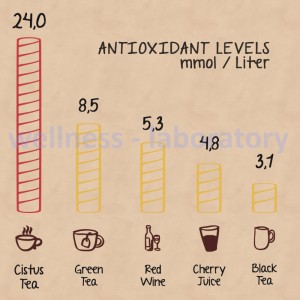
A member of a Spanish group that I work with asked about Cistus Incanus. She knows that I am always interested in herbs — for two reasons, no prescription needed to get, likely less collateral damage than prescription medication. There are only 29 citations on PubMed. She reports very good response to it.The graphic below may explain part of the why.
UPDATED Mar,2020 — due to COVID-19. There are now 45 citations

wellness-p2-small-300x300

from http://passion4luxus.com/?p=1904

Cistus species … have been employed in Mediterranean folk medicine as herbal tea infusions for healing digestive problems and colds, as extracts for the treatment of diseases, and as fragrances…. Various preparations from Cistus species have traditionally been used as remedies in folk medicine around the Mediterranean basin, especially in Greece, Italy, Spain, and Turkey. The targeted conditions and diseases include anxiety, arthrosis, asthma, bronchosis, various types of cancer, bacterial and fungal infections, cardiopathies, catarrh, corn, diarrhea, duodenosis, dysendery, dyspnea, fracture, gastrosis, headache, hepatosis, hernia, hysteria, induration, infection, inflammation, insomnia, leukorrhea, myalgia, neuralgia, osteoarthritis, polyp, proctosis, rhinosis, sore, spasm, splenosis, ulcer, uterosis (Duke et al., 2008).

Organic and aqueous leaf extracts of C. monspeliensis, and also C. villosus (=incanus), growing naturally in Morocco and Tunisia were shown to have antimicrobial and antifungal properties that were mostly active against Staphylococcus aureus, Enterococcus hirae, and Pseudomonas aeruginosa and the yeast Candita glabrata (Bouamama et al., 2006).

Exhibited a rather weak activity against E. coli and P. aeruginosa, moderate against Candita albicans, Micrococcus luteus, and S. epidermidis, and most active against S. aureus and Bacillus subtillis (Demetzos et al., 1995), ” [2014]

Bottom Line

Recommended:  E.Coli is almost resistant to it (for CFS a very good thing), it is very effective against S.Aureus (a strong suspect). It has also a long history of being used in folk medicine for digestive issues — the type of herbal usage signature that I look for!

Migraines, FM Pain and Brain Fog

I am a modeler and the model that I ended up for FM/CFS/ME/IBS came out building “sub-models” that took collection of research findings and found a simple model that explains all of the research results.

Today, I chatted with a CFS person who has severe migraines and was wanting to try probiotics. She was wisely warned to delay starting them because some probiotics can give massive headaches — massive headaches on top of migraines will likely result in non-compliance to the approach.

Why would probiotics cause headaches? Probiotics produces antibiotics against other strains and species. These can kill off those bacteria — just like taking an antibiotic.

In this post I will describe the model that I use for the topics in the title. A model explains what is happening and thus can suggest things that could be tried.

The diagram below shows the model:

migraines

The root cause of all three symptoms is low oxygen delivered to the brain (or in the case of FM, to tissue).

The symptoms are likely a result of DNA, see this page for DNA SNPs associated with Migraines, and for DNA SNPs associated with Fibromyalgia

Looking at what can cause low oxygen, hypoxemia,  we actually have a significant list:

  • Thick blood aka hyper-coagulation. Blood moves slower and thus the volume of blood (oxygen) that gets delivered is reduced.
  • Low iron — hemoglobin in the blood is what transfers oxygen. It needs iron.
  • Inflammation – swelling of tissue and blood vessels means that the volume of blood that gets thru is reduced. Instead of having a 1″ garden hose, you have a 1/4″ hose.
  • Vascular constriction – this may be due to inflammation OR due to other causes.
  • There are a few other causes:
    • Living at altitude (i.e. one mile or 1.5 kilometer above sea level)
    • Mild carbon monoxide poisoning, as well as a variety of other chemicals

A few diagnostic points:

  • Oxygen saturation in the blood may be normal (except for iron deficiency). The problem is with oxygen delivery and not the oxygen level in the blood. It can also be localized to specific spots (the brain or tender spots in FM) This is why SPECT brain scans for CFS  that show hypoperfusion (low oxygen delivery to brain tissue) is important.  [Post with references to studies]
    • SPECT was performed on 5 patients with classical migraine and 18 patients with migraine accompagnée. At the time of investigation, all patients were symptom-free. Cerebral blood flow was decreased in all patients with migraine accompagnée, and often corresponded to the site of headache as well as to the topography of transient neurological symptoms. This reduction was most obvious in a patient with persisting neurological symptoms. Most patients with classical migraine, however, did not show any alteration of cerebral perfusion. It appears that migraine–and in particular migraine accompagnée–is characterized by a permanent alteration not only of cerebral blood flow but also of neuronal activity. Migraine attacks may occur in connection with exacerbations of preexisting metabolic alterations.” [1987]

Treatment

Our model above has multiple possible causes — someone with migraines can attempt to address one cause at a time to see if it reduces the severity of the migraine.  My suggestions (to be discussed with a knowledgeable MD always) are:

  • Hypercoagulation: also see this post also:
    • Grape Seed Extract (as alternative to aspirin)
    • Alpha Lipoic Acid
    • Turmeric (with some black pepper mixed in)
    • Piracetam.
  • Low Iron – a good PubMed article is here. It can be associated with H. Pylori and Giardiasis infections.
    • Iron supplements
  • Inflammation – there are many herbs and supplements that are anti-inflammatory. Unfortunately there are no studies comparing their effectiveness in human patients.
    • My own preferences are the gums such as boswellia, mastic and myrrh. Many of these can be chewed in the mouth.
  • Vascular constriction
    • Regular flushing niacin. This is also the cheapest niacin. You do NOT want no-flush niacin, nor time release. You want to turn red as a lobster!
    • “We have found that when red blood cells are exposed to abnormally low oxygen for long periods, they become depleted of an essential substance that they normally release to relax blood vessels in the lung,” [2005]

If any of the above does reduce the severity of migraines, then it points in a direction for further treatment. If you suffer from migraines, then a herx — dumping of toxins into the body will likely make the migraine very much worst.

Again, this is a model to provide a framework for experiments to deduce the cause. I believe strongly is systematic and progressive experiments. Almost all of the items above can be associated with microbiome shifts – which leads back to my model.


Menses and Symptoms

A reader asked, “Why do many woman with ME report a worsening of their symptoms just before or on the first day of their periods? (And why for me does fasting during this time seem to help mitigate the effects?)”

This is actually a very good question because the incidence of CFS/ME/FM/IBS for women is much higher than men.

  • “The female to male incidence rate ratio of CFS/ME was 3.2″ [2014] i.e. 3.2 women for every 1 men.
    • ” The incidence rate varied strongly with age for both sexes, with a first peak in the age group 10 to 19 years and a second peak in the age group 30 to 39 years.”
  • “Prevalent CFS and/or FM were more common among women, adults aged 40 years and over, those with lowest income, and those with certain risk factors for chronic disease (i.e. obesity, physical inactivity and smoking).” [2015] some of these may be consequences of CFS, for example income!

The obvious suggestion for this are hormone shifts. The literature supports an association.

  • “Our results indicated significant relationships between interleukin-8 and ratings of pain catastrophizing (r=0.555, P<0.05), pain anxiety (r=0.559, P<0.05), and depression (r=0.551, P<0.05) for postmenopausal women but not premenopausal women (r,0.20 in all cases).” [2014]
  • Age-of-onset of menopause is associated with enhanced painful and non-painful sensitivity infibromyalgia. [2013] ” These results suggest that an early transition to menopause (shortening the time of exposure to estrogens) may influence pain hypersensitivity and could be related to aggravation of FM symptoms.”
  • “Nevertheless, it is likely that hormone disorders are involved in the symptoms genesis of most middle aged women with FMS.” [2012]
  • “The studies on the influence of the hormones on the symptomatology of the patients with fibromyalgia have not managed to establish a link of causal union between the hormonal climacteric decline and the development of the painful syndrome. Nevertheless, there are studies that relate the pain, the anxiety and the depression to the level of sexual steroids.” [2011]

Now to the question of menstrual cycle. Since the model is a disruption of the microbiome, we can infer that studies dealing with IBS, IBD and CD are likely useful.

  • “There were no significant differences in follicle stimulating hormone (FSH), luteinizing hormone (LH), estradiol and progesterone levels in both of menstrual phases of patients versus controls.” [2004]
  • “Mean values for progesterone and all of its metabolites were higher in CFS patients, the most marked being a 2.3-fold elevation in isopregnanolone (3beta,5alpha-tetrahydroprogesterone; p < or = 0.001). Progesterone levels were correlated with those of its metabolites, but even after controlling for progesterone by ANCOVA, isopregnanolone levels were still elevated (p < or = 0.001). These elevated levels of isopregnanolone could not be attributed to medications (antidepressants and anxiolytics).” [2004]
  • Menstrual cycle, sex hormones in female inflammatory bowel disease patients with and without surgery. [2015] “the majority of healthy women also complain of worsening of GI symptoms either during the premenstrual or menstrual phase. Despite conflicting evidence, studies suggest that sex hormones may increase GI transit time during the luteal phase. Similar phenomenon is also observed in women with underlying inflammatory bowel disease (IBD).”
  • “Gender-related physiological variations in gastrointestinal (GI) symptomatology have been observed in women of reproductive age. Many women experience cyclical changes in GI symptomatology during their menstrual cycle, particularly alteration in their bowel habits. Physiological studies of healthy women during the menstrual cycle showed a prolonged GI transit time during the luteal phase, either in the oro-cecum route or in the colon. Worsened GI symptoms, such as abdominal pain, bloating or diarrhea are observed in patients with irritable bowel syndrome (IBS) during menses…Women with inflammatory bowel disease (IBD) also have exacerbated symptoms during menses; however, it is unclear whether this relates to physiological variation or disease exacerbation in IBS or IBD. Studies examining the association of the menstrual cycle and GI symptomatology in patients with IBS or IBD, have not yet clarified the underlying mechanisms.” [2015]
  • “Changes in menstrual function occur frequently in the year before IBD diagnosis; therefore, screening for menstrual irregularities should be considered in women with newly diagnosed IBD.” [2014]
  • “Symptomatic improvement in cyclical IBD symptoms was reported by 19% of estrogen-based contraceptive users and 47% of levonorgestrel intrauterine device users. Only 5% of all hormonal method users reported symptomatic worsening.” [2014]
  • “Premenstrual symptoms were reported by 93% of all women but statistically more often by patients with CD (p < 0.01). CD patients were also more likely to report increased gastrointestinal symptoms during menstruation ( < 0.01), diarrhea being the symptom reported most often. All disease groups had a cyclical pattern to their bowel habits significantly more than controls (p=0.01).” [1998]
  • “Premenstrually, women with CD (46%) vs. UC (26%) were more likely to report worsening of their IBD symptoms (P = 0.0007), but there was no difference between CD (47%) and UC (39%) for reporting worsening during menses (P = 0.24).” [2012]

Putting it all together

The reader’s observation appears to agree with studies. The increased in (prolonged) GI transit time means that bacteria can work more on food (think of grape juice fermenting) which results in additional production, which I term “double fermentation”. Fasting means that there is less food to “double ferment” and thus reducing the worsening of symptoms. Decreasing GI transit time (somehow) should also help.

  • ” No known therapy is highly efficacious, safe, and cost effective for treatment of slow-transit bowel disorders.” [2013]  This review did report B. lactis HN019 being the most effective probiotic in those reviewed. This probiotic is available in UAS Labs UP4 Probiotics Senior on Amazon.Com for $24.00 (On Amazon.co.Uk it is an outrageous £64.45)

We did find a study reporting that using a levonorgestrel intrauterine device appears to reduce symptoms in almost 50% of patients.

Bottom Line

The cause appears to the prolonged GI transit time happening with menses. This results in an increase of symptom-causing chemicals by the bacteria. Fasting is one approach to this issue. An alternative is to try to decrease the transit time.

Whether this pattern is seen, or explanation works for IBS-D, IBS with diarrhea , is unknown.


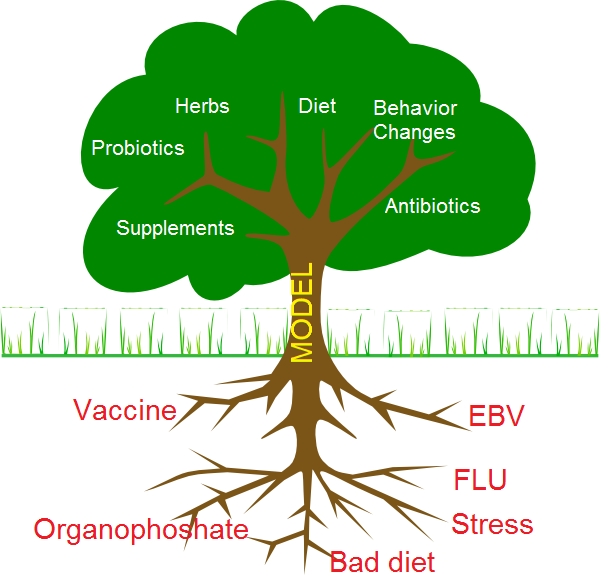
A Model Illustrated

model

The roots of CFS can be one (or multiple) of many things. The most likely causes, IMHO, are actual flu virus and a combination of latent EBV and Stress.

The model states that these events start a cascade of changes in gut bacteria towards a characteristic profile shared across FM/IBS/CFS. The details are different for every person, because before CFS, everyone had bacteria that was more distinct than their DNA.  There are some studies indicating that DNA and specific strains of bacteria exist in cooperation.  In simpler terms, gut bacteria evolved with your DNA and is inherited down generations.

Symptoms are gut bacteria related. The reader report found some symptoms disappeared and kept away even when things went backwards due to whopping cough.  The chemical produced by the bacteria impact symptoms.  Eliminating certain strains, result in certain symptoms reducing or disappearing. A second aspect is DNA –  some symptoms are associated with DNA; Bacteria Strain + DNA => some symptoms (like pain in FM). Those that are histamine sensitive know that the wrong probiotic can make their symptoms much worst. Histamine is produced by bacteria.

“I wanted to add a quick update. Up to 10 drops [of Symbioflor-2] a day now from start of 3 about a week and a half ago. I stopped align and the anxiety seemed to go away. This was after reading Kens response to a comment on a different post. I’ve also considered maybe it wasn’t the align and I was just taking it long enough to get through some initial die off. Still sleeping hard, vivid dreams, and not waking up as much. Waking up refreshed. Feel like I have more energy, I’ve noticed my allergies have improved considerably. Where I’m at it’s 11.5/12 for tree pollen for the last week straight, and I don’t feel any aversion to going and taking a walk in the middle of the day. For someone that traditionally has had to avoid enjoying the outdoors on high pollen periods like this, for almost my whole life, that’s huge,” [Comment on Symbioflor-2 page]

The branches to recover are multiple — the goal is the same, to reach the light of day after the darkness of CFS.

One person may have bacterial strains that are resistant to most antibiotics. Another person strains may be sensitive to a simple antibiotic like minocycline. We are not talking about a single infection, but hundreds of bacteria strains and species.  The same applies to herbs and spices.  A gum from India or from Africa may have the same name – but because of differences in cultivation and soil, one may work and the other will not work.

A second factor is that many bacteria are adaptive. This means that you may eliminate 98% of a family with an antibiotic or herb, what is left may be resistant. Staying on the same anti-infection agent means that the 2% left can grow and take over. Changing to a different anti-infection agent may mean that 80% of those left are killed, leaving just 0.4% of the population, ideally a level sufficient that good bacteria and the immune system can finish cleaning house. Rotation is essential. More time on an antibiotic/herb is not better, but worst.

The branch that you need to take towards the light must be felt out. You must experiment, observe and proceed by intelligent trial and error. As my reader wrote in her story here,

  • Neem worked very well for her
  • Olive Leaf was a neutral, she wonder if a different source would work — a valid question
  • Haritaki was a negative.

Other readers have reported no effect from most of the probiotics that I cite as candidates, but one was very effective in causing change. Others improve from every probiotic.

My role is to find candidates that should be tried based on what has been reported in pub med studies that should help correct the shift. For antibiotics,  I refer to Jadin’s protocol. Her choice of antibiotics are rational according to the model and based on years of her experience as well as MDs from the Pascal Institute treating “occult ricktettsia” infection (i.e. chronic Lyme would fit under that label).  I have used it twice successfully for myself (the 2nd time was a short course because I found Neem and Tulsi to be highly/more effective for myself).

I know many things that I suggest will have zero effect for some people. Some people may improve from everything suggested. This is precisely what is expected from the model.