Commercial Bifidobacteria probiotics

In my last post, we found that low Bifidobacteria was common across many illness/syndromes deemed to be in the autoimmune family. We also found that Lactobacillus increases as Bifidobacteria increases – in other words they are complementary and cross supporting, with the key observation that Lactobacillus increases inflammation while Bifidobacteria decreases it. This may account for the poor/non success of Lactobacillus probiotics for CFS.

A good list of probiotics available is at CandidaDiet showing various combinations and their alleged content. Alleged? That’s the sad news.

Strains are rarely listed and Contents may not be as advertised!

“A new study by scientists at the University of California has found that contents of many bifidobacteria probiotic products differ from the ingredients listed….16 products.. only one matched the ingredient list .. Some products also contained non-label species” [Source 2015] –OUCH!

Studies

Criteria: Studies with only Bifidobacteria probiotics. (There is a probiotic, BIO-THREE, which does not have Bifidobacteria but it does cause an increase according to PubMed [2007] – I have made inquiries with the manufacturer on retail availability in the US)

Probiotic Conditions Study
Bifidobacteria infantis 35624 CFS,ulcerative colitis, Psoriasis reduce systemic pro-inflammatory biomarkers in both gastrointestinal and non-gastrointestinal conditions[2013]
Bifidobacterium breve strain Yakult ulcerative colitis improve the clinical condition of patients with UC [2011]
Bifidobacterium enterococcus; Bifidobacterium lactobacillus (Bifico) ulcerative colitis is effective in preventing flare-ups of chronic UC. [2003]
Bifidobacterium longum Y 10, B. infantis Y 1 and B. breve Y 8 (VSL-3) colitis, crohn’s, IBS, Many StudiesMany Studies “evidence for the use of probiotics in IBD is scarce. Most studies are limited by design or do not show that probiotic treatment is effective. Only a few randomised controlled trials have demonstrated any beneficial effect of probiotic use in IBD; namely, the use of VSL#3 in patients with pouchitis and ulcerative colitis.” [2012]
Bifidobacterium breve strain Yakult, Bifidobacterium bifidum strain Yakult ulcerative colitis has anti-inflammatory effects against ulcerative colitis. [2008]

Apart of VSL-3, there are almost no clinical trials against various conditions. The Japanese Probiotic company, Yakult, appears to be a dominant player in this area.

So, we know that low levels are associated with many conditions, we know that what is labelled on the bottle may not be what is in the bottle, almost no-one give strains, there are few clinical studies…  Welcome to the art of probiotics. 😦

I have assembled a table of species and commercial products below for at least some guidance.  In general, I would not advocate anything containing L. Acidophilus.
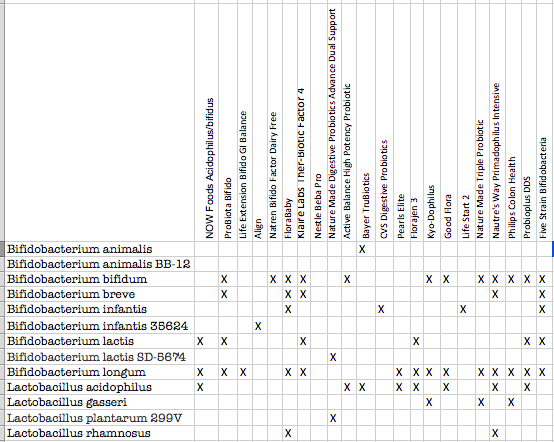
Screen Shot 2015-11-26 at 11.42.27 AM

Rules of thumb:

  • Select the one with the most B. Species at a reasonable cost (i.e. Monthly Cost/Species)
  • Change probiotics when you finished a bottle.
  • Try getting different species each time you change

— Key words from above chart/image

NOW Foods Acidophilus/bifidus ProBiota Bifido Life Extension Bifido GI Balance Align Natren Bifido Factor Dairy Free Flora Baby Klaire Labs Ther-Biotic Factor 4 Nestle Beba ProNature Made Digestive Probiotics Advance Dual Support Active Balance High Potency Probiotic Bayer TruBiotics CVS Digestive Probiotics Pearls Elite Florajen 3 Kyo-Dophilus Good FloraLife Start 2 Nature Made Triple Probiotic Nature’s Way Primadophilus Intensive Philips Colon Health Probioplus DDS Five Strain

  • Bifidobacterium animalis
  • Bifidobacterium bifidum
  • Bifidobacterium breve
  • Bifidobacterium infantis
  • Bifidobacterium lactis
  • Bifidobacterium longum


Bifidobacteria role in multiple diseases and gluten allergies

In my last post there was an interesting items on Bifidobacteria that I want to dig into:

“Bifidobacteria are common and frequently dominant members of the gut microbiota of many animals, including mammals and insects. Carbohydrates are considered key carbon sources for the gut microbiota, imposing strong selective pressure on the complex microbial consortium of the gut. Despite its importance, the genetic traits that facilitate carbohydrate utilization by gut microbiota members are still poorly characterized. Here, genome analyses of 47 representative Bifidobacterium (sub)species revealed the genes predicted to be required for the degradation and internalization of a wide range of carbohydrates, outnumbering those found in many other gut microbiota members.” [2015]

Crohn’s Disease[CD] have problems with starches/carbohydrates, and we find:

“Lactobacillus and Bifidobacteria decreased obviously but Bacteroid increased in CD patients” [2010]

“except for a decrease in bifidobacteria in the active state of IBD,”[2010]

“among the few bacterial groups considered, only bifidobacteria were significantly decreased in IBS samples.” [2014]

“Rifaximin, a rifamycin derivative, has been reported to induce clinical remission of active Crohn’s disease (CD)…it caused an increase in concentration of Bifidobacterium, Atopobium and Faecalibacterium prausnitzii.” [2010]

“with lower levels of bifidobacteria, celiac patients have an imbalance in the intestinal microbiota” [2014]

“In comparison to patients with fibromyalgia, the RA patients had significantly less bifidobacteria”[2008] – NOTE: there was no comparison to controls in this study.

Treatment Results – Suggestions

“We found a significant rise in both Lactobacillus and Bifidobacteria in those taking the Lactobacillus casei strain Shirota(Yakult) , and there was also a significant decrease in anxiety symptoms among those taking the probiotic vs controls (p = 0.01).” [2009]

“Live probiotic Bifidobacterium lactis bacteria inhibit the toxic effects induced by wheat gliadin in epithelial cell culture” [2008 (http://www.ncbi.nlm.nih.gov/pmc/articles/PMC2453197/)%5D

From Intestinal Microbiota and Probiotics in Celiac Disease, 2014 (http://www.ncbi.nlm.nih.gov/pmc/articles/PMC4135898/)

“Bifidobacterium infantis 35624 alleviates symptoms in IBS; this symptomatic response was associated with normalization of the ratio of an anti-inflammatory to a pro-inflammatory cytokine, suggesting an immune-modulating role for this organism, in this disorder.”[2005 (http://www.ncbi.nlm.nih.gov/pubmed/15765388)%5D

“a probiotic dietary supplement, containing four strains of lactic acid bacteria, on symptoms of IBS.. the probiotic combination was not significantly superior to the placebo in relieving symptoms of IBS” [2008 ] Note: Bifido works, Lacto does NOT.

“Bifidobacterium strains are generally regarded as less pro-inflammatory than Lactobacillus,” [2008 (http://www.ncbi.nlm.nih.gov/pmc/articles/PMC2640389/)%5D

“There were statistically significant difference in expansion of bacteria between the wholemeal and white flour (wholemeal more bifidobacteria, white more lactobacillus) (p = 0.02; p = 0.04, respectively).”[2014 (http://www.ncbi.nlm.nih.gov/pmc/articles/PMC4065312/)%5D – so avoid food using white flour

“gum arabic has prebiotic effects to increase bifidobacteria in the human body (114  [2014]

Which Probiotics?

“It has been demonstrated that levels of bifidobacteria and lactobacilli are reduced in CD patients, and thus, these bacteria have been seen as promising targets for probiotic therapy. However, there is still a lack of consensus regarding the shifts in bacterial composition, primarily at the species level. Thus, future studies should emphasize microbiota characterization with potential benefits to gut health. Strains capable of producing enzymes that degrade gliadin peptides and induce anti- inflammatory effects are believed to be better suited for the treatment of this disorder.” Intestinal Microbiota and Probiotics in Celiac Disease, 2014

My next post will look at commercial probiotics that are mainly bifidobacteria.

Probiotics News 2015-11-24

“Probiotic strain Lactobacillus plantarum 299v increases iron absorption from an iron-supplemented fruit drink” [2015]  This STRAIN is available from Jarrow and is sold on Amazon.

“Eating a bowl of porridge oats a day could alter gut microbial functions, according to Scandinavian researchers who have tipped the ingredient as a possible prebiotic.”[2015]

“People with better control of blood sugar after eating barley kernel bread also have a different balance of microbes in the gut, a new study in Cell Metabolism reveals..Metagenomic analysis showed that the gut microbiota of responders was enriched in Prevotella copri and had increased potential to ferment complex polysaccharides after BKB” [2015]

“Low counts of a bacterial species generally have been discounted in importance, but slight shifts in the ratios of abundant microbe populations have been thought to have roles in obesity, diabetes and inflammatory bowel diseases such as Crohn’s disease.”[2015]

“Supplements containing Lactobacillus gasseri KS-13, Bifidobacterium bifidum G9-1, andBifidobacterium longum MM2 may shift the microbiota of elderly adults to those of healthier and younger people, says a new study”[2015]

“Diagram showing how various species gut bacteria matches other species:” [Source]

111415_scivis_inline_730

“Intestinal worms manipulate their host’s immune system to ensure their survival, in part by changing the metabolism of the host’s gut microbiome. The worms, called helminths, infect around 2 billion people around the world, and are able to block harmful inflammatory responses in humans and mice.” [2015]

“Bifidobacteria are common and frequently dominant members of the gut microbiota of many animals, including mammals and insects. Carbohydrates are considered key carbon sources for the gut microbiota, imposing strong selective pressure on the complex microbial consortium of the gut. Despite its importance, the genetic traits that facilitate carbohydrate utilization by gut microbiota members are still poorly characterized. Here, genome analyses of 47 representative Bifidobacterium (sub)species revealed the genes predicted to be required for the degradation and internalization of a wide range of carbohydrates, outnumbering those found in many other gut microbiota members.” [2015] NOTE: Bifidobacteria are often very low with CFS — which implies carbothydrates are not handle, possibly leading to gluten and other issues with starch.

“Saccharomyces cerevisiae CNCM I-3856 in irritable bowel syndrome: improvement in abdominal pain and bloating in those with predominant constipation”[2015]

Lactobacillus Reuteri – Sources

Update: 2018 Summary on L Reuteri.

L. Reuteri is very low in all Chronic Fatigue patients.  L. Reuteri is one of very few bacteria that produces B12 (which is almost always low in CFSers). Until a few years ago, BioGaia AB in Sweden, was the dominant providers. Today there are more varieties and thus more strains.

Today, there are more sources (ordered by my opinion). If you know of others (no more than 3 probiotics in a mixture), please email or comment.

Brand Sources Strain Notes
Cardioviva Walmart, Amazon NCIMB 30242

  • Does NOT produce reuterin 
  • lacks bacteriocin-like antimicrobial activity
  • 9 PubMed Studies
  • Cholesterol lowering and inhibition of sterol absorption [2012]
  • increases mean circulating 25-hydroxyvitamin D [2013]
Microbiome Plus+ Manufacturer NCIMB 30242 See Cardioviva above
BioGaia Probiotic ProTectis Amazon Protectis (ATCC55730)
Swanson’s L. Reuteri Plus Amazon L. Reuteri
L. Rhamnosus, L. Acidophilus
No PubMed Studies
BioAmicus Reuteri Amazon Unknown No PubMed Studies
Nature’s Way Primadophilus Reuteri Amazon Lactobacillus rhamnosus; Lactobacillus acidophilus; Lactobacillus reuteri HA-188 No PubMed Studies

Tulsi and Fertility

A reader asked the question about Tulsi and fertility because he was a younger person and once CFS is in remission, wants to have a family. Most CFSers are post family-additions, so this post is focused on the younger ones only. This also appears to apply to Chinese hibiscus.

The PubMed article that raised his concerns was: “Effect of tulsi (Ocimum Sanctum Linn.) on sperm count and reproductive hormones in male albino rabbits”[2010] which states: “present study clearly show that tulsi treatment (2 g/day) brings about a reduction in sperm count [on rabbits]” and later “This contraceptive effect was comparable to female contraceptive pills, and was reversible.” on the mechanism that they suspect was occurring.

“The Ocimum sanctum L. has also been suggested to possess antifertility,” [2005] [2010] and then we found a clear study:

“Anti-fertility

Benzene extract of O. sanctum L. leaves have a reversible anti-fertility[55] effect, as O. sanctum L. extract (250 mg/kg body weight) for 48 days decreases the total sperm count, sperm motility and forward velocity. The percentage of abnormal sperm increased in caudal epididymal fluid and the fructose content decreased in the caudal plasma of the epididymis and the seminal vesicles. All these parameters returned to normal two week after the withdrawal of the treatment.” [2010]

So there is no real concern about starting a family later!