Probiotics available in the EU and UK

A reader asked me about what probiotics are available in the UK or EU that are suitable. I will largely be using Amazon sites because of greatest variety and ease of use — especially for home bound CFSers

WARNING: Some of these require refrigeration and shipping with ice-packs. Marked with ***. Verify from seller before ordering.

If you know of others, please comment on this page.

CFS as Post-infectious Disease Syndrome

My model of CFS is that is the result of a stable dysfunction in microbiome after an illness or other event (which can include inoculations, stress, etc). The short answer is that the microbiome change caused by the illness stayed, and with it, many of the symptoms of the illness. This implies that many symptoms are the result of the microbiome changes and NOT directly connected to the infection.

I thought a quick review of the literature on PIDS would be informative. A good summary from 1988, is a smart place to start.

Many post-infectious syndromes have been recognized in the last 50 years [from 1938!], some following viral infections and others closely related to bacterial disease. The occurrence of prolonged fatigue following an apparent viral illness of varying severity is also well documented. The lack of a recognizable precipitating cause and the tendency for epidemic fatigue to occur among hospital staff led many to believe that the illness may be psychogenic in origin.” It cites mononucleosis (Epstein-Barr virus) and enterovirus

A related article entitled Post-Infectious Fatigue was published in 1987, which writes

In most cases the illness is attributed to a chronic Epstein-Barr virus infection. Symptoms include weakness and fatigue in the absence of physical findings or significant laboratory abnormalities. These patients are frequently depressed and have considerable disability resulting in prolonged loss of time from work. The illness may be persistent or can be relapsing, but often lingers for two years or more. There is no effective therapy.”

Jumping ahead to 1998, we find “Post-infection fatigue syndrome following Q fever“,

“In summary, we conclude that a syndrome characterized by undue fatigue, breathlessness on exertion, excessive sweating and blurring of vision occurs after infection by Coxiella burnetii, and that these symptoms persist for many years. The mechanism for this effect remains elusive, but possibilities such as sub-clinical cardiomyopathy or autonomic dysfunction need to be tested using this unique cohort of patients.”

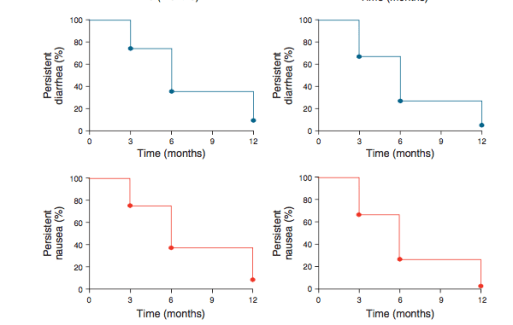
Post-infectious irritable bowel syndrome (PI-IBS) may develop in 4 31 of affected patients following bacterial gastroenteritis (GE), symptoms persist after successful treatment in some for months as shown below taken from this 2005 article. Note that at 1 year, there are some still showing symptoms.
Screen Shot 2015-10-17 at 3.51.18 PM

In 2014, a followup study was done on some 1252 patients that had a Giardia Infection and were successfully treated. They found:

  • irritable bowel syndrome (39.4%) by Rome III criteria – Relative risk to matched population 3.4 times as likely
  • chronic fatigue (30.8%) in the exposed group – Relative risk to matched population 2.9 times as likely

As time went on from 3 years to 6 years:

  • the prevalence of irritable bowel syndrome decreased by 6.7%
  • the prevalence of chronic fatigue decreased by 15.3%

Development of IBS in a subset of patients with acute gastroenteritis is uncontested. This is expected to open a paradigm shift in understanding the pathogenesis of IBS.” [2011]

Summary

The mechanism for Post-Infection Fatigue has traditionally been not understood by the medical establishment. There is growing evidence that it is a slow (or never) return from a shifted microbiome caused by a disease, vaccination, antibiotic, stress, etc (and I mean and so forth — the list goes on and on) that may be the cause.

A growing body of work provides evidence supporting a role for pathogen-mediated modifications in the resident intestinal microbiota, epithelial barrier integrity, effector cell functions, and innate and adaptive immune features, all proposed physiological manifestations that can underlie GI abnormalities in IBS.” [2014]

Or as this title states, Redefining the gut as the motor of critical illness.

Review on news about Probiotics

This is a periodic review of news stories dealing with probiotics — all aspects — that happened in the last few months:

  • Why one probiotic strain may be a drug (FDA regulated and requiring a prescription) and another in the same family is a unregulated supplement [explanation]
  • “our results suggest that high altitude may contribute to shaping human gut microbiota.”[2015]
  • “the decreased relative abundance of the Mucor genus in obese subjects was reversible upon weight loss. Collectively, these findings suggest that manipulation of gut mycobiome communities might be a novel target in the treatment of obesity.” [Nature]
  • “In 2000, a flood in the Canadian town of Walkerton contaminated the town’s drinking water with pathogens such as Escherichia coli and Campylobacter jejuni. About 2,300 people suffered from severe gastrointestinal infection, and many of them developed chronic irritable bowel syndrome (IBS) as a direct result.During an eight-year study1 of Walkerton residents, led by gastroenterologist Stephen Collins at McMaster University in Hamilton, Canada, researchers noticed that psychological issues such as depression and anxiety seemed to be a risk factor for persistent IBS.” [Nature]
  • Yakult has joined fellow probiotic giant Danone in winning health claims for its probiotic yoghurt drinks in Switzerland.http://www.dairyreporter.com/Regulation-Safety/Yakult-wins-Swiss-probiotic-health-claim, namely “Yakult contributes to the normal functioning of the intestine by improving stool consistency and reducing transit time”

  • “contrasting effects of the same spice (turmeric), illustrate the importance of understanding the interaction between diet, microbes and specific functions of members of the human gut microbiota…The researchers also found that returning to the home diet at the end of the simulated journey[of diet from elsewhere in the world] did not restore transit times to their pre-travel baselines, suggesting long-term effects of temporary diet changes.” [2015]
  • “individuals could be uniquely identified by the combination of bacteria in the air surrounding them.” [The Scientist]
  • Proton Pump Inhibitors Alter Specific Taxa in the Human Gastrointestinal Microbiome:
  • Ibsium (strain of Saccharomyces cerevisiae) claim that “helps to reduce abdominal pain and discomfort associated with IBS” has been a been approved by Canada (i.e. sufficient studies to support claim) [2015]
  • certain probiotic strains (bacteroides thetaiotaomicron, Faecalibacterium prausnitzii, Streptococcus thermophilus) may increase iron uptake and storage [2015]
  • “this study goes farther to show that feeding different types of fat result in very different composition of gut microbiota,” [The Scientist]
  • Keeping Gut Bacteria in Balance Could Help Delay Age-related Diseases

  • “New research enables “tailored” diet advice – based on our personal gut microbiome – for persons who want to lose weight and reduce the risk of disease. Systems biologists at Chalmers University of Technology have for the first time successfully identified in detail how some of our most common intestinal bacteria interact during metabolism.The researchers at Chalmers University of Technology have developed a mathematical calculation platform that makes it possible to predict how different patients will respond to a modified diet, depending on how their gut microbiome is composed.[2015] [2015]

  • “We used a variety of antibiotic perturbations to generate a diverse array of gut microbiota structures, which were then challenged with C. difficile spores. Across these treatments we observed that C. difficile resistance was never attributable to a single organism, but rather it was the result of multiple microbiota members interacting in a context-dependent manner… Together, these results indicate that individual bacterial populations do not drive colonization resistance to C. difficile. Rather, multiple diverse assemblages act in concert to mediate colonization resistance [ASM]

  • Consumption of Lactobacillus reuteri probiotics may boost insulin release in healthy people, says a new study [2015]

  • Researchers identify signature of microbiomes associated with schizophrenia[2015]

  • T cells activated in the microbe-dense gut can spark an autoimmune eye disease, [The Scientist]

  • The normal smell of human faeces is largely due to indole, one of the major metabolites. Recent studies indicate that this foul-smelling substance is also of utmost importance for our healthToday, it is considered possible that alterations of the microbiome (‘dysbiosis’) may be a major cause not only of irritable bowel syndrome, fibromyalgia, and chronic fatigue syndrome but also a number of other common diseases such as obesity, diabetes mellitus, atherosclerosis, and allergic and autoimmune diseases (3, 4). Indole is an example of a microbe-generated signal substance that has positive effects on its host as well as the microbiome, and normal-smelling faeces may be an underestimated health indicator. [2015]

  • Fifteen of the products tested during the study, presented during Digestive Disease Week (DDW) in Washington, D.C., May 17to19, were labeled gluten-free. Of those labeled gluten-free, six contained gluten in amounts permissible by FDA. [2015]

  • The oral and gut microbiomes are perturbed in rheumatoid arthritis and partly normalized after treatment [Nature]

  • Microbial cocktails join fecal transplants in IBD treatment trials [Nature] The cocktail contains some 50 species. [Company]

  • show how bacterial biofilms found in the gut can provoke the onset of lupus in lupus-prone mice [NeuroScientistNews]

  • A high-fat diet may affect the bacterial populations in the gut and detrimentally affect satiety signaling to the brain, says a new study using lab rats [2015]

  • The probiotic Lactobacillus rhamnosus GG ATCC 53103 may not change the host’s gut microbiota but may stimulate anti-inflammatory activities of microbes already resident, says a new study [2015]

FYI: Guest post on Health Rising

http://www.cortjohnson.org/blog/2015/10/12/lactic-acidosis-causing-cfs-fm-symptoms/

How do I get there from here!!!???!! – Part Seven— Essential Supplements

CFS patients are often found to low on one vitamin, amino acid, etc. The logical approach has been to supplement those in the hope that it would help. Too often, there was no significant change found in clinical studies. The why may well be connected to an absence of gut bacteria needed to transform/transport these supplements into the body.

The following is a list of supplements demonstrated to have positive effects in clinical studies not on the prior lists.

  • Vitamin D3 – Often 15,000 to 20,000 IU per day is need to keep a CFS/FM patient at the top end of the normal range where there can be a major reduction of symptom severity. Vitamin D2 is NOT recommended
  • CoQ10  300 mg/day – Studies in this post.
  • Magnesium

Other were included in earlier list: Piracetam, Licorice, D-Ribose.

B12 is also in the list, with preference for Lactobacillus Reuteri (produces B12 and this species is abnormally low with CFS patients). While L.Reuteri also produces lactic acid, the goal is to reduce lactic acid and not to totally eliminate it.