How to kill your gut bacteria and be unhealthy!

While the theme of this blog has been to correcting gut bacteria, it is also good to know how you can harm gut bacteria:

  • Splenda(sucralose) and Stevia (see earlier post)
    • “Splenda exerted numerous adverse effects, including reduction in beneficial fecal microflora,” [2008]
  • Stressful life
    • “captivity appears to have induced a hyper-inflammatory state in house sparrows, perhaps due to disregulation of glucocorticoids, natural microflora or both.”[2011]
    • “stressor-induced alterations in the composition of gut microbial communities contribute to stressor-induced behavioral changes.”[2015]
  • Antibiotics
  • Junk Food
    • Serious study on shifts from eating McDonalds (Telegraph, UK)
      • Before: 3500 species
      • After: 2100 species – net lost 1400 (40%) after 10 days
    • 75% of people are adversely impacted [article]
  • Western Diet aka Diet of Convenience

“Fifteen thousand years ago our ancestors regularly ingested around 150 ingredients in a week.Most people nowadays consume fewer than 20 separate food types and many, if not most, are artificially refined. Most processed food products come, depressingly, from just four ingredients: corn, soy, wheat or meat”.  –Researcher

  • “sorghum benefit the gut microbiota and parameters related to obesity, oxidative stress, inflammation, diabetes, dyslipidemia, cancer, and hypertension” [2015]
  • “Food consumption and household food expenditure trends in Canada (1938–2011) present a clear picture of the dietary shift in the last century. Unprocessed or minimally processed roots and tubers as a contribution to household caloric intake have declined by 80%. On the other hand, the consumption of ready-to-consume processed and ultra-processed foods has more than doubled…. there are uncanny functional resemblances between plant root and human intestinal microbiota that may be of evolutionary significance” [2015]

Hint: Count the number of ingredients (real food, not chemical additives) you consume per week.

– let me see, today: Nuts (peanuts & walnuts), radish, pork, beef, spinach, broccoli, rye (100% rye bread), cheese, salad, egg , green pepper — if is not volume, but variety.

So what should you add back to your diet? A few suggestions are: jicama, radish, turnip, rutabaga, carrot, and many more – raw when practical.

Short Term attempts to alter are likely futile

“review of the current literature suggests that the adult microbiome is a highly stable structure resilient to short-term interventions. In fact, most evidence to date demonstrates that therapeutic agents targeting the microflora trigger rapid changes in the microbiome, which then reverts to its pre-treatment state once the therapy is completed.” [2015]

In short, it means having to do permanent changes in eating habits.

Autoimmune Diseases: Histamines, Glutamate and Sleep Problems

My model is that the majority of auto-immune diseases is caused by gut dysfunction – aka. Microbiome has stabilized in an unhealthy state. I have seen personally and have had reported to me, that sets of symptoms disappears or are reduced by a single probiotic. Not all symptoms cured – no magic yogurt – just one set of them. A  dysfunction consists of many evil strains cross-supporting each other, each strain produces their own symptoms (and more than one strain may be responsible for a symptom). While this model does an awesome job of explaining the very wide variety of symptoms between patients for illnesses such as Chronic Fatigue Syndrome- CFS – [each patient has their own unique set of strains!], and appears to be well supported by PudMed articles and studies on the microbiome, it has more complexity for treatment than modern medical skills and knowledge has acquired – both main stream and alternative medicine.

The use of antibiotics have worked for some CFS patients but fails with others. For Crohn’s Disease, the use of the most commonly prescribed antibiotics have actually worsen the microbiome dysfunction (i.e. greater shifts away from healthy base lines after use than existed before — although symptoms can improve). Appropriate probiotics seem to be the “do least harm” if appropriate research is done first. Saying “Probiotics can reduce allergy problem” is an over-generalization that can do more harm — some probiotics can increase allergy issue. “Specific probiotics can reduce allergy problems, and others can make it worst — yogurt may not be your friend in Allergy Season!” is a better statement.

Sleep Issues

A reader contacted me because of increasing sleep issues — it seemed to have gotten worst since starting Yakult (the last item changed always get the blame!) although Yakult seem to have improved other symptoms significantly. Fortunately, there was a reliable record of supplements taken and not taken taken by a third party.  They had, too typically, stopped taking a set of supplements two weeks before starting Yalkult. Detail record keeping can be priceless!.

One cause of sleep issues

This reader has histamine issues, for example any citric fruit will trigger a severe histamine release, so I thought that I would look down that path as it seems the most probable mechanism is histamine related. The problem was that while exhausted, tired, with a calm mind — they were unable to get to sleep for hours and hours. Often getting only 2-3 hours of poor quality sleep a day. This is not good because the immune system generally “kick ass” against infections when a person is sleeping.

The medical Literature

The following is some samples of what I found – a bit of medical geek speak –

  • “The prominent role of histamine as a wake-promoting substance has drawn interest to treat sleep-wake disorders, especially narcolepsy, via modulation of H3 receptor function.” [2010]
  • “The histaminergic system modulates different processes including wakefulness, feeding, and learning and memory consolidation. Histamine receptors (H1R, H2R, H3R, and H4R) belong to the rhodopsin-like family of G protein-coupled receptors, present constitutive activity, and are subjected to inverse agonist action. ” [2014]
  • There were many recent (2013,2014) pub med articles saying there is no known prescription drug that impacts the H3 in the desired path — so, Plan B is required.
Going to Wikipedia on H3, I read
  • “whether H3 receptor ligands could be useful in modulating wakefulness (because of effects on noradrenaline, glutamate and histamine).
And then followed the glutamate lead on to this
  • “High levels of the neurotransmitter glutamate may be to blame for the insomnia associated with restless leg syndrome (RLS), a small study suggests.” [Gupta Guide]

Treatment Hypothesis

 The root cause of the sleep issue is the level of glutamate in the brain. Effective treatment may be to reduce those levels – but how??? The location of excessive glutamate is in the brain — this adds a challenge to treatment because of the Blood-Brain Barrier. Many supplements and herbs may be effective in lowering it in the body, but have no impact on the brain.

Blood-Brain-Barrier

For a good description on the history and issues of the Blood Brain Barrier see this article[2005]. The article identifies that a compound should havemolecular weight below 450 in order to cross the barrier. Some examples for antibiotics are:

  • Minocycline: 457
  • Doxycycline: 444
  • Cefoperazone: 645
  • Sparfloxacin: 392

This aspects is often missed by treating physicians resulting in useless antibiotics and drugs being tried that cannot make it into the brain. 😦

Search Results

A logical starting point was to look at glutamate and each of the supplements that were stopped. This produced some interesting results:

  •  Piracetam caused a decrease in mouse brain glutamate content and glutamate/GABA rate.[1991]
    • According to the supplement records, the person had been taking 1000 mg of Piracetam daily but this was stopped two weeks before starting Yakult. A smoking gun? While Piracetam was being taken for other reasons, a side effect may have been the lowering of glutamate levels which slowly creep up after it was stopped being taken resulting is sleep problems as it increased.
  • Alpha Lipoic Acid (ALA) “observed a significant increase in glutamate content (37%) and a decrease in taurine level (18%) in rat hippocampus,” [2011]
    • Ah, this one should not be re-introduced, alternatives should be found for why it was being used.
  • Ashwaganda(Withania somnifera) ” pre-treatment inhibited glutamate-induced cell death and was able to revert glutamate-induced changes in HSP70 to a large extent.”[2012] “protected the glial and neuronal cells from oxidative as well as glutamate insult”[2015]
    • Tentatively  reads like it should be used.
  • Cinnamon: “attenuating the reduction in glutamate uptake”[2012]
    • A little fuzzy if good or bad
  • Turmeric (Curcumin): “curcumin-mediated inhibition of glutamate release involves modulating downstream events”[2012] “curcumin inhibited the release of glutamate”[2011]
    • Definite good. No release, no high levels

Bottom line appears to be that the glutamate levels likely increased significantly, once the above supplements were stopped. Not immediately next day, but slow rising and resulting in increasing difficulty with sleep due to high glutamate levels in the brain. None of the above was being taken explicitly for controlling glutamate levels, but for other reasons — it just happened that they impacted glutamate levels very positively.

With a working hypothesis appearing to be validated, now it is time to see if this patient will return these supplements and then see if sleep quality improves as a result. Recommendations to discuss with health professional:

  • Piracetam: 1000 – 6000 mg/day
  • Turmeric (kitchen spice): 1000 – 6000 mg/day

Hay Fever and Probiotics

The other day I happened to be in a grocery chain owned by a Japanese family and was surprised and delighted to see Yakult (Esperanto for yogurt – not a Japanese word!). It is the only commercial source for  Lactobacillus casei Shirota. It is available at some US locations, click here to search. There are two chains in Seattle area that carries it.

  • A study failed to find clear evidence of any clinical impact on hay fever[2013], while an early one did [2005]

I came home and because it was known to reduce mast cells release of histamine, and my wife was miserable with hay fever, she agreed to try some. To everyone surprise, her hay fever disappeared within 20 minutes and stayed away for over 18 hours. There was a side effect, a bit of diarrhea (which may have been cause by the high sugar content). In an earlier post, this species and  Bifidobacterium lactis NCC2818[2013]  were well documented as effective for treatment.Some are known to have no effect such as E.Coli Nissle 1917 [2014]. Some authors feels that some general families are to be avoided for example “Lactobacillus casei,and Lactobacillus bulgaricus.”[source] [source], however if you can get an actual strain that is know to be good then use it (for example: Shirota cited above) A year ago, I posted about what increase histamine and decreases histamine, note that the L.Casei family in general increase histamine, but the shirota stain does the opposite effect (just like Mutafor (E.Coli Nissle 1917) is a good E.Coli.

  • Increases
    •  Lactobacillus casei [2011]
    • Lactobacillus delbrueckii subsp. bulgaricus [2011]
    • Lactobacillus reuteri [2014] [2013] [2012]
    • Bacillus licheniformis A7 [2013]
    • Bacillus coagulans SL5 [2013]
    • Morganella morganii [2013]
    • Pseudomonas aeruginosa[2012]
    • Citrobacter koseri [2012]
    • Enterobacter spp [2012]
  • No Impact
    • Lactobacillus acidophilus [2011]
    • Lactobacillus lactis subsp. lactis [2011]
    • Lactococcus lactis subsp. lactis [2011]
    • Lactobacillus plantarum [2011]
    • Lactobacillus sakei CRL1862 [2012]
    •  Lactobacillus plantarum Tensia[2012]

Bottom line, there is only two that appear to be “easily” available:

My wife had been taking Culturelle, so IMHO, for her at least, Yakult is far more effective.

http://www.actimel.com/ is Danone “mimic” of Yakult and appears to have similar characteristics. It’s available in most of Europe and Canada

Getting a measure of your Escherichia coli

A reader emailed

“We wanted to take a test like from uBiome, but when we looked at how the test results are broken down, there is no indication about the E. Coli population.
Our question is: is it possible to still obtain useful information about the E. Coli population for the other data provided by the uBiome test, or is there another company that gives actual % for E. Coli in their tests?”

This is actually a challenging issue to get results. For myself, I went off research studies and naively assumed that I was a match and did not do the testing.

Genova Stool results

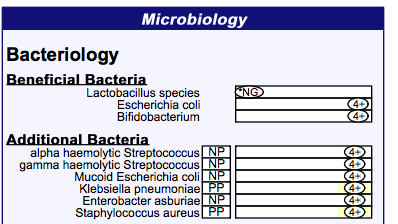
This test(latest edition) does give information, as shown below:

Screen Shot 2015-04-24 at 12.17.55 PM

This can lead to inferring the state by looking up the bacteria hierarchy and seeing what the level of Proteobacteria Phylum  is. The uBiome shows the results for Proteobacteria, as shown from this CFS blog post

Screen Shot 2015-04-24 at 12.39.41 PM

Unfortunately, the results of the total was up, instead of the hoped for lower (suggesting lower levels of E.Coli by inference).

Note, that this does not indicate it the strains are good or bad ones.

On the older tests (2006), we see it also listed.

Screen Shot 2015-04-24 at 12.24.50 PM

And older probiotic news

  • A nice newsletter [Syntrophy] describing dysbioaia – repairing dystfunctional host-microbiota
  • Your microbiome changes thru out the day.
  • Imbalance in Gut Bacteria can lead to cancer [article]
  • Gut bacteria Impacts blood-brain barrier [article] [article] [article]
  • VSL#3 probiotic reduces Liver Disease Severity[article]
  • Research on the chemicals in farts to diagnosis disease [article]
  • Retinoic acid [Vitamin A metabolite] as a dietary intervention restored lactobacilli that were downregulated in lupus-prone mice, and this correlated with improved symptoms.” [article]
    • “Clostridiaceae and Lachnospiraceae, both harboring butyrate-producing genera, were more abundant in the gut of lupus-prone mice at specific time points during lupus progression.”
  • “Frozen poop probiotics” [article] – 70% improved after 2 days/20 capsules. 90% [article]
  • Christensenella minuta, led to reduced weight gain.[article]
  • Gut bacteria impacts whether you get an infection [article]
    • “Individuals who became Campylobacter positive had a significantly higher abundance of Bacteroides (P = 0.007) and Escherichia (P = 0.002) species than those who remained culture negative. Furthermore, this group had a significantly higher abundance of Phascolarctobacterium (P = 0.017) and Streptococcus (P = 0.034) sequences than the Campylobacter-negative group, which had an overrepresentation of Clostridiales (P = 0.017), unclassified Lachnospiraceae (P = 0.008), and Anaerovorax (P = 0.015) sequences. Intraindividual…The relative abundances of Escherichia coli and Bacteroides species have been pointed out as important determinants of susceptibility to Gram-negative pathogens in general and Campylobacter infection in particular. “
  • “bacteria protect against infection by altering the composition of bile acids in the gut.” [article]
  • “Clostridium scindens, a bile acid 7á-dehydroxylating intestinal bacterium, is associated with resistance to C. difficile infection” [Article]
  • Jet lag impacts gut bacteria – “jet-lagged microbes from either mice or humans into germ-free mice, the rodents became more susceptible to glucose intolerance and diabetes.” [article]