Christmas and New Year reflection – pros and cons

I see I have a stack of comments as well as some phone calls to do today to some of my readers, so I will hopefully get caught up today.

Christmas can be a high risk scenario for CFS relapse

This christmas and new year ended with considerable fear in me of a potential relapse. I have been burning the candles at multiple ends (beyond both) since July with house renovations consuming weekends and weekday evenings, with practically nil time for myself.  Christmas started with pre-event stress. My wife and daughter are uber-chemical sensitive and both had flares of autoimmune that lasted months from the last family gathering attended.

On Christmas eve morning, we got a call that an over 80 close relative had been taken by ambulance to hospital. This relative usually phones before calling an ambulance — so this raised stress levels… the relative is OK now. In short the potentially CFS relapsing stressors were:

  • Stress dealing with issues of multiple over 80 relatives for which I am in the first round of support,
  • Doing dutiful eating of the wrong type of food over many days of family visits
  • Not maintaining regular exercise habit (IMHO, a key part of staying in remission)

Once we were done with seasonal activities and got home, stomach was in an upset condition, the body ache all over, waves of cold hands and feet, a decrease (but not loss of) executive decision making – more a strong preference for avoidance which is not typical for me, headaches (rare for me), psoriasis flaring badly after almost 2 years of being in remission, and 8 lb weight gain. Any (and all) of these symptoms are amber alerts for increased CFS relapse risk.

Remediation

For the last few days I have been on a 100% rye bread (no wheat gluten) and peanut butter diet (plus 1 egg/day) for breakfast, lunch and dinner, PLUS large dosages of Mutaflor (E.Coli Nissle) and bifidobacterium probiotics. I have been in the infrared sauna for an hour each day and pushing myself to do at least 1 hr of WII-fit each day. As well as these, heavy dosages of non-prescription anticoagulants(turmeric with black pepper, piracetam and other racetams, aspirin) especially fibrolytics (nattokinease, lumbrokinease, serrapetase) and 500 mg of flushing niacin (as a vasodilator).

The symptoms are decreasing quickly, including weight lost. My WII scores this morning set some new records, so the physical is coming back. Stomach is still upset a little but less so. It actually seems to become less upset after doing exercises.

Recap of Symptoms to Gut Bacteria shift

  • Increase of weight without an apparent change of diet: this implies a shift of bacteria that may:
    • Be more efficient in extracting calories from food
    • Sending signals to the body to store food (“famine signals”)
  • Body ache all over, cold extremities — this implies a shift of bacteria that sends out coagulation or vascular constriction signals (i.e. the bacteria favors low oxygen environment)
    • This is in keeping with the Berg-Hemex model/findings
  • Cognitive changes — we already know that bacteria can cause significant cognitive changes in animals and there is increasing evidence of this in human (Article)
  • Psoriasis – other autoimmune conditions will usually track with CFS risks.

Some nuggets that I found in a Christmas Present…

My wife gave me “Danish Cookbooks” by Carol Gold. This is NOT a cook book, but rather an academic study of cookbooks published in Denmark.  I’m 100% Danish and very interested in history.

I have always been inclined towards going for ancestral diet patterns, and did Paleo for a while. My problem with Paleo is that it is more idealogical based than actual (scientific) archeologically based. It is also trying to jump the diet back thousands of years which effectively ignores how our bacteria evolved to meet our changes of diet.

A diet based on typical diet of your ancestors 400 – 1400 years ago is likely a better choice. You avoid the newly introduced foods, for example, potatoes. You also avoid process foods and modern additives. On the plus side, your gut bacteria is likely closer to the optimized bacteria your ancestors evolved from eating the same food for a thousand years.

In this book, I found two gems from the historical records:

  • We have decreased the use of spice considerably — in 1600, the common spices were:
    • cumin, anise, coriander, dill, fennel, lavender, sage, rosemary, mint, bay leaves, cloves, pepper, saffron, thyme, marjoram, nutmeg, cardamon, ginger, cinnamon, hyssop, wormwood, lemon balm, angelica-root.
    • “The issue here is … the use of seasonings in general slackens” p.47
    • Many of these spices (like wormwood and ginger) have strong antibacterial characteristics which would have kept some gut bacteria families in control well.
  • “Their most common food was meat” p. 122
  • White (wheat) bread was very uncommon, expensive, and typically seen only in upper class homes on special occasions(not as part of the regular menus). It appears that most of the carbohydrates came from Rye Bread.

I am sure that some readers who favor a diet that is vegan or vegetarian on ideological grounds would object to these suggestions.  My response is simple, if your ancestors were vegetarians for centuries or millenniums (as some friends who were born in India can validly claim), then that is the right diet without any doubts.

Evidence shows that gut bacteria is inherited through generations — hence it is good to know what your ancestors ate because your gut bacteria have likely adapted to that diet. Given my heritage (which likely applies to people from the UK, Poland, northern France and Germany etc), this boils down to:

  • Rye Bread without any wheat flour
  • Meat and Fish (especially since the family seemed to always been within 5 miles of the coast back to 1500..)
  • Vegetables:

No potatoes — they really did not enter my ancestor dies until the early 1800’s – after one of my great-grandfather was born. Little or no sugar (“Worldwide through the end of the medieval period, sugar was very expensive[1] and was considered a “fine spice“,[2] but from about the year 1500, technological improvements and New World sources began turning it into a much cheaper bulk commodity.” – Wikipedia)

So I advocate not a Paleo diet, but a medieval-food diet (modified for modern nutritional perceptions).
Analysis of uBiome Results for a CFS Patient – Reducing Verrucomicrobia, Cyanobacteria and Actinobacteria

Verrucomicrobia

The third largest phylum showing a major shift is Verrucomicrobia. There is no further breakdown with biome (or should I say, just 1 class etc). It is similar to  Chlamydiae and Lentisphaerae (which are in the uBiome results) and the display suggests that chlamydiae may be aggregated into the results. Planctomycetes-Verrucomicrobia-Chlamydiae is sometimes referred to a super phylum. Chlamydia pneumonia is one of the CFS-causing infections with some sites dedicated to this theory.

Antibiotics and Verrucomicrobia

  • Reduced (in some species) by imipenem(intravenous β-lactam antibiotic) and doxycycline [2013]
  • High-level colonization of the human gut by Verrucomicrobia following broad-spectrum antibiotic treatment  [2013]

With little information, our best guess is to look at the super phylum and how to reduce that. Not an ideal situation, but the best punt with our more information. The CPN Help group has a treatment page.

Cyanobacteria

The next phylum is Cyanobacteria. Looking at the range of value reported with different diet, there is not enough clear shift to assume this is significant.

1

gut

CFS Patient X 0.43%

gut

Vegetarians 0.18%

gut

Paleo Diet 0.41%

gut

Healthy Omnivores 0.25%

gut

Vegans 0.55%

gut

Heavy Drinkers 0.51%

gut

Weight Loss 0.2%

gut

Weight Gain 0.28%

gut

Antibiotics 0.27%

gut

All Samples 0.29%

Actinobacteria

The next phylum is Actinobacteria, which has very low number as seen below.

1

gut

CFS Patient X 0.16%

gut

Vegetarians 3.01%

gut

Paleo Diet 2.37%

gut

Healthy Omnivores 2.97%

gut

Vegans 2.04%

gut

Heavy Drinkers 3.24%

gut

Weight Loss 2.78%

gut

Weight Gain 2.42%

gut

Antibiotics 2.35%

gut

All Samples 2.64%

Ubiome results breaks down into two sub-classes. Low Actinobacteridae is the one of greatest concern.

Coriobacteridae

Sample Site Group Coriobacteridae
1

gut

Your sample from Kit 901-008-644 (01 Jul 2014) 0.14%

gut

Vegetarians 0.52%

Actinobacteridae

gut CFS Patient X 0.02%

gut

Vegetarians 2.49%

gut

Paleo Diet 1.76%

gut

Healthy Omnivores 2.29%

gut

Vegans 1.68%

gut

Heavy Drinkers 2.4%

gut

Weight Loss 2.1%

gut

Weight Gain 1.76%

Streptomyces, a largest member of this class produces the following antibiotics:

This hints that the resulting very low levels of naturally produced tetracyclines resulting on overgrowth of bacteria that are inhibited by tetracyclines. This is an interesting model to consider. So what can we do to change this?

For research, there are cultures available from ATCC which has the disclaimer: “for research, not for human or animal consumption”.

The naive approach is to see how S. rimosus and  S. aureofaciens are cultured —

  • the best medium were starch, 53.313 g; defatted peanut powder, 9.376 g; (NH(4))(2)SO(4), 6.244 g; and NaCl, 5.836 g; in 1l of distilled water. [2008] – this is interesting because in my 2009 flare, I craved peanut butter and still have it as part of my regular diet.

Our old friend prescript assist, contains

  • Streptomyces fradiae produces neomycin [1965]
  • Streptomyces celluslosae – produces fungichromin [1989]
  • Streptomyces griseoflavus – produces colabomycin [1994]

I have dropped an email to the Prescript-Assist folks asking whether they can produce a Streptomycin rich probiotics. Streptomycin probiotics have been used successfully with fish [article].

Microbiome: uBiome Results for a CFS Patient: Reducing Proteobacteria

One of the complexities of dealing with the microbiome is that some strains are good and some are bad. Current medical knowledge is very fragmented and incomplete — forcing us to be a little naive in how we proceed. With that said, let us see what we can do with reducing Protebacteria.

Proteobacteria

The Proteobacteria are a major group (phylum) of bacteria. They include a wide variety of pathogens, such as Escherichia, Salmonella, Vibrio, Helicobacter, Yersinia, and many other notable genera.

Typically, Escherichia coli is very low with CFS (and very high with Crohn’s disease). The good E.Coli probiotics appear effective in dealing with both cases: supplements with CFS and out competes the bad one in Crohn’s Disease. Long time readers know that I mean Mutaflor aka E.Coli Nissle 1917. It also suggests that after taking supplements to reduce this phylum, supplementation with Mutaflor is likely beneficial.

  • For dealing with the E.Coli group see my prior post dealing with Crohn’s disease overgrowth of E.Coli if interested — however, I do not believe the evidence support trying to reduce E.Coli, other members are of greater

What does the result for this patient say?

Alphaproteobacteria

1

gut

CFS Patient X 5.59%

gut

Vegetarians 0.38%

gut

Paleo Diet 0.85%

gut

Healthy Omnivores 0.7%

gut

Vegans 0.79%

gut

Heavy Drinkers 0.56%

gut

Weight Loss 0.63%

gut

Weight Gain 0.5%

gut

Antibiotics 0.34%

gut

All Samples 0.65%

Gammaproteobacteria

In the normal range

gut CFS Patient X 1.1%

gut

Vegetarians 1.28%

gut

Paleo Diet 0.95%

delta/epsilon subdivisions

Shift is moderate (2x instead of 10x seen with Alphaproteobacteria)

1

gut

CFS Patient X 0.89%

gut

Vegetarians 0.35%

gut

Paleo Diet 0.45%

Betaproteobacteria

This is greatly reduced (although the phylum is much higher)

  • Burkholderiaceae levels were normal.
  • Sutterellaceae was very low (0.01% versus 0.93% in healthy individuals – 93x shift!)
1

gut

CFS Patient X 0.03%

gut

Vegetarians 1.05%

gut

Paleo Diet 1.13%

gut

Healthy Omnivores 1.04%

gut

Vegans 0.76%

gut

Heavy Drinkers 1.54%

gut

Weight Loss 1.09%

gut

Weight Gain 0.98%

gut

Antibiotics 0.84%

gut

All Samples 0.99%

 Action Plan

My first action was checking out what is in Prescript Assist — which is rich in different phylums and classes. It contains some Alphaproteobacteris 😦 and no Betaproteobacteria:

  • Alphaproteobacteris
    •  Rhodospirillales
      • Azospirillum brasiliense,
      • Azospirillum lipoferum,

If is unknown if these two species will out-compete the bad species. 😦

Decrease Alpha Proteobacteria

This class is associated with the triggering of autoimmune disease [2009].

Bartonella is a very likely candidate for the overgrowth, it is in the order of Rhizobiales in the class Alpha Proteobacteria. “depression, anxiety, mood swings, severe headaches, muscle spasms, interphalangeal joint stiffness, decreased peripheral vision, diminished tactile sensation, and hallucinations”[2011] is associated with this type of infection – a lot of those are associated with CFS. Also the often CFS associated Rickettsia is in this class [Notes].

  • gentamicin and doxycycline [2013][2014], wikipedia also cites tetracyclines and macrolides as being effective (which is agreement with C.Jadin’s Rickettsia protocol)
  • According to ubiome results, antibiotics and a vegetarian diet reduces the rate by 50% each.

Increase Beta Proteobacteria

Several species are known to be bad (gonorrhea and bacterial meningitis: Neisseria gonorrhoeae,Neisseria meningitidis). I was unable to find anything to increase the incidence. There were only three articles on PubMed dealing with Sutterellaceae.

  • Avoid amoxicillin [Notes]

Analysis of uBiome Results for a CFS Patient

A reader asked me to review and comment on their uBiome results (site).  Finally, I have a few hours from excessive support activity to do it.

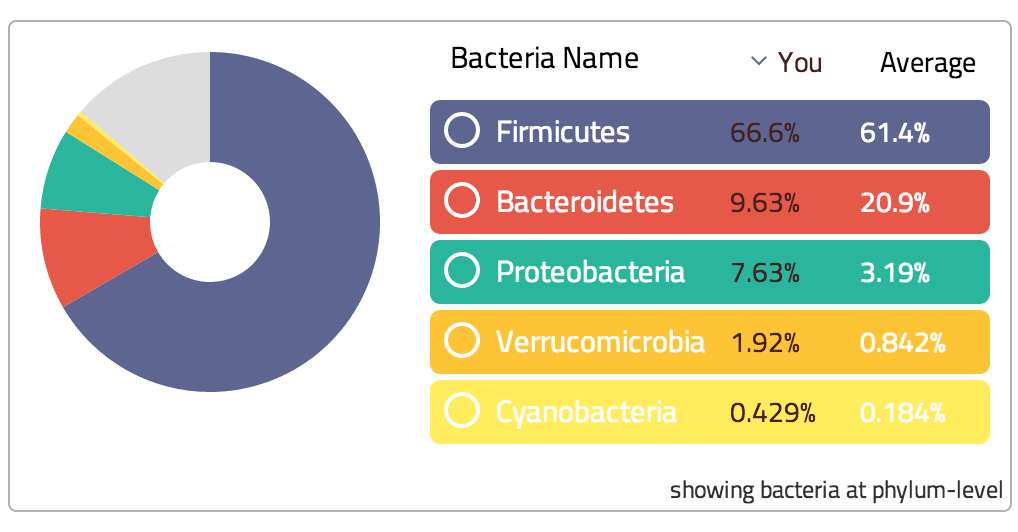
The Results Summary

Screen Shot 2014-10-26 at 10.06.27 AM

As you can see above, at a phylum level many groups have altered by a factor of 2 from normal healthy people:

  • Bacteroidetes are 1/2x
  • Proteobacteria, Verrucomicrobia, Cyanobacteria are  2.4x, 2.8x and 2.3x
  • For smaller phylums the numbers can be worst, up to a 7x difference.
  • Firmicutes are normal ( bifidobacterium and lactobacillus belongs to this family)

Clearly there is a dysfunction of the microbiome. This is not caused by diet, none of the diet groups are anyway close to this distribution. Nor is this causes by antibiotics (which some MDs would claim to dismiss dealing with this shift), uBiome provides a handy table to exclude this speculation.

Sample Site Group Bacteroidetes
1

gut

CFS Patient X 9.63%

gut

Vegetarians 19.03%

gut

Paleo Diet 20.61%

gut

Healthy Omnivores 20.67%

gut

Vegans 20.91%

gut

Heavy Drinkers 21.89%

gut

Weight Loss 21.17%

gut

Weight Gain 23.08%

gut

Antibiotics 18.31%

gut

All Samples 20.89%

Weight

The first item of interest is Bacteroides, which are significant for those CFS that have weight problems. “Bacteroidetes are the most prominent gut microbes in much of the world. They are thought to help protect against obesity because they do not digest fat well….Bacteroidetes are under represented in the guts of Europeans and North Americans” So not only are they low by world standards, they are low by the lowest population! Ok, my audience is brain-fogged so I will not go further into technical analysis but move on to the real concern — treatment! (Assuming that this patient is not vested in CFS and want to move towards remission)

Treatment

We will start with the biggest phylums that have shifts and proceed towards the smaller ones.

Increasing Bacteroidetes

This is a bit of a challenge because normally research is done on how to reduce bacteria (for this family, bad oral members of bacteroidetes). Bacteroides consists of three classes, with the class bacteroidia being the one is measured which breaks down into the following families:

One of the challenges is that most research is centered on killing/decreasing bacteria — not increasing them! I did find a video with suggestions on how to modify it by increasing the intake of polyphenols (for example, Rutin, Quercetin, Ginger ), for example:

  • Blueberries
  • Wine Vingears
  • Fruit

See wikipedia for a list of known foods.

Take

  • probiotic Prevotella bryantii 25A [2012] – this is an animal probiotic, may not be available in “human grade”
  • Probiotic Lactobacillus casei BL23 [2014]
  • Lactobacillus mucosae Dairy Product Culture Collection(DPC 6426) [2014]
  • Oligosaccharides 2-fucosyllactose and 3-fucosyllactose [2014] (found in human breast milk). Commercial source may be available soon (article)
  • Growth rates on polymerized carbohydrates were as fast or faster than on corresponding simple sugars,” [1990] aka polysaccharides: Chitin(chitosan), Pectins

Avoidance

  • Don’t take rhubarb root (Rheum officinale) [1987]
  • Simple Sugars “Growth rates on polymerized carbohydrates were as fast or faster than on corresponding simple sugars,” [1990]
  • ALL bacteriocin-producing probiotics know to impact the above, they include:
    • Lactobacillus salivarius [2013]
    • Bifidobacterium breve strain Yakult [2011]
    • Bifidobacterium longum [2011]
  • Antibiotics:
    • metronidazole; imipenem; amoxicillin/clavulanate and clindamycin [2014]

 Bottom Line:

The best single item after reading the literature is adding gum arabic to your diet (Recipes: ifood.tv) or make pills of it and take daily (up to 30 gm/day is reported safe! – I would suggest limiting to 8 gm) . There seems to be a significant number of articles on PubMed supporting this suggestion. It is also very affordable! Chicory forage (if available) seems very effective [2014, 2006] as well as high dietary fiber, xylose and non-starch polysaccharides. Tomorrow, I will move on to the next phylum.

As always, this is educational only — any changes of supplements, food, medications should be done in consultation with a knowledgable medical professional.

A Probiotic advertising as helping CFS Probiozym/HLC Mindlinx

A reader forwarded me a link to  Probiozym (in the US and Canada, it is called HLC Mindlinx). He indicated that he has heard that people are reporting an improvement from it. With CFS, I tend to be wary of “reported improvements” over the social networks — too often it turns out to be a placebo effect. I actually like placebo effects because often they reduce stress in the individual (which helps ameliorate symptoms).

So the key questions about this new offering should be:

  • Is there any objective evidence that it may be effective?
  • If the cost is above the price of “equivalent probiotics” is the premium warranted?

What is in this probiotic?

The product was developed in Norway. Unlike many probiotic manufacturers, they are open about the contents:

  • Lactobacillus rhamnosus NEU 427 50.0 mg
  • Lactobacillus crispatus NEU 458     50.0 mg
  • Lactobacillus acidophilus     50.0 mg
  • Bifidobacterium bifidum      2.5 mg
  • Fructooligosaccharides (FOS)          137,5 mg

On first look, it should help because it contains Bifidobacterium bifidum as cited in earlier posts [1],[2]. There is a species that I have not seen before, Lactobacillus crispatus. This and Lactobacillus Jensenii are predominant species found in the female lower genital tract. 13% of the genome is novel and not found in other species. It is considered to be one of the strongest H2O2-producing Lactobacilli.

Object Evidence

I found no PubMed articles on this probiotic (either name). There was nothing for either of the strains cited (NEU 427 or NEU 458). I focused on Lactobacillus crispatus and found no studies for the usual IBS, CFS, etc. All of the trials were treatment with bacterial vaginosis.

Cost Effectiveness

I found it on Amazon.com at $40 for 60 capsules which is comparable to the pricing of Align. IMHO, pricing is reasonable. Pricing is better than Seroyal Gammadyn Mn-Cu 30 Unidoses which contains only Lactobacillus crispatus (unknown dosage).

Summary

My reading on Lactobacillus Crispatus suggests that it is definitely worth a try — while I tend not to be favorable to Lactobacillus acidophilus containing probiotics — balancing everything, there is more likelihood for positive than negative consequences. A key factor is that it is a major hydrogen peroxide producer.

Unlike Lactobacillus case  and Lactobacillus delbrueckii subsp. bulgaricus (common in yogurts) which are histamine producers this appears to be low producers.