For New Readers

This post is to present a reference post to suggest what should be read, especially, for the brain fog. The following four links (3 to Health Rising) should explain the model and experience that I had:

The next item is a starting point post, that suggests a starting point.

Probiotics

The first thing to realize is that Lactobacillus Acidophilus is NOT a friend to CFS patients. You want to avoid it whenever possible. Heresy – no argument from me. L.A. works well for healthy individuals. For CFSers it makes a bad situation worst.

The following probiotics are very likely to have positive effects (especially if you have IBS concurrent with CFS):

In addition to the above, Dental Oral Probiotics are recommended (again, avoid any  with L.A.)

This will give you a starting point on the journey…
Propionibacterium freudenreichii – Another Probiotic of Interest

Many thanks to Espen Samuelsen for finding another commercially available probiotic that I was not aware of: Propionibacterium freudenreichii 

It is available as NutriCology Allergy Research‘s Securil Propio-Fidus.

No, it’s not a psychoanalysis probiotic (the “Freud” in it’s name), it is actually used in making  Emmental cheese!

So what do we know about it (apart from being used to make one of my favorite cheeses!)

Looking at colitis

Bottom line: If passes my baseline criteria for use with CFS — it is effective for IBS.  “I approve this probiotic!”


Update – thanks to AM for doing further research and forwarding it.

  • “During cheese production, Propionibacterium freudenreichii ferments lactate to form acetate, propionate and carbon dioxide. The Propionate is a salt of propionic acid. Propionic acid is an organic, carboxylic acid, and is strongly anti-fungal, and supplementation with P. freudenreichii can boost the localised Propionate levels in the GI tract and help to eliminate Candida albicans and other yeasts and moulds. The Propionic acid molecule is shown below.“A bacterium used in the production of Emmental.” Genoscope. 16 Jan. 2008
  • “The five common strains of Bifidobacter include B. infantis, B. adolescentis, B. bifidum, B. longum, and B. breve. [P. freudenreichii]…provides the food that allows growth of all Bifidobacteria, so your body can maintain its own unique, health-promoting combination of the different stains. The Bifidobacteria levels remain high in your gut only while they have adequate food and stimulation to grow. ‘ [1987]
  • Propionibacterium freudenreichii ferments and converts lactate to form: propionic acid (which favors the growth of bifidobacteria) [1994]


Where to start…

As a result of some comments on another post, I realized that there appears to be a logical sequence for some of the supplements and probiotics. I suspect that this may be a good first sequence for many people because it should improve symptoms within a month.

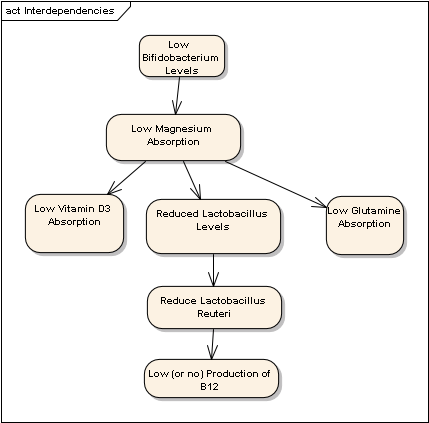
  1. Magnesium deficiency is common with CFS patients. A 2012 study revealed that one bacteria is significant for the release of magnesium from food: Bifidobacterium :   http://www.ncbi.nlm.nih.gov/pubmed/22047159.
    1. This agrees with studies finding that Bifidobacterium are low in CFS patients.
  2. Low Magnesium levels inhibits the absorption of two items where higher levels have been found to have less symptoms:
    1. Vitamin D3
    2. Glutamine
  3. Magnesium is needed by some Lactobacillus species according to http://www.ncbi.nlm.nih.gov/pubmed/23082775 [2013]
    1. Thus low magnesium levels contribute to the low Lactobacillus levels seen in CFS patients.
    2. L.Reuteri is dependent on magnesium levels  — so low or no B12 production
      1. Enhancement of alpha- and beta-galactosidase activity in Lactobacillus reuteri by different metal ions. [2010]

This suggests that taking a magnesium supplement (like Magnesium Malate), eating magnesium rich food, and taking a pure  Bifidobacterium probiotics for the first 1-2 weeks, followed by adequate Vitamin D3 (15000 IU?) and Glutamine should reduce symptoms in 4 to 6 weeks.

  • NOTE: Align is a single strain Bifidobacterium that has been shown to put IBS into remission.  I found other pure Bifidobacterium at Walgreen’s — they are often label as digestive probiotics, for example Ultimate Flora RTS – Colon Care Probiotic which has six different ones and no Lactobacillus! 🙂   (
    • Bifidobacteria species.
    • Bifidobacterium lactis (A)
    • Bifidobacterium lactis (B)
    • Bifidobacterium bifidum
    • Bifidobacterium breve
    • Bifidobacterium lactis (C)
    • Bifidobacterium longum)
    • These are different then the Bifidobacterium infantis in Align. So there are seven species at least available.
  • Remember: The more species that you take the better your odds are finding one that “clicks with your DNA and takes up residence!” and “takes an attitude to the CFS causing cartel of bacteria”
  • “Bifidobacteria, naturally present in the dominant colonic microbiota, represent up to 25% of the cultivable faecal bacteria” (http://www.ncbi.nlm.nih.gov/pubmed/16167966 2005)…. reminder: there are myths about Lactobacillus being the dominant one… it’s false. Futhermore, L.Reuteri is the dominant one of all Lactobacillus in healthy mammals (including humans) — not L.acidophilus which just flows thru your bowels (and does NOT take up residence)!

This is all theoretical.  I do know that I was taking a lot of Magnesium Malate during my second onset to moderate symptoms (and it worked) as well as 20,000 IU of vitamin D3.

To put it together as a picture:

Interdependencies

References of interest:

Emotional Lability and moderating it

Reduced ability to control emotions  may be diagnosed as pseudobulbar affect, pathological laughter and crying, emotional lability, emotionalism, emotional dysregulation, or, more recently, involuntary emotional expression disorder (IEED) is a characteristic of several conditions. including Chronic Fatigue Syndrome, Alzheimer’s disease, and brain injury. Brain injury includes many types of neurological disease, including stroke, tumors, and neurodegenerative gray and white matter disorders[2006].  It is also associated with complications of disorders of the adrenal glands[2014] which likely includes andrenal fatigue [2014].There are no US Food and Drug Administration-approved treatments for this[2006].

The depression  that comes from CFS may be associated with less severe injury or injury in other locations. Studies have found that it appears to be associated with certain areas of the brain being impacted [2008] other studies believe it is a disruption of the  pathways involving serotonin and glutamate[2013].

Checking on PubMed for “Emotional Lability herbs” found nothing. I have experienced this and found that the following herbs dampen the emotional swings.

It was interesting to note that a Chinese Medical Guide gives only one mixture for treating emotion lability, “Strenght Heart”  containing

  • Chinese salvia root (dan shen)
  • jujube seed
  • schisandra fruit
  • lophatherum leaf & stem
  • ophiopogon tuber
  • polygala root
  • Chinese licorice root
  • lotus seed
  • lotus plumule
  • Asian ginseng

Jujbe seed alone,  is reference on other chinese medicine pages for this condition. I was unable to find any Ayudevia pages citing which herbs to treat it with.

Taking Turmeric – Why and How

What are the benefits

The active ingredient of this kitchen spice is curcumin. Turmeric may be more effective than curcumin(the extract). Curcumin has anti-inflammatory, anti-oxidant, pro-apoptotic, chemo preventive, chemotherapeutic, anti-proliferative, wound healing, anti-parasitic, anti-malarial and anti-bacterial activity. Although inexpensive, apparently well tolerated and potentially active, curcumin has not been approved for the treatment of any human disease. According to PubMed articles the following benefits exists for CFS patients:

  • Normalizes Choline levels
  • Benefits IBS
  • Bioactivity is increased by adding 1% black pepper
  • Increases fibrinolytic activity
  • Inhibits platelet aggregation, increases coagulation time
  • Inhibits EBV, antiviral
  • Inhibits H. pylori
  • Inhibits inducible nitric oxide synthase (iNOS)
  • Neuroprotective
  • Reduces high level of fibrinogen
  • Reduces IL6, IL8, TNF
  • Antifungal activity
  • Inhibits biofilm formation

And recently:

How to take it?

The best (and cheapest) way is to make your own “00” capsules from organic turmeric powder (often $11 for 1 lb), i.e.

Starwest Botanicals Organic Turmeric Root Powder – 1 lbs by Starwest Botanicals

To this, add 1% black pepper (about 1/8 of an oz).

Dosage: 500 mg of turmeric four times daily is deemed safe by NIH. “To maximize its absorption, it is recommended that patients accompany curcumin[turmeric] with fatty foods or ideally used simultaneously with fish oil supplement.”[site]  If you are taking other anticoagulants, you may wish to take a lower dosage or stop the other anticoagulants.