Is CFS in your DNA?

This is not a theoretical post, but a practical post!  The site 23AndMe.com offers DNA testing for $99 that gives you almost a million pieces (SNPs) of your DNA. SNP stands for single nucleotide polymorphisms.

There has been several recent papers that has found distinctive DNA for CFS patients and other autoimmune diseases. For this post, I will take one of these papers and show how you can determine if you have “CFS-DNA”.

The paper that I will use is Combinations of single nucleotide polymorphisms in neuroendocrine effector and receptor genes predict chronic fatigue syndrome. byGoertzel BN, Pennachin C, de Souza Coelho L, Gurbaxani B, Maloney EM, Jones JF. Pharmacogenomics. 2006 Apr;7(3):475-83.  I actually found a copy of the full text here, courtesy of The WISCONSIN MYALGIC ENCEPHALOMYELITIS / CHRONIC FATIGUE SYNDROME ASSOCIATION, INC.

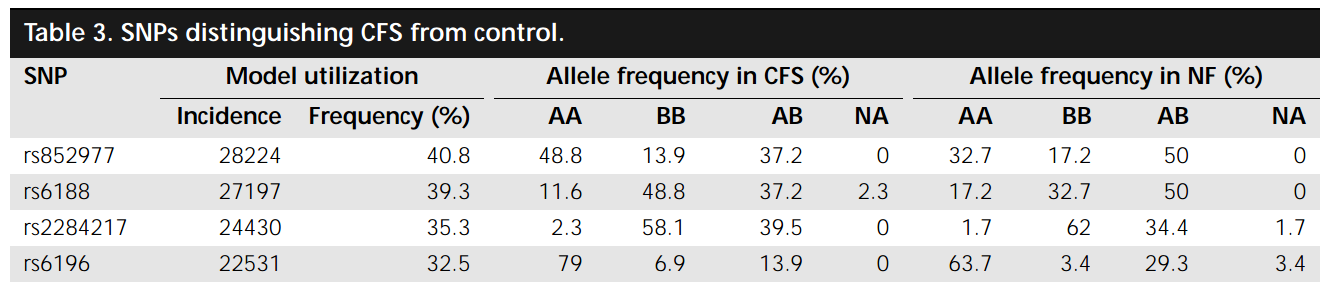
In table 3, you will see:

SNPs associated with CFS

SNPs associated with CFS

This is typical of what the papers look like, a rs##### on the left and two letter combinations across the top.

Your 23AndMe Matching DNA

With 23AndMe.com(once your results are returned), you will see under your name, a RAW DATA option.

Where you can find your individual SNPs

Where you can find your individual SNPs

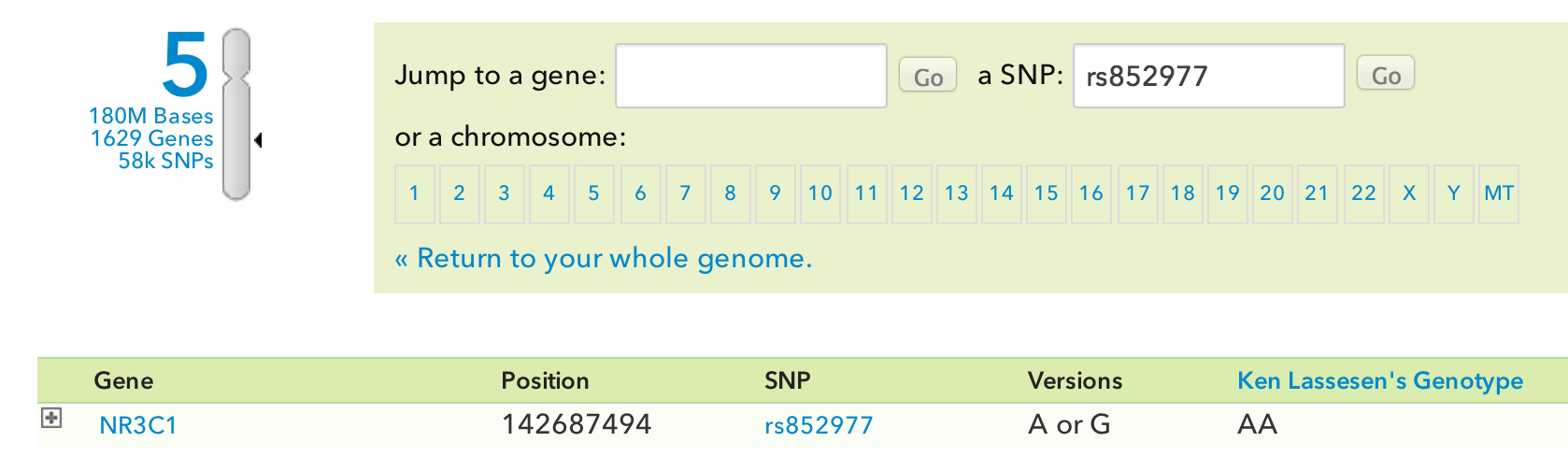
So clicking this takes you to a page where you can search, for example, I entered the first SNP (rs####) as shown below:

Results for looking at first SNP

Results for looking at first SNP

My value is “AA”. According to the article, 48% of CFS patients have an “AA” and only 32% of normal people. I can now go on to the other ones and see how many of them are matches for the research (I choose not to disclose the results).

At present there are approximately 20 studies that have been done and more in progress. This is informational only, although it may have some advantage is dealing with MDs and other disbelievers. “If it is all in my head, then why is it also in my DNA?”

Some additional articles available with full text:

which has a nice table in it.

Screen Shot 2013-10-28 at 8.35.15 PM

If you have GG for this one, the odds are significantly higher. You will not find all of the SNPs in the 23AndMe dna — but you will find most are listed.

The severity of CFS appears to be echo in your DNA. This does not mean that you are preDNAed to have CFS, it suggests you are more inclined.

The challenge of tracking progress in CFS

CFS can be exceedingly difficult to “track” progress because there are no clear markers. My last onset and remission found two indicators were very helpful. The first one, Vitamin 1,25D level which went so far outside of the normal range that the lab repeated the test twice — fearing a lab measurement problem.  The second one, WII Fit, seems ideal for most CFS patients, and repeatedly showed “herx” and improvement over the course of treatment.

Vitamin 1,25 D as indicator of activation level of CFS and other auto-immune conditions

The last time around I was aware of hypercoagulation issues and self-medicated with known and effective anti-coagulants in order to keep working. That is, I did until I started to bruise very easily — at that point I stopped and did a severe crashed in 7 days. Prior to this, testing for hyper-coagulation was constantly returning normal ranges (of what they were willing to test for). Because the items that I were using were non-prescription (or did not require a prescription in the US), the professional medical staff ignored the list. The list included:

  • grape seed extract
  • alpha lipotic acid
  • serrapetase
  • nattokinease
  • lumbrokinease
  • turmeric (very effective against the measure that I was normally high in)
  • racetams (very effective against the measure that I was normally high in)

There was a catch-22 situation. There was hypercoagulation happening but it was being effectively controlled. If I stopped to allow it to spike and thus get significant readings — I would also be unable to work and promoting a situation that could cascade out of control quickly.

Fortunately, Dr. Kim Iller, my physician, was willing to test for vitamin 1,25D (dihydroxycholecalciferol), not a typical lab test, as well as the usual Vitamin D levels. The 1,25D results matched that reported on PubMed for auto immune conditions (Vitamin D metabolites as clinical markers in autoimmune and chronic disease. [2009]. My Vitamin-D levels were at the top of the normal range (intentional) which resulted in the least severity of symptoms (as reported in multiple PubMed studies).

The last test done for 1,25D before I was cleared to return to work had it back in the high normal range instead of being almost off the scale. This appear to correspond well with the change of symptoms.

Some literature:

Suggestion: get a Vitamin D and Vitamin 1,25D lab done at least once every 6 months.

  • If Vitamin D level is not close to the threshold of being high, supplement. Often a daily intake of 15,000 – 20,000 IUs seems to be needed for some CFS patients.
  • 1,25D is used solely as a general state indicator. If it increases, chances are that symptoms have increase and you may wish to re-examine changes that have been made between measurements.

WII Fit as a indicator of CFS state

WII Fit means a WII controller, a WII balance board and the WII fit game. When it first came out, many rehabilitation services adopted them.  Today, you can buy both on the second hand market for around $40-$60 for the game and the board, and $70-$80 for a refurbish WII System.  Often you can find smaller game shops sell them for much less (or garage sales). Craiglist have prices of $20 and $40 often.

Example chart for tracking information on WII FIT

WII Fit is very nice because if offers a wide range of exercises and durations. It also keeps track of a daily status:

  • Weight
  • Performance on two randomly selected tests of cognitive or other processes that are used to predict a “Fit age”.

You can then look at your stats over time to see if things are improving or getting worst. For Fit Age, you typically need to average several days to get a stable number. Some tests you may do very well on and other bad on.

My Experience

I was doing 40-50 min/day of WII Fit before the onset. My WII Fit age was typically in the mid 20’s.  With onset, my performance went up to the 60’s. What I found especially interesting was the change of treatment being reflected in these scores.

  • Starting minocycline, a neuroprotective antibiotic, saw my WII Fit age drop to the high 30’s within a week.
  • Starting Mutaflor (E.Coli Nissle 1917) with it’s headache and severe herx, saw my FIT Age approaching 70 for 10 days and then started to come down.
  • When I was ready to return to work, my average WII Fit age was the high 20’s.

This morning, I did the WII Fit Age and it came in at 21 — not bad for a white haired person!

WII Fit age is helpful for determining if something(drug,  probiotic, antibiotic, elimination) has an impact.

  • Significant improvement after starting is a good sign
  • Deterioration with a herx or similar symptoms when starting something new — suggests that it is having an impact — but the deterioration should reverse itself within 14 days with some improvement over your prior score.

Last but not least, it tracks how much time that you exercise each day.  5 minutes is fine. Just doing the fitness tests is fine. All of the exercises are graded from a MET of 1 (deep breathing only) to an energetic MET of 4. Starting on the yoga choices is strongly recommended.  Do the lowest MET exercises when you start and slowly increase the MET level. Gradual regular exercise helps reduce CFS symptoms — if only by allowing better removal of toxins from the body.

  • If you have payback from doing too much, you can see how much time you spent yesterday and cut that time in half for the next week. Then slowly work upwards again.

CFS patients are absent minded and do not log much information. This is worst because their cognitive abilities are impaired (so what is logged may be very unreliable), see this recent article for more information ( Effects of Time Frame on the Recall Reliability of CFS Symptoms). The WII Fit approach results in information being recorded daily and amount of physical activity recorded.  It is a great encouragement when you see you beating your best scores from two weeks ago — you become competitive against yourself. Fortunately, after every exercise, the WII Fit displays the total time you have been active today. It also nags you to take a break at 30 minutes. You are much less likely to “over-exercise”.

CFS: Challenge of tracking progress

Allergies and Microbiome – Is there a relationship?

A recent comment stated  “I had an allergic reaction to both CoQ10 (of which is listed as a “core” on this blog) and SAM-E – both of which are known to be required for the synthesis of ATP production.” I decided to do a little digging into this area.

CoQ10 – The literature

  • We know that CoQ10 levels are lower with bronchial asthma [2002], [2002] [2005] and with food intolerance and allergies [2011]
  • We also find that some bacteria can impact CoQ10 [2003] and that different bacteria produces it [2012] [2010]

SAMe (Ademetionine)- The literature

The wikipedia article is an interesting read but has no reports of allergies. PubMed searches turned up similar findings as above, including production by bacteria.

We can similarly go on to other allergies, such as peanuts which had had an exponential growth as well as autoimmune. There is much speculation as to the cause.

My own speculation is that there has been an alteration of the microbiome from changes in food and that the root cause if this microbiome shift.

Inferential evidence come from some recent work:

  • Mouth Microbes Influenced by Ethnicity “a machine-learning classifier was able to reliably identify a person’s ethnicity based on their subgingival microbes.”
  • Black children have higher incidence in same urban areas than hispanic and other races [2012] [2012]
  • Arabs and Jews in Israel have different allergy profiles [2012]

Our microbiome (including mouth) appears to have evolved with our traditional (ethnic) food and been passed along by such items as children sticking their fingers in their parent mouths.  When this healthy population is subject to a different food supply (change of diet), then the microbiome shifts because there is an abundance of food that one uses, and a decrease in the food another one needs. A good population goes bad.

How to treat? Two experiments would be interesting to see if they impact allergies, especially peanut allergies,

  • The oral probiotics:
    • Jarrow Formulas Saccharomyces Boulardii + MOS
      on Amazon (90 capsule for $18) – Saccharomyces Boulardii
    • Now Foods OralBiotic on Amazon (60 capsule for $14) – Streptococcus salivarius BLIS K12
  • Fecal transplants or the new proposed pill version

The chemicals producing the allergic reaction may well be a result of chemicals released by the microbiome when exposed to these foods or supplements.

New techniques — and monotonic thinking

I just read “A metagenomic approach to investigate the microbial causes of myalgic encephalomyelitis/chronic fatigue syndrome: moving beyond XMRV” on About.

While I have strong agreement with this on first read, a second read revealed some subtle but important issues.

“Nevertheless, even if the causal microbe is no longer present, it may have changed the composition of the microbiome, by altering the presence or relative abundance of other microbes. Such changes could be detected by metagenomics and be used to diagnose and, in principle, treat the symptoms of ME/CFS, even if not the initial cause.”

My conclusion from my own review of the literature, is that the causal microbe is either no longer present, or no longer in an acute (active) state. I also agree with the alteration of the micro-biome suggested.

Where I differ comes from my statistical training and work doing machine learning at Amazon. Given the huge range of families, species and strains in our micro-biome, the sample size needed to get any significant (and reliable, reproducible) results is likely 400,000 CFS patients with 400,000 controls. The testing costs to collect this data would be around $200,000,000.

Even once this is done, the question arises on how to correct this when there is estimated to be at least 10,000 species (and likely 200,000 strains!).  Anything impacting one strain may impact hundreds of other strains.

The author being cited has a feeling of expecting to find a single species and not complex interdependencies of many strains that as a whole causes the problem.

The philosophy is right, the requirements for a successful execution is far more challenging then imagined….