ME/CFS improved on antibiotics

A reader wrote to me

Hi Ken,
So I had my first sinus / ear infection in years and was put on Augmentin. Within 24 hours, I was feeling better than I have in years. That has continued somewhat the whole course of treatment, though I only have a few days left.
I think it’s possible to use your site to see what a specific antibiotic might be doing to the microbiome? Can you do a walkthrough? Maybe I can replicate the effect Augmentin is having with supplements, probiotics and food since my last microbiome test is over a year old now.
Always striving…

This type of email, describing feeling better on some antibiotics, I have seen many, many times from people with ME/CFS. The problem is physicians will prescribe antibiotics for other issues, for example Acne, but not for severely life-changing conditions like ME/CFS.

I have one more question, for example if I want to replace the fluoroquinolones antibiotic class with a herb or herbs, can I use your website to find a “replacement” that would have a similar impact on the microbiome ? If yes, how would I do that ?

From a different reader in this morning’s emails. With a specific microbiome, it can be inferred – but in terms of a generic equivalent … antibiotics impact too many things to get a reasonable replacement of herbs and spices.

This reader asked something which was an elegant request, “replicate the effects of the antibiotics”. After some experiments, I discovered that it was possible and just finished creating a page.

  • A microbiome (16s) is needed before the antibiotics
  • The name of the antibiotic

Verbal Description of the Steps

  1. Log on to the site, you will see a new button [Antibiotics Helped]
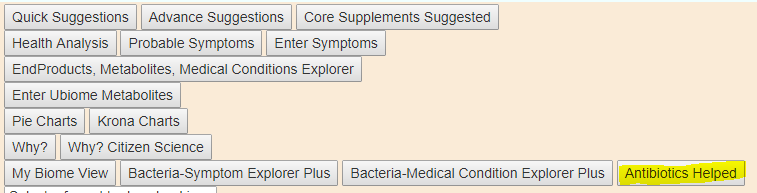
A new page appears, type in the name of the antibiotic, perhaps with ‘%’ around it to do a general search

Note: This can be done for ANYTHING in our modifier database that made a major improvement.

You may get multiple items, usually brand names for the same thing,

Check the item desired (only one is allowed), THEN pick the microbiome sample you used. Click the button if needed.

A new page will appear. This consists of the bacteria impacted by this antibiotic and what you had. The person may have 500 taxa, the antibiotic may have 60 taxa, what is in common (the “intersection”) may be just 30 taxa. The items that are in common are what is shown.

Inspect the candidates, and put a check box by the ones you wish to include. Then click add to hand picked taxa. This will send you back to the samples page. On this page you will see a golden line of buttons appear.

Click View to see what was added:

Return, and then try the golden suggestions buttons. I first did it with just herbs and antibiotics to see if there are alternative antibiotics, and more important, where did my antibiotic show up in the rankings

Augmentin is the trade name for amoxicillin

That’s it. A video with more discussion is below.

A walkthru with comments

ADDENDUM 1

A reader pointed out that this can be used for screening / testing for likely side-effects on the microbiome BEFORE taking! An example is shown below


ADDENDUM 2

I decided to make available under the DEMO login, my microbiome from early in my ME/CFS relapse. The microbiome may not apply to you — but if you are looking for herbs, spices etc for fluoroquinolones and minocycline, Zithromax, etc and DO NOT have a microbiome sample, then it is likely better than no information. From my experience with various antibiotics, some work very well and others “so-so”
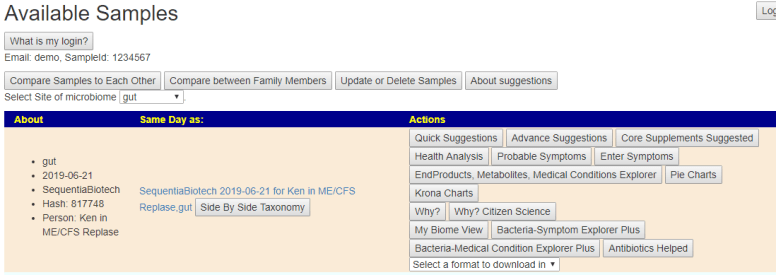
If anyone else wishes to share one of their samples for a specific condition, feel free to email me. I will change the email to “demo” and update the person information in the database to preserve your privacy.
Neuroinflammation – Options

Neuroinflammation is defined by Wikipedia as “inflammation of the nervous tissue. It may be initiated in response to a variety of cues, including infection, traumatic brain injury,[1] toxic metabolites, or autoimmunity.[2

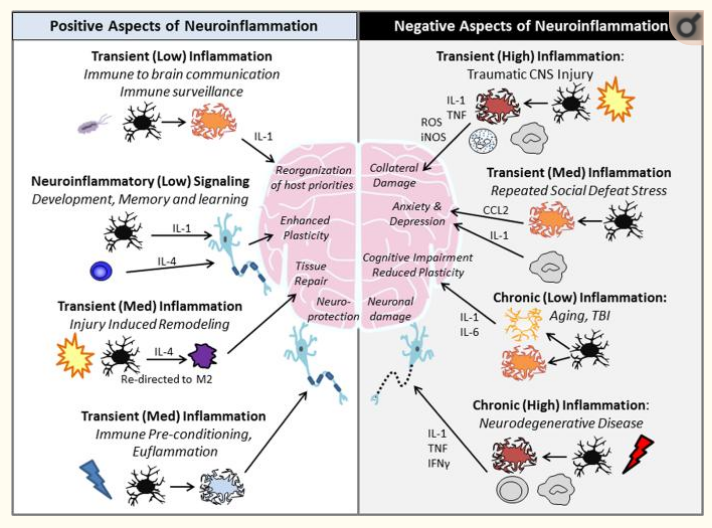
Neuroinflammation is defined as an inflammatory response within the brain or spinal cord. This inflammation is mediated by the production of cytokines, chemokines, reactive oxygen species, and secondary messengers. These mediators are produced by resident CNS glia (microglia and astrocytes), endothelial cells, and peripherally derived immune cells. There are immune, physiological, biochemical, and psychological consequences of these neuroinflammatory responses. Moreover, the degree of neuroinflammation depends on the context, duration, and course of the primary stimulus or insult (Figure 1)

Neuroinflammation: The Devil is in the Details [2016]
Note that IL-1 is on both sides

In terms of ME/CFS where stress is a very common cause/contributor

  • “the response to chronic or traumatic stressors. Traumatic or chronic stressors appear to promote a more neuroinflammatory profile that involves both resident microglia and bone marrow-derived macrophages (Wohleb et al. 2014a) ” [2016] Which leads to removal of chronic stress as a key treatment choice (sometimes called, re-adjusting expectations or giving the finger to those with high expectations of you!)
  • “Neuroinflammation is present in widespread brain areas in CFS/ME patients and was associated with the severity of neuropsychologic symptoms.” [2014]

For more technical details, read the article cited above.
I would also advocate bookmarking the Journal of Neuroinflammation

Neuroinflammation and the Microbiome

Review studies on pubmed we find:

Bottom Line

There are many items that will help with reducing neuroinflammation. In terms of priorities, removing contributors should be a high priority. “Plug the hole in the dyke, do not send for more buckets!” This likely include some significant items:

  • Removal of personal stress (letting go, ” Que Sera, Sera -what will be, will be”)
  • Removal of environment stress
  • Work on oral health

All of these can be challenging. For me, we have moved to 25 acres in the country, local organic food, no work email on my phone or home computer, blocked all phone numbers except for a few, employer has no issue with my cutting hours as needed – 20% of the staff just work 4 days a week by choice.

A friend is Spain would love to get some of the old rural monasteries or nuneries re-purpose as sanatoriums for ME/CFS people. I very much agree with her — that would be awesome.

Reflections on “Antivirals for the Gut? Study Points To Potential New Gut (and Brain) Treatment”

A reader shipped me a link to Antivirals for the Gut? Study Points To Potential New Gut (and Brain) Treatment and asked for comments.

After reading, my first concern is about some naivety about biophages. Biophages are uber specialists in general, often they will address only a very small selection of bacteria. Just like bacteria, there is communications between them.

” Sorek’s team was looking for evidence that a bacterium called Bacillus subtilis might alert other bacteria to phages. The researchers knew that bacteria speak to their brethren through secreting and sensing an array of chemicals. This phenomenon, called quorum sensing, allows the bacteria to adjust behaviours according to the numbers of other bacteria around. For instance, bacteria use quorum sensing to decide whether to divide or when to launch an infection.  Instead, the team found, to its surprise, that a viral invader of Bacillus bacteria — a phage called phi3T — makes a chemical that influences the behaviour of other viruses. …

Sorek’s team found more than 100 different arbitrium(name of this class of chemicals)-like systems, most of them in the genomes of other Bacillus viruses. “Phages broadcast in different frequencies. They speak in different languages and they can hear only the language that they speak,” he adds. “

Do you speak virus? Phages caught sending chemical messages“[2017].

So conceptually, this sounds nice … a magic silver bullet! The problem is every phage is a different caliber so finding the right gun to shoot it becomes a challenged.

In theory: We need to identify which of the 3000+ bacteria each person has that are associated with the condition. Each person with the same condition will have different taxa involved. Then we need to find the appropriate matching phages for each. Each bacteria will likely need a different phage. In the 2017 study cited above, they found 100’s of phages for bacillus genus. We have years, if not decades, that will need researching.

The article cites Firmicutes being high in ME/CFS and links to the study. I suspect that brain fog has hit the author. I read the opposite

A highly significant separation could be achieved between Norwegian controls and Norwegian patients: patients presented increased proportions of Lactonifactor and Alistipes, as well as a decrease in several Firmicutes populations.

High-throughput 16S rRNA Gene Sequencing Reveals Alterations of Intestinal Microbiota in Myalgic Encephalomyelitis/Chronic Fatigue Syndrome Patients [2013]

Hoping over to my library of studies we find those below. Many of the low items are co-morbid with ME/CFS. (I excluded the above study because results were different for the two sets of ME/CFS patients used)

  1. Parkinson’s Disease reported from 1 studies to be High and Low
  2. Allergies reported from 1 studies to be High
  3. Gastro-esophageal reflux disease (Gerd) including Barrett’s esophagus reported from 1 studies to be High
  4. Inflammatory Bowel Disease reported from 1 studies to be High
  5. Metabolic Syndrome reported from 1 studies to be High
  6. Sjögren syndrome reported from 1 studies to be High
  7. Type 1 Diabetes reported from 1 studies to be High
  8. Type 2 Diabetes reported from 1 studies to be High
  9. Ulcerative colitis reported from 1 studies to be High
  10. Acne reported from 1 studies to be Low
  11. ADHD reported from 1 studies to be Low
  12. Autism reported from 1 studies to be Low
  13. Celiac Disease reported from 1 studies to be Low
  14. Chronic Kidney Disease reported from 1 studies to be Low
  15. Crohn’s Disease reported from 3 studies to be Low
  16. Depression reported from 1 studies to be Low
  17. Inflammatory Bowel Disease reported from 1 studies to be Low
  18. Irritable Bowel Syndrome reported from 1 studies to be Low
  19. Juvenile idiopathic arthritis reported from 1 studies to be Low
  20. Multiple Sclerosis reported from 1 studies to be Low
  21. neuropsychiatric disorders (PANDAS, PANS) reported from 1 studies to be Low
  22. Small Intestinal Bacterial Overgrowth (SIBO) reported from 1 studies to be Low
  23. Stress / post-traumatic stress disorder reported from 1 studies to be Low
  24. Systemic Lupus Erythematosus reported from 1 studies to be Low

The findings suggested to the authors that antibacterials like minocycline and probiotics might be helpful not just in returning the gut to health, but also in reducing the neuroinflammation present in Gulf war Illness and similar disorders.

What is excluded is that success with minocycline and other tetracyclines with GWI and ME/CFS has been known for a while. For example Garth Nicolson, Continuing Research into Gulf War Illness 2001; Philippe Bottero, Co-Infections, 1987; C.L. Jadin, Common Clinical and Biological Windows on CFS and Rickettsial Diseases , 2000

In 2017, Solve ME funded a gut virome study, and a fecal transplant study is underway in Norway.

There is no mention of the massive research being done in Australia — so massive and successful that “Australians are running out of shit” (unbelievable and could not resist!) [News] In The GI microbiome and its role in Chronic Fatigue Syndrome: A summary of bacteriotherapy[2011] found ” Results: 35/60 patients who underwent initial bacteriotherapy responded to treatment. 10/15 patients who failed this course were offered a secondary transcolonoscopic infusion followed by a rectal infusion or an oral course of cultured bacteria. Of these 7/10 responded, giving a total of 42/60 (70%) patients who responded to treatment. “

Bottom Line

I often see the same old concepts being recycled for more funded investigations into these “new” concepts. Often it seems that the researchers are in their own little niche speciality and have not read (beyond a glance) the massive body of literature and studies on ME/CFS.

After some 20+ years in the ME/CFS world and having read everything that I could find multiple times…. I tend towards “Folks, put it together and get on with treating people!” The reality is that there is massive inertia in medical practice, my classic example is that many MDs believed ulcers were caused by stress for over 30 years after it was discovered to be treatable by antibiotics. MDs preached to their patients — “The ulcer is because YOU are stressed, I can’t help with that”…”What!!! Antibiotics, that is not standard of care — sorry, I will not be reckless!”

Update on Infrared Sauna and ME/CFS

It’s been six years(2013) since my earlier review on Infrared Sauna and autoimmune conditions. As stated earlier, it is my hypothesis that this alters the microbiome — how, has still to be reported. It kicks start changes whose benefit appears not the same day, but in the week following.

The following additional studies have come out:

Perceived fatigue significantly decreased after therapy, although no significant reductions were observed during therapy. In addition, a negative mood, including anxiety, depression and fatigue, and the performance status significantly improved after therapy. However, the levels of pain and vigor did not change significantly. No patients reported any adverse effects during the therapy.

Effects of Waon therapy on chronic fatigue syndrome: a pilot study. [2015]

Bottom Line

I continue to still use my infrared sauna at least once a week (and likely should do more often). The evidence suggests that it does help with CFS, and potentially may reduce brain fog.

Potentiators: Often the difference between success and failure

In dealing with ME/CFS I came across a group of supplements/drugs that I continue to use. The main reasons are:

  • They are biofilm breakers, thus weaken the defenses of some bacteria
  • Blood thinners of diverse mechanisms – I deal with a Prothrombin 20210 A/G defect (85+% of ME/CFS patients are believed to have coagulation defects – often due to epigenetics)
  • They make antibiotics more effective because a much (up to 10x ) higher amount of the antibiotics makes it into tissue.
  • Last, it reduces my risk of blood clots; remove much of blood vessel fibrin deposits that reduce the amount of oxygen you receive.

This is a short summary of my main ones with their literature.

Serrapeptase 

This in an enzyme derived from silk worms. It is produced for the silkworm to escape it cocoon. It is effective against some types of coagulation.

Benefits:

Nattokinase

This is an enzyme that exhibits strong fibrinolytic activity. Natto is a kind of fermented soy bean-cheese used in Japan. This characteristic is not from the soy but the fermentation (produced from Bacillus subtilis Natto).

Lumbrokinase

This is strong fibrinolytic enzyme was readily obtained in saline extracts of the earthworm.

  • digested fibrinogen and inhibited platelet adhesion [1991]
  • fibrinogen decreased significantly. Inhibition of intrinsic coagulation pathway and the activation of fibrinolysis via an increase of t-PA activity.  [2000]

Bromelain 

This is an extract from pineapple stem.

Bottom Line

These should not be taken continuously.

Warning 1:Most are anticoagulants which means that the risk of easy bruising and failure of the blood to clot is high.

Warning 2: With antibiotics, they can change a minor herx into needing to crawl on the floor herx. With 10x the concentration, you are effectively increasing the antibiotic dosage 10x!

Appropriate dosage and duration should be done in consultation with your medical professional.