I have added a new page today that shows the relative production of various vitamins and a few metabolites compared to a healthy population. It is linked to from the samples page.
Each sample will give different results
The regular suggestions pages may list these vitamins because it is known that they will impact other bacteria that we wish to change. There is incomplete knowledge.
This new page computes for known producers, the amount that is likely being produced and compare it to those who declared themselves healthy in the uploads.
My own in a remission periodAt start of flare, GABA dropped a lot and B12 decreased2 weeks later, GABA declined more4 weeks later, GABA almost gone, Butyrate is increasing, Folate is climbing fast
There is a lot of uncertainty in modifying an ill microbiome. This starts with selecting the bacteria you want to change, see this post Steeing the species that may need correction to whether something actually modifies a bacteria without causing undesirable side-effects. You cannot be blinkered to a single bacteria because there are a large number of interactions between different bacteria (often across orders)
The Advance Suggestions page allows you to refine how suggestions are generated and what you are willing to do to modify your microbiome. For example, some people may not wish to do antibiotics (or have MDs that will not prescribe); others may be vegans.
The next item determines how fine you want the suggestions to be. Let me explain, some suggestions are based on reports of a suggestion impact on a Family or an Order as a reporting unit. If you go to a lower level, you will get less suggestions and they will be more specific to specific bacteria. It’s a trade-off. If you get no suggestion, try moving to a higher level.
The next step is whether you want to include literature reports that a specific bacteria was significant for a specific condition. If you have a condition, then this will increase the odds of the right bacteria being picked. The number of bacteria will likely decrease, and number of suggestions too. There is a long list of conditions:
The next is a list of categories of suggestions that you can filter to. Everything is checked by default. Uncheck the items that you are not interested in.
The last choices limit the items displayed to the best and worst suggestions. In some situation, more than a hundred items were reported with the old process. You can still see all if you want… but this is intended to just shown the best.
Last, when you click, the report will be shown in a NEW WINDOW OR TAB in your browser. This allows you to compare different combinations against each other.
Some sample reports are below:
Oops too many antibiotics, so I uncheck some choices.Antibiotics disappear and other things appear…What! No coffee!!!
You can also see how suggestions changes between sample. Once you have a good set of filters, just change the sample and you will see what the older sample would produce.
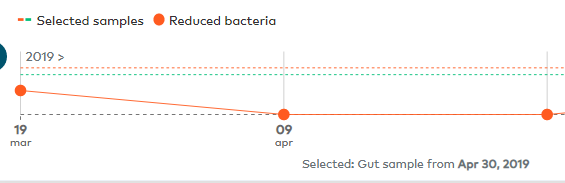
This ubiome sample was done a week after my last posting. Some interesting things happened during the week:
Changes
I stopped taking 100-150 BCFU per day (because Lactobacillus et al ) were not at the top of suggestions
Changed probiotics to Bacillus Coagulans (Digestive Advantages) instead of Bacillus Clausii (Enterogermina)
Stopped supplementing with Potassium Citrate, Folate and Berbine
Consequences
Found myself becoming quickly fatigue physically
Fatigue accompanied with overheating feeling.
Stools became very burning with frequency increasing every day
Tested a vial of Bacillus Clausii and could literally feel things becoming better
Leg cramps, sore muscles across the body
Response
After getting the sample for ubiome, returned to 100+ BCFU of lactobacillus et al probiotics taken with organic yogurt. Stool burning and frequency declined within 12 hours.
When I re-introduced Potassium Citrate, the leg cramps and sore muscles disappeared. I seem to be resetting to where I was 10 days ago.
I wanted to get the sample to get some insight on what went wrong.
Changes
Loss of the little progress that was made was lost.High bacteria decreased more, but low bacteria increased Biogenic Amine.
Drill down into specifics
Looking at the raw data for this sample
Lactobacillus paracasei is at 29/ /1000000
Lactobacillus casei is at 29/1000000
For prior sample:
Bifidobacterium animalis 33/1000000
Bifidobacterium longum 373/1000000
Lactobacillus curvatus 113/1000000
Lactobacillus casei 33/1000000
First sample after flare:
Lactobacillus: 162/1000000 with no species identified
No Bifidobacterium
Prior to flare
Lactobacillus: none
Bifidobacterium 3356/1000000
Bifidobacterium bifidum 36/1000000
Bifidobacterium animalis 434/1000000
Bifidobacterium longum 2885/1000000
It looks like the B.longum and B.animalis were making a comeback after the flare eliminated them with approximately the same ratio. It does hint that Bifidobacterium animalis and Bifidobacterium longum probiotics are desired to assist.
Unchanged
Change of Suggestions
The new Advance Suggestions makes it easy to compare suggestion between samples. For you current sample, tune the suggestions appropriately. Then just select another sample and see the results. Comparing this (downhill) with the prior sample (uphill), I saw some interesting flips:
Folate (B9) flipped from avoid to take
Berbine flipped from avoid to take
Resveratol (grape seed extract) flipped from avoid to take
This causes me to be careful when something flips from take to avoid when things are improving. The suggestions are just that suggestions (based on a healthy microbiome data). It also indicates that some microbiome populations had significantly altered.
Bottom Line
By symptoms, I knew that I had lost ground with the modifications that I made; this appears to be confirmed by the results. I am restoring the above three to my supplements and then waiting a week before doing the next uBiome sample. I have been doing seed probiotics for a week now, and I am curious if this human source probiotics has any persistence.
A new rule is suggested
If things are improving and a new test’s suggestion says stop on what the last test suggestion says take. — Ignore it.
Some readers have requested that I show the list of bacteria that were selected to make suggestions from. I have done some refactoring and they are now available from three different ways of selecting bacteria that are available on the site now. Reports go down to the strain in some cases.
Choices for Determining What you wish to change
Once you have logged on, if you select Advanced Suggestions
There are multiple paths available for determining what could be wrong, and thus what you may wish to modify. Click on the above high lighted link will show you the actual bacteria picked from each of these methods. A short summary of each is below:
Bacteria that has an association with symptoms that you have and you are an exact match. This will be the smallest list — but it is the most certain of being right
Bacteria whose population are outliers (that is far away from the expected patterns). This is the medium size list — it is uncertain if they are significant
Bacteria above or below normal ranges. This is the simplest to understand and may be most leading. The typical 16S report has 500 to 1500 bacteria listed. Assuming the normal range is the middle 90% (5% high and 5% low), we would get 50 to 150 bacteria listed here by random chance.
The Parents and Grandparents are included because most people do not know which family some genus or species is in.
I did some counts on different samples, which confirms the counts from each method.
Note: The symptom and outlier filter is dynamic. As more data is added, their ability to detect improves. For symptoms, there must be 16 people people reporting the same symptom before we will do detection of association.
In Summary
You can try all three methods, and experiment. You really want to get the smallest list of bacteria (because in figuring out suggestions, the more bacteria you include, the more complex it gets!).
For myself, I did suggestions from each and found a few items appeared in common with all of them. Those items are definitely on my list (“Almonds in the morning, Almonds in the Evening, Almonds at supper time”) sung to the tune below..
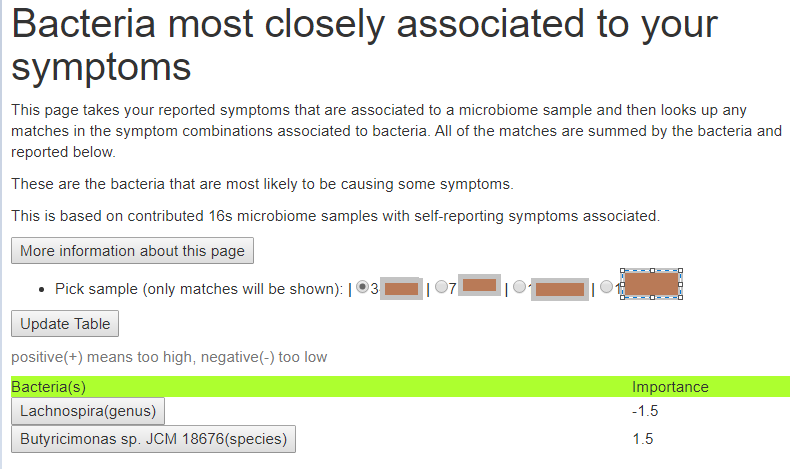
This is taking the associations of bacteria to symptoms found for the entire population and applying it to the symptoms you have recorded and your uploaded microbiome.
If you have not recorded your symptoms, nothing will appear.
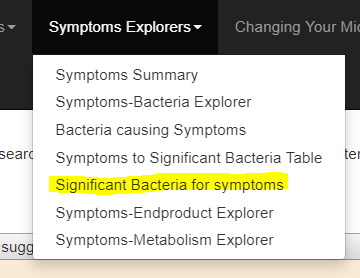
After you have logged on, a new menu item will appear:
When you select this, you will be taken to the new page.
Mine when relatively symptomless
The number can vary greatly — only precise matches are shown. In some cases species will be shown.
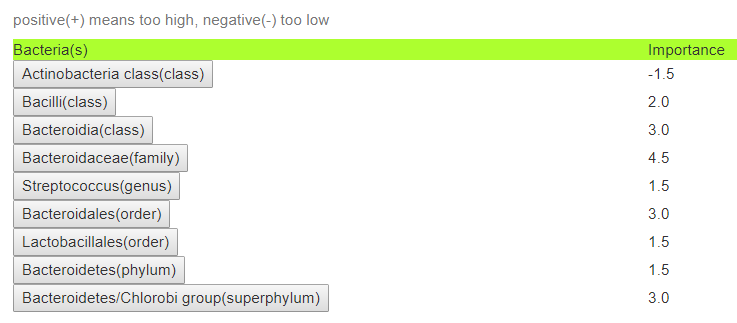
This is mine during a myalgic encephalomyelitis flare.
Above, Streptococcus(genus) parents are Lactobacillales(order) and Bacilli (class).





 CFS Remission