There are many reasons to manipulate the microbiome. Some simple reason may be to treat a condition like Psoriasis (see this post) where a reader wrote:
Ken – my head has stopped itching and I have only been taking the Align for 2 days!!!!!!!!!!!!!! I can’t believe it – but at the same time it makes sense – I had a severe gastrointestinal issue over a year ago for 6 months, and then I stopped eating yogurt because the soy yogurt maker went out of business…..and then the psoriasis started in last August…. Wow…. I will keep taking the Align and hopefully this will be permanent!! I am so grateful Ken! Thank you for writing the blog!!
For others, it is striving to optimise physical performance or mental performance.
Evidence for benefit manipulating
There are a large number of medical conditions that have microbiome shifts associated with it. I have created a chart of these relationship here. Many believe that these shifts either contribute to the conditions (or some of the symptoms) and in some cases may be the main cause.
The strongest evidence that microbiome shifts may be causing some of these medical conditions comes from dramatic results from Fecal Microbiota Transplants. Some reports include:
Fecal Microbiota Transplantation Induces Remission in Patients With Active Ulcerative Colitis [2017]
Fecal microbiota transplantation induces remission of infantile allergic colitis [2017]
“In Crohn’s disease, there has been no randomized,placebo-controlled trial evidence to date involving FMT. There are only observational data, which showed that approximately two-thirds of people went into remission with FMT.” [2018]
Fecal microbiota transplantation for managing irritable bowel syndrome [2018]
Fecal Microbiota Transplantation for Fibromyalgia: A Case Report and Review of the Literature [2017]
Fecal microbiota transplantation in metabolic syndrome: History, present and future [2017]
Dutch Clinical Trial Points to Fecal Transplant as Diabetes Treatment [2017]
“There are preliminary reports on the use of FMT therapy in a wide range of disorders including Parkinson’s disease, fibromyalgia, chronic fatigue syndrome, myoclonus dystonia, multiple sclerosis, obesity, insulin resistance, metabolic syndrome, and childhood regressive autism” [2016]
FMT is the most extreme form of microbiome manipulation — and not something you can get at your local pharmacy — or even in many jurisdictions. For example, in the US — the FDA has taken a strong position (see this statement). Many people have done DYI FMT (with several reporting positive effects) — which have risks.
How to Manipulate
There are some major challenges when it comes to manipulation. These include:
We do not what the right microbiome should be. Microbiome depends on both DNA and diet — and every one is different
Any change may impact dozen of different types of bacteria in different ways
What are the tools of manipulation?
The most common ones for intentional manipulation are:
prebiotics
probiotics
antibiotics
The most common ones for unintentional manipulation are:
diet (including going vegan or gluten free)
other prescription drugs
supplements
The chart [2017] show that different types of protein have different effects.
Influence of diet on the gut microbiome and implications for human health
Attempting to balance all reputable information
The site http://microbiomeprescription.com/ attempts to take all of the known information about how hundreds of substances influence thousands of bacteria types using an Artificial Intelligence Engine.
No one knows which way is best, the choices available at this site are:
You have a condition with common known shifts, what can I do to correct these shifts? No testing require.
You suspect that some prescription drugs are responsible for symptoms and want to compensate for their impact.
Just go this this page and click what you are taking
You have a common (non-detail) stool report. You trust their standards.
Just go to this page, select the lab and fill out the reports.
You have done a uBiome, American Gut or Thryve detail analysis. You trust the ‘normals’ used by uBiome.
Just go to this page and upload your data download.
You have done a uBiome, American Gut or Thryve detail analysis and your family also. You do not trust the ‘normals’ used by anyone
See this post on how to use family members to establish good norms..
Suggestions are not doctrine nor guaranteed
The suggestions are based often on a single study. In many cases, the study was not on humans. They are the best information that we have.
You can limit the scope of what you want to change on the suggestions page.
Yes, things are complex. Unfortunately, there is no simple “just take this pill” — actually, if it is the right FMT pill then that may be true.
Lacking this solution, it becomes changes of diet, supplements and probiotics — avoiding somethings and adding new things in.
Remember that many items will affect only some people (there is an average benefit — but you may not be in the average!). One small study found 50% are resistant to some probiotics.
My usual advice is to be systematic in trying things and keeping detailed notes.
Dealing with a sick family member, there is a desire to correct their microbiome…. but to what!
Different Paths to correcting microbiome
The microbiome site now has 3 paths available:
Comparing your microbiome against a reference microbiome derived from ubiome ‘normal’
Working off high values or low values as reported by some lab (using their standards).
NEW: Working off the values seen by healthy family members that hopefully are eating similar. This is the subject of this post.
Comparing to healthy family members
After you log on, you are taken to the sample page. There is a new element there:
new panel
This takes you to a page where you can select one Unhealthy person and as many healthy people as you have.
Make a selection and click on. You now see a display of the differences. You may adjust the depth up or down (i.e. looking at bacteria families only or classes etc).
You may adjust by taxonomy level, and also by excluding very low count bacteria — whether these are significant is unclear. Once you are happy, just click the “Use for Suggestions” and you will be moved to the usual suggestions page –but using your family members for the norm!
Bottom Line
This gives a better and far more specific to the individual approach for adjusting the microbiome or identifying where a shift has occurred.
For many of you with health issues — you now have a reasonable estimate of what is healthy for your DNA and your diet using those around you who do not have health issues.
Whose Best to compare to?
I would rank them in the following order:
A healthy child that lives in the same house – 50% same DNA, same diet – more biodiversity due to being younger
A healthy sibling that lives in the same house – 50% same DNA, same diet
A healthy parent in the same house – 50% same DNA, same diet – but less biodiversity due to age
A healthy cousin who eats similar – 25% same DNA, similar diet
A healthy spouse – no shared DNA (hopefully 😉 ) but same diet
This is an education post to facilitate discussing this approach with your medical professionals. It is not medical advice for the treatment of any medical condition. Always consult with your medical professional before doing any changes of diet, supplements or activity. Some items cites may interfere with prescription medicines.
Over the last few weeks, I have been having a dialog with a very intelligent parent of a child with epilepsy. There appears to be a combination of SNP mutations and microbiome shifts involved which are largely not explored by conventional researchers.
This post attempts to document what is available on PubMed. I am also adding Epilepsy to the conditions listed on the http://microbiomeprescription.azurewebsites.net site in the hope that other parents can upload the microbiome of people with epilepsy and citizen scientists use the data to find associations.
“Seizures and epilepsy are not the same. An epileptic seizure is a transient occurrence of signs and/or symptoms due to abnormal excessive or synchronous neuronal activity in the brain. Epilepsy is a disease characterized by an enduring predisposition to generate epileptic seizures and by the neurobiological, cognitive, psychological, and social consequences of this condition. Translation: a seizure is an event and epilepsy is the disease involving recurrent unprovoked seizures.”
“Specifically, patients with four seizures per year or fewer showed an increase of Bifidobacteria and Lactobacillus than those with more than four seizures per year.” [2018]
“The timely work by Zhang et al. [1] suggests that there are differences in intestinal bacterial composition between pediatric patients with refractory epilepsy that do and not respond to the ketogenic diet. This study raises several questions: 1) How does gut bacteria affect epileptogenesis? 2) Can monitoring gut bacterial composition be used as a marker for treatment efficacy and, as is seen in mouse models, 3) Can altering bacterial composition be used as a therapeutic strategy? ” [2018]
“After 6 months of treatment, 2 patients were seizure free, 3 had ≥ 90% seizure reduction, 5 had a reduction of 50-89%, and 10 had < 50% reduction. All 10 responders showed an improvement in EEG. Compared with baseline, fecal microbial profiles showed lower alpha diversity after KD therapy and revealed significantly decreased abundance of Firmicutes and increased levels of Bacteroidetes. We also observed that Clostridiales, Ruminococcaceae, Rikenellaceae, Lachnospiraceae, and Alistipes were enriched in the non-responsive group.” [2018]
Ongoing clinical trial with “twice a day for 4 months (Streptococcus thermophilus, Lactobacillus acidophilus, L.plantarum, L. paracasei, L. delbrueckii subs bulgaricus, Bifidobacterium breve, B.longus y B.infantis. y CD2).” [2018]
Can epilepsy be treated by antibiotics? “ “We present six patients with drug-resistant epilepsy who attained temporary seizure freedom during antibiotic treatment.”
“Enrichment of, and gnotobiotic co-colonization with, ketogenic diet(KD) -associated Akkermansia and Parabacteroides restores seizure protection. Moreover, transplantation of the KD gut microbiota and treatment with Akkermansia and Parabacteroides each confer seizure protection to mice fed a control diet… Overall, this study reveals that the gut microbiota modulates host metabolism and seizure susceptibility in mice.” [2018]
It is important to remember that DNA and the microbiome are strongly associated. FMT transplant from people with close DNA similarity are more successful than with strangers.
Recent research has found that about every autoimmune disease are strongly associated with microbiome dysfunction.
The research focused on 12 major autoimmune diseases, and all of these autoimmune diseases were found to be correlated with a high predisposition for epilepsy.
Alas, there is not enough research published yet to create a microbiome profile for epilepsy — but given the number of studies from 2018, I suspect it will be possible in a few months. I have started a profile and will expand it as new material comes in
or, smarter increasing of some bacteria — depending on your goal. After writing the last post and coding up the comparison page, I took our corgis for a walk. On the walk I realize that I can borrow some of the code to assist people whose goal is to reduce a specific bacteria, for example, Staphylococcus aureus.
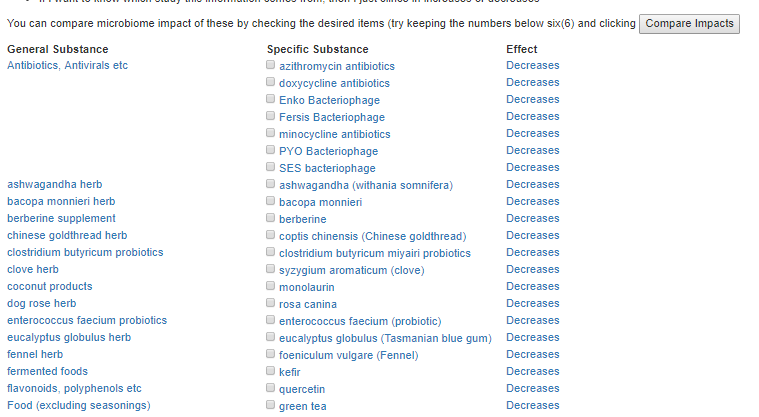
Find the bacteria you are interested in, and click it. It will show a list of known modifiers and the direction of modification, with one new addition — a checkbox by each!
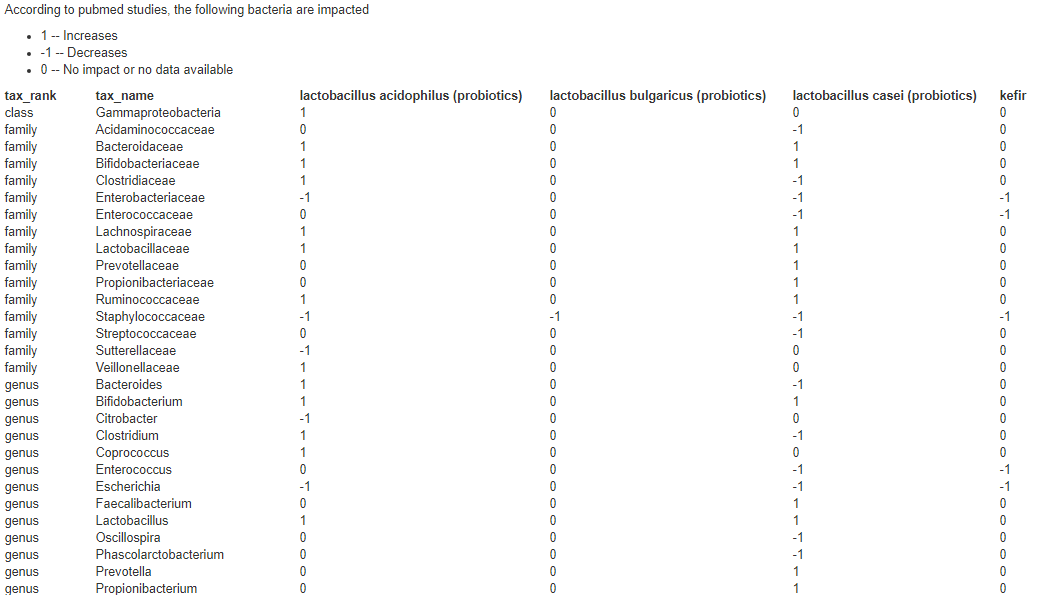
Check the ones that you are interested and click compare impacts.
What this does is really makes you aware of the side-effects on other bacteria that various substances may have.
Bottom Line
This exposes some of the internals of my AI engine that produces suggestions. The number of factors that this engine handles is far more than most people can handle — but it does give you better control of decision making within a limited scope.
This is an education post to facilitate discussing this approach with your medical professionals. It is not medical advice for the treatment of any medical condition. Always consult with your medical professional before doing any changes of diet, supplements or activity. Some items cites may interfere with prescription medicines.






 CFS Remission