Some sources to consider for probiotics

A reader wrote:

I’d like to do:
  • Lactobacillus Fermentum ME3
  • Lactobacillus Kefiri LKF01
  • Lactobacillus Reuteri
  • Lactobacillus Casei
  • Bifidobacterium infantis
  • Bifidobacterium Longum
  • Bifidobacterium bifidum
  • Bifidobacterium Breve
But I don’t find them isolated. 😦
As readers know — I tend to look unfavorably on both probiotics mixtures and probiotics that lacks strain information. If the probiotic source is not human, there is a very low chance that they will take up residency (Soil Based Organism are the probable exception)
The sources that I know of for these are:

Custom Probiotics provide strain information, including the ATCC number.

Note: they may not be available in the country you are in. I have faced that issue often. My past solution is to get an online friend to forward them to you and you buy them and get them delivered to their address, they then forwards as “Gift – probiotics” for customs.

The other option is looking on eBay – the vendors there tend to ignore any government regulations that prevents regular outlets from stocking them or shipping to your location.
Reducing the risk of C. difficile while on antibiotics

A reader is dealing with an antibiotic resistant abscess which have kept recurring after several courses of different antibiotics. She wrote because the latest escalation had a risk of  C. difficile. Actually, it is Peptoclostridium difficile  and not Clostridium difficile, because it has been recently reclassified.

The first harsh reality is that 55% of people have some of this bacteria…. so the issue is whether this bacteria will seize the opportunity to expand to clinically significant levels.

  • “Clostridium difficile is the leading infectious cause of antibiotic-associated diarrhea and colitis. C. difficile infection (CDI) places a heavy burden on the healthcare system, with nearly half a million infections yearly and an approximate 20% recurrence risk after successful initial therapy. ” [2018]
  • “Probiotic use did not appear to attenuate the odds of CDI in patients exposed to high-risk antibiotics, but moderate-risk antibiotics appeared to significantly attenuate the odds of CDI in patients who received probiotics.” [2018]
    • “From the perspective of the medical system, oral probiotics as a preventive strategy for CDAD in hospitalized children and adolescents receiving a therapeutic course of antibiotics reduced the risk of CDAD and represents a cost-saving strategy.” [2018]
  • ” C. difficile infection incidence in the United States has increased dramatically since 2000. In the United States ” [2018]
    • “Outbreaks of hypervirulent strains of Clostridium difficile began to be reported in healthcare facilities worldwide around 20 years ago. Concurrently, trehalose became a common additive used by the global food industry. A new study provides evidence that these two observations are a linked phenomenon [2018]

Using the http://microbiomeprescription.azurewebsites.net site, we find that the following reduces this bacteria according to studies:

And the following should be avoided:

Bottom Line

A sugar-free (or at least reducing sugar content) diet is the first suggestion. Increased vitamin B supplementation and melatonin is also suggested. Adding 1-3 bananas a day may also be beneficial as well as making food from scratch (i.e. no prepared foods due to trehalose additives). Evidence for probiotics is generally deemed weak in all of the latest studies.

NOTES:

  • On prepared foods, trehalose may not be explicitly labelled, rather included under “sugar”.
  • Trehalose occurs naturally in small amounts in mushrooms, honey, lobsters, shrimps, certain seaweeds (algae), wine, beer, bread and other foods produced by using baker’s or brewer’s yeast [3].
  • Trehalose is heat stable and preserves the cell structure of foods after heating and freezing, so it is used as a food texturizer and stabilizer in dried foods, frozen foods, nutrition bars, fruit fillings and jams, instant noodles and rice, white chocolate, sugar coating, bakery cream, processed seafood and fruit juices [3,4].


Thryve Uploads are fixed

Some readers discovered some bugs with the Thryve upload. I believe the identified issues are fixed.

If you have done a Thryve upload in the past, you may wish to delete your old data and upload again. There was one scenario where some numbers may have been under reported in the upload.

Drug Effectiveness and the microbiome

A reader wrote about how a prescription drug effect on her varied greatly day by day. I recall that the microbiome can vary greatly day by day (from charts on http://richardsprague.com/ ). I thought I should visit this topic.

Many people know that grapefruit interacts with many drugs.


Microbiome and Diet

Diet

Diet impacts the microbiome, whether the effects below are independent of the microbiome or due to temporal changes of the microbiome is unknown.

  • Influence of diet and nutritional status on drug metabolism [1996].
    • ” It is well known that smoking, charcoal broiled food or cruciferous vegetables induce the metabolism of many xenobiotics, whereas grapefruit juice increases the oral bioavailability of the high clearance drugs nifedipine, nitrendipine or felodipine by inhibiting their presystemic (intestinal) elimination. Energy deficiency, and especially a low intake of protein, will cause a decrease of about 20 to 40% in phenazone and theophylline clearance and elimination of those drugs can be accelerated by a protein-rich diet. In the same way, protein deficiency induced by either vegetarian food or undernourishment will have the opposite pharmacokinetic consequences.”
  • ” Feeding rats brussels sprouts or cabbage stimulates the intestinal and hepatic metabolism of drugs in animals. This effect is caused, at least in part, by certain indoles normally present in these vegetables. The feeding of a charcoal-broiled beef diet to rats stimulates the metabolism of phenacetin in vitro, and a similar diet stimulates the in vivo metabolism of phenacetin in man” [1977]
  • “Several dietary factors influence the oxidative metabolism of chemicals in humans. Increasing the ratio of protein to carbohydrate or fat in the diet, feeding cabbage and brussels sprouts or feeding charcoal-broiled beef for several days stimulates human drug metabolism. The chronic ingestion of ethanol stimulates drug metabolism whereas the chronic ingestion of methylxanthine-containing foods inhibits drug metabolism. In contrast, an increase in the ratio of fat to carbohydrate in the diet of normal subjects or the fasting of obese individuals for several days has little or no effect on drug metabolism. Flavonoids in edible plants influence the metabolism of foreign chemicals by human liver in vitro. The addition of flavone, tangeretin or nobiletin to human liver microsomes activates both the hydroxylation of benzo[alpha]pyrene and the metabolism of aflatoxin B1 to mutagens. On the other hand, quercetin, kaempferol, morin and chrysin, which are also normally occurring flavonoids, inhibit the hydroxylation of benzo[alpha]pyrene by human liver microsomes.” [1980]

Microbiome

  • “These data clearly illustrated that gut microbiome phenotypes significantly affected arsenic metabolic reactions, including reduction, methylation, and thiolation. These findings improve our understanding of how infectious diseases and environmental exposure interact and may also provide novel insight regarding the gut microbiome composition as a new risk factor of individual susceptibility to environmental chemicals.” [2013] – likely applies to pharmaceutical chemicals also.
  • “The influence of our microbiota reaches from primary metabolites to secondary effects such as substrate competition or the activation of eukaryotic Phase I and Phase II enzymes. Further on it plays a hitherto underestimated role in drug metabolism, toxicity and pathogenesis.” [2015]
  • Metabolism by the intestinal microbiota might result in a different metabolite profile than that produced by host tissues. This could potentially result in either activation or inactivation of the pharmacological and/or toxicological actions of the compound in question. The contribution of the intestinal microbiota to drug metabolism remains relatively unexplored.” [2013]
  • ” Given that the interplay between the gut microbiota and host cells is likely subject to high interindividual variability, this work has tremendous implications for our ability to predict accurately a particular drug’s pharmacokinetics and a given patient population’s response to drugs.” [2015]
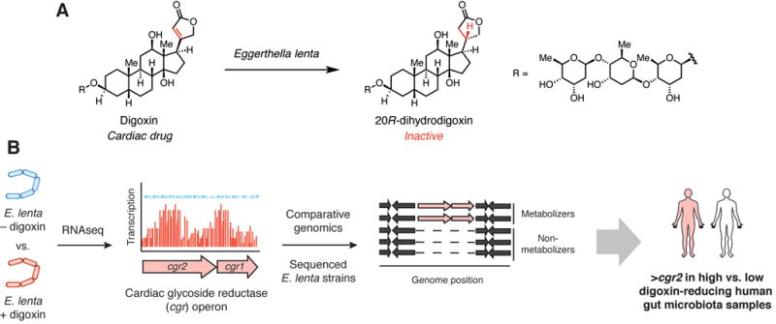
  • A specific example of a bacteria strain that predict cardiac drug metabolism [2017]

nihms875153f1

Bottom Line for Drug Effectiveness

If a drug has no effect on Monday, it may be effective a week or month later. The cause may be due to diet and/or microbiome (which can be influenced by diet). Welcome to the complexity of human health!

If a drug does not have the desired effect, consider a change of diet, supplements and herbs for 1-2 weeks and then try again.

Enteragam – another medical food

2-FL (Human Milk Oligosaccharides) is a medical food which I wrote about in this August 2018 post. A reader ask for my thoughts on Enteragam, another prescription medical food. It’s Serum-derived bovine immunoglobulin/protein isolate

A general introduction to the topic of medical foods can be find in

The Emerging Therapeutic Role of Medical Foods for Gastrointestinal Disorders[2017].

  • “A medical food, according to the FDA, is a food that is developed to be eaten or administered enterally under the guidance of a physician and that is meant for the specific dietary management of a condition or disease for which distinctive nutritional requirements, based upon known scientific principles, are established by medical evaluation.

Current and emergent pharmacologic treatments for irritable bowel syndrome with diarrhea: evidence-based treatment in practice[2017].

The US distributor describes is as:

“EnteraGam® (a serum-derived bovine immunoglobulin/protein isolate, SBI) is a medical food product intended for the dietary management of chronic diarrhea and loose stools. EnteraGam® must be administered under medical supervision. EnteraGam® binds microbial components, such as toxic substances released by bacteria, that upset the intestinal environment. This helps prevent them from penetrating the lining of the intestine, which may contribute to chronic diarrhea and loose stools in people who have specific intestinal disorders.”

SBI


So, what is published about it?

Bottom Line

. This is a promising medical food that may have implications across most of the conditions that I tend to look at. The absorption of toxins from bacteria makes it a universal treatment candidate.

If you have an opportunity to try it, I would recommend the experiment (and ideally reporting back here after 30 days).

A similar product (non-prescription)

Note: No explicit pubmed studies found on this product. It is also just one type of immunoglobulin.

SBI Protect Capsules

SBI Protect is the only purified, dairy-free source of immunoglobulin G (IgG) available as a dietary supplement. Pure IgG helps to maintain a healthy intestinal immune system by binding a broad range of microbes and toxins within the gut lumen.