From new scientist today

This describes how ubiome and other gut bacteria work… And more important, what they totally miss.

To identify microbial species, researchers usually look for a particular gene that acts as a genetic barcode for bacteria and archaea. Different species have subtly different DNA sequences in this gene, so reading the sequence can tell you what microbes are present in a sample.

Moissl-Eichinger and her colleagues have shown that the standard sequencing method often detects no archaeal species, or just one, in samples taken from people’s bodies. But when her team used a version of the sequencing method optimised to detect archaea in the same samples, it revealed that there were in fact dozens of these species present.

Each part of the body seems to be home to characteristic species of archaea, as with bacteria.

What’s more, in the nose and appendix, individual archaea cells outnumbered those of bacteria. “We did not expect that,” says Moissl-Eichinger. Because we have only just discovered them, we don’t know what most of the archaea in our bodies do.”

From A huge number of mystery microbes are living on your skin https://www.newscientist.com/article/2172076-a-huge-number-of-mystery-microbes-are-living-on-your-skin/

Hay fever and thick blood — the connection

A reader wrote about this year being very bad for allergies/hay fever for her. DAO, REAL sudafed, etc only made a small dent in it. She tried niacin (the flushing type) and fibrinolytics (bromelain, serrapetase, lumbrokinease, nattokinease) which made a much bigger improvement …. what gives?

For back references:

Allergy and Coagulation

Different Allergy Mechanisms

  • “The immune-mediated adverse reaction to food is defined as food allergy (FA) which is roughly divided into IgE mediated or non-IgE mediated FA (NFA)… there is far less of an understanding of NFA than IgE-mediated FA and its clinical relevance is likely under-estimated in most cases…The lack of easily accessible diagnostic measures also contributes to the problem.  ” [2008]
    • This also applies to Hay Fever and other allergies
  • “Although pathogenesis of NFA is still not well understood, recent studies indicate widely variable clinical manifestations of NFA…This review discusses recent progress in our understanding of the regulatory mechanisms of gut immune homeostasis and recently revealed widely variable clinical presentations of NFA with respect to it pathogenesis.” [2012]
  • Inhibition of IgE- and non-IgE-mediated histamine release from human basophil leukocytes in vitro by a histamine H1-antagonist, desethoxycarbonyl-loratadine. 1994
  • “Nonallergic rhinitis represents a non-IgE-mediated group of disorders that share the symptoms of nasal congestion, rhinorrhea, sneezing, and/or postnasal discharge but not pruritus that characterizes allergic rhinitis…. skin testing for aeroallergens is negative.” [2012]

Of special interest (especially for MCS folks)
“The classic symptoms of idiopathic nonallergic rhinitis are nasal congestion, postnasal drip, and sneezing triggered by irritant odors, perfumes, wine, and weather changes.” [2012]

“: Idiopathic nonallergic rhinitis (iNAR) has been difficult to define because of the long differential diagnosis of rhinopathy in the absence of allergic rhinitis. iNAR has traditionally been a diagnosis of exclusion with no clear unifying pathophysiology. Increased sensitivity to triggers such has climate changes, cold air, tobacco smoke, strong odors, and perfumes have been thought to be characteristic, but recent studies do not support this hypersensitivity hypothesis. New investigations of the local nasal environment and systemic “functional” syndromes have offered new insights into this condition. iNAR may be a heterogenous disorder that includes (1) anatomic abnormalities requiring nasal endoscopy for diagnosis, (2) incipient, local atopy (entopy), (3) dysfunction of nociceptive nerve sensor and ion channel proteins, and (4) autonomic dysfunction as found in chronic fatigue syndrome and other functional disorders.” [2009]

Bottom Line

If you are having bad hay fever and the “standard popular knowledge” is not doing it for you, you may wish to discuss coagulation as being part of it with your medical professional.


DNA and Microbiome interplay….

A reader forwarded their report from NutraHacker (https://www.nutrahacker.com/). They offer free reports and more advanced paid reports.  Their reports also contain Encourage and Avoid items.

What is interesting is when you combine recommendations from http://microbiomeprescription.com/ with their recommendations. In some cases they corresponds and in other cases disagree. DNA says one thing, existing microbiome says another thing.

Simple Example for Vitamin E

VitaminE

So this person with AG should NOT be supplementing with Vitamin E because it will increase inflammation. What about the case of a high Vitamin E take by diet?

Looking at a list of foods that are HIGH in vitamin E, we see:

  • Almonds
  • Hazelnuts
  • Sunflower Seeds
  • Avocado
  • Mango
  • Abalone
  • Salmon
  • Wheat Germ Oil

Looking at this person’s suggestions from the Microbiome, we see Almonds listed.

Almonds

This suggests that almonds should be excluded (mainly because there are lots of other suggestions) because of DNA and not microbiome.

Bottom Line

DNA and microbiome interacts.


Looking at Urine Element Profiles

A reader forwarded their Comprehensive Urine Element Profile from Genova Diagnostics. with some questions. This is an area that I did not expect to find much or anything.

The reports had high:

  • Antimony
  • Copper
  • Lead
  • Thalium
  • Zinc

A 2008 study was interesting and may be related. Humans were given bismuth supplements and the results were:

“The upshift of the bismuth content also led to an increase of derivatives of other elements (such as arsenic, antimony, and lead in human feces or tellurium and lead in the murine large intestine). “

Bismuth or it’s salts are in a fair number of supplements, for example:

WebMD states:
“People take bismuth salts by mouth for inflammation of the lining of the colon(colitis), constipationdiarrheaindigestionHelicobacter pylori (H. pylori) infection, odor caused by an opening in the belly wall during surgery (ileostomy odor), stomach problems caused by nonsteroidal anti-inflammatory (NSAID) drugs, stomach ulcers, stomach flu, and preventing traveler’s diarrhea.”

Additionally, “Many epidemiological studies have shown an association between Parkinson’s disease  and exposure to metals such as mercury, lead, manganese, copper, iron, aluminum, bismuth, thallium, and zinc. ” [2018] We know that Parkinson’s has a distinctive microbiome shift too.

High Copper (Cu) Possible Consequences

“high-copper diets led to liver injury in high-fructose-fed rats, and this was associated with gut barrier dysfunction, as shown by the markedly decreased tight junction proteins and increased gut permeability. … [2018]

High Lead(Pb) Possible Consequences

” For the gut microbiota, at the phylum level, the relative abundance of Firmicutes and Bacteroidetes changed obviously in the feces and the cecal contents of mice exposed to 0.1mg/L Pb for 15weeks” [2018]
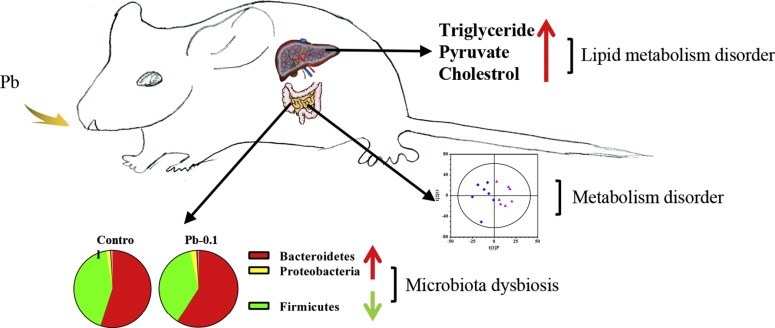
1-s2-0-s0048969718308003-fx1_lrg

High Zinc (Zn) Possible Consequences

“dietary Nano-ZnO increased the bacterial richness and diversity in ileum, while decreased both of them in cecum and colon. Specifically, the relative abundances of Streptococcus in ileum, Lactobacillus in colon were increased, while the relative abundances of Lactobacillus in ileum, Oscillospira and Prevotella in colon were decreased (P < 0.05). I” [2017]

Bottom Line

We have some interesting questions to ask:

  • Was this person recently consuming any supplements containing bismuth?
    • There was no detectable bismuth in the results
    • If so, some of the test results could be due to that
  • Did the person take EDTA or other biofilm breakers — or fibrinolytics recently?
    • These could release the above into the blood system, resulting in higher urine levels
  • We know almost nothing about which bacteria uptake these mineral
  • We see that some of these elements are known to influence the microbiome.

In short, no answers and many questions. What we did find is that bismuth compounds are likely significant microbiome modifiers — in some case this may be by an indirect route (i.e. increasing lead and arsenic)

“At the end of bismuth therapy, the relative abundances of Bacteroidetes and Actinobacteria decreased to 0.5% (P < .001) and 1.3% (P = .038), respectively. Additionally, the relative abundance of Verrucomicrobia also decreased from 3.2% to 1.11E-3% (P = .034). In contrast, the relative abundances of Proteobacteria and Cyanobacteria increased (P < .001 and P = .003, respectively). ” [2018]

“we report that the production of methylated bismuth species by the methanoarchaeum Methanobrevibacter smithii, a common member of the human intestine, impairs the growth of members of the beneficial intestinal microbiota at low concentrations. The bacterium Bacteroides thetaiotaomicron, which is of great importance for the welfare of the host due to its versatile digestive abilities and its protective function for the intestine, is highly sensitive against methylated, but not against inorganic, bismuth species. The level of methylated bismuthspecies produced by the methanoarchaeum M. smithii in a coculture experiment causes a reduction of the maximum cell density of B. thetaiotaomicron. ” [2011]


A reader’s experience

Hi Ken
Just wanted to update you on the excellent results I am having using you site. My main condition was microcolitis, and I had just a little help with prescription drugs from gastroenterologist, with unpleasant side effects.

Based on the suggestions from your site, started using b longum and b plantarum from custom probitocs, and acidophilus from Solgar, and my symptoms were resolved within a week.

I’m still amazed by this, after almost two years of great discomfort.

It’s been two months now, and I am still symptom free. Again, thank you, so grateful for the work you do!

One question, for the avoid items, they are listed from low to high values, so if
clostridium butyricum is  avoid -1.127
vsl #3 probiotic           is  avoid -4.442
it would be more important to avoid the vsl #3 correct?”

Thank you for sharing.

On the analysis site http://microbiomeprescription.com/  the numbers in the confidence column reflect the number of studies reporting the change. It is the confidence of the recommendation.  Some items have positive effects reported in some studies and negative in others. The cause may be because one study looked at the impact with people with disease X and the other with people with disease Y.

As always — these are suggestions based on pubmed studies and are strictly theoretical. These have not been validated in any clinical trial. There is no need to do all of the suggestions, it is more a “Guide book”. If you buy a guide book on London, you do not visit every place listed;  you visit the places that interest you, at a reasonable cost, in the time you have.

This is an education post to facilitate discussing this approach with your medical professionals. It is not medical advice for the treatment of any medical condition. Always consult with your medical professional before doing any  changes of diet, supplements or activity. Some items cites may interfere with prescription medicines.
