Emotional Lability

A friend in dealing with a difficult person noticed a change of some microbiome associated symptoms (6-10 bowel movements a day, increased night sweats). He asked me about his dramatic increase of emotional lability he has seen recently. SPECT scan studies indicate that CFS includes acquired brain injury. From Australia Health department – a good PDF on it is here and some quotes:

“Emotional lability refers to rapid, often exaggerated changes in mood, where strong emotions or feelings (uncontrollable laughing or crying, or heightened irritability or temper) occur. These very strong emotions are sometimes expressed in a way that is greater than the person’s emotions. “

“Emotional lability occurs because of damage to parts of the brain that control:

  •  Awareness of emotions (ours and others)  Ability to control how emotions are expressed – so ability to inhibit or stop emotions coming out
  • Stronger emotional responses”

The medical term is Pseudobulbar affect since the term emotional lability has been used in multiple ways. “It is hypothesized that these primary neurologic injuries and diseases affect chemical signaling in the brain, which in turn disrupts the neurologic pathways that control emotional expression.[21][22][23]

A change of microbiome will impact chemical signaling.

Microbiome Connections?

It has been demonstrated in the literature that microbiome shifts are associated with many neurological conditions — so can we find any literature dealing with emotional lability. A PubMed search suggested the following studies:

This area appears to be understudied – but we do see a frequent reference to streptococcal infections, which are often reported in association with flu.

A Perfect Storm: Increased Colonization and Failure of Vaccination Leads to Severe Secondary Bacterial Infection in Influenza Virus-Infected Obese Mice [2017].

“Our studies utilized a coinfection model to show that obesity increases mortality from secondary bacterial infection following influenza virus challenge through a “perfect storm” of host factors that lead to excessive viral and bacterial outgrowth. In addition, we found that vaccination of obese mice against either virus or bacteria failed to confer protection against coinfection, but antibiotic treatment did alleviate mortality.”

Bottom Line

For some people it is hard to say “I have infection acquired brain trauma, one of the symptoms is emotional lability” and then ask people for their assistance by handing them a print out of the lovely Australian PDF above.

Looking at contributed microbiome with “Neurological: emotional overload” – an easier to understand symptom than “Pseudobulbar” or “lability” we have 38 samples with 16 of these having metabolism data.

Looking at the data

http://microbiomeprescription.com/Metabolite/Explorer?filter=18

  • We observe these patterns frequently:
    • Bacterial Abilities: Flagellar assembly – LOW
    • Lipid metabolism: alpha-Linolenic acid metabolism LOW
    • Lipid metabolism: Arachidonic acid metabolism LOW
    • Lipid metabolism: Ether lipid metabolism LOW
    • Secondary metabolite degradation: Dioxin degradation LOW
    • Secondary metabolite degradation: Xylene degradation LOW

Going over to the Bacteria explorer

http://microbiomeprescription.com/Data/SymptomExplorer?site=gut&filter=18

Symptom modification suggestions:

This is an education post to facilitate discussing this approach with your medical professionals. It is not medical advice for the treatment of any medical condition. Always consult with your medical professional before doing any  changes of diet, supplements or activity. Some items cites may interfere with prescription medicines.


20 month later – an update and request

“Know of a doctor in the Philadelphia region who has a good track record with CFS patients?” – from reader below

In December 2015 a reader emailed me describing the results of selectively following suggestions from this blog.  She did an update in April, 2016

“At the time I found your blog, these were my symptoms, all of which, disappeared or diminished within days  of taking action based on reading your blog (except for the asthma and allergies, which nonetheless somewhat better)”

I just got an update with a request that I am sharing with my readers in the hope that they can help:

“Hi, Ken! I don’t know if you remember me as it has been a couple of years since I’ve been in touch. I continue to read your blog often and still really appreciate the work you are doing (though it is a bit over my head lol).

I am writing both to update you on my situation, and to ask if you have any words of wisdom.  I can write a background summary for you again if you need it, but the best summary is probably the one that you posted back in December 2015.

Anyway….the good news is that since my “miraculous recovery” that I wrote you about, my CFS has been *pretty much* managed in that the physically painful symptoms are still gone, though they will start to come back if I discontinue treatment with supplements, probiotics, etc.

But….I still haven’t found a doctor to treat me and at present I fear that I may be on the verge of a relapse. I am having a lot of trouble with motivation, energy level, planning, and some brain fog. And after about 18 months or more with no upper respiratory infections, I have now had 3 since December, all of them going to bronchitis. My health collapse previously was preceded by chronic upper respiratory infections. 

I have moved from …..  to Philadelphia last fall…..do you by chance know of a doctor in the Philadelphia region who has a good track record with CFS patients?

At present I am working at trying to get a referral through my primary care doctor, but I am not hopeful because on my “get to know you” visit with him in January I presented him with my CFS history and asked about a referral and his response was “it seems like that was in the past and you are doing really well now.”

Two places here that pop up when I search “CFS Philadelphia” are The Marcus Institute for Integrative Health and the Garabedian Clinic, if you have ever heard of them.

Thank you so much for all you do. If it wasn’t for you I think I would probably have been virtually bedridden for the past three years. As it is I still am living a limited life and would like to broaden that.

Take care,


November 2016

Hi, Ken!! I hope you are well!! 

Even though I have been out of touch I am still reading your blog and appreciating it greatly, and have shared it with others.

I wanted to give you another update….the last time I wrote you, I had just tried Symbioflor II, which really didn’t work for me, and I also asked you about how you defined “remission” and I followed your advice and got a really undemanding part-time temp job which lasted couple of months and which I enjoyed a lot but which let me know I didn’t have as much stamina as I thought I did because I got sick the first week in and then was back to sleeping whenever I wasn’t at work. There was also a lot of family upheaval and stress ……

Anyway, all that is background to the fact that I am actually doing pretty well in many ways, much thanks to you, plus a couple of other things that I have started doing that seem to be shoring up my results. I would say that I am at 60 – 70 percent energy most days, with that being pretty steady. In other words, without the energy surges and crashes I used to have before I got sick. I’m not taking naps, and all in all I’d say I have enough energy to get by on except the one deficit I really still have is in drive and motivation and the ability to concentrate (I sort of think of those three combined as one thing)


Here’s what I am doing:

  1. Using the CFS Remission model – I will send you a detailed list of what I am taking in a day or two. I made changes based on your suggestion that I alternate between Prescript Assist and Equilibrium, which worked well (and if you have another broad spectrum probiotic to recommend I would be interested in hearing about it). I also tweaked my herbs based on the results of your reader survey, and added in D-Ribose at the suggestion of a friend with fibromyalgia (and then I saw that you had written about it though I somehow missed it).
  2. I finally saw a naturopath in October who said the CFS/ME diagnosis was pretty obvious. I printed out my initial letter to you and the other posts of mine you included on your blog, as well as your disease model. I gave them to her when I saw her but she hadn’t read them at the time – perhaps she’ll comment when I see her next. She did look at my supplement list, though, and gave it the thumbs up. She also made some diet recommendations. Here’s where it gets pseudo-science-y. She recommended the Blood Type diet, which I am aware has been debunked. I am blood type O. What I noticed about food lists for me is that many of the foods were those I had already been avoiding from the histamine restricted diet. Also, I had noticed that I felt a lot better when I ate beef, which according to the BTD is probably the best source of protein for me. It also recommended against grain (which you have also) and dairy. So I just chose to interpret her recommendation primarily as keep avoiding histamines, keep eating beef, and cut out milk and most grains, and of course most sugar and that seems to be working for me. I would say it has made the difference between having steadier energy vs. surges and crashes, which I was still having up until I started eating this way. I have also lost a little bit of weight, which I am happy about though I wasn’t really trying to do that.
  3. I have gradually started exercising again. As you know it’s hard to exercise with CFS, not to mention contraindicated, so I had cut way back and was pretty inactive and deconditioned as a result of basically sleeping a whole year, and then when I got whooping cough you basically can’t exercise without triggering a fit that makes you feel like you are going to die. I literally once turned blue from doing the kind of yoga where you do nothing but lay on floor and breathe; it was terrifying. So despite the fact that exercise has always been my go-to for managing my depression, I was scared to start exercising again. I started with walking (since I have a dog) and using Audible and or/ talking to my husband on a headset while I walk, and I am enjoying it immensely, averaging about 8,000 steps a day, and sometimes a lot more – I got lost when I visited my husband and walked 11.5 miles and expected a crash afterwards, but none came. Yay! I have also started swimming twice a week (deliberately doing it *much* less strenuously and with less duration than I used to, because I think over-swimming was part of what triggered my CFS or mono or whatever my initiating event was) and rather than having to nap after a workout I feel energized. I want to do yoga again but the turning blue scare is still holding me back a bit even though I know I am recovered from whooping cough…if my heath holds up I will ease my way into that too.
  4. This is something that I haven’t mentioned before, I don’t think….I have had depression on an off since adolescence, sometimes acute, sometimes low-grade, and have been off and on antidepressants since my twenties. Most recently, I was on them for about 10 years, and at the time I got whooping cough I had three prescriptions going. While acutely ill with whooping cough, I was too sick to take them and thus went off them without intending to. I didn’t want to start them again without talking to my prescriber, but, meanwhile, between the herbs and probiotics etc., which I did restart when I was able,  my mood problems diminished drastically. I never did go see my prescriber and now have been off for almost a year, and feel better than I did when I was taking the meds (even though they helped and I am not an anti-med person at all). Often, if I go through a patch of getting tearful easily, adding in or increasing the Miyarisan takes care of it within 24 hours.
  5. As I mentioned above, the thing that keeps me from being what I think of as functional is my lack of focus of motivation, which no longer rises to the level of brain fog but which really holds me back. Coffee and tea disagree with me. But one energy drink, or even half of one, and BAM! I am good for the day. My drink of choice is organic Rock Star, which contains sugar, green coffee extract, guarana, ginseng, vitamin B12 and taurine. Of course the naturopath told me not to do this, and I have been saving it for days when I really have to get a lot accomplished, but it would be nice to be able to be more productive all the time. So far, there doesn’t seem to be a big downside (except when I drank three whole cans three days in a row – some of my symptoms returned) and I’m considering using it more consistently, half a can per day, though it is basically  just enhanced soda and I have always disapproved of soda. I tried taking ginseng pills and also guarana pills with relatively little effect, haven’t tried green caffeine or taurine. What do you think? It would make life easier for my husband, my other families, and not to mention me if I could be a more productive version of me on a regular basis.  Alternatively, I have found that chocolate sometimes has the same effect, either the 85% kind from Trader Joes, or these dark chocolate covered almonds they have at Costco. There is something unnerving in trying to fuel my ability to concentrate with, essentially, candy and soda when I am trying so hard to be healthy in other ways and putting a lot of work into it.

 Anyhow….I wanted to let you know I am still around and still “working the program” and very grateful to you.

 Happy Thanksgiving!!


Bottom Line

This person has not done ubiome yet, and I would strongly urge it. They were working off the earlier post before I started detail analytics of microbiome. Ubiome with the new site would give very specific advice which have a good probability of improving the remaining symptoms.

REMEMBER: Those suggestions are NOT a replacement, but additional fine tuning.

This is an education post to facilitate discussing this approach with your medical professionals. It is not medical advice for the treatment of any medical condition. Always consult with your medical professional before doing any  changes of diet, supplements or activity. Some items cites may interfere with prescription medicines.
 

Revisiting obesity and leanness

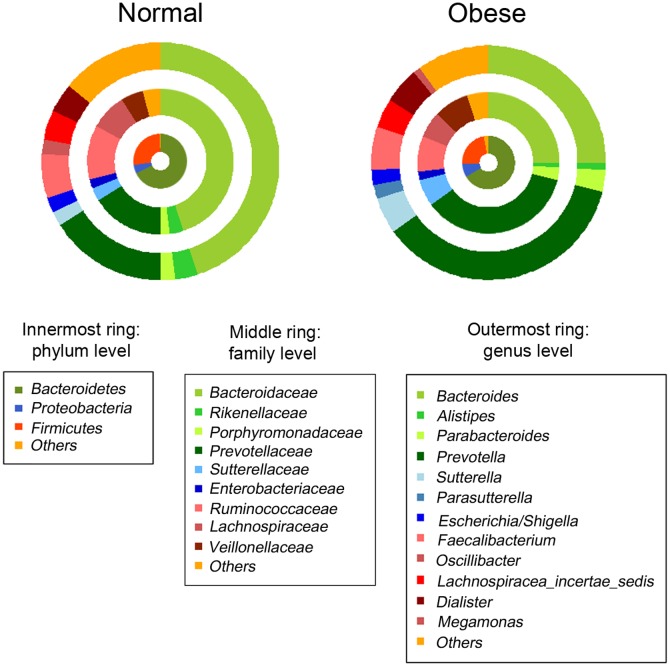
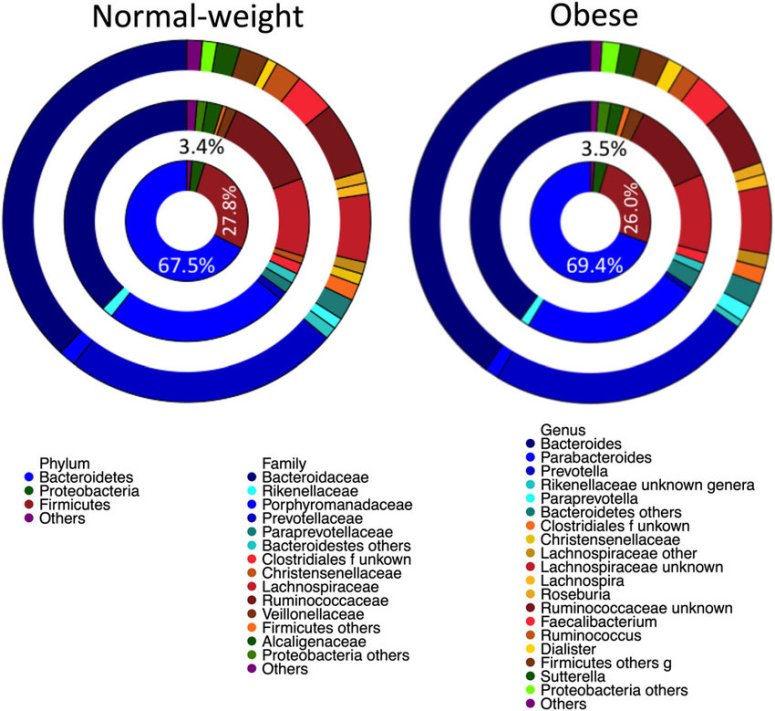
We are aware that microbiome influence obesity, with charts like the one below [2015] [2017]

pone.0134333.g001

Gut-microbiota-composition-in-normal-weight-and-obese-children-The-innermost-ring-shows

This last week a lovely study was published:

Citrus peel extracts attenuated obesity and modulated gut microbiota in mice with high-fat diet-induced obesity.[ June 1, 2018] which stated “Compared to the case of the HFD group, PMF B altered the gut microbiota by increasing Prevotella and decreasing rc4-4 bacteria.”

rc4-4 means a genus under Firmicutes; Clostridia; Clostridiales; Peptococcaceae; rc4-4;

Related under the Peptococcaceae family are:

As you can see, there are some 13% of this family that do not have a reported genus in uBiome results.

More on Citrus Peels

So, it appears eating the peel of citrus fruit may have significant impact on obesity.

More on Prevotella

Bottom Line

Some people with various conditions will lose weight for years and then suddenly increase weight with the same, or even greatly reduced calories/diet.  The simple explanation is that their microbiome has shifted.  Correcting the shift by adding citrus peel to meals as a filler may both help with the weight issue and may even help with other health conditions.

Background on how suggestions are made

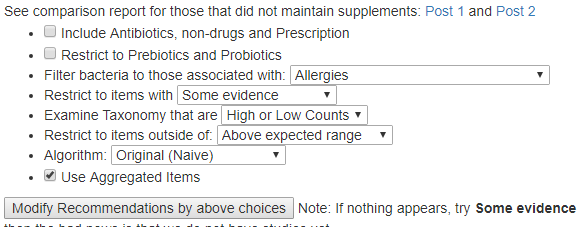
Creating suggestions on http://microbiomeprescription.com/ is an art and not a science. I recently added choice of algorithms:

algor

To illustrate, you have 4 bacteria:

  • A 2x normal
  • B 8x normal
  • C 1/2 normal
  • D 1/100 of normal

If A is normally  0.1% of bacteria and B is 10% of bacteria – do you treat them the same? B produces 100x more metabolites than A… so likely it is better to reduce B than reduce A.

Some herb reduces B (10% of population) and also reduces D which is 0.001% of the normal population and only 10% of patients have any of this bacteria. Do you take the herb or not?

The process of balancing factors such as:

  • Percentage of total bacteria
  • How often do people have this bacteria
  • Side-effects on other bacteria
  • How much shift we see

is what algorithms are about. If you restrict items to only what reduces your high bacteria OR encourages your low bacteria… you will have nothing in the suggestions.

A simple algorithm could be something like this for each substance

  • Sum up all of the high bacteria it reduces and the low bacteria it increases and use this to rank suggestions.
    • Problem: you are ignoring the low bacteria that may also be reduced and the high bacteria that may be further increased!
  • Sum up all of the high bacteria it reduces and the low bacteria it increases. Then subtract the high bacteria that it increases and the low ones that are reduced. Use this to rank suggestions.
    • Problem: A bacteria that is 10% of the bacteria is given equal weight to one that is just 0.00001% of the bacteria.
  • Sum up all of the high bacteria  it reduces and the low bacteria it increases using the expected percentage of the population. Then subtract the high bacteria that it increases and the low ones that are reduced using the expected percentage of the population. Use this to rank suggestions.
    • Problem: We are ignoring if the overgrowth is 10% or 800%!

Then we hit the question of — do we know anything abiut what this bacteria does? If this bacteria is not associated with any known condition and only occurs in 10% of the population…

Take: Propionibacteriaceae (14.35% of Samples) family a recent paper explains why — only 14% have it… so do we need to reduce or increase it??? Honestly, we do not know and I would exclude it from adjustments.

“For example, for SNP rs2297345 in the gene PAK7, we detected a correlation between genotype and a single microbial taxon, Propionibacteriaceae”
https://www.ncbi.nlm.nih.gov/pmc/articles/PMC5740987/

Formal Statement

  • S() returns a vector of factors
    • Output vector including, but not limited to
      • Taxonomy
      • Estimate of change for each taxonomy
      • Reliability of change for each taxonomy
      • DNA Snp factors
    • Input matrix including, but not limited to
      • Study
      • Study size
      • Study statistical significance
      • Shift reported by the study
      • Species involved
      • Background diet
      • Existing conditions or DNA
  • B() is a person matrix including, but not limited to
    • Taxonomy
    • Population size
    • Statistical error factors
  • R() is a reference matrix including, but not limited to
    • Taxonomy
    • Population size
    • Statistical error factors
    • Distributions broken down by:
      • Medical conditions
      • DNA
      • Age
      • Lab results
  • H() is a matrix of a person (the target), including, but not limited to
    • Medical conditions
    • Laboratory results
    • DNA
      • Ethnic background/heritage
    • Age
    • Normal Diet

Predictions are the output vector from   P(H(…),B(…), S(….), R(….))

The algorithms that I have implemented are Trade Secrets, do not ask me to disclose them.

Bottom Line

Suggestions come out of algorithms that attempts to balance a ton of different factors. The sequence of suggestions will likely change between algorithms and it is unlikely something would move between the take and avoid list.

There are two algorithms there at the moment, I will likely add more. Which one is best? We do not know.

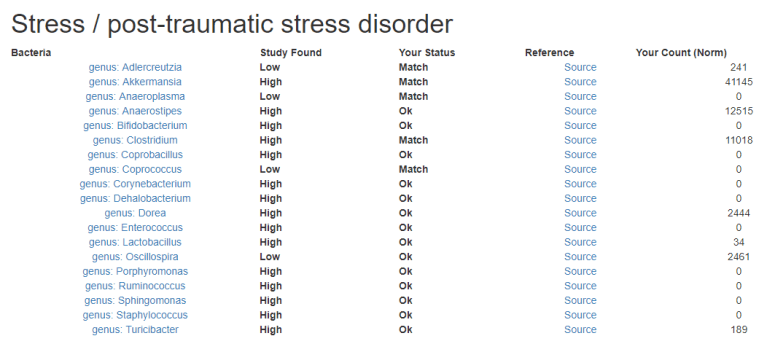
Stress / PTSD Microbiome Profile Added.

There was a recent article, Altered fecal microbiota composition in all male aggressor-exposed rodent model … which reports shifts seen from stress. I have converted the information reported to a new profile.

There were a few surprises — for example high Akkermansia which I would expect to be low. In reflection, stress is the start of the cascade — putting things in motions.

stress

This is an education post to facilitate discussing this approach with your medical professionals. It is not medical advice for the treatment of any medical condition. Always consult with your medical professional before doing any  changes of diet, supplements or activity. Some items cites may interfere with prescription medicines.