European MD suggestions on KyberKompakt Pro Results

A reader forwarded me results for this variation of KyberKompakt as well as their digestive European MD prescription.

kyber

European Digestive MD suggestions

The suggestions look like a standard cook book and definitely worth sharing.

What are the suggestions generated by the site

http://microbiomeprescription.com/Kyber/Recommendations/

Take:

I added a 🙂 after items that match the MD’s prescription above. The only item that did not match was resistant starch type 3, which was not listed. Two additional probiotics appear.

  • lupin seeds
  • broad beans
  • apple
  • low processed foods diet
  • high-level dietary fibre
  • inulin 🙂
  • enterococcus faecium sf 68 🙂
  • high-level dietary fibre
  • jerusalem artichoke
  • mediterranean diet
  • mutaflor 🙂  (E.Coli)
  • bacillus coagulans
  • high fiber diet
  • bifidobacterium longum bb536
  • lactobacillus acidophilus 🙂
  • resistant starch type 4
  • bifidobacterium animalis lactis 🙂

Avoid

  • omega 3 fatty acids
  • flaxseed
  • high fat diet
  • wheat
  • sorghum
  • garlic
  • walnuts
  • dates

Bottom Line

Apart from the Soil Based Organisms Probiotics (Prescript Assist, General Biotics Equilibrium) not being included in the game plan from the MD, I am very delighted with his plan.


Phages 101

A reader asked about phages and supplied a Youtube and a BBC program on it

http://www.bbc.co.uk/programmes/articles/yGJ6MtYrP2S0gjssltQBS2/could-viruses-called-bacteriophages-be-the-answer-to-the-antibiotic-crisis

As well as a shop selling them. http://bacteriophagepharmacy.com/shop/

Phage theraphy has been proposed for CFS and other conditions for at least 20 years. I am skeptical that it will be of significant help because my belief is that it is not a single bacteria responsible.

Phage Basics

A 2001 NCBI article does a nice background on it. I recommend strongly reading it BEFORE trying phages

“Bacteriophages or phages are bacterial viruses that invade bacterial cells and, in the case of lytic phages, disrupt bacterial metabolism and cause the bacterium to lyse[aka die]. ”

” In the 1940s, the Eli Lilly Company (Indianapolis, Ind.) produced seven phage products for human use, including preparations targeted against staphylococci, streptococci, Escherichia coli, and other bacterial pathogens…with the advent of antibiotics, commercial production of therapeutic phages ceased in most of the Western world. ”

Phages are far more specific than antibiotics — often effective against a single bacteria. 

“Very specific (i.e., usually affect only the targeted bacterial species); therefore, dysbiosis and chances of developing secondary infections are avoided… Because of the high specificity of phages, many negative results may have been obtained because of the failure to select phages lytic for the targeted bacterial species ”

Wait a minute, we are precise to a species!

So a phage for Bifidobacterium scardovii  will kill that one only and not any other bifidobacterium species. You may have a slackia overgrowth, using a phage may reduce Slackia isoflavoniconvertens, but the slackia overgrowth remains

FDA Workshops on Phage Theraphy

Bottom Line

So if you are targeting one specific species, a phage is ideal. It is “a smart bomb that take out a lance corporal in an army and leave the officers and soldiers untouched”. Antibiotics can be like atomic bombs — kills the soldiers, civilians etc.

If you have an overgrowth of the specific bacteria species that the phage is very targeted against, then it may be worth the experiment.

For example:

pio-amp-300x173

“a specific lysis of bacteria belonging to: Staphylococcus (S. aureus), Streptococcus (S.pyogenes, S. sanguis, S.salivarius, S. agalactiae), E.coli (Different types), Pseudomonas Aeruginosa, Proteus (Mirabilis and Vulgaris) spices. ”

We see from 300+ samples uploaded at http://microbiomeprescription.com/  that

So the odds of it being a match will typically be 1 in 60 patients.  Looking at the data, exactly two uploads are good matches for the above.

I will see about adding a phage recommendation page (using the products listed at http://bacteriophagepharmacy.com/shop/ this weekend. It should make the decision much easier for every one (i.e. don’t waste your money if you have nothing that the phage will kill!).

Beware of Products being hyped on Phages but wrong ones!

I did an earlier review of an inappropriate one,  Phage-Complete-A-Review/

Mutaflor Probiotic Feedback

I have written about E.Coli Nissle 1917 (“Mutaflor”) several times before, this week got two comments that I thought that I should share.

I should also note that Bifidobacterium longum infantis “failed to inhibit E. coli”. so may be taken with it. [2020], this may also be true for other Bifidobacterium.

Comment #1

“As you know I’ve been following your site and suggestions for several years now. I’ve seen some improvement lately with one major side effect and I’m hoping you have some thoughts.
I was recently able to find Mutaflor again. I’ve been able to get it occasionally over the last three years. The improvement each time I’ve dosed at full strength is profound and reliable. My pain almost disappears. When I’m in a flare of muscle pain and weakness, two Mutaflor is more effective than Advil. It also helps greatly with fatigue overtime as I continue to take more. One caveat is that it also results reliably in loose stools at best and pretty awful diarrhea at worst. This has happened every time in the past and is repeating again currently. Any suggestions on how to counteract this. Maybe taking some other probiotic alongside it?  

I can get Symbioflor (US Source, World Wide Source) more reliably, and while it does help, it’s not near what Mutaflor is. Also, it will cause loose and frequent stools at a high enough dose to effect positive change on pain, fatigue, etc.

Prior to my disabling CFS, I had IBS-D. But diarrhea is largely not a problem for me now and usually a rare symptom. And my IBS and once diagnosed Crohn’s have been reversed for nearly 10 years. However, all of my CFS like symptoms have continued to worsen over the last decade. “
– Email

Comment #2

“I have been in a mild UC flare for several weeks and just began taking Mutaflor along with my other excellent pribiotic, L-GG, and S. boulardii. (I dropped VSL#3, which I took for 6 months and never stopped causing gas. Maybe because I avoid dairy.) I noticed flu symptoms within a few hours of first taking 2 caps of Mutaflor. Symptoms worsened as I took 2 caps two more times the next day, then lightened up when I cut back drastically. Definitely detox, not the flu.

I’ve read a research abstract from 2013- 2014 that taking Mutaflor with two other strains of probiotics plus S. boulardii was very effective in getting UC into remission and keeping it there! My general probiotic by 1MD has both in it, I believe, but I’m using it up, regardless, with the Mutaflor and that probiotic yeast, which also helps with leaky gut. I need to seal my leaky gut before my colon can heal.

My UC became severe pancolitis 10 months ago, but I will not do any more steroids or drugs. My liver was being harmed, and this treatment should actually work better. After just 2 days, I see no blood or mucus and stools are normal again! (Just still too often and too urgent.)

The ECN 1917 kills a large quantity of bad bacteria that hinder colonizing by probiotic strains, even those with excellent adherence capability. ECN makes other probiotics many times more effective! Until I can get a full copy of the research mentioned above, however, I won’t know exactly how much to take of any of those studied together.

For now, I’m doing just two caps Mutaflor with one cap each of the other three. My detox or herx reaction should be easy enough to handle at that level.

Mutiflor was very easy to get thru Feel Good Natural in Canada. With shipping and a discount for buying 2 boxes, my net cost was only $10 US more than would cost if bought for me OTC in Canada. Shipping with ice packs was under $13 to VA.”

Comment on a prior post

Ascribing a condition to one (or even a few) bacteria may be very wrong

An illness to a single bacteria is a standard medical practice. Helicobacter pylori for ulcer, or one of several E. Coli (E. coli O157:H7 and other STECs like E. coli O145 and E. coli O121:H19) for food poisoning.

If we expand our eyes and ask “What if the condition is caused by over or under production of some metabolite?”

For CFS over production of d-lactic acid has been proposed, see this post

Let us assume that this is part of it. So which bacteria produces it?

Our old friend DataPunk lists:

PRODUCED AS ENDPRODUCT BY: 

  1. Aerococcus
  2. Allobaculum
  3. Anaerostipes
  4. Atopobium
  5. Bacillus coagulans
  6. Bifidobacterium
  7. Cardiobacteriales
  8. Cardiobacterium
  9. Carnobacterium
  10. Catenibacterium
  11. Enterococcus
  12. Faecalibaculum
  13. Faecalibaculum rodentium
  14. Gemella
  15. Haemophilus
  16. Holdemania
  17. Lachnobacterium
  18. Lactobacillales
  19. Lactobacillus
  20. Lactobacillus acidophilus
  21. Lactobacillus casei
  22. Lactobacillus delbrueckii
  23. Lactobacillus helveticus
  24. Lactobacillus rhamnosus
  25. Lactococcus
  26. Leptotrichia
  27. Leuconostoc
  28. Microbacterium
  29. Moryella
  30. Oenococcus
  31. Pediococcus
  32. Rothia
  33. Ruminococcus faecis
  34. Scardovia
  35. Serratia marcescens
  36. Streptococcus
  37. Tetragenococcus
  38. Vagococcus

Let us suppose that we also have low or no butyrate – again datapunk lists:

PRODUCED AS ENDPRODUCT BY:


  1. Agathobacter rectalis
  2. Allobaculum
  3. Anaerostipes
  4. Anaerostipes hadrus
  5. Anaerotruncus
  6. Butyricicoccus
  7. Butyricicoccus pullicaecorum
  8. Butyricicoccus sp. ORNL_6EZ5-Gt_4_Pl1-35
  9. Butyricicoccus sp. ORNL_6EZ5-Gt_6_Pl2-147
  10. Butyricicoccus sp. ORNL_V42_E05
  11. Butyricicoccus sp. ORNL_W42_C10
  12. Butyricimonas
  13. Catenibacterium
  14. Christensenella
  15. Cloacibacillus
  16. Cloacibacillus porcorum
  17. Clostridia
  18. Clostridiales
  19. Clostridium
  20. Clostridium butyricum
  21. Coprococcus
  22. Defluviitalea
  23. Eubacteriaceae
  24. Eubacterium limosum
  25. Eubacterium oxidoreducens
  26. Faecalibacterium
  27. Faecalibacterium prausnitzii
  28. Flavonifractor
  29. Flavonifractor plautii
  30. Fusibacter
  31. Fusobacterium
  32. Lachnobacterium
  33. Lachnospiraceae
  34. Moryella
  35. Moryella indoligenes
  36. Oscillospira
  37. Peptoniphilus
  38. Roseburia
  39. Roseburia faecis
  40. Roseburia hominis
  41. Roseburia intestinalis
  42. Roseburia inulinivorans
  43. Ruminococcus torques
  44. Subdoligranulum

So how many possible “too much and not enough” pairs are there if we just pick just one from each list…  38 x 44 = 1,672!!! 

My current gut feeling is that taking the % of each taxonomy in each group –> producing a fuzzy measure of a 0.23% Lactic acid and 0.01% butyrate, may reveal clearer patterns for symptoms than the individual bacteria taxonomy. This is a fuzzy measure because the production of lactic acid and butyrate vary greatly from genus to genus.

Other options for stepping away from pine needles of individual bacteria to looking at tree as a whole include KEGG pathways,

KEGG pathways produce some tentative correlation for D-Arginine and D-ornithine metabolism in CFS/IBS in my earlier post.

Bottom Line

The same change of metabolites in the body can happen in many many different ways. Looking at the metabolites (even with fuzzy ‘punted’ data base on what is available) may produce better predictive results than just looking at individual bacteria.

Unloading Thryve Profiles

v1

The page will update as shown below

v2

In a few minutes an email should be delivered

v3

Click on the link, and this will appear

v4

Enter password (please try to make them strong …) You will next be sent to the login screen

v5

You will land on a page like below (unless you also have ubiome samples already uploaded under your email – in which case they will be listed)

Please check your upload file, the first line should be:

“taxon_id”,”rank”,”name”,”parent”,”count”

If it is not, please email it to me at ken /at/ lassesen /dot/ com so I may adjust the code.

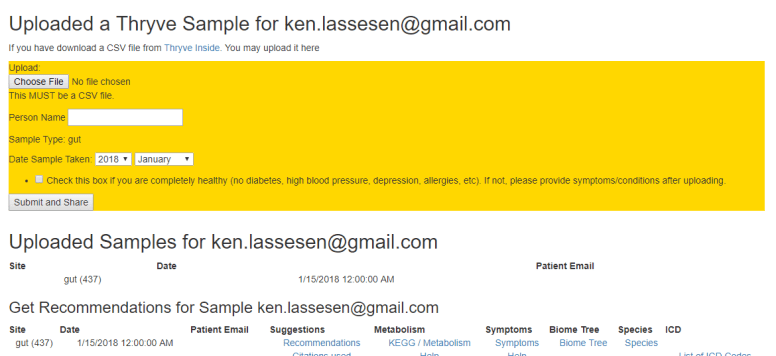
v6

Select your file, the name of who it is (in case you are handling several people) and when the sample was taken.

v8

Bottom Line

This is still in Alpha–  there were a lot of side-effects and refactoring required to support these imports — but changes would make it easier to support other uploads.

Email me if you encounter any bugs  Ken /at/ lassesen /dot/ com