This is post M, that is #1000 post on this blog. In it I will attempt to answer Nick’s comment on Thick Blood, Clots dimension of CFS etc
Nick:
I assume the minimum list are still tests rarely done? It’s interesting reading, especially as my wife’s head symptoms are getting worse, I’m wondering if there’s a blood flow issue and wonder how I could test the theory safely?
First thing, by medical standards, this can only be answered by a hematologist that is willing to do a full comprehensive panel, and an insurance company willing to pay for it.
- What I can do is share some experiences that I have had.
- Readings on Coagulation Disorders:
There are more than one defect!!
I recall literature stating that they estimate that only 80-90% of the thick blood issues can be identified by lab tests. My own defect, Factor II or Prothrombin G20210A was only discovered in the 1990’s despite
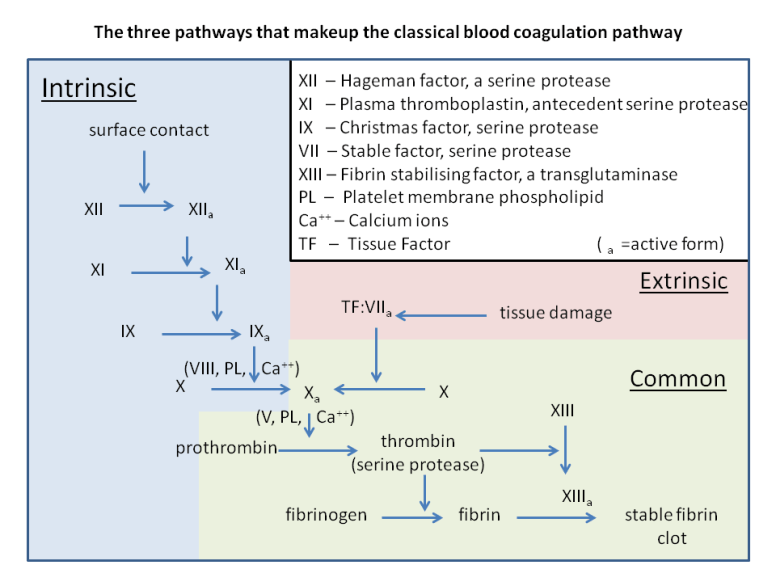
This diagram shows the cascade — if there is an issue at any one point, then thick blood can occur because of this bottleneck.
Cave Lector, hoc est, ad disputationem de tua professio medicinae tantum.
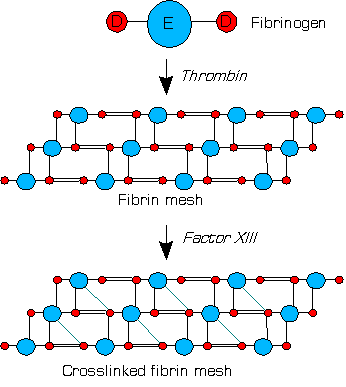
Decreasing Fibrin deposits that reduces oxygen flow
This is actually one that may be a challenge to test by lab results. The fibrin deposits may have happened due to past events — the results are still there (in theory being slowly dissolved usually) but the cause is no longer there.

Recently I was on antibiotics and used fibrin dissolvers (fibrinolytics) to improve the flow of antibiotics into tissue. I gave my physician the notes below — she was very interested and did not raise any objections to my using them. She was also honest: she was unfamiliar with them and could not give guidance. Notes in blue are precisely what I shared with her.
Nattokinase
4000 FU x 4/day
“ a nattokinase/fibrinolytic enzyme and this enzyme may be considered as a new source for thrombolytic agents.” [2011] https://www.ncbi.nlm.nih.gov/pubmed/?term=Nattokinease+fibrinolytics
Lumbrokinase
80 mg x 4/day
“The six lumbrokinase fractions (F1 to F6) with fibrinolytic activities were purified from ..“ [2004] https://www.ncbi.nlm.nih.gov/pubmed/15469696
Serrapeptase
240,000 SPU’s x 4/day
“ reports suggest it to possess anti-atherosclerotic effects also, due to its fibrinolytic and caseinolytic properties.” [2013] https://www.ncbi.nlm.nih.gov/pubmed/23380245
“concentration of antibiotic in tissue increased by
- ciclacillin – 8.5 fold (850%)
- ampicillin – 5.7 fold (570%)
- cephalexin – 3 to 5 fold (300-500%)
- minocycline – 2.2 fold (220%)”
[1980] https://www.ncbi.nlm.nih.gov/pubmed/7001087?dopt=Abstract
Bromelain
1200 GDU x 4/day
“ studies demonstrate that bromelain exhibits various fibrinolytic, antiedematous, antithrombotic, and anti-inflammatory activities. “ [2012] https://www.ncbi.nlm.nih.gov/pubmed/23304525
*Bromelain has been demonstrated to enhance the potentiation of antibiotics (Altern. Med. Rev. 1998;3:302–5)
“[A PLANT PROTEASE FOR POTENTIATION AND FOR POSSIBLE SUBSTITUTION OF ANTIBIOTICS].” 1965, https://www.ncbi.nlm.nih.gov/pubmed/14295046
Also:
Bottom Line on fibrinolytic
- There is a risk of altered drug penetrations here (for antibiotics — well documented). So starting at a low dosage and increasing slowly is recommended.
- It is unlikely there will be an immediate effect. There may be layers and layers of fibrin which may need to be dissolved layer by layer.
- Each of the above acts on different parts/type of fibrin. I usually do a preventative cycle of each for a week, once a quarter.
Aspirin Recklessness
This reckless experiment was how I got my family practice MD to order coagulation tests from Hemex Labs (sold to a larger firm since) and got to know the director there well, Dave Berg.
I looked at a regular aspirin bottle and what the maximum dosage it listed. I did that every day up to the maximum number of days. Logic was simple — unless there are complicating factors (like ulcers), it was generally deemed to be safe.
On Drugs.com it states: 3g- 4g /day depending on condition, for example for a child:

The usual full strength aspirin is 325 mg… so we have 12 tablets/day
Around day 7, I was starting to run up and down the walls! The MD was persuaded of the coagulation dimension to CFS.
Bottom Line for Aspirin
Once I demonstrated the hypothesis and switched to grape seed extract. IMHO, keeping on aspirin had too many other risks if taken continuously. See WebMD for more background on grape seed extract.
Piracetam and other nootropics
I have taken this (in fact, I have a kilogram of piracetam on the shelf!!) and take it whenever I sense any cognitive issues (lack of concentration, slowness of thought). I recall trying to tutor a daughter (with coagulation defects) on math and she was unable to correctly add up columns of integers. She took two tablets of piracetam and in about 20 minutes, she could not only add up the integers correctly, but also quickly grasp algebra content that was part of her homework.
It’s coagulation impact is described in this 1993 pubmed article
- “The particular efficacy of 8 g piracetam daily in 3 divided doses at 8-hourly intervals can be attributed to its unique dual mode of action; inhibition of platelet function by inhibition of thromboxane A2 synthetase or antagonism of thromboxane A2 and increased formation of prostaglandin I2, together with a rheological effect involving reduction in blood and plasma viscosity through an increase in cell membrane deformability and a reduction of 30-40% in the plasma concentrations of fibrinogen and von Willebrand’s factor. In addition, the administration of piracetam appears to be devoided of adverse effects.”
You will recognized a lot of terms from earlier parts of this post.
Bottom Line on Piracetam (And Turmeric)
This definitely has the best safety profile. This drug is not on the pharmacy lists in the UK, Canada or US, your medical professional may be at a loss to know how to interpret and significant improvement caused by it.
Turmeric with 1% Black Pepper
Curcumin is an extract from Turmeric.
“Data showed that curcumin and BDMC(curcumin extract) prolonged aPTT and PT significantly and inhibited thrombin and FXa activities. They inhibited the generation of thrombin or FXa. In accordance with these anticoagulant activities, curcumin and BDMC showed anticoagulant effect in vivo. Surprisingly, these anticoagulant effects of curcumin were better than those of BDMC indicating that methoxy group in curcumin positively regulated anticoagulant function of curcumin. Therefore, these results suggest that curcumin and BDMC possess antithrombotic activities and daily consumption of the curry spice turmeric might help maintain anticoagulant status.” [2012]
Again, we are talking dosage of 8 – 16 gm/day of turmeric for therapeutic impact.
Bottom Line
Another relative safe way to test. This article found that extracts performed less well than the original. I have seen the same reported elsewhere and thus prefer the original instead of extracts usually!.
Bottom Line
Above are sharing of my experiences. I recall from conversations with Dave Berg that some coagulation defects are very hard to treat.
For more information, see these conversations with Dave Berg:
Hemex Protocol and Dave Berg
Usual Disclaimer:
This is an education post to facilitate discussing this approach with your medical professionals. It is not medical advice for the treatment of any medical condition. Always consult with your medical professional before doing any changes of diet, supplements or activity. Some items cites may interfere with prescription medicines.



 CFS Remission