Map of treatment approaches for CFS/IBS/FM

A reader in Denmark asked me to recap where I am and what he can do prior to getting a ubiome done. I have been very busy working on the website at  http://microbiomeprescription.com/ for the last 5 months, so this is a quick catch up on older style posts.

The key premise is that every CFS/FM/IBS (and many autoimmune diseases) have unique to the individual microbiome dysfunction.  This mean that nothing will work for everyone.

I am formally trained as a mathematician, specializing in probability and statistics. My goal is to offer suggestions with significantly good odds of being helpful.

There are three main legs:

  • Taking items from user surveys with high benefit and low risk (often these items have never been studied in formal studies)
  • Taking items from PubMed published studies (often these are single studies which have never been repeated — hence ‘low reliability’)

Process

  • Assume the microbiome accounts for many symptoms and try adjusting it to deal with both overgrowth and critical undergrowth
    • This is typically a 2-3 months cycles because each set of modifiers will move the microbiome to a different state.

User Surveys

From User Surveys, the following are 4 times more likely to cause an improvement than making things worst. (raw data, simplified recommendations)

  • General Biotics Equilibrium – no information available
  • Ashwagandha (see what it modifies here)
  • Metronidazole (see what it modifies here)
  • Licorice, (see what it modifies here)
  • Neem. (see what it modifies here)

Publish Studies

I have done many posts (almost 1000 post), so I will just give one citation for each item below. Some of the studies were very specific on the patients selected, so the results may not apply to every one or condition.

  • Vitamin B1
    “The absence of blood thiamine deficiency and the efficacy of high-dose thiamine in our [CFS] patients suggest that fatigue is the manifestation of a thiamine deficiency, likely due to a dysfunction of the active transport of thiamine inside the cells, or due to structural enzymatic abnormalities. The administration of large quantities of thiamine increases the concentration in the blood to levels in which the passive transport restores the normal glucose metabolism in all cells and leads to a complete regression of fatigue.” [2013]
  • Vitamin B9  (Folate/Folinic acid)
    A remarkable 81% of CFS patients experienced subjective improvement of their symptoms after treatment with folinic acid” [2006
  • Vitamin B12
    Dose-response relationship and long-lasting effects of B12/folic acid support a true positive response in the studied group of patients with ME/fibromyalgia. [2015]
  • Vitamin D3
    Vitamin D deficiency changes the intestinal microbiome reducing B vitamin production in the gut. The resulting lack of pantothenic acid adversely affects the immune system, producing a “pro-inflammatory” state associated with atherosclerosis and autoimmunity [2016].

  • D-Ribose  
    WebMD
    , “Ribose is a kind of sugar that is produced by the body. It is used as a medicine… it has also been used to improve symptoms of chronic fatigue syndrome (CFS), fibromyalgia, and coronary artery disease. ”

  •  Magnesium
    magnesium was demonstrated effective on ME/CFS patients’ symptom profiles.” [2012]

  • Prescript Assist Probiotic
    “Based on the results from the present 1-year extension study, treatment with this probiotic-prebiotic complex may be an option for short-term (2-4 weeks) and long-term ( approximately 60-week) reductions in IBS symptoms.” [2007]
  • Symbioflor-2 (E.Coli probiotic from Germany)
    “Treatment of IBS with the probiotic Symbioflor-2 is effective and superior to placebo in reducing typical symptoms of IBS” [2009]
  • Bifidobacterium bifidum
    “Bifidobacterium bifidum MIMBb75 effectively alleviates global IBS and improves IBS symptoms simultaneously with an improvement of quality of life.” [2011]
  • CoQ10
    “The results show that lowered levels of CoQ10 play a role in the pathophysiology of ME/CFS and that symptoms, such as fatigue, and autonomic and neurocognitive symptoms may be caused by CoQ10 depletion.” [2009]
  • curcumin, N-Acetyl-Cysteine, quercitin, silimarin, lipoic acid and omega-3 fatty acids
    “It is suggested that CFS patients should be treated with antioxidants, which inhibit the production of NFkappabeta, such as curcumin, N-Acetyl-Cysteine, quercitin, silimarin, lipoic acid and omega-3 fatty acids.” [2007]
    “Positive outcomes were highlighted in some included studies for polyphenol intakes in animal studies, D-ribose supplementation in humans and aspects of symptom alleviation for one of three polynutrient supplement studies. Omega three fatty acid blood levels and supplementation with an omega three fatty acid supplement also displayed positive outcomes in relation to chronic fatigue syndrome symptom alleviation.” [2017]

Dosages are a Challenge

In general dosages are ‘therapeutic’ – up to 1,250x RDA levels often.

  • Example for Vitamin B12
    • RDA Vitamin B12  2.4mcg [NIH]
    • The CFS MD, Dr. Myhill “I usually start with 1/2 mg (500 mcg) daily by subcutaneous injection, ” [web page]
    • This is 208x the RDA.
  • Example for Vitamin B1 – Benforiamine
    • RDA Vitamin B1  1.2 mg [NIH]
    • CFS study “leads to a complete regression of fatigue” dosages up to 1500 mg/day [2013]
    • This is 1,250x the RDA

Determining the maximum safe dosage is for health professionals to advise on.  I can cite studies and public literature — I cannot advise any one to do those dosages.

If you take the ‘bottle recommendations’ or RDA — and have no effect — I would suggest that response given a very low dosage for a CFS patient is probable .

I consolidated some dosages used in various studies in this post,

Some other dosages reported in studies:


Microbiome Model – No testing assumption

If you have not had testing, I tend to take the 1998 report at face value (until someone replicates it in different world population).  20 years ago this was reported in Australia at the 1998 Alison Hunter Memorial Clinical and Scientific Meeting. “For the anaerobes, the mean percentage distribution of Bacteroides spp. for the control subjects and CFS patients was 92.8% and 91% respectively; Bifidobacterium spp, 7.1% and 2%; Lactobacillus spp., < 1% and 0%.”

This leads me to suggest the metabolites that would be produced by the reduced bacteria taxonomy. See this post for the study references. To the above:

With Microbiome Testing

I create the http://microbiomeprescription.com/ for several reasons

  • Too much data to keep in my head: 78,692 bacteria interactions are in the database
  • Took a lot of my time to manually get rough suggestions for each ubiome
    • I prefer to have more accurate suggestions!

Once you have your ubiome results and upload them. You have lots of choices on how to get suggestions.  That is what they are — SUGGESTIONS. Try to reduce the items listed as avoids, try to increase the items listed as take. You do NOT need to do everything!

MOST IMPORTANT: Do not stop taking the items above. If you are low on vitamin B12, supplements will provide food for bacteria and processes needing it.  It is part of establishing a healthy environment for the good bacteria.

Bottom Line

Nothing above is guarantee to improve your symptoms. The odds are that they are far more likely to improve symptoms than make them worst. Your microbiome is unique and each will require different supplements.

A good start is taking what has been shown to help in the past by patient experience or studies. The next step is working on the assumptions that the microbiome shift is causing some, if not all, of the symptoms. This is creditable from many many reports of almost immediate remission after a fecal material transplant (FMT). Unfortunately, these FMT patients often relapses in a few months.

Trying to modify the microbiome by altering food, supplements, probiotics is cutting edge. It is a theoretical approach. Individual reports seem to suggest it will work for some at least. See these posts:

This is an education post to facilitate discussing this approach with your medical professionals. It is not medical advice for the treatment of any medical condition. Always consult with your medical professional before doing any  changes of diet, supplements or activity. Some items cites may interfere with prescription medicines.


User Surveys Updates

The latest results are below:

  • Risk the chance of making things worst
  • Better the chance of making things better
  • Confidence: comes from the number of reports. The higher, the more likely the numbers are good estimates

Items in RED are definitely worth trying!

Type Name Risk % Better Confidence
Adaptogen American Ginseng 20% 0% 40%
Adaptogen Ashwagandha 6% 50% 71%
Adaptogen Asian Ginseng 13% 25% 50%
Adaptogen Dang Shen 50% 0% 25%
Adaptogen Jiaogulan 0% 0% 31%
Adaptogen Jujube 50% 50% 25%
Adaptogen Magnolia-Bark 0% 0% 25%
Adaptogen Reishi Mushroom 22% 11% 53%
Adaptogen Rosavin 14% 43% 66%
Adaptogen Siberian Ginseng 9% 18% 59%
Amino Acid Arginine 0% 0% 18%
Amino Acid Glutamine 0% 50% 25%
Amino Acid Glycine 0% 0% 18%
Amino Acid Isoleucine n/a n/a 0%
Amino Acid Lysine 0% 0% 25%
Amino Acid Methionine 0% 0% 18%
Amino Acid Threonine n/a n/a 0%
Amino Acid Tryptophan 33% 33% 31%
Amino Acid Tyrosine 33% 33% 31%
Amino Acid Valine n/a n/a 0%
Antibiotic Amoxicillin 63% 25% 71%
Antibiotic Bacitracin 0% 100% 25%
Antibiotic Doxycycline 33% 56% 75%
Antibiotic Fluoroquinolone 50% 38% 50%
Antibiotic Macrolides 21% 68% 77%
Antibiotic Metronidazole 10% 50% 56%
Antibiotic Minocycline 40% 50% 56%
Antibiotic Rifampicin 100% 0% 31%
Antibiotic Sulfonamides 80% 20% 40%
Antibiotic Tinidazole 14% 71% 47%
Herb Cinnamon 11% 11% 53%
Herb Ginger 13% 27% 68%
Herb Licorice 7% 67% 68%
Herb Neem 9% 73% 59%
Herb Olive Leaf 7% 47% 68%
Herb Oregano 18% 55% 59%
Herb Rhubarb 0% 100% 18%
Herb Thyme 0% 67% 43%
Herb Tulsi 30% 30% 56%
Herb Wormwood 25% 38% 50%
Probiotic Align 15% 31% 90%
Probiotic Colibiogen 0% 100% 18%
Probiotic Culturelle 25% 36% 94%
Probiotic Enterogermina 0% 100% 18%
Probiotic GB Equilibrium 0% 89% 53%
Probiotic Just Thrive 100% 0% 18%
Probiotic Kyo Dophilus 9 0% 33% 31%
Probiotic Kyo-Dophilus 0% 50% 25%
Probiotic L. Gasseri 0% 67% 31%
Probiotic L. Plantarum 299V 14% 36% 66%
Probiotic L. Reuteri 12% 31% 90%
Probiotic MegaSpore Biotic 25% 25% 35%
Probiotic Miyarisan 41% 36% 83%
Probiotic Mutaflor 21% 68% 77%
Probiotic Perfect Pass n/a n/a 0%
Probiotic Prescript Assist 22% 38% 100%
Probiotic Prescript Assist Pro 0% 60% 40%
Probiotic Symbioflor-2 31% 44% 71%
Probiotic Yakult 36% 21% 66%


Another ubiome comparison with improvement except for FM

A reader wrote:

“As an engineer and accountant I have been so appreciative of the work you have done.  I found your site last June (2017) when looking for anything to help my daughter.  We did a UBiome in Oct and a second UBiome in March 2018… Today i finally  got back to see the changes you have made since the site was launched in January.  I am still working through interpreting the aggregated results. 

At this time I had one intriguing observation as it relates to my daughter’s results.  After 11 years she was finally been labeled as having fibromyalgia with 18 of 18 trigger points.  We had started doing some of your protocols in the fall and have gotten increasingly into the routine.  (It is hard for her to do it on her own …..)

Using the protocol many of her symptoms have improved, not tremendously, but improved. 

  • Migraines have gone from weekly to only one in the last 4 months,
  • light sensitivity has gone from not being able to comfortably go out during the day even with sunglasses to being able to be outside on the nice spring days. 
  • Anxiety much lessened.
  • Brain fog a little better.
  • Fatigue a little better.
  • Another symptom, which is observational, is that her lip and skin color is much improved.  It was not unusual for her to have while or blue lips most days.  Currently, she rarely has color that pale. I actually use that as my first assessment tool.  If she is looking a little grey or pale, I know she is having a poor day.

But, the one thing that has not improved are the FM symptoms of joint and muscle pain, still pretty severe.  Now the interesting observation, I just got done entering all of the 3/31/18 UBiome results.  And when I did the compare samples, the October test had a 0 for FM and the March test has a 1.  It just seems odd as her other symptoms (chronic fatigue, depression, digestive issues, etc) all had multiple hits.  

Just wanted to share with you as it was the first piece of information that appears to not match our situation.”

Standard Comparison

Overall, we have the significant improvement in the autoimmune profiles. The FM profile consists of only ONE item, so it is technically a 100% match! I just checked PubMed and there appears to be no further studies 😦 . We need to wait until someone does and publishes a study.

Measure   Oct, 2017     Mar, 2018  
* All Profiles 164 138
* All Profiles HIGH 61 31
* All Profiles LOW 103 107
* Metabolism Average 0.985922330097088 0.969174757281553
* Metabolism Std Dev 0.255159261658681 0.389777523954483
* Symptoms 4 0
ADHD 10 8
Allergies 6 6
Alzheimer’s disease 12 9
Autism 10 8
Autoimmune Disease 5 3
Brain Trauma 9 9
Chronic Fatigue Syndrome 12 11
Crohn’s Disease 7 8
Depression 12 10
Fibromyalgia 0 1
Gout 12 8
Hashimoto’s thyroiditis 3 3
High Blood Pressure 5 3
Histamine Issues 2 1
Histamine Issues From Ubiome 2 4
Inflammatory Bowel Disease 8 6
Irritable Bowel Syndrome 5 4
Metabolic Syndrome 4 3
Mood Disorders 7 4
Rheumatoid arthritis 11 9
Schizophrenia 0 0
Systemic Lupus Erythematosus 16 15
Type 2 Diabetes 6 4
Ulcerative colitis 0 1

Suggestions

The one FM taxonomy is low lactobacillus. Looking at the recommendations, the specific probiotics to try seem to be:

With CFS and FM — coagulation issues (past or present) is a factor. From my observation of myself, I believe microbiome plays a part — unfortunately, no studies could be found testing this hypothesis.

“Vasoconstriction occurs in the skin above tender points in FM patients, supporting the hypothesis that FM is related to local hypoxia in the skin above tender points.” [2000]

I said past or present, because the result of coagulation is typically fibrin deposit. It is likely that fibrinolytic may reduce or eliminate the pain points. Each of the items below work in slightly different ways.

Nattokinase

a nattokinase/fibrinolytic enzyme and this enzyme may be considered as a new source for thrombolytic agents.” [2011] https://www.ncbi.nlm.nih.gov/pubmed/?term=Nattokinease+fibrinolytics

Lumbrokinase

The six lumbrokinase fractions (F1 to F6) with fibrinolytic activities were purified from ..“ [2004]  https://www.ncbi.nlm.nih.gov/pubmed/15469696

Serrapeptase

reports suggest it to possess anti-atherosclerotic effects also, due to its fibrinolytic and caseinolytic properties.” [2013] https://www.ncbi.nlm.nih.gov/pubmed/23380245

Bromelain

studies demonstrate that bromelain exhibits various fibrinolytic, antiedematous, antithrombotic, and anti-inflammatory activities. “ [2012] https://www.ncbi.nlm.nih.gov/pubmed/23304525

CAVEAT

“Because clotting is an issue for my daughter.  The amount of bleeding she has after having blood taken for tests always surprises the techs as blood is streaming down her arm.”

For one of my own daughters, she was found to have  three inherited coagulation defects. One from me, and two from her mother. I would press for a full inherited coagulation panel for you daughter. There may be multiple factors at play:

  • Fibrin generation
  • Absence of bacteria processing or producing Vitamin K (thus the blood streaming)

According to Wikipedia, E.Coli produces Vitamin K2 (desired form). So mutaflor and/or Symbioflor-2 should be considered also for probiotics.

Other bacteria producing Vitamin K include:

  • Enterobacter agglomerans,
  • Serratia marcescens and
  • Enterococcus faecium. [2006]

Bottom Line

As always, consult with your knowledgeable medical professional.

” The one thing I like about your site is that it presents possibilities.  The big problem for me is that I am an engineer and we are trained to only change one variable at a time.  You have now presented me with a number of new things to try and it will take a while to work through them.  I will let you know if anything seems to be significant.”

As a mathematician and statistician, I am similarly trained. When I started doing big data and fuzzy logic professionally the discipline of one item at a time was no longer possible. The result is I give choices and a fuzzy-logic probability of each having the desired  effect.

This is an education post to facilitate discussing this approach with your medical professionals. It is not medical advice for the treatment of any medical condition. Always consult with your medical professional before doing any  changes of diet, supplements or activity. Some items cites may interfere with prescription medici


2nd comparison with worst Autoimmune profiles

This is a followup to the last post. If things do not go ‘as expected’, I want to know so I can try discovering the root issue. I will not filter to only good or ideal reports. This is a process of discovery for my readers and myself.  The following comments are from a reader:

“Hi Ken,

I’ve uploaded a couple of ubiome samples but I can’t seem to access the suggestions and comparisons for them. I’m particularly interested in the newer feature where you can see if your profiles fit certain autoimmune or diagnostic profiles.
Since I’m writing you, let me give you a quick update. After trying to incorporate the changes from the last post you did about my ubiome, what little improvements I was seeing from my protocol seemed to disappear and I continued to get worse. In the last two months I’ve gone back to your older protocol of rotating through probiotics and herbs and I’m back to where I was prior. I know you often preach that CFS is a constantly moving target, but I haven’t found any relief and actually got worse following the diet recommendations and specific supplements and probiotics suggested. 
I’m curious what feedback you’ve had, if any, of readers going into remission following the suggestions on the new website? I’m thinking about going back on antibiotics to get relief though they are tough of my system, causing herx, etc.”

Standard Analysis

Sample Id   Older    Newer
* All Profiles 124 162
* All Profiles HIGH 23 42
* All Profiles LOW 101 120
* Metabolism Average 1.02087378640777
* Metabolism Std Dev 0.217666351962583
* Symptoms 83 0
ADHD 7 11
Allergies 4 6
Alzheimer’s disease 9 8
Autism 8 11
Autoimmune Disease 4 5
Brain Trauma 6 7
Chronic Fatigue Syndrome 11 14
Crohn’s Disease 5 10
Depression 12 16
Fibromyalgia 1 1
Gout 4 8
Hashimoto’s thyroiditis 2 4
High Blood Pressure 3 4
Histamine Issues 1 2
Histamine Issues From Ubiome 4 5
Inflammatory Bowel Disease 4 7
Irritable Bowel Syndrome 6 4
Metabolic Syndrome 2 4
Mood Disorders 5 8
Rheumatoid arthritis 5 5
Schizophrenia 0 0
Systemic Lupus Erythematosus 15 15
Type 2 Diabetes 4 6
Ulcerative colitis 2 1

As with the last post, the profiles An interesting comparison between 2 ubiome for the same person the profiles went up. A quick note to the reader to see if we have the same situation got this response:

” Yes and No. When incorporating the specific changes I stopped rotating herbs and probiotics from your past general recommendations (Prescript Assist, Symbioflor, Olive Leaf, Neem, etc). I did stay on the basics (B vitamins, etc)

The ubiomes are about a year apart. I’m not surprised to see things going the wrong way. I’ve definitely been getting worse overall. So I guess it’s a good thing that your site and the results are reflecting that, at least in terms of your overall theory and the value of the website

So unlike the last reader who following my suggested practise:

  • Got a uBiome results
  • Looked at the suggestions and made a selection
  • Kept on them for 3 months
  • Redid the uBiome to find the next set of changes

This reader started with an out of date ubiome, The microbiome is constantly changing…

Bottom Line

There are words of caution from this post:

  • Make sure that your ubiome results are current.
  • Do not take the suggestions as a REPLACEMENT, they are a list of suggestions which:
    • Likely good to do most of the avoid
    • Likely good to do the easy/cheapest ones of the take

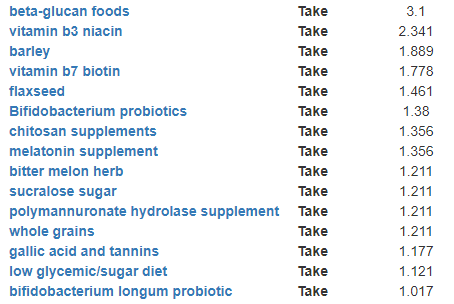
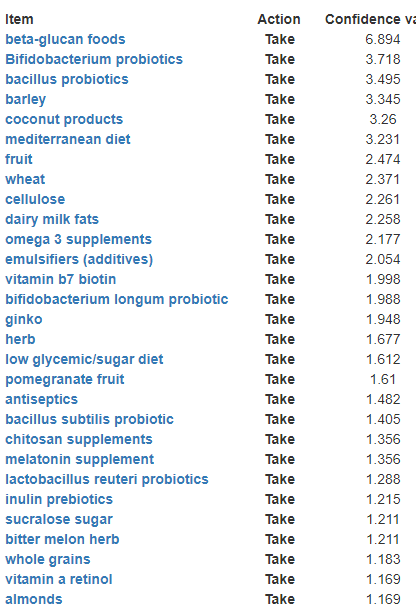
I ran two sets of recommendations thru — one focused only on high bacteria and one focused on low bacteria only. It is interesting to note that there is a lot of overlap between the two — despite having no bacteria in common with either group. This illustrate how bacteria tend to have a Ying-Yang aspect.

High Low
low drew1

This list of items is similar to the last post with a few minor changes.

This is an education post to facilitate discussing this approach with your medical professionals. It is not medical advice for the treatment of any medical condition. Always consult with your medical professional before doing any  changes of diet, supplements or activity. Some items cites may interfere with prescription medicines.

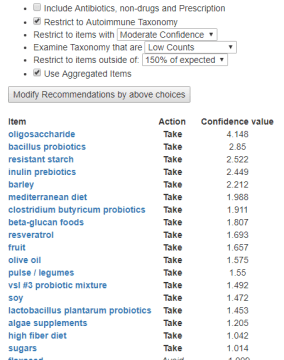
New recommendation options: For autoimmune bacteria only

From doing the reviews this weekend, I realized that adding a filter to ignore all taxonomy (bacteria types) that are not associated with any autoimmune condition may give a more effective and targeted set of recommendations.

This is at http://microbiomeprescription.com/Biome/login (if you are interested and have not done a ubiome and uploaded it, a sample login in on this page for you to use).

In short, if the taxonomy is not associated with a known autoimmune condition, we will ignore it (high or low).

Example:

Often they will be the same, but as we see below:

  • Coconut products disappeared
  • Bacillus probiotics appeared
  • Soy appeared
All Bacteria Taxonomy Autoimmune associated

bacteria taxonomy

off on

This is an education post to facilitate discussing this approach with your medical professionals. It is not medical advice for the treatment of any medical condition. Always consult with your medical professional before doing any changes of diet, supplements or activity. Some items cites may interfere with prescription medicines.