Kegg Pathway – Metabolism and Microbiome

I have just created a new set of pages to allow people who have done uBiome to share the metabolism information that is also provided there.  I put my own and a friend’s thru and was struck by the differences. Almost all of mine was sitting at .95 – 1.05 of normal. Many of her’s were sitting at 0.03, 0.05 of normal.

Short Explanation

Bacteria have a large number of interactions and behaviors. There is a site where this information has been gathered, KEGG PATHWAY Database. uBiome has used this site with your bacteria sample to predict/estimate how well various pathways are working with your current bacteria mixture.

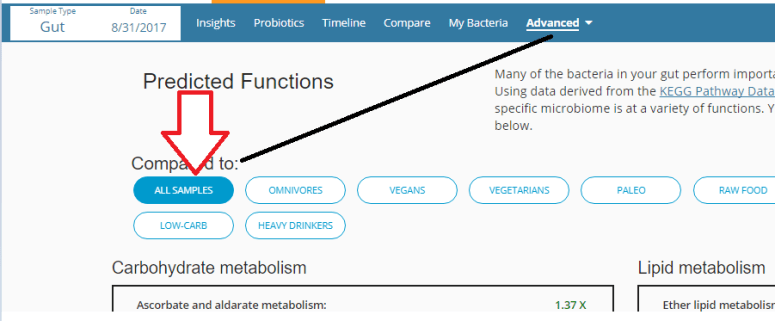
You will find this information under [Advance] on your uBiome page
meta

There is no ability to download and upload it at present. The items are arrange from highest to lowest value.

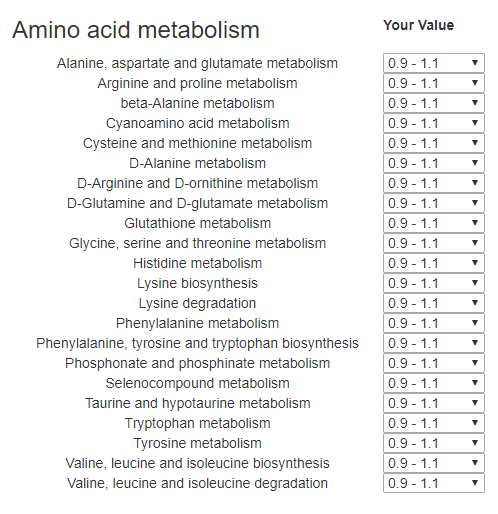
I have created an entry page (AFTER YOU LOGIN and pick the sample) at: http://ubiomecfsweb.azurewebsites.net/Metabolite/metabolismEntry

The page is shown below. I have chunked ranges together to make entry easier.
meta2

In general, we are concerned about low values. What the values means and what you can do about them will be covered in later posts when we get data.

Examples:

  • A low “Ubiquinone and other terpenoid-quinone biosynthesis” means that your bacteria under produces Ubiquinone (a.k.a. CoQ10) and thus you should be supplementing with it — perhaps in higher dosages than usual.
  • A low “Styrene degradation” means that you may need to really avoid items with even trace amount styrene, in fact, “The U.S. Environmental Protection Agency (EPA) has described styrene to be “a suspected toxin to the gastrointestinal tract, kidney, and respiratory system, among others”.[29][30] ” which may be a contributing factor for IBS
  • A low “Retinol metabolism” (Vitamin A),  means it takes longer for the body to use it. In some cases if it is water borne, then you may urinate it out unprocessed and have little effect from a normal dosage.

I will likely do deep dives into these — every 5 sets submitted will result in the lowest common values seen being the next deep dive.

A video

For more videos, go to this page.

Bottom Line

Adding metabolites WITH symptoms may help discover association between chemical sensitivity and the metabolic functioning, etc.  We need uBiomes, symptoms and metabolites to obtain a rich set of data to identify symptoms to both bacteria and to metabolites (i.e. hints to the specific supplements that may help you!)

I have also stubbed out a symptoms to metabolite explorer page.

GENDER AND AGE Has Been Added to Symptoms

If you have entered symptoms, please update it with your gender and age.
Just fixed a bug on…

Just fixed a bug on the Reference pages. Please recheck any exploration by specific bacteria you did.

This did NOT impact the Recommendation pages.
http://microbiomeprescription.com/Library/Detail/?high=0&taxon=1678

IBS/CFS/Long Covid Insight from Bergen’s Giardia Infection

I have been following the 2004 Giardia infection population studies because it is a good size population with a laboratory-confirmed root cause of CFS and IBS for the patients in the population. It is a reference case for Post Infection Syndromes. The 10 year report has just be published on PubMed Prevalence of Irritable Bowel Syndrome and Chronic Fatigue 10 Years after Giardia Infection [2018].

“In 2004, the drinking water source in Bergen, Svartediket, was infected by the Giardia lamblia parasite. At least 2,500 people suffered from diarrhoea and abdominal pains as a result. Many have struggled with abdominal complaints and fatigue since then, results from the follow-up studies show.” [2015]

My model is that some event (infection often) result in a shift of the microbiome which did not return to the prior state within 6 months (diagnostic definition for CFS).  In this case, we have a specific known event (instead of “some event”) and can see something about the life cycles of CFS/IBS/LC given the large number of patients with the same initial event at the same time. This is a unique population significant for understanding LC, CFS and IBS behaviors.

The numbers below come from different authors who sometimes did different samples and criteria. 😦

For CFS (remember CFS diagnosis require 6+ months. Fukuda et al’s 1994 criteria was used)

  • in 1-3 years: 60%
  • After three years: 46.1%
  • After five years: 41.5%
  • After six years: 30.8%
  • After ten years: 26%

For IBS (Rome II criteria):

  • After one year: 43%
  • After three years: 46.1%
  • After three years: 46.1%
  • After five years: 59.6%
  • After six years: 39.4%
  • After ten years: 40%

Irritable bowel syndrome and chronic fatigue 3 years after acute giardiasis: historic cohort study. [2012]

Chronic fatigue syndrome 5 years after giardiasis: differential diagnoses, characteristics and natural course [2013]

Irritable bowel syndrome and chronic fatigue 6 years after giardia infection: a controlled prospective cohort study. [2014]

  • “Lactulose-induced hydrogen breath excretion was not significantly different in patients and controls.” [2006]
  • “Exposure to Giardia infection was associated with perceived food intolerance 3 years after giardiasisIBS status did not alter the association between exposure status and perceived food intolerance. Perceived intolerance to high FODMAP foods and low FODMAP foods were both statistically significantly associated with exposure to Giardia infection.” [2015]
  • “A total of 58 (60%) out of 96 patients with long-lasting post-infectious fatigue after laboratory confirmed giardiasis were diagnosed with CFS.” [2012]

Bottom Line

“CFS has been reported to affect 10% following Epstein Barr virus (EBV) infection [4,5], and fatigue, depression and hair loss is a common syndrome following Dengue fever [6,7]. In controlled studies chronic fatigue has been reported after Lyme borreliosis [8], Parvovirus B19 infection [9], Q fever [10] and Ross River virus infection [4].”  [2013]

Doing some math, for natural recovery

  • At 1-3 years: ~ 9% recovered from CFS per year
  • At 3-6 years: ~ 13% recover from CFS per year
  • At 6-10 years: ~ 4.2% recover from CFS per year

In short, the longer the dysfunction continues, the more stable it becomes — thus the harder to undo.

IMPORTANT — Natural recovery is cited above

That is doing nothing, or a variety of ad hoc things.

See https://cfsremission.wordpress.com/2016/03/12/ibs-probiotics/ for probiotics that have had demonstrated effective for IBS in studies.

Your probiotics could be causing thick blood

A reader asked:

“Do you still think thick blood is a common issue and do you still recommend getting the multiple labs for thick blood? Is there a viscosity test you recommend for seeing that the thickness is at any given time?”

Given that I have been focusing on the microbiome  (mainly because it is actionable in many ways — diet, probiotics, antibiotics; and easily measurable => ubiome.com), it is a good question to ask and to remind people that this can be a significant factor and it is not isolated from the microbiome!

Literature

“Many bacteria and bacterial components can directly activate individual human coagulation factors. However, direct initiation of the coagulation cascade and the formation of a propagating clot are not typically observed1117. These bacterial components usually activate low levels of coagulation factors, which does not result in the amplification and positive feedback necessary to form a clot that can grow and propagate. For example, Staphylococcus aureus produces coagulase, a protein that binds prothrombin stoichiometrically and leads to cleavage of fibrinogen to fibrin14. However, this conversion simply precipitates fibrin and does not result in production of thrombin, feedback or amplification of the coagulation cascade. Escherichia coli that express the protein Curli are also known to activate coagulation factors, such as factor XII (ref. 17). This process was shown to cause slower initiation of coagulation due to depletion of factor XII (ref. 17). Bacteria are also well known to directly initiate coagulation in some organisms, such as horseshoe crabs, but this mechanism of controlling infection is believed to have been lost during the evolution of vertebrates18. All of these results prompt the following simple question: are bacteria capable of directly initiating the coagulation cascade and causing coagulation of human blood?” [2008]

This went on to give some results from experiments

  • “Clusters of B. cereus initiated coagulation of flowing human whole blood in 3-13 min (Fig. 2b,c), whereas coagulation did not occur until 48-59 min in experiments with the control strain of E. coli (Fig. 2dP < 0.001)…. both coagulation factor X and prothrombin are required for initiation of coagulation by B. cereus, which is not expected for S. aureus-type coagulase activity.”
  • “In addition to B. cereus, we found that clusters of several other Bacillus species, including B. anthracis, the anthrax-causing pathogen, rapidly initiated coagulation of human blood plasma (Fig. 4a). The closely related species Bacillus thuringiensis and other species, including Bacillus subtilis and Bacillus licheniformis, also initiated coagulation. “
  • “We predict that other bacterial species that activate coagulation factors may demonstrate this quorum-acting mechanism, although this prediction remains to be tested. Porphyromonas gingivalis, a causative agent of gum disease, is one likely candidate. Purified proteases of P. gingivalis are particularly potent and known to activate many coagulation factors and reduce coagulation times in standard assays11P. gingivalis infections have also been linked to cardiovascular disease, although the nature of this connection is still under investigation49.”

IN OTHER WORDS _- TAKING ANY BACILLUS PROBIOTICS MAY ENCOURAGE THICK BLOOD.

Bottom Line

We only have partial knowledge on which bacteria can cause coagulation / thick blood. We do see that one of them, Staphylococcus aureus, is strongly associated with CFS (see my last post on the new study from Australia-New Zealand). Of special concern is that a common type of probiotic was demonstrated to cause coagulation!

The reader asked if there was “Is there a viscosity test you recommend for seeing that the thickness is at any given time?”, See Erythrocyte Sedimentation Rate – SED

For more reading on this see these posts (from almost 2 decades ago!)

Thick Blood, Clots dimension of CFS etc

New CFS Study — but almost nothing new :-(

The title sounded grander than what it actually contained

Open-label pilot for treatment targeting gut dysbiosis in myalgic encephalomyelitis/chronic fatigue syndrome: neuropsychological symptoms and sex comparisons [2018] – Full text

“Conclusions

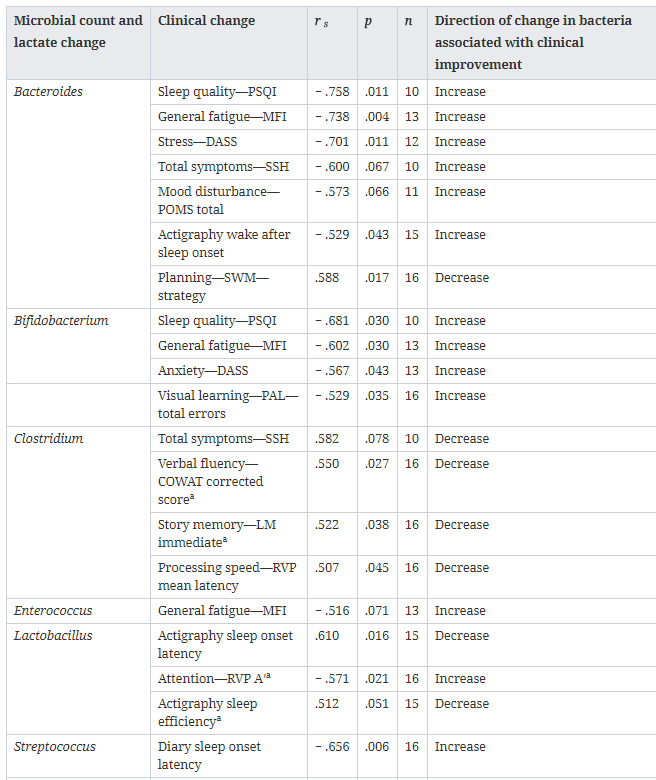
Results support the notion that specific microorganisms interact with some ME/CFS symptoms and offer promise for the therapeutic potential of targeting gut dysbiosis in this population. Streptococcus spp. are not the primary or sole producers of d-lactate. Further investigation of lactate concentrations are needed to elucidate any role of d-lactate in this population. Concurrent microbial shifts that may be associated with clinical improvement (i.e., increased Bacteroides and Bifidobacterium or decreased Clostridium in males) invite enquiry into alternative strategies for individualised treatment.”

The role of staphylococcus was known in 2015, and I did a post on it in January  2016. The d-lactic aspect, I posted about in 2015 in this post Approaches to D-Lactic Acidosis.

What they appear to miss was streptococcus causing histamine issues, see this 2014 post,  Histamine intolerance – a possible CFS mechanism.

Their Protocol?

Alternative weeks of:

Antibiotic

Erythromycin

400 mg/b.d.

Probiotic

Pro4-50 d-Lactate Free Multistrain

1 tablet b.d.

It was interesting to note that there was no attempt to reduce streptoccocus by diet etc. The suggestions from existing literature are on the ubiome analysis site. A small example:

The choice of Erythromycin is a bit of a puzzle, because of increasing resistance of many streptoccocus to this antibiotics. I pointed this out in my 2017 post, Reducing Streptococcus genus  where I cited this study

Phenotypic and genotypic characterization of antibiotic resistance of methicillin-resistant Staphylococcus aureus  isolated from hospital food. [2017]

  • MRSA strains harbored the highest prevalence of resistance against penicillin (100%), ceftaroline (100%), tetracycline (100%), erythromycin (89.18%) and trimethoprim-sulfamethoxazole

Symptoms to Bacteria Association

They did find that shifts of bacteria did result in improvement of symptoms — which is exactly what I expected to see.

improvementBottom Line

This study supports and illustrates the basics  of my model. If you are not too brain fogged, it is an interesting read. Their approach seems a little simplistic, but they did obtain good results.