

Recommendations lists should now be larger. An error resulted in the latest addition of reference to be excluded.
Many thanks to VK for checking the recommendations versus bacteria and finding an disagreement.
Category Archives: Conditions
Some Microbiome Statistics from uploads
I have just added stubs for a new set of statistics based on uBiome reports uploaded. I believe we can assume that 90% of the uploads are for CFS/FM/IBS spectrum.
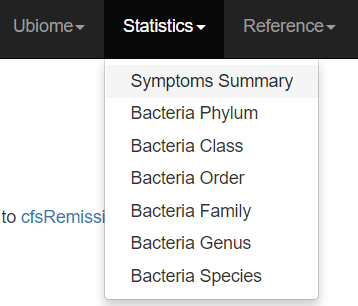
If you go to Bacteria Species you will see some distinctive patterns.

So very few with any Lactobacillus But we also see that almost every one has some other ones:

We see similar for Bifidobacterium except for one strain, Bifidobacterium longum.
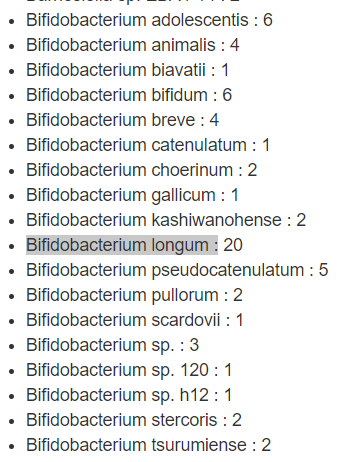
I will leave interested readers to explore and speculate. The most frequently seen were
- Flavonifractor plautii 34
- Bacteroides vulgatus 33
- Blautia wexlerae 33
- Parabacteroides distasonis 32
- Bacteroides thetaiotaomicron 30
- Faecalibacterium prausnitzii 30
- Blautia faecis 30
- Anaerostipes sp. 5_1_63FAA 30
- Blautia luti 30
Bottom Line
This is just a sample of what is possible with the design of the site. Explore these statistics pages. There is a real possibility that citizen-science may unlock key components of CFS.
Just updated Microbiome analysis, found…
Just updated Microbiome analysis, found a bug that explained some people problems and possibly gave an incorrect analysis for a few people.
It does not hurt to verify that it did not impact your analysis.
Avoid and Take Mathematics for Recommendations
Some people wonder why there is a number for both avoid and take of an item. This morning I answered an email asking if they should take spore probiotics. Spore probiotics are usually in the Bacillus family of probiotics.
I went to look at the Modifier Reference page for bacillus and the whys are immediately seen for bacillus:
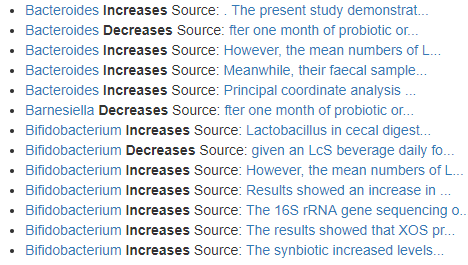
We see some studies had one result and other studies a different result! Bacillus contain many genus — so it is likely the specific genus is responsible for the difference. When we drill down to the genus level, we usually see less variation. For example, bacillus subtilis
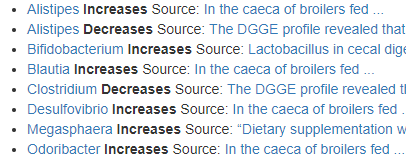
We can still see differences. The information is fuzzy. Other factor are errors entering the data or misinterpretation of the study or even how the study was designed or the tools used for measurement. Fuzzy logic is what we need to use to process this fuzzy data (as well as double checking references).
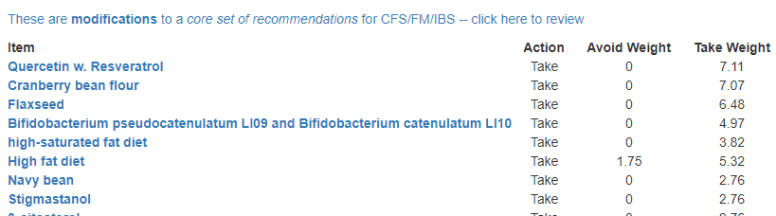
So what are the weights?
This is a fuzzy summing of the individual items for one item, which is then fuzzy summed for the number of items (taxonomy) that are impacted by this material with a plus or minus (according to overgrowth or undergrowth).
The bottom line is a simple recommendation (Avoid, Take, —) from the best item to take to the items that you should exclude. The numbers are shown for the more technical reader because there is uncertainty when there are both plus or minus for an item. Our knowledge is fuzzy, the studies are fuzzy and we are trying to modify a complex interacting microbiome using studies that could be well described as naive.
Bottom Line
Applying fuzzy logic to data is part of my academic training and has been part of my work experience since the late 1980’s. Giving advice to patients is something that I am unlicensed to do and unqualified — hence the disclaimer at the bottom of the pages.
Finding a clinical physician that is qualified in AI, microbiome and medicine is likely a quest for the holy grail. My best suggestion is to take the academic suggestions and review them with a qualified physician before starting. In some cases, the recommendations may conflict with your condition or prescription medications — things that I cannot factor in.
This is an education post to facilitate discussing this approach with your medical professionals. It is not medical advice for the treatment of CFS. Always consult with your medical professional before doing any changes of diet, supplements or activity. Some items cites may interfere with prescription medicines.
Theoretical Diet Exploration for Histamine Issues
Working off Alison Vickery’s associated bacteria list for histamine producing bacteria, I added a feature to the histamine page — I took all of these bacteria and used the website AI to look for things that they may have in common.
There appear to be a pattern — some highlights are below. Including children/parents did result is some dramatic shifts:
- Berbine went from strong take to neutral
- VSL#3,bifidobacterium bb-12, jumped to strong avoid
I will leave it to readers to explore further.
| Item | Action | Avoid Weight | Take Weight |
|---|---|---|---|
glyphosphate |
Take | 0 | 8 –> 11 |
berberine |
Take | 0 | 7 -> 0 |
laminaria hyperborea |
Take | 0 | 6 –> 11 |
magnesium-deficient diet |
Take | 0 | 6 -> 9 |
sucralose |
Take | 0 | 6 |
chemotherapy |
Take | 2 | 6 |
high fat diet |
Take | 2 | 6 |
laminaria digitata |
Avoid | 3 | 0 |
proton-pump inhibitors |
Avoid | 3 | 0 |
arabinoxylans |
Avoid | 3 | 0 |
chicory |
Avoid | 3 | 0 |
chondrus crispus |
Avoid | 3 | 0 |
fructo-oligosaccharides |
Avoid | 3 | 0 |
green tea |
Avoid | 3 | 0 |
inulin |
Avoid | 3 | 0 |
jerusalem artichoke |
Avoid | 3 | 0 |
ketogenic diet |
Avoid | 3 | 0 |
red wine |
Avoid | 5 | 0 |
resveratrol |
Avoid | 7 | 1 |
almonds/ almond skins |
Avoid | 6 | 0 |
daesiho-tang |
Avoid | 6 | 0 |
magnesium |
Avoid | 6 –> 9 | 0 |
navy bean |
Avoid | 8 -> 11 | 0 |
sesame cake/meal |
Avoid | 8 -> 11 | 0 |
The above is strictly a conceptual exploration assuming that the cause is a microbiome shift. Many of the items may initially trigger histamine release.
This is an education post to facilitate discussing this approach with your medical professionals. It is not medical advice for the treatment of CFS. Always consult with your medical professional before doing any changes of diet, supplements or activity. Some items cites may interfere with prescription medicines.
 CFS Remission