New Scientist: You and Your Microbiome

“Two papers published earlier this year showed that people with chronic fatigue syndrome – also known as myalgic encephalomyelitis, or ME/CFS – have less of a gut bacterium called Faecalibacterium prausnitzii  “

The following are permissible extracts (200 words per article). Click [more] to read more…
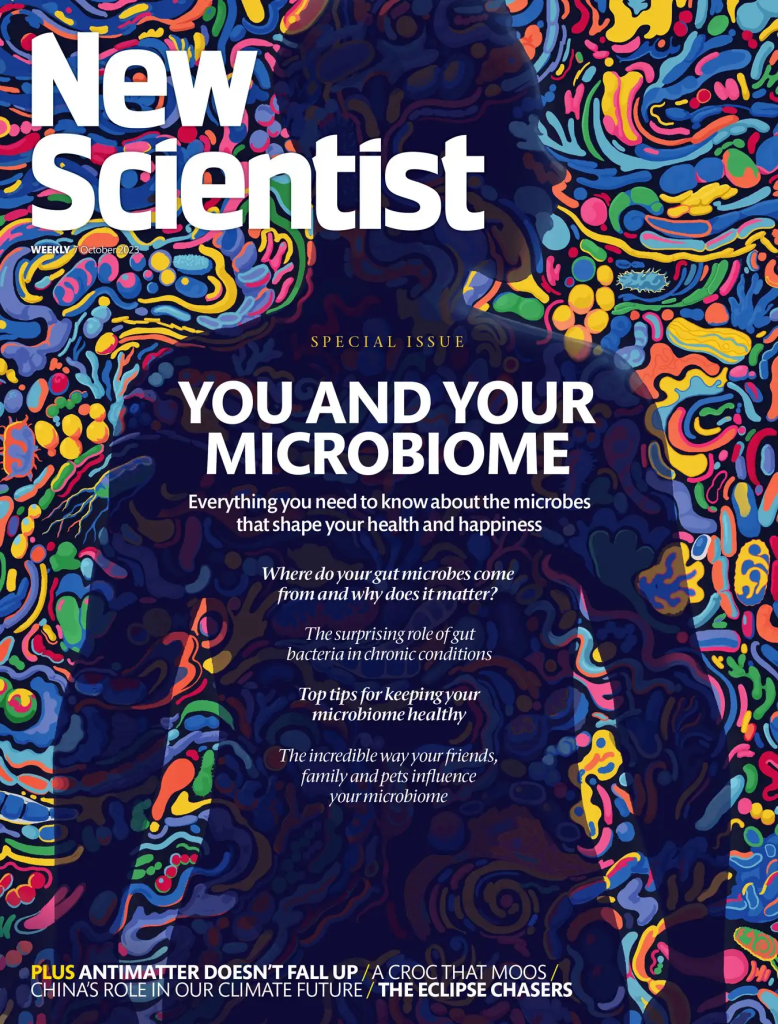
How the microbiome changes our idea of what it means to be human

YOU may, quite reasonably, think you are an individual of the species Homo sapiens. Once you have finished reading what follows, you will hopefully have been convinced that there is far more to us than that. Trillions of other organisms live on (and, more notably, in) your body. As you will see in the reports that follow, their impact on you is such that you will probably never think about yourself in the same way again. Your microbes change who you are and what it means to be you. With knowledge of this facet of ourselves growing rapidly, exploring it has never been more relevant.

Until recently, scientists believed that there were three discrete parts of our nature that reflected solid aspects of an individual self: the immune system, the genome and the brain. “None of these pillars of the traditional definitions of the self – immunity, genome integrity, the central nervous system – are free of microbial impact,” says Thomas Bosch at Kiel University in Germany.

The microbes that colonise us, collectively known as the microbiome, challenge the concept of a discrete self. These include bacteria, viruses and fungi, although the bacteria are the best-studied. [more]

The best way to care for your microbiome to keep it healthy as you age

Your gut microbiome is a vital support system for mental and physical health, supplying the body with all-important nutrients and helping tune the immune system.  

As we get older, the balance of microbes in our gut changes. There are declines in beneficial types, such as the anti-inflammatory Faecalibacterium, and an increase in species that lead to more inflammation, which is implicated in multiple age-related conditions, including heart disease, cancer and cognitive decline. Many studies, with participants ranging from an isolated rural population in India to a wealthy semi-urban community in Italy, show striking similarities in the microbiome signatures of old age. One key finding is that people who have no significant health concerns in older age have an abundance of distinct beneficial microbes that are lost when there is a shift to physiological decline.

It isn’t clear whether the microbiomes of healthy older people are driving their vitality or are a result of the way they live, but an astonishing study in mice by John Cryan at University College Cork, Ireland, and his colleagues found that transplanting gut microbiota from young animals to elderly ones reversed age-associated impairments in brain function. [more]

Can probiotics and supplements really improve your gut microbiome?

If you have a condition like irritable bowel syndrome (IBS), a finnicky gut or just want to keep your microbiome in top condition, you might be tempted by products and treatments that offer a microbial tune-up. But what really works? Here are the main tools to engineer a better gut.

Probiotics

Probiotics are microbes that may help to restore healthy gut microbiota. If they also improve your mood, they are called psychobiotics. You can typically get them from eating naturally fermented foods like yogurt that contain beneficial bacteria, such as Lactobacillus or Bifidobacterium.

But as an adult, these microbes are unlikely to colonise your intestines. To the extent that they are helpful, their benefit comes while they are passing through. Such probiotics stimulate immune cells in the gut to reduce inflammation, increase mucus production and deter pathogens by producing lactic acid. But as mere visitors, they need daily top-ups.

Probiotic supplements have been used (with mixed success) for more than a century to help with the gut conditions of Crohn’s disease, colitis and IBS. They have also been shown to help with weight loss in people who are overweight and are increasingly being used for other conditions… [more]

Secrets of a long and healthy life reside in your gut microbiome

WHY do we age? As youngsters, we seem invincible. We climb trees, frolic in the dirt and blithely share alarming quantities of mucus. At college, we can thrive on a diet of ramen and beer, party all night and still sit an exam the next day. But in our 30s, we start to wind down. It becomes harder to maintain muscle tone and avoid illness. Our joints start to ache and our memory begins to dim. And it is mostly downhill from there.

People have long attempted to stop or reverse this process. But fountains of youth and secrets of immortality remain firmly in the realms of fiction. Our bodies wear out, even if we no longer do the back-breaking physical labour our ancestors did. And the world seems determined to grind us down with a plethora of disease-causing microbes. To help fend off these pathogens, our bodies recruit other microbes, vast numbers of which reside in our intestines, where we feed them in exchange for their services. But, as we age, this gut microbiota becomes less effective at fighting diseases too. [more]

Where does your gut microbiome really come from – and does it matter?

Imagine a remote island, recently formed by volcanic activity, in the middle of the ocean. At first, it is lifeless, but a growing variety of plants take hold, providing food for pioneering animal species, until eventually there is a diverse and flourishing ecosystem.

This is a useful way to think about how our gut ecosystems develop. “Your microbiome goes on a journey,” says Alan Walker at the University of Aberdeen, UK. “When you’re born, some bugs get in and then, when you start eating solid foods, other bugs replace them. There’s a dynamic process where your microbiome changes until you get to mid-to-late childhood. Then, through adult life, you’ve got a reasonably stable microbial community.”

Does a C-section affect a baby’s microbiome?

The first individuals that colonise an island can have long-lasting influences on its ecosystem, an idea known as the founder effect. Until recently, the thinking went that if the founder bacteria in a baby’s gut were unusual – because the baby was born by Caesarean section, for instance – this might disrupt their bacterial ecosystems. This idea has led some parents to take radical steps to get their children’s microbiomes back on the right track.  [more]

What is the role of the microbiome in diseases like chronic fatigue

ONE of the most compelling discoveries about the gut microbiome is its influence on the immune system. Between 70 and 80 per cent of immune cells are in the gut, where they are constantly communicating with microbes. This crosstalk helps fight disease, strengthen immune responses and regulate inflammation, our body’s first line of defence against infection. Controlling inflammation is critical, as too much damages cells and helps drive chronic illness.

It is no surprise, then, that a growing body of evidence implicates the gut microbiome in various chronic diseases, from arthritis to Alzheimer’s. It is still early days, and most of these findings only point to associations. But they raise the possibility that gut microbes may contribute to, or even cause, some of our most intractable conditions, an idea that has already inspired new treatments.

It is now well established that gut microbiomes in people with conditions like multiple sclerosis, type 1 and type 2 diabetes, Parkinson’s disease and even asthma differ significantly from those of people without an underlying illness. Two papers published earlier this year showed that people with chronic fatigue syndrome – also known as myalgic encephalomyelitis, or ME/CFS – have less of a gut bacterium called Faecalibacterium prausnitzii  [more]

How your microbiome is shaped by your friends, family, lovers and pets

When we are born, we get most of our gut microbes from our mothers (see “Where does your gut microbiome really come from – and does it matter?”). But as we get older and form other close relationships, including with intimate partners, friends and pets, we start to pick up their microbes too. This could potentially affect our risk of developing conditions like obesity, inflammatory bowel disease, asthma and allergies (see “What is the role of the microbiome in diseases like chronic fatigue?”).

“I jokingly say that your dating app profile should include your microbiome profile,” says Brett Finlay at the University of British Columbia in Canada.

The strongest evidence comes from work published in January by Mireia Valles-Colomer at the University of Trento, Italy, and her colleagues, who conducted the largest study to date of how our gut microbiomes are shaped by the people around us. They analysed DNA in the faeces of more than 7000 people from households around the world, including rural parts of Africa and South America and cities in the US, Europe and China, to find out which bacterial strains were in their guts and what proportion they shared with others. [more]

—————– from older issues ———————-

Your gut microbiome is linked to your fitness and biological age

The diversity of microbes in the gut could affect a person’s fitness and their biological age. Better understanding this may one day lead to probiotics that alter the gut’s microbial make-up to promote health.

Zsolt Radak at the Hungarian University of Sports Science and his colleagues studied 80 amateur rowers, aged 38 to 84, who participated in the 2019 World Rowing Masters Regatta in Velence, Hungary.

The rowers, whose training regimens ranged from practising every day to once a week, each provided a stool sample to identify the bacteria in their guts. The researchers also took blood samples to gauge the participants’ biological ages – a measure based on DNA markers, rather than the number of years someone has been alive.

The researchers found that having higher levels of gut microbiome diversity was linked to lower levels of fitness and an accelerated rate of biological ageing. This somewhat goes against previous research that linked lower gut microbial diversity to conditions such as obesity and type 2 diabetes. [more]
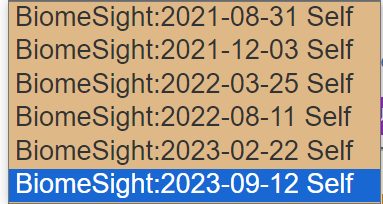
Update #4 on ME/CFS Person

The person in this prior post has done a retest. This analysis looks at what changed from selectively following suggestions from this prior post.

His comments are below:

“Things that I have been taking since the last test in February 2023:

  • Rosemary
  • Grapefruit seed extract
  • Turmeric
  • Natto 
  • Tetracycline 
  • Clove
  • Anise
  • Acacia gum 
  • Amoxicillin 
  • Apple peel powder
  • Thyme
  • Symbioflor 2
  • Neem 
  • Jarlsberg cheese

My symptoms:

  • Still get the red nose (some form of rosacea). But it is better than before.
  • Still feel fatigued (both physically and mentally). But it is better than before.
  • Feeling stressed. But it is better than before.
  • Brain fog.
  • Bloated.
  • Lots of gas – I fart and burps a lot. “

This is his fifth sample. Multiple samples are not unusual because fixing the microbiome means a lot of course corrections.

Analysis

First, we will look at measures that were not available for the earlier posts. In the last period, we see a dramatic change of the histamine values!

SampleAnti-Inflammation ValueHistamine Value
2021-08-3197%ile98%ile
2021-12-03 96%ile98%ile
2022-03-2518%ile87%ile
2022-08-1130%ile90%ile
2023-02-2265%ile86%ile
2023-09-1287%ile3.2%ile

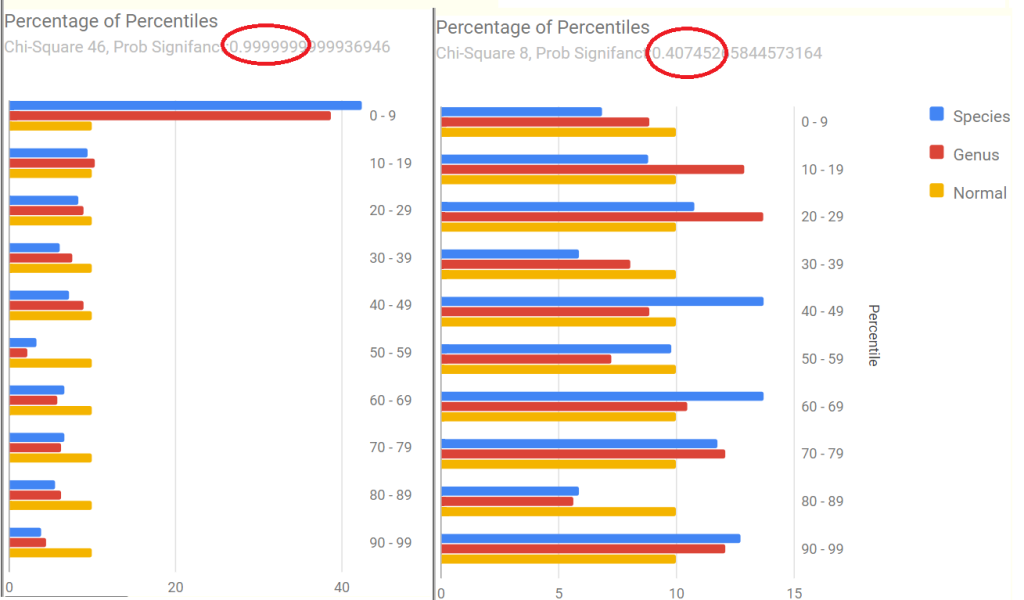
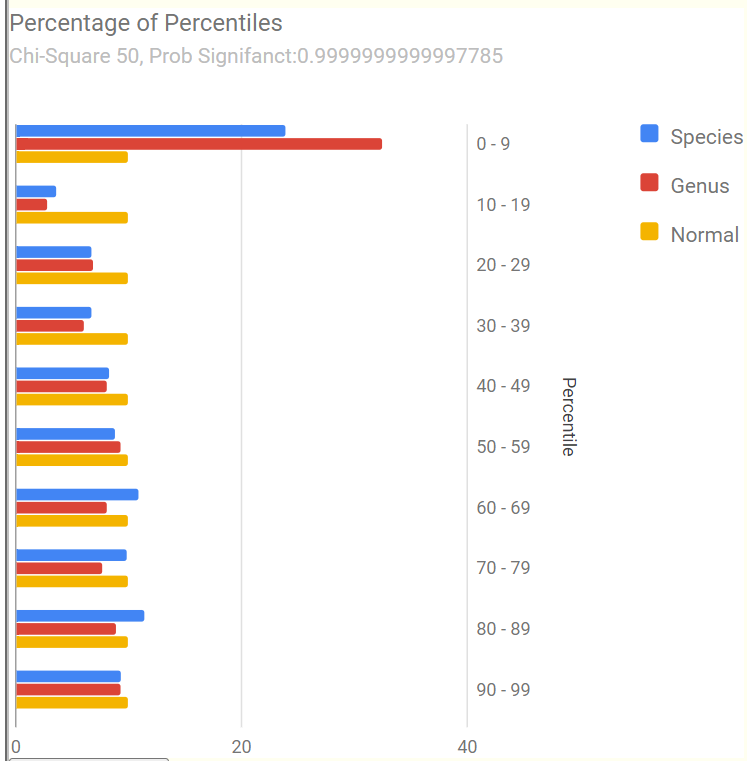
We also see a dramatic change in the Percentages of Percentiles charts that suggests improvement. In fact, there is no longer any statistically significant shifts (going from 0.99999… to .40!). Dropping below 0.95 is an objective target. The pattern went from the common ME/CFS and Long COVID pattern to an normal pattern.

Potential Medical Conditions Detected

We have the following candidates to consider that were not flagged in the prior sample (where nothing stood out):

  • Allergic Rhinitis (Hay Fever): 100%ile
  • Stress / posttraumatic stress disorder: 98%ile
  • Irritable Bowel Syndrome: 97%ile

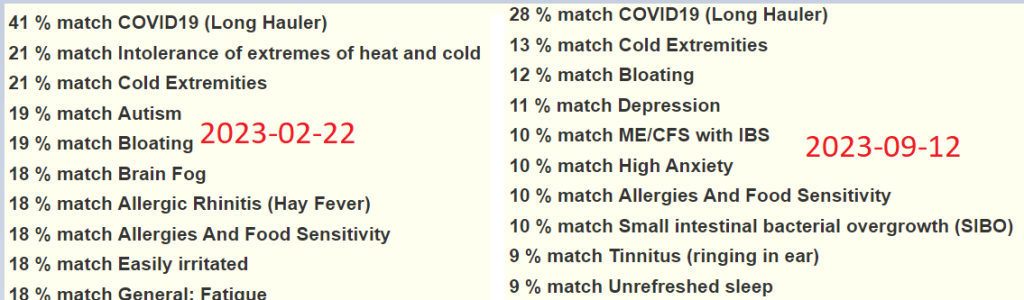
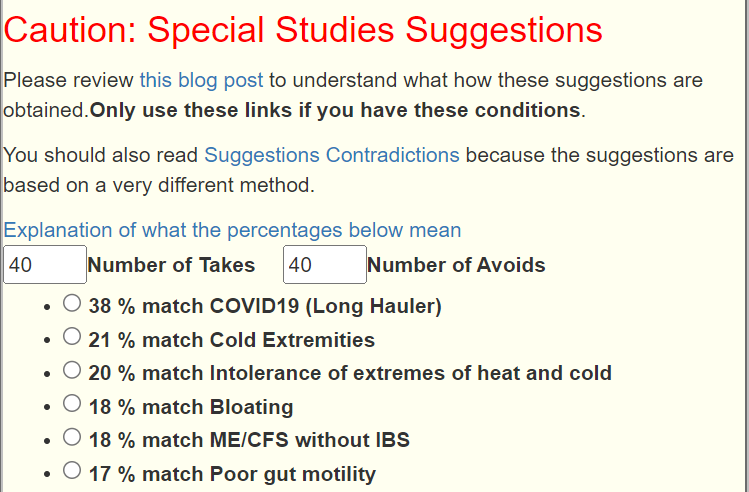
This may be just randomness or because the microbiome is calming down, patterns hidden by noise are showing up. Looking at Special Studies pattern matching, the top one was COVID19 (Long Hauler) at 28% match (prior was 41% match) — a definite improvement. Other items dropped about 8% match each, most were so low, that there may not be significance.

These appear to agree with his personal observations. We have Prevotella copri is at 76%ile, hinting that mycotoxin present (mold) may be in his environment (see this post for more exploration).

Going Forward

In terms of subjective and objective measurements, this person has improved. So time for the next course correction. I am going to just run with the “just give me suggestions” since nothing really stands out.

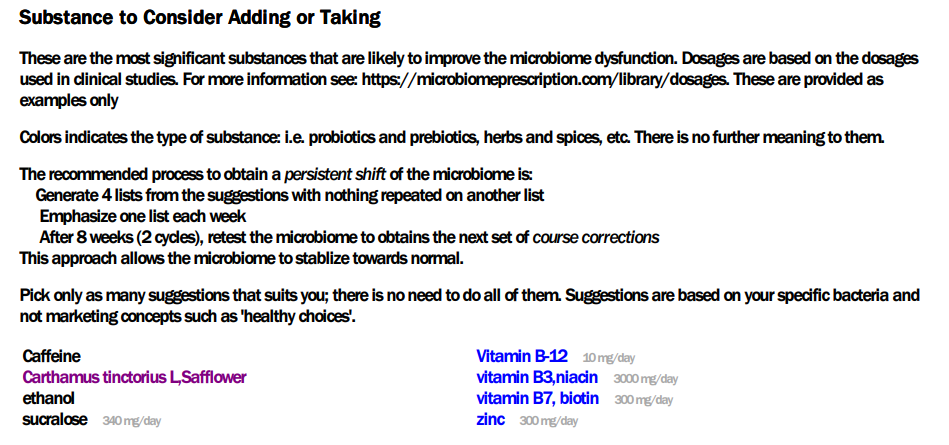
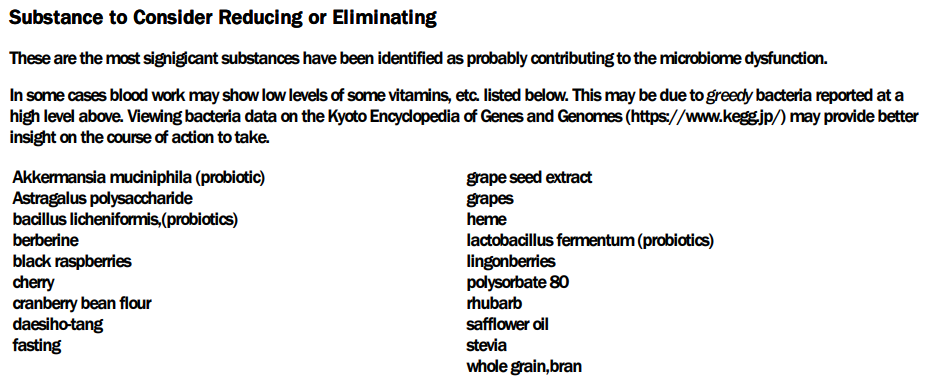
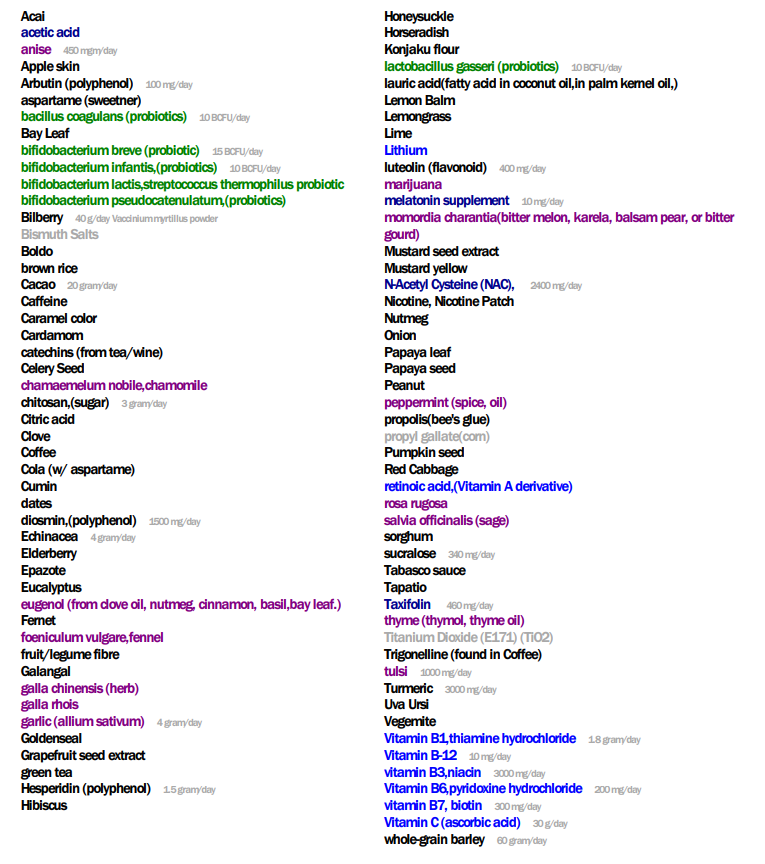
The non-prescription items from the PDF are by far the shortest that I have seen! So the safflower may be difficult because it does not mean safflower oil (an avoid), but the herb.lots of coffee and perhaps a little Aalborg Aquavit.

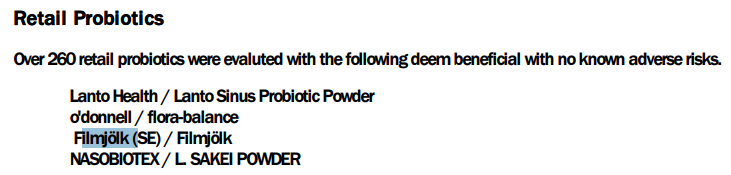
In terms of probiotics, he lucked out — Filmjölk is likely available to him

The avoid or reduce list is much longer!!

Going over to items computed from the Kyoto Encyclopedia of Genes and Genomes we have the top item being the typical one for ME/CFS: Escherichia coli (i.e. Mutaflor or Symbioflor-2). In terms of supplements, the two most significant one are: Glutamine, Threonine, Serine.

Since the person has a co-operative MD (i.e. two antibiotics were listed), I reviewed the prescription items. The top item was amoxicillin (antibiotic)s[CFS], which has already been used. We have gatifloxacin, ciprofloxacin (antibiotic)s[CFS]and clinafloxacin (antibiotic) which is a different family (a fluoroquinolones which has a lot of bad press). The next one worth considering is nadifloxacin (antibiotic): Nadifloxacin is a broad-spectrum quinolone antibiotic(in fluoroquinolones family) that has been approved for use in the treatment of acne vulgaris and skin infections. This may impact his rosacea. The next one down the list may be similar: fusidic acid sodium salt (antibiotic).

One factor to consider is that Cecil Jadin has been using fluoroquinolones for twenty years without seeing any adverse effects. The duration is only 10 days or less. Longer duration of use may be a significant factor. See this post and video for more information.

Questions

“All those antibiotics MUST be taken: after food ( not only water ) and without any dairy products. Patients must avoid sugar intake and some supplements(for example magnesium). Antibiotics should be taken in the morning and the evening. Patients must avoid sugar intake and supplements.”Cecile Jadin, MD  Video Presentation of Dr. Jadin’s Current Protocol for ME/CFS, Q-Fever, Chronic Lyme and related conditions

Q: I’m going to do another round with  amoxicillin.
— In Jadin’s presentation she says to only take it for 7 days, ain’t ok to take it for 14 days as we talked about before?
— Can’t I take other supplements like magnesium when I take antibiotics?

  • A: The duration range of 7 – 14 days is, IMHO, fine. My main concern is long duration that can result in antibiotic resistance.

Q: If I want to have a longer list for what to take / avoid, can I use the three that is blue below (as earlier)?

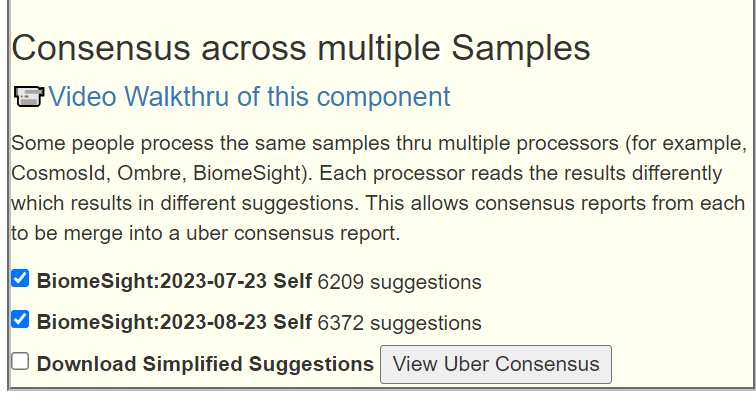
  • A: What is shown above is from the PDF which I am preferring to use for posts because it keeps things simpler. You can do any combination you wish. You could also consider doing your last sample suggestions and this sample suggestions, an “uber consensus” which should produce suggestions of what has been out of range with both samples. Caution should be done because of how different the two samples are!

This does produce a massive list!!

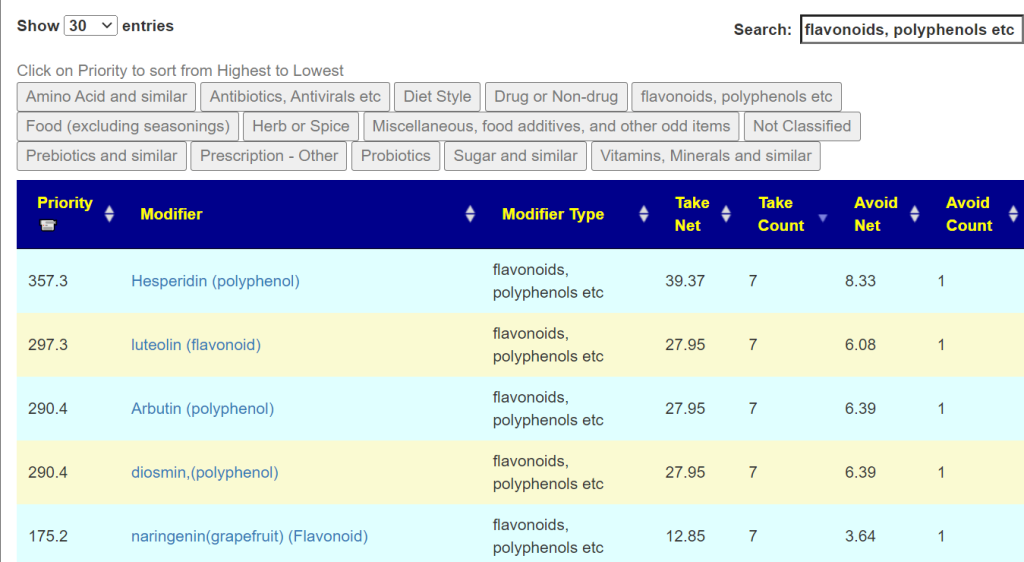
I would then go thru the list and cross out items that are not shown with at least 7 of the possible 8 in the technical details.

Bottom Line

My own experience with recovery was that it took about a year for many symptoms to wear off. The body is not an electronic device with an on/off switch; think of a meadow that has been damaged by fire, flood, or chemical spill — it takes time for things to come back.

Postscript – and Reminder

I am not a licensed medical professional and there are strict laws where I live about “appearing to practice medicine”.  I am safe when it is “academic models” and I keep to the language of science, especially statistics. I am not safe when the explanations have possible overtones of advising a patient instead of presenting data to be evaluated by a medical professional before implementing.

I can compute items to take, those computations do not provide solid information on rotations, dosages, etc.

I cannot tell people what they should take or not take. I can inform people items that have better odds of improving their microbiome as a results on numeric calculations. I am a trained experienced statistician with appropriate degrees and professional memberships. All suggestions should be reviewed by your medical professional before starting. Some suggestions may be counterindicated for other medications you are taking and medical conditions.

The answers above describe my logic and thinking and is not intended to give advice to this person or any one. Always review with your knowledgeable medical professional.

ME/CFS da molto tempo dopo i fluorochinoloni

I encourage people that can translate any of my pages to a different language to do so. You have my permission (provide the site is open access and free). Many people with ME/CFS do not English and thus cutoff from both scientific literature and this blog.

I would encourage people that also have technical skills to create a FREE word press site (ideally with a name like CFSRemission-IT.Wordpress.com (the ending letters being the language). I will gladly provide links to such site on this site.

———————————————————————————-

Questo proviene da un lettore con cui sono in corrispondenza dal 2017 e che conosco da gruppi online da decenni..

Ok, non vuoi l’intervista completa 😀 (scherzando) e quindi scriverò le prime impressioni attuali di un paziente ME/CFS dal 1998 . Sono qualcuno che ha provato di tutto; davvero di  tutto .
Innanzitutto, come vi avevo già raccontato in chat, utilizzo come criterio di miglioramento della malattia l’aumento del tono cardiovascolare, cosa che in realtà è avvenuta per poco tempo fintanto che ho mantenuto una dieta non proprio ferrea, ma molto difficile per me: comportava l’eliminazione di tutti gli zuccheri raffinati.

Per chi fosse interessato, ne ho parlato qui: https://www.fable.it/fluorochinoloni-hrv-dieta-e-me-cfs/ (in italiano – usa Google Translate). Per i primi sette giorni di dieta non è cambiato nulla, niente! Dopo questi 7 giorni improvvisamente, attenendomi a questa dieta, il tono cardiovascolare ha iniziato ad aumentare fino a quando… beh… ho mantenuto il resto della dieta ma ho reintrodotto gli zuccheri (ma non l’alcol). Quindi il miglioramento si è interrotto (ma sono stati mantenuti i miglioramenti esistenti).

Da Lettore

Gli eventi significativi recenti sono:

  • tossicità dei fluorochinoloni nel 2020
  • integratori di akkermansia muciniphila un mese prima dell’ultimo campione (vedi sotto per la sua esperienza)
  1. Risultati dei vecchi test 

Di seguito è riportato il risultato del test del 23 agosto 2016. Il test riguarda solo pochi batteri senza alcun intervallo di validità normale. Confronteremo i pochi elementi riportati con l’ultimo test Biomesight. Ci sono stati pochi cambiamenti in 7 anni.

Immagine che contiene testo, ricevuta, numero, schermata

Descrizione generata automaticamente
  1. Eventuali effetti persistenti da fluorochinoloni?

Ho effettuato un confronto dietro l’interfaccia utente di ciò che i fluorochinoloni sono cambiati con il suo campione. Anche se sono passati 3 anni, sono curioso. Nessun impatto avrebbe un risultato 50-50. Abbiamo 64 batteri che mostrano l’effetto che i fluorochinoloni causerebbero e 43 che mostrano l’effetto opposto. Ciò si traduce in un valore P di 0,0423 dal chi quadrato. Un valore P inferiore a 0,05 è ritenuto statisticamente significativo negli studi medici. Quindi, questa è la prova che l’impatto dei fluorochinoloni è ancora presente dopo 3 anni .

Questa è un’osservazione interessante: scegliere l’antibiotico sbagliato può avere effetti che persistono per anni.

  1. Confronto con il test precedente mostrato sopra

Ogni laboratorio utilizza le proprie metodologie per le misurazioni (vedere L’incubo della tassonomia prima di Natale… per il motivo e Confronto dei microbiomi di tre diversi fornitori per un esempio reale). Quindi non possiamo determinare se i livelli sono saliti o scesi.

Il microbioma è rimasto relativamente stabile per 7 anni. In effetti, il test Biomesight chiarisce quanto estremi siano i valori (cosa che non risultava chiaramente dal rapporto precedente).

  1. Dove andiamo da qui?

Il modello della percentuale di percentili mostrato di seguito corrisponde a quello osservato con molti microbiomi ME/CFS o COVID lungo.

Spiegazione nerd : utilizzando i percentili, i dati vengono trasformati in una distribuzione uniforme. Un campione imparziale (ovvero normale o sano) avrebbe lo stesso numero in ciascun intervallo del 10%. Noi non. Abbiamo il picco tipico nell’intervallo 0-9% (cioè troppe specie e generi che hanno una rappresentazione simbolica ).

Immagine che contiene testo, schermata, software, Icona del computer

Descrizione generata automaticamente

Il batterio più importante/riguardante identificato è stato Prevotella copri . Questo batterio costituisce il 43% del microbioma!!!! Questo batterio è spesso associato alla presenza di micotossine nell’ambiente [ 2020 ]. Questo di solito significa esaminare lo spazio abitativo per individuare muffe e funghi, oltre ad evitare cibi che potrebbero contenere muffe (vedi OMS per maggiori informazioni). La sua risposta a questo commento è stata:

Sì, vivo in un appartamento esposto a nord dove non c’è mai il sole sui muri. Solo in una camera non più utilizzata come camera da letto è presente della muffa visibile (foto allegata). Ho provato a trattare con candeggina al cloro. Nel febbraio 2023 ho chiamato un pittore. Ha trattato con soluzione antimuffa e pittura termica (che può essere pericolosa. Non avrei mai abitato in quella camera finché non fosse sparito l’odore.
E sì, il sole mi ricarica e non so se intacca anche le micotossine. Comunque nel mio quartiere  / zona in cui vivo, non abbiamo mai meno del 60% di umidità , ma in estate solitamente abbiamo il 70-75%quindi… l’umidità è una preoccupazione.

Da Lettore

Ci sono molti siti che forniscono suggerimenti su questo problema, alcuni sono: [ Aircare Hawaii ] e questo

La muffa è legata all’umidità?
Le case europee e italiane sono tipicamente costruite con telai in cemento armato e pareti in mattoni.
Le superfici delle pareti e del soffitto sono rifinite con malta/intonaco e vernice a base acqua. Poiché
le idropitture non sono impermeabili, le finiture ad intonaco tendono ad assorbire e trattenere l’umidità. Queste zone possono
diventare umide o bagnate a causa di una perdita d’acqua o della condensazione dei vapori prodotti dagli elettrodomestici
e dalle normali attività domestiche.

Da https://www.aviano.af.mil/

L’uso di una vernice impermeabile dopo la pulizia (e l’utilizzo di un deumidificatore) nella camera da letto è un approccio possibile. Il lettore ha risposto (con sua gioia) che è stata utilizzata vernice resistente all’acqua!

Questo, oltre ad altri cambiamenti, corrisponde a una serie di condizioni mostrate di seguito. Molti sono in comorbilità con la ME/CFS.

Immagine che contiene testo, schermata, software, numero

Descrizione generata automaticamente

I probiotici calcolati di KEGG Enzymes avevano numeri molto alti (oltre 600!). Numeri elevati significano che il numero di molti enzimi è molto basso. Alcuni di questi sono disponibili nei probiotici, con i migliori suggerimenti fattibili:

Due probiotici venduti al dettaglio per il Bacillus di cui sopra sono: Energybalance / ColoBiotica 28 Colon Support e microbiome labs/ megasporebiotic . La persona si trova in Europa, quindi sono disponibili i due probiotici E.Coli: Symbioflor-2 e Mutaflor. Per altri, vedi Miscele probiotiche .

Rimanderò il resto dei suggerimenti al PDF, allegato di seguito. È interessante notare che i probiotici di Akkermansia muciniphila sono ben raccomandati (vedi esperienza di seguito).

In questo caso, abbiamo avuto una buona esperienza positiva con i lettori prima che venisse fatto il suggerimento! Dovrebbe incoraggiare il lettore a fidarsi degli altri suggerimenti (dopo tutto, “un suggerimento ha funzionato prima di riceverlo!” 🙂)

Scarica europeo

Ho anche guardato la versione MD che suggeriva alcuni antibiotici:

Nessuna di queste è tipicamente utilizzata per la ME/CFS (ma altre tetracicline lo sono). Abbiamo un unico grande obiettivo: P.Copri. Spero che tu abbia un medico cooperativo. Ho cercato informazioni sugli antibiotici che spesso hanno scarsi effetti su P.Copri, questi studi hanno elenchi estesi.

  1. Esperienza Akkermansia Muciniphila

Un’altra cosa, Ken, è la scoperta sensazionale quest’anno dei probiotici Akkermnasia (nel mio caso della Metagenics). Nei miei primi due giorni sono passato dall’andare in bagno una volta al giorno ad andarci tre quattro volte. Quante volte abbiamo letto che un normale transito intestinale prevede da 1 evacuazione al giorno ad una ogni 2-3 giorni? NO ! Il transito ideale è andare in bagno circa mezz’ora dopo aver mangiato! Ebbene, questo mi è successo mentre assumevo Akkermansia una volta al giorno. Ed è solo una varietà!!! Non solo quello ! Mi sentivo meno “lotta o fuga” ma più sereno, anche quando mi svegliavo dal sonno notturno. Anche con croste sugli occhi che chissà da quanti anni non trovo (quante di noi hanno gli occhi perennemente asciutti?). Ho interrotto l’integrazione dopo un mese e ora la sto riprendendo.

Perché ti scrivo questo Ken? Per perdere tempo!!! No, ti scrivo perché avevo letto per la prima volta di questa Akkermansia tre anni fa sull’etichetta di un prodotto austriaco, Omni Logic Plus, che contiene un sacco di cose buone (FOS, GOS, ecc.) per alimentare questo specifico batteri, Akkermansia. Tre anni di integrazione ogni giorno non hanno migliorato nulla.
Dopo appena pochi giorni di Akkermansia, ovvero la varietà che quell’Omni Logic Plus avrebbe dovuto nutrire, ha fatto il miracolo! Cosa intendo con tutto questo? Quello che penso è che invece di agire sul cibo, se sono disponibili come integratori, dovrebbero essere introdotti piccoli ceppi batterici, per un effetto molto migliore.

Da Lettore

  1. Domande:

D: Quando sono presenti i “nutrienti” dei batteri soprannumerari, questi crescono. Se si eliminano i loro nutrienti, l’effetto sulla diversità del microbiota è estremamente “reattivo”!!! È successo quando ho tolto gli zuccheri?? Sei d’accordo con il mio ragionamento?

  • R: Sì, considera una popolazione umana ben nutrita (anche obesa). Se improvvisamente imponi loro un rigido razionamento, il loro comportamento cambia notevolmente (spesso con azioni criminali).

D: È più efficace rimuovere il cibo che alimenta i batteri sovrarappresentati e contemporaneamente integrare i ceppi sottorappresentati non tanto con la dieta e il cibo, ma con i probiotici?
Un esempio del mio caso personale? Quando nel report generato dal vostro sito vedo tra i consigli il clostridium butyricum , che non ho mai provato in vita mia.

  • R: Gli algoritmi lo fanno effettivamente: identificano il materiale che inibisce i sovrarappresentati e che non ha un impatto sui sottorappresentati. Anche il contrario, nutrire i sottorappresentati senza nutrire i sovrarappresentati. Puoi provare a calcolarli manualmente, ma è un’enorme quantità di letture e ricerche. Microbiome Prescription utilizza circa 1,8 milioni di fatti estratti da quasi 12.000 studi.

D: Chissà se può darmi gli stessi benefici di Akkermansia? Dopo anni trascorsi settimane intere, ho provato vari prodotti. Come tutti gli altri, ho speso centinaia di euro. Per esempio:

  • Probactiol duo (miliardi di Saccharomyces boulardii)
  • 8,5 miliardi di una miscela probiotica – miscela Howaru (Lactobacillus acidophilus NCFM®, Bifidobacterium lactis Bi-07®, Lactobacillus paracasei Lpc37™, Bifidobacterium lactis Bi-04™)
  • R: Lo scopo di Microbiome Prescription è calcolare quelli più probabili in base al tuo microbioma e quali studi riportano gli effetti dei vari probiotici. Ciò significa maggiori probabilità di effetti positivi! Molto meglio (e più economico a lungo termine) che provare cose suggerite dagli influencer o che hanno funzionato per qualcuno con un microbioma molto diverso.

La tua lista è molto breve: il 50% è ciò che hai scoperto di recente funziona!!

Immagine che contiene testo, Carattere, schermata, algebra

Descrizione generata automaticamente

Per i probiotici , eseguirne uno alla volta per 10 giorni, quindi passare a un altro. Perché? Il loro effetto è spesso dovuto agli antibiotici naturali che producono. Il loro mantenimento continuativo consente lo sviluppo della “resistenza naturale agli antibiotici”.

Mold, Fungi, Mycotoxins and ME/CFS – 2023

My last two post both dealt with ME/CFS patients with high Prevotella copri which is associated with mold. The association of mold to a subset of ME/CFS patients goes back to the last millennium. A man called Erik Johnson was nicked name the “Mold Warrior” and mentioned in articles such as:  Chester Levine “Association of concurrence between sick building syndrome and CFS: Epidemic neurasthenia revisited” [1994] – that is 30 years ago!!! He has a YouTube channel for those who are interested as well as many interviews with him by others.

A mycotoxin is a toxic secondary metabolite / chemical produced by fungi and is capable of causing disease and death in both humans and other animals. A car’s “mycotoxin” is carbon monoxide and other air pollution products.

What is Mold?

We need to tread gently not to overgeneralized or over simplified this. As a starting point: “”the most important mycotoxins associated with human and veterinary diseases, including aflatoxin, citrinin, ergot akaloids, fumonisins, ochratoxin A, patulin, trichothecenes, and zearalenone.” Mycotoxins[2003]. Molds are a group of fungi called “Hyphomycetes“. For many people they are two words for the same thing.

Going over to my favorite definitive source, KEGG: Kyoto Encyclopedia of Genes and Genomes, we get a much more complete list. (Click on the C-link to get more information on each)

Mycotoxins
Aflatoxins
C06800 Aflatoxin B1
C16753 Aflatoxin B2
C16754 Aflatoxin G2
C16755 Aflatoxin G1
C16756 Aflatoxin M1
Trichothecenes
C09662 Diacetoxyscirpenol
C19952 HT-2 Toxin
C09738 T-2 Toxin
C19583 Fusarenone X
C06080 Nivalenol
C09747 Vomitoxin
C20017 Satratoxin H
Fumonisins
C19241 Fumonisin B1
C19242 Fumonisin B2
Ergot alkaloids
C09023 Agroclavine
C09162 Ergocornine
C09164 Ergocristine
C07545 alpha-Ergocryptine
C20590 beta-Ergocryptine
C07543 Ergonovine
C07544 Ergotamine
Indole diterpene alkaloids
C20555 Aflatrem
C20527 Emindole SB
C20600 Janthitrem B
C20601 Janthitrem C
C20551 Lolitrem B
C20530 Paspaline
C20553 Paspalicine
C20554 Paspalinine
C13782 Paxilline
C20070 Penitrem A
C20731 Penitrem B
C20795 Penitrem C
C20596 Penitrem D
C20597 Penitrem E
C20598 Penitrem F
C20599 Pennigritrem
C20546 Terpendole C
Others
C16765 Citrinin
C09955 Ochratoxin A
C16748 Patulin
C09981 Zearalenone
C16838 Alternariol
C08511 Tenuazonic acid
C08441 Tentoxin
C11590 Beauvericin
C15740 Enniatin B
C15757 Enniatin D
C20591 Fusaproliferin
C20592 Moniliformin
C16766 Citreoviridin
C19379 Cyclochlorotine
C03032 Cyclopiazonic acid
C19953 Cytochalasin A
C19954 Cytochalasin B
C10595 Gliotoxin
C16763 Luteoskyrin
C20046 Mollicellin C
C16804 Penicillic acid
C19955 Phomopsin A
C06079 PR-toxin
C16767 Rubratoxin B
C16764 Rugulosin
C16768 Sporidesmin J
C00961 Sterigmatocystin
C20045 Verruculogen
C14752 alpha-Zearalanol
C14750 alpha-Zearalenol
C14751 beta-Zearalenol
From   Natural Toxins on KEGG

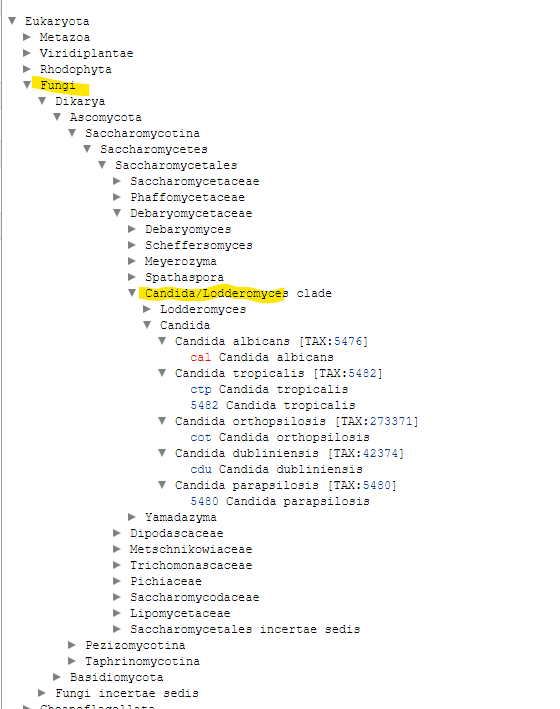
These toxins are the product of molds. Different molds produces different ones in different amounts. See Growth of Fungal Cells and the Production of Mycotoxins [2018] for more discussion. One fungi is Candida. There are many more as shown below.

The amount of research is actually very sparse. One rule of thumb (applies to some cases only) is that excessive Prevotella growth may happen from some fungi.

Different mycotoxins may cause increase or decrease of different bacteria. This is made worse in clinical practice because only a few may be tested for.

Literature Review

There is limited study of the microbiome and mycotoxins. There is an association of mycotoxins and Prevotella copri but in the clinical literature, high levels of Prevotella copri is not reported for ME/CFS – thus we should infer that it impacts a subset only.

Mycotoxin impact on the microbiome

Information here is sparse (and high level)

Oral Sub-Chronic Ochratoxin a Exposure Induces Gut Microbiota Alterations in Mice [2021]. This study found that the the shifts were positive or negative depending on dosages (marked with a * indicating shift seen for low dosages).

Unclassified BacteroidalesIncreases
BacteroidaceaeIncreases
PorphyromonadaceaeIncreases
PrevotellaceaeIncreases
RikenellaceaeIncreases
S24-7Increases
OdoribacteraceaeIncreases
Unclassified CyanobacteriaIncreases
DeferribacteraceaeDecreases*
LactobacillaceaeIncreases
StreptococcaceaeMajor Increase
Unclassified ClostridialesDecreases
ClostridiaceaeIncreases
DehalobacteriaceaeIncreases
LachnospiraceaeDecreases*
PeptococcaceaeIncreases
RuminococcaceaeDecreases
MogibacteriaceaeIncreases
ErysipelotrichaceaeDecreases
Unclassified AlphaproteobacteriaDecreases
AlcaligenaceaeDecreases
DesulfovibrionaceaeIncreases
EnterobacteriaceaeMajor Increase
AnaeroplasmataceaeIncreases

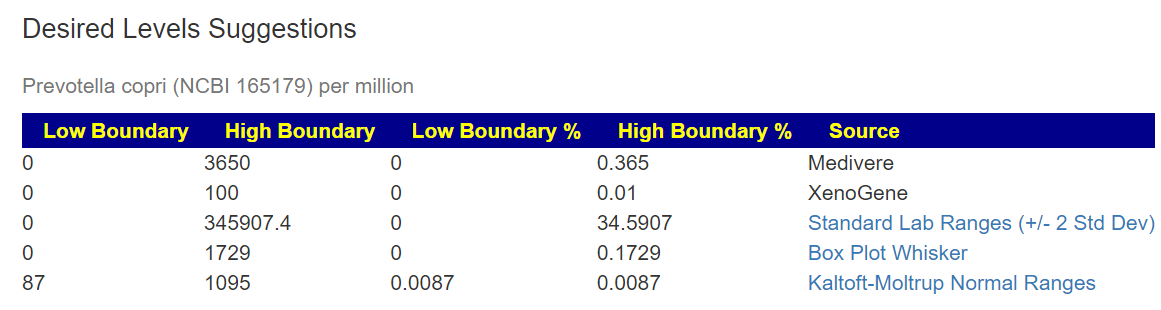
Prevotella copri Levels Of Concern

A Summary is below — but bacteria do not follow a bell curve. Instead look at the chart below

Values over 0.01% are of concern (IMHO)

Bottom Line

We know that we do not know much about different mycotoxins and their associated fungi. This is made worse because of an absence of standards!

In most cases, if visible mold growth is present, sampling [for mold] is unnecessary. Since no EPA or other federal limits have been set for mold or mold spores, sampling cannot be used to check a building’s compliance with federal mold standards. Surface sampling may be useful to determine if an area has been adequately cleaned or remediated. 

Mold Testing or Sampling – United States Environmental Protection Agency

As you can see from the chart below, ideally some 34,000 species should be tested for. Often people test using a $10 kits (Home Depot) or use an inspector that tests for only a few species. Chart Source

Can we definitively say that high Prevotella copri indicate a fungi issue — No. for some types of fungi that appears true but not for all.

We know that fungi can alter the microbiome but details on the fine print is missing.

Beware of Mycotoxins in Food

Mycotoxins are chemicals — sterilization does not kill the mycotoxins. It will kill the fungi producing the mycotoxins but the mycotoxin will still be there. Some examples:

In short, storage in a humid environment increased mycotoxin risk.

Keep your environment dry!

This usually means dehumidifiers. We have one as part of our heat pump system and smaller units in storage area. We usually set it to 40% humidity or less. We also picked up some Airthings monitors which send us messages when humidity becomes a concern.

Low humidity is also helpful for dealing with heat. The body is able to cool you down faster by sweat.

Image from Best Dehumidifiers for Your Home

We use a unit ($25) like below to keep an eye on each room. One for Three Digital Thermometer Hygrometer

New Belgium ME/CFS Patient

I am newly ill from ME/CFS (4-5 months) and wonder if my results look like a “typical ME/CFS” for you, or Long Covid for that matter.  I am a bit confused and some of the recommendations are contradictory.From Reader. He used Biomesight.com (serves the world, discount code “Micro”)

This will be an interesting analysis — the microbiome evolves over time, so a 20 year ME/CFS and a few months of ME/CFS will have differences. I know of no clinical studies looking at “fresh ME/CFS”. There are studies for “fresh Long COVID”.

Percentages of Percentiles

This tends to have a regular pattern for ME/CFS and Long COVID for most people. Over representation of bacteria in the 0-9% percentile range. This matches his pattern. A healthy person would have all of the bars around 10% – they are not.

Going to the Potential Medical Conditions Detected, there was nothing significant. Prevotella copri is 2% (78%ile) which is borderline for mold issues — it would be good to do inspect the home for that risk. Dr. Jason Hawrelak Recommendations comes in at 99.7%ile with high Methanobrevibacter and low Bifidobacterium being the most severe shifts. Anti inflammatory Bacteria Score is 63.1%ile which is a bit better than most people. So, many medical professionals would tell the patient that I cannot see anything wrong.

Special Studies

Special studies are statistical studies that uses samples uploaded and look at the self-reported symptoms. The analysis is done individually for each lab (needed because of differences in how labs process samples). In this case… we see that COVID Long Hauler is by far the strongest match, almost double the next one.

I did the usual Just Give Me Suggestions and then did the Long Hauler suggestions . This gave five (5) packages of suggestions. I then looked at the antibiotics suggestions, focused on those used with ME/CFS. The top ones are:

  • METRONIDAZOLE (ANTIBIOTIC)
  • AZITHROMYCIN,(ANTIBIOTIC)S
  • CHLOROQUINE DIPHOSPHATE
  • DAPSONE (ANTIBIOTIC)

If you have a cooperative MD, I would suggest following the protocol of the Belgium MD, Cecile Jadin: Dr. Jadin’s Current Protocol for ME/CFS.

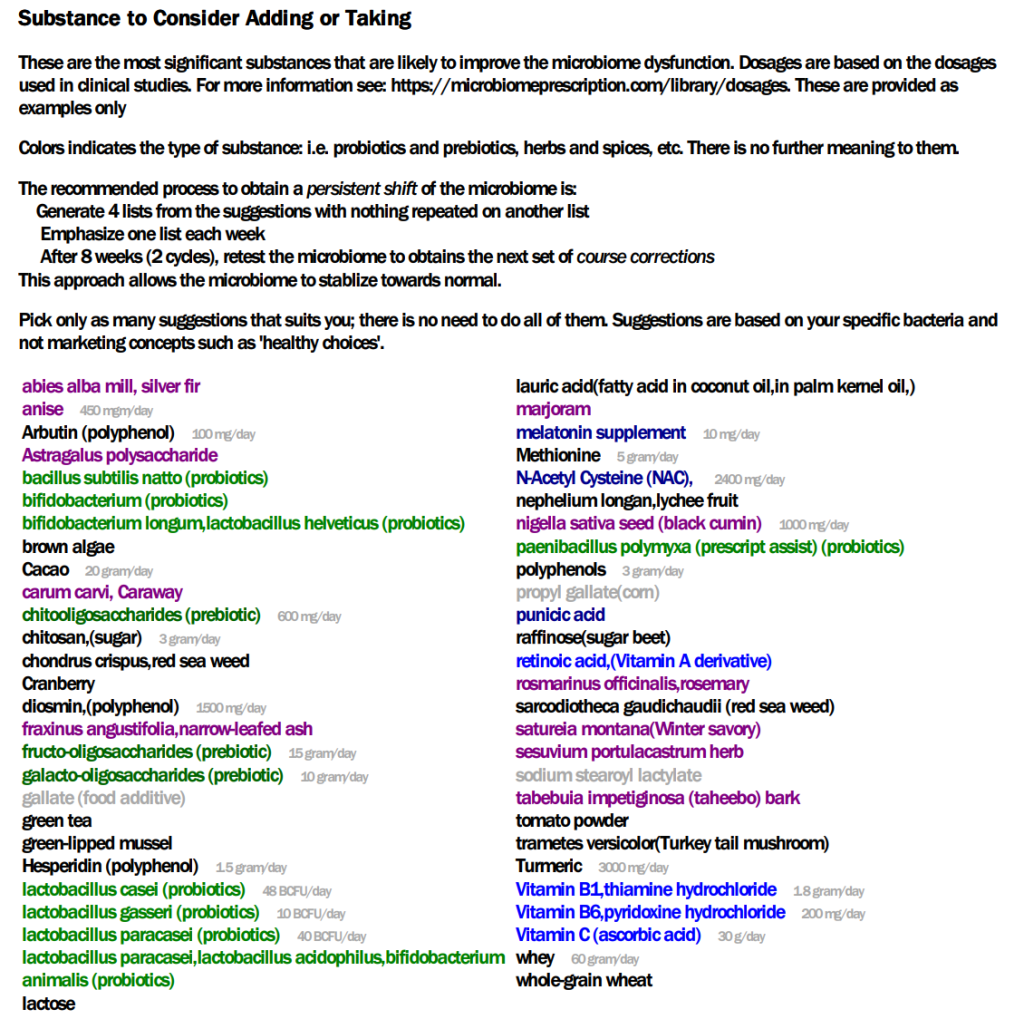
The list of suggestions to take is actually bigger than usual.

  • REMEMBER: There is no need to take all of them, just take what works for you (i.e. no adverse effect and acceptable cost).
  • Probiotics should be rotated (change to a different one) every 7 to 14 days. Probiotics often work by producing natural antibiotics. Continuous taking of the same probiotics may result in it not working because of “natural antibiotic resistance”.
  • The colors have no meaning except as indicators for category. For example, green is probiotics
  • Dosages are those that have been used in clinical studies (for other conditions), and thus deemed safe dosages. Often I have see people taking < 1% of these dosages and wondering why nothing happens.

For example, it you are lactose intolerance, then ignore the lactose suggestion. If not, regular cups of good Belgium Cacao would be a good prescription!

The safe retail probiotics were calculated to be

  • symbiopharm/ symbioflo2 – an E.Coli probiotic from Germany
  • Filmjölk (SE) / Filmjölk – a Swedish milk drink
  • enterogermina – Bacillus Clausii
  • SunWavePharma / Spor Sun – Bacillus Clausii

Why are these lists not the same? The latter list are ones that will not shift a single one of the bacteria we are focused on in the wrong direction: NOT A SINGLE BACTERIA. This is an extremely safe conservative suggestion. The top list with probiotics in green often contain probiotics that shifts 30 bacteria in the right direction and 3 in the wrong direction. The odds are that they are very likely to help.

We have a third list of probiotics (to make probiotic suggestions even more confusing), the KEGG suggestions. This looks at what enzymes your microbiome are low in, then sees which probiotics can provide those enzymes. Our goal is to reduce enzymes starvation; this cascades in metabolites — chemicals that the body uses — starvation. The key items from this list are:

If you have significant brain fog, I would be careful with taking lactobacillus probiotics. Some retail species can increase brain fog.

The Avoids

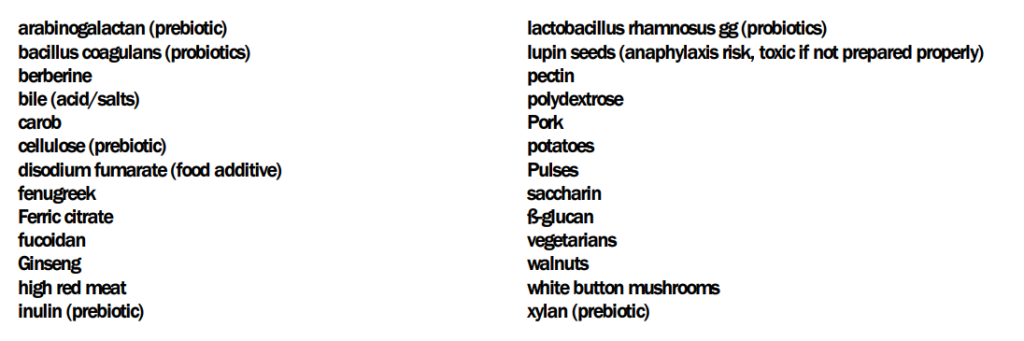
Frequently “good suggestions for general health” are bad for some conditions. The avoid list of things to avoid is short

Some quick translation: no iron supplements (ferric citrate), beta-glucans usually means no oats, barley or Reishi mushrooms. The names are those used in clinical studies — so they tend to be “unresolved” often in common speech.

Suggested Cycles

After implementing the above suggestions for 6 weeks, do another test and see what has changed.

Questions and Answers

Q: Is it best to take the antibiotics + the protocol you suggested ? Or is it one or the other?

  • A: My own choice would be to do both at the same time. If you follow Jadin’s approach, then
    • First week of antibiotics per month — no probiotics at the same time
    • Second week do some of the probiotics (I am inclined towards the E.Coli probiotics but that is based on my personal experience — your mileage may vary)
  • Rotate the other supplements over the weeks. I would suggest 10 days and then change to a different set.

Q: And lastly, in the « Avoids », the « vegetarians » suggestion is a little confusing to me. What does it mean?

  • Vegetarians mean no animal or fish is being consumed. So, have fish — but some animal proteins are to be reduced: no pork, moderate beef. Duck, chicken and rabbit are fine.

Q: The suggested dosage in the suggestions seems very high. 30g of Vitamin C per day??? Is this correct ?

  • The actual dosage should be discussed with your medical professional. The dosages are the highest that have been done in clinical studies and thus assumed to be safe dosages. We have no data on what the threshold for an effective dosage should be. I have seen a few studies where 1000 mg of a substance has minor/no effect while 1100 mg has twice the impact and 1200 mg has four times the effect. For many substances there seem to be a threshold that triggers changes.
    • Usually start at 1/8 of the dosage and double it every second day until there is a response. If very good keep at that dosage. If bad, cut the dosage in half and try a few more days. Give the body time to adapt.

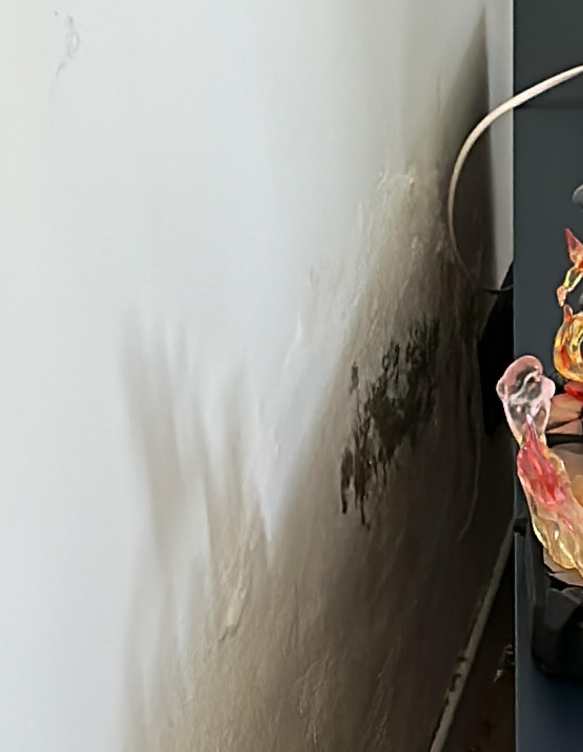
My comment about mold caused him to check his environment carefully…. what he found was out of sight!

Postscript – and Reminder

I am not a licensed medical professional and there are strict laws where I live about “appearing to practice medicine”.  I am safe when it is “academic models” and I keep to the language of science, especially statistics. I am not safe when the explanations have possible overtones of advising a patient instead of presenting data to be evaluated by a medical professional before implementing.

I can compute items to take, those computations do not provide solid information on rotations, dosages, etc.

I cannot tell people what they should take or not take. I can inform people items that have better odds of improving their microbiome as a results on numeric calculations. I am a trained experienced statistician with appropriate degrees and professional memberships. All suggestions should be reviewed by your medical professional before starting. Some suggestions may be counterindicated for other medications you are taking and medical conditions.

The answers above describe my logic and thinking and is not intended to give advice to this person or any one. Always review with your knowledgeable medical professional.

Mold and ME/CFS Relationship

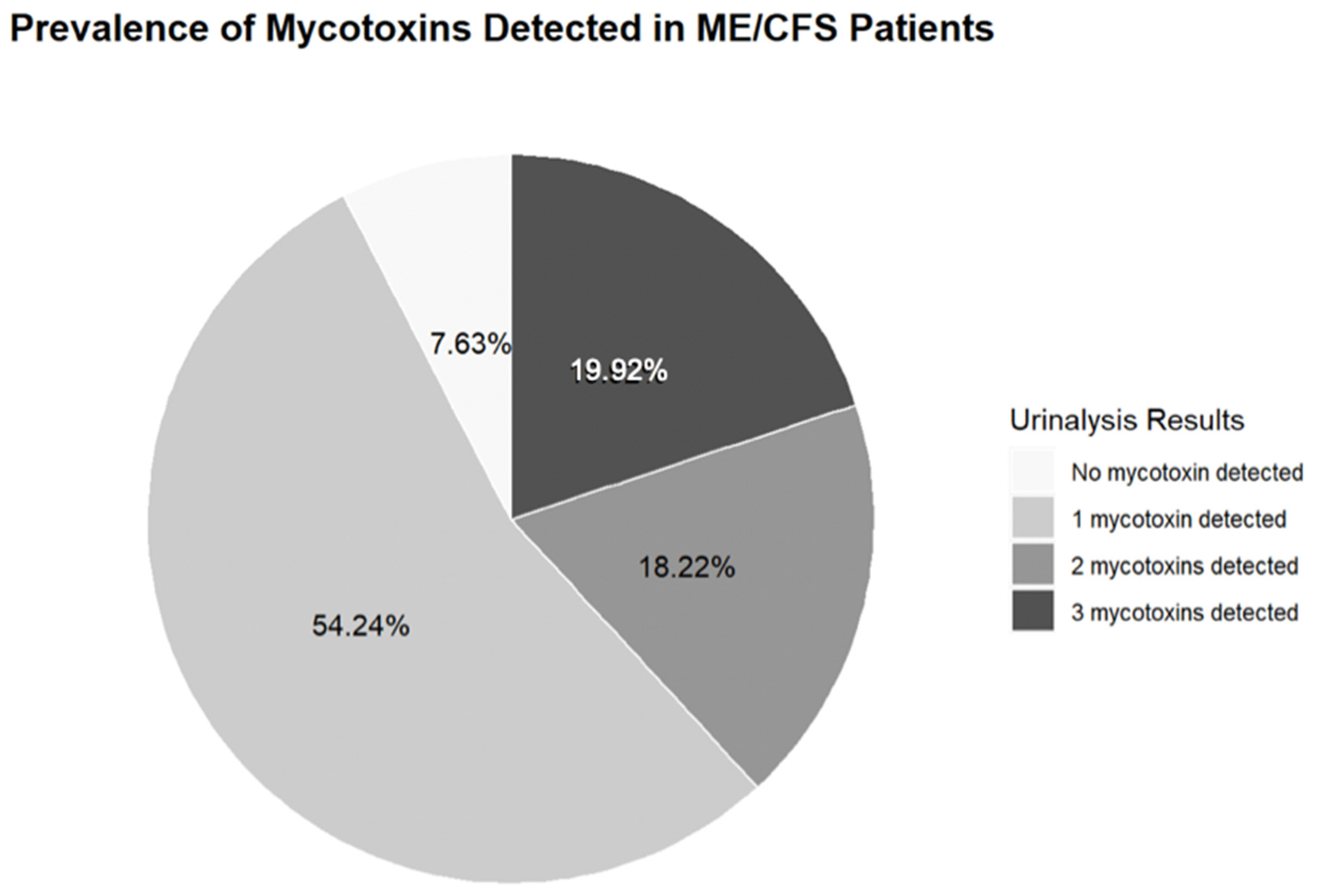
“Urine specimens from 104 of 112 patients (93%) were positive for at least one mycotoxin” from Detection of Mycotoxins in Patients with Chronic Fatigue Syndrome [2013]

Environmental factors – exposure to mold or toxins has been suspected as a trigger for ME/CFS. However, associations of specific environmental factors with ME/CFS have not been established.” [CDC]

Prevalence of Aspergillus-Derived Mycotoxins (Ochratoxin, Aflatoxin, and Gliotoxin) and Their Distribution in the Urinalysis of ME/CFS Patients [2022]