Reader’s improvement and microbiome shift after 3 months

I had done an analysis of his original before doing deep-dives in this Aug, 2017 post and a followup post later that month.

Reminder: This is all based on a model, a hypothesis that appears to match the known studies. The model purpose is to increase the odds of getting improvements. There are many factors that may influence what works and does not work – DNA, specific strains of some bacteria. We do not have enough knowledge to know what will work for any individual — we can make suggestions that appear to be far more probable to work.

Reader Notes

First, Thank you for all the work you do that so benefits this community.

Using your guidelines for changing my biome I went vegan, except 4oz of kefir in the AM.
The space of time is a little over 2 and half months. There are some remarkable changes.
For one my mood has most definitely stabilized, I’m much calmer. Energy is a little better, hyper-sensitivity seem to be lessened.
I’m far from well but am really pleased with the progress.
Within this time frame I did a short course of amoxicillin for dental work.
I realize the time involved and the number of request you receive, but would love your input on my latest uBiome. 
As mentioned I went vegan except for a small amount kefir about 4 oz, part of a breakfast with Trader Joe’s ancient grains cereal, a lot of blueberries, whey, ground flax seed, inulin, almonds, prescript assist and Bimuno.
I added a few of the probiotics but felt they caused more issues, so I stayed with only Prescript assist. 
Along with these I ate 100% rye with a table spoon or 2 of avocado oil, also included bakers !00% chocolate. 
Everything else was lots of beans and vegetables. 
PS, I’ve regained bowel function! (chronic constipation) 

Standard Items:

  • Lactobacillus: 0.04x ( 0.04 Prior)
  • Bifidobacterium: < 0.01 (< 0.01 Prior)
  • Akkermansia:  1.98x (7.36x prior)
  • Diversity:  68%ile (95%ile prior)
  • Firmicutes to Bacteroidetes:  1.0:1 (Normal 2.1:1)
    • 1.1:1 prior
    • Bacteroidetes 1.25 –> 1.5
    • Firmicutes  0.64 –> 0.7

Historic Trends

We can see there are significant shifts of some phylums
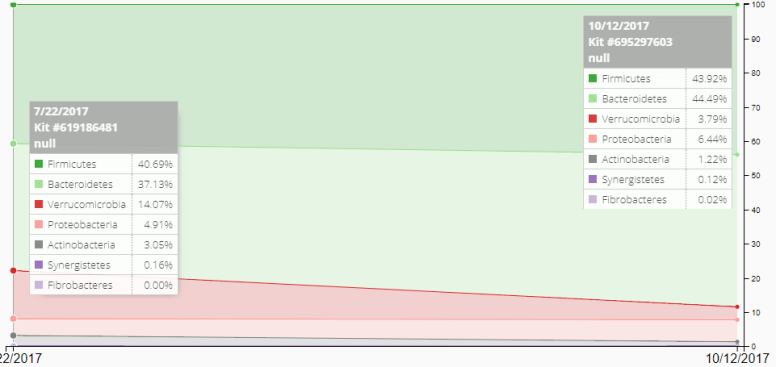
Untitled

Uncommon Bacteria

Proteiniphilum Genus 0.7%
Caldicoprobacter Genus 3.1%  (was in Prior)
Parasporobacterium Genus 3.5%
Parvibacter Genus 4.1% (was in Prior)
Christensenella Genus 4.5%

High Bacteria

Bacteria
Ratio
Oscillospira:  4.19 X (2.42x prior)
Alistipes:  3.54 X (4.53x prior)
Parasutterella: 2.50 X (2.98x prior)
Coprobacter: 2.15 X
Intestinimonas: 2.14 X  (2.00x prior)
Butyricimonas: 2.05 X (1.92 prior)
Thalassospira: 1.90 X
Flavonifractor: 1.60 X
Pseudobutyrivibrio: 1.55 X

Following have dropped below 1.5x

Akkermansia (was 5.26x –> down to 1.42): , Intestinibacter (was 5.0x –> down to 0.24x): 

References

Bottom Line Suggestions For New Ones

The lists below are done by merging the lists from the deep dives linked above. Some items may encourage one genus and discourage another genus — those are removed (unless it seems that it strongly predominates on one). The impact on Lactobacillus, Bifidobacterium and E.Coli are intentionally ignored [See this post for the logic]. This is all based on applying logic to the results of studies — thus theoretical. This is an addition (not a replacement) to this overview post.

Avoid

  • Barley and oat
  • Bifidobacterium animalis subsp.  lactis  B-12®
  • Bifidobacterium catenulatum
  • Bifidobacterium pseudocatenulatum
  • Black Tea
  • Clostridium butyricum (i.e. Miyarisan) probiotics
  • Generic Bacillus probiotics
  • Lactobacillus fermentum
  • Lysine supplements and foods
  • Metformin
  • Saccharomyces boulardii
  • Vitamin K2
  • Walnuts

Take

  • Alchohol
  • Bacillus subtilis natto
  • Bifidobacterum Bifidum
  • Bifidobacterum Infantis
  • Cranberry bean flour (or fresh cranberries)
  • E.Coli Probioitics
  • Enzymatically modified resistant starch
  • Faecalibacterium prausnitzii
  • Flaxseed
  • Gallate – Green Tea
  • Inulin
  • Lactobacillus Casei
  • Lactobacillus kefiri LKF01
  • Lactobacillus paracasei
  • Lactobacillus salivarius
  • L-glutamine
  • Polymannuronic acid
  • Resistant starch (type II & IV)
  • Tannin and Gallate   — green tea see this web page.

Personal Comments

It is interesting that Black Tea is a to avoid, while Green tea is a to take.

This is an education post to facilitate discussing this approach with your medical professionals. It is not medical advice for the treatment of any condition. Always consult with your medical professional before doing any  changes of diet, supplements or activity. Some items cites may interfere with prescription medicines.

Reducing Flavobacterium genus

For updated information see Microbiome Prescription

DataPunk.Net

Nothing

PubMed Data

There are 3400+ studies on PubMed, many dealing with fish.

Disease

Diet

Prebiotic

Probiotics

Antibiotics

BottomLine

Avoid

Take

Pyrroloquinoline quinone for CFS?

A reader starting taking this and their two earlier uBiomes had zero lactobacillus and zero bifidobacterium.  Both of these bacteria genus appear at low level afterwards (an improvement of both microbiome and general state).

Pyrroloquinoline quinone (PQQ), an aromatic tricyclic o-quinone, was identified initially as a redox cofactor for bacterial dehydrogenases. Although PQQ is not biosynthesized in mammals, trace amounts of PQQ have been found in human and rat tissues because of its wide distribution in dietary sources. Importantly, nutritional studies in rodents have revealed that PQQ deficiency exhibits diverse systemic responses, including growth impairment, immune dysfunction, and abnormal reproductive performance. Although PQQ is not currently classified as a vitamin, PQQ has been implicated as an important nutrient in mammals. In recent years, PQQ has been receiving much attention owing to its physiological importance and pharmacological effects.” [2015]

” PQQ supplementation resulted in significant decreases in the levels of plasma C-reactive protein, IL-6 and urinary methylated amines such as trimethylamine N-oxide, and changes in urinary metabolites consistent with enhanced mitochondria-related functions. ” [2013]

PubMed Literature

Informal Comments

One discussion group:

  1. THUMBS UP: “DID yield decent enough beneficial therapeutic effects; and DID NOT EXPERIENCE intolerable side effects; and IS WORTH the cost” (71 votes [61.74%] – View)
  2. THUMBS DOWN: “DID NOT yield decent enough beneficial therapeutic effects; and/or EXPERIENCED intolerable side effects; and/or IS NOT WORTH the cost” (44 votes [38.26%] – View)
  • “I have FMS/CFS and started taking PQQ recently and it has made a huge difference in my mental health as well as fatigue. Nothing has ever made any difference to the crippling fatigue I experience day in day out, so I was so happy to have come across this. I also started taking ubiquinol (Coq10 did nothing for fatigue) which also has the same effect as the PQQ (or maybe it is boosting what the PQQ has regenerated?) but sometimes when I take them together I become really angry and can end up in an uncontrollable rage. B12 also does this to me so maybe it is a methylation issue.” [Src]
  • I take it at Klimas’ suggestion. IIRC, she said I should get my CoQ-10 levels up before adding PQQ for the best effect. PQQ supposedly helps us generate more mitochondria, but I guess if you don’t have enough CoQ-10 for the mitochondria you already have to work properly, how smart is it to try to grow new mitochondria that also wouldn’t be able to function properly? [Src]

    This study found that PQQ helped fatigue, tension-anxiety, depression, anger-hostility and confusion, appetite, sleep, obsession and pain, with the full effect appearing after 8 weeks supplementing daily with 20 mg of PQQ. [Src]

Bottom Line

The documented neuroprotective aspects of PQQ makes it an attractive supplement for CFS. There is an absence of studies on the microbiome or studies with CFS/IBS/FM.

There is no supporting evidence that it increases Lactobacillus or Bifidobacterium, nor evidence of adverse effect.

A Reader with mild CFS microbiome

Looking at this uBiome, I noticed that the standard items are far less extreme (today) than most CFS readers. This was not the case a year ago, or 3 years ago. This appears to agree with only 1 uncommon bacteria and just 2 overgrowth bacteria genus (the lowest number that I recall seeing).

Reader Notes

 I’ve been sick so long, and tried so many things, that I’m not easily able to make choices.
I’ve tried many dietary interventions, ranging through Wahls’ Paleo Plus, Crook’s candida diet, high resistant starch, nothing but potatoes, etc.  I recently realized that I have histamine issues, so my latest rotation of probiotics dropped histamine-producing strains.  I’ve had presumed Lyme this summer and last, and did a month of doxycycline each time.  I have always taken probiotics during and after antibiotics.  
I have slow-onset, gradual progression CFS.  In my 30 years of experimentation, the only things that help are a very low carbohydrate diet (but I immediately get severely constipated and give up), and starting in August, 20mg Pyrroloquinoline quinone (PQQ) daily.  The PQQ has bumped me from high-moderate to high-mild. 
I am on day 3 of Bimuno.  I bought 3 packs of 30 because…..shipping from the UK.  If this is a bad idea, I would like to know that.
I have had multi-waking insomnia for decades.  I wake 3-5 times a night (in 8-9 hours), and usually go back to sleep quickly.  I have trouble with mental focus, so I don’t drive in crowded situations, or for longer than 15 minutes, or on highways.  I’m self-sufficient, spend almost all of my time alone, and leave the house 2-3 times a week for groceries and to replenish books from the library.  I can’t handle tv, movies, or any kind of streaming.
Gradual decline 3year ago  => 1 year ago, continuing until about 2 weeks from starting PQQ, then slow, irregular increase in function

Standard Items:

  • Lactobacillus: 0.02x (2014, 2015 – 0x)
  • Bifidobacterium: 0.18x (2014, 2015 – 0x)
  • Akkermansia:  0.28x (2.66x in 2014, 0x in 2016)
  • Diversity:  75%ile
  • Firmicutes to Bacteroidetes:  2.0:1 (Normal 2.1:1)
    • 5.1:1 in 2014
    • 1.1:1 in 2016

Historic Trends

bb12

Uncommon Bacteria

Bacteria name Rank % of Samples
Anaerovorax Genus 3.2%

High Bacteria

Subdoligranulum: 3.71 X
Sutterella: 1.96 X

ReferenceBB121

Bottom Line Suggestions

The lists below are done by merging the lists from the deep dives linked above. Some items may encourage one genus and discourage another genus — those are removed (unless it seems that it strongly predominates on one). The impact on Lactobacillus, Bifidobacterium and E.Coli are intentionally ignored [See this post for the logic]. This is all based on applying logic to the results of studies — thus theoretical. This is an addition (not a replacement) to this overview post.

Avoid

  • Berberine
  • Bifidobacterim Breve
  • BPA bottles
  • Lactobacillus Casei
  • Lactobacillus salivarius
  • Omega 3
  • Saccharomyces boulardii
  • Walnuts

Take

  • Bifidobacterium Longum probiotics
  • High Fat diet
  • Inulin
  • Lactobacillus plantarum probiotics

Personal Comment

The appearance of Lactobacillus and Bifidobacterium, with Firmicutes to Bacteroidetes approaching normal is a very positive sign. I need to revisit “Feeding of Lactobacillus”.

I will be researching Pyrroloquinoline quinone (PQQ) it is not something that I have come across before.

This is an education post to facilitate discussing this approach with your medical professionals. It is not medical advice for the treatment of any condition. Always consult with your medical professional before doing any  changes of diet, supplements or activity. Some items cites may interfere with prescription medicines.

A Healthy FMT Donor Microbiome and response to FMT

The reader whose uBiome I reviewed  here in September, did a followup with his FMT donor and got permissions from the healthy donor to share. This is of great interest because FMT for CFS tend to work well for a while and then the patient relapse. Understanding the factors involve with FMT is an important quest.

Reader Notes

I did a series of 5 FMTs for my CFS, back in August. And I was lucky in my donor. I found a longtime friend locally, more than willing to help, and in extremely good health. Breast-fed as an infant, clean diet, no antibiotics in past 6 months, passed all the basic pathology screenings.
And when I say “extremely good health,” I mean: an athlete who does CrossFit, low anxiety, whom I’ve never seen tired or irritable. If I asked 10 of our mutual friends who is the healthiest man they personally know, they would all mention his name.
But my FMT was only mildly helpful. It immediately corrected my previous 2 months of severe fatigue (following a difficult outpatient surgery after which I declined antibiotics). But there were no other significant changes. It just brought me back to me pre-surgery baseline, which has been decades of CFS (brain fog, low energy, exercise intolerance, general hypersensitivity, etc).
With that in mind, I got his permission to let you take a look at his uBiome results we just got back.
The analysis of the reader who had the FMT is here.

Standard Items:

  • Lactobacillus: 0x
  • Bifidobacterium: 4.07x
  • Akkermansia:  0x
  • Diversity:  59%ile
  • Firmicutes to Bacteroidetes:  1.8:1 (Normal 2.1:1)

Uncommon Bacteria

Bacteria name Rank % of Samples
Leptotrichia Genus 1.5%
Anaerobacter Genus 3.0%
Parasporobacterium Genus 3.5%
Neisseria Genus 4.2%
Aggregatibacter Genus 4.7%

High Bacteria

It is interesting to note that every high genus (apart from Bifidobacterium) is on the list of typical overgrowths seen with CFS (see this post)

Odoribacter: 2.55 X
Bifidobacterium:  2.55 X
Faecalibacterium:  1.91 X
Slackia: 1.88 X
Streptococcus:  1.75 X
Subdoligranulum: 1.73 X
Adlercreutzia: 1.65 X
Clostridium:  1.59 X

Bottom Line

In my earlier post, Theortical Protocol for Fecal Transplants for CFS/IBS etc, I suggested “donor should not have any bacteria genus > 1.5x that the recipient has > 1.5x.”  This donor match this criteria, so well it may be helpful (as it was in this case), I would like to suggest raising the threshold to: “No bacteria genus > 1.5x should be on the list of common bacteria genus overgrowths listed at Overview of this Blog and the Microbiome.

How can the donor be healthy with no Lactobacillus?

There are several possible answers:

  • He may be taking adequate supplements to compensate.
  • His DNA (remember DNA SNPs are associated with CFS/IBS/FM and symptoms).
  • Other bacteria may be compensating
  • He may be borderline CFS
  • The high Bifidobacterium compensated.

This is an education post to facilitate discussing this approach with your medical professionals. It is not medical advice for the treatment of any condition. Always consult with your medical professional before doing any  changes of diet, supplements or activity. Some items cites may interfere with prescription medicines.