Revisiting old Ubiome’s “C”

A year ago, several readers shared their ubiome for me and I did a series of post looking for patterns. See this post on the Genus Numbers.

It is time that I do deep dives for these early sharers.

Results C:

  • Diagnosis: ME/CFS, POTS, MCAS, IBS-C, mold illness. No probiotics before test. I changed environments and had some health improvement between tests.
    • C1 10/1/2013
    • C2 9/13/2015
    • C3 6/23/2016
Genus C2
Akkermansia 13.04
Bilophila 3.13
Alistipes 2.81
Eggerthella 2.36
Intestinimonas 1.96
Odoribacter 1.88
Bacteroides 1.55
Flavonifractor 1.51

Deep Dive References

Bottom Line Suggestions

The items from each of the deep dives aligned very nicely for this microbiome, for example, Inulin was listed many times.

The lists below are done by merging the lists from the deep dives linked above. Some items may encourage one genus and discourage another genus — those are removed (unless it seems that it strongly predominates on one). The impact on Lactobacillus, Bifidobacterium and E.Coli are intentionally ignored [See this post for the logic]. This is all based on applying logic to the results of studies — thus theoretical. This is an addition (not a replacement) to this overview post.

Avoid

  • Akkenmansia muciniphila probiotic (when it becomes available)
  • Allergens
  • Animal-based diet
  • Arginine supplements
  • Bacillus subtilis
  • Barley
  • Bifidobacterium Animalis subsp. Lactis BB-12
  • Bifidobacterium catenulatum
  • Bifidobacterium pseudocatenulatum
  • Bile
  • Broad beans  and lupin seeds
  • Capsaicin (Chili Peppers)
  • Daesiho-tang (DSHT)
  • fermented Korean soybean paste
  • Fructo-oligosaccharides
  • gum arabic
  • Heme
  • High animal protein/meat diet
  • High meat diet
  • High protein diet
  • L. casei
  • Lactobacillus acidophilus
  • Lactobacillus fermentum
  • L-citrulline
  • Lingonberries
  • Low fat diets
  • Low processed foods diet
  • Lysine supplements and foods
  • Melatonin
  • Metformin
  • Milk-derived saturated fat
  • Pomegranate ellagitannins
  • pomegranate juice
  • Resveratrol
  • Rhubarb
  • Saccharin
  • Stevia
  • Stress
  • Tannic acid

Take

  • Bacillus licheniformis
  • Bacillus subtilis natto
  • Bifidobacterum Bifidum
  • Bifidobacterum Infantis
  • Chicory
  • Faecalibacterium prausnitzii
  • Flaxseed
  • Garlic
  • Inulin
  • Lactobacillus kefiri LKF01
  • Lactobacillus plantarum
  • Oligosaccharide prebiotics
  • Omega 3 fatty acids
  • Polymannuronic acid
  • Sucralose (Splenda)
  • Tea Tree Oil
  • Vitamin D
  • Walnuts
  • Whole-grain barley
  • β-Glucan

This is an education post to facilitate discussing this approach with your medical professionals. It is not medical advice for the treatment of CFS. Always consult with your medical professional before doing any  changes of diet, supplements or activity. Some items cites may interfere with prescription medicines.
Revisiting old Ubiome’s “D” – IBS only

A year ago, several readers shared their ubiome for me and I did a series of post looking for patterns. See this post on the Genus Numbers.

It is time that I do deep dives for these early sharers.

Results D:

  • IBS. No CFS
    • D2 1/16/2015
    • D1  3/26/2015
Genus D1
Dorea 3.01
Clostridium 2.79
Blautia 2.19
Enterorbabdus 1.55

Deep Dive References

Bottom Line Suggestions

The items from each of the deep dives aligned very nicely for this microbiome, for example, Inulin was listed many times.

The lists below are done by merging the lists from the deep dives linked above. Some items may encourage one genus and discourage another genus — those are removed (unless it seems that it strongly predominates on one). The impact on Lactobacillus, Bifidobacterium and E.Coli are intentionally ignored [See this post for the logic]. This is all based on applying logic to the results of studies — thus theoretical. This is an addition (not a replacement) to this overview post.

Avoid

  • Animal-based diet
  • Bacillus subtilis
  • barley
  • Berberine.
  • Bifidobacterium longum
  • Bifidobacterium animalis
  • brown rice
  • Cholic acid
  • flavone
  • Fluoroquinolone
  • Helminth infections
  • high grain diet
  • Lactobacillus plantarum
  • Lactobacillus salivarius
  • Metformin
  • omega-3
  • Resistant starch (type II, IV)
  • Rosemary
  • Saccharomyces boulardii
  • Safflower oil
  • Sodium butyrate
  • Stress
  • Walnuts (and likely pomegranates)

Take

  • Bacillus licheniformis
  • Bifidobacterium Breve
  • Bile acid
  • Chitosan supplements
  • Coconut Oil, Monolaurin (Lauric Acid)
  • Flaxseed
  • Galactooligosaccharides
  • Grape seed polyphenols,/ Wine
  • Have Chocolate!
  • Lactobacillus casei
  • Lactobacillus paracasei  24 billion viable  daily
  • l-glutamine
  • Oral Iron Supplements
  • Oranges (pectin/flavanones)
  • Polymannuronic acid
  • Prescript Assist
  • Smoking (!?!)
  • Streptococcus Probiotics
  • Vitamin D3
  • Xylooligosaccharide
  • β-glucan

This is an education post to facilitate discussing this approach with your medical professionals. It is not medical advice for the treatment of CFS. Always consult with your medical professional before doing any  changes of diet, supplements or activity. Some items cites may interfere with prescription medicines.

Revisiting old Ubiome’s “A”

A year ago, several readers shared their ubiome for me and I did a series of post looking for patterns. See this post on the Genus Numbers.

It is time that I do deep dives for these early sharers.

Results A

  • ME/CFS for 20 years, 90-100% functional for years 2-8, 60 – 80% functional for years 9-16, 10% – 70% functional for years 16-20 Currently about 50%-60% again. Main symptoms, fatigue, lack of energy, feeling crappy (flu-like), get sick easily and stay sick for months (I have 2 kids 8 – 10 now so they kept bring home infections) no brain fog now, but currently issues with a tired brain, IBS or dysbiosis, Urinary Issues
    • A1 – 9/18/2015
    • A2 3/17/2016
Genus A2
Intestinibacter 8.66
Flavobacterium 4.39
Marvinbryantia 3.62
Terrisporobacter 1.99
Hespellia 1.68
Phascolarctobacterium 1.61
Subdoligranulum 1.56

Deep Dive References

Bottom Line Suggestions

The items from each of the deep dives aligned very nicely for this microbiome, for example, Inulin was listed many times.

The lists below are done by merging the lists from the deep dives linked above. Some items may encourage one genus and discourage another genus — those are removed (unless it seems that it strongly predominates on one). The impact on Lactobacillus, Bifidobacterium and E.Coli are intentionally ignored [See this post for the logic]. This is all based on applying logic to the results of studies — thus theoretical. This is an addition (not a replacement) to this overview post.

Avoid

  • Berberine
  • Bifidobacterim Breve
  • High Fat Diet
  • Lactobacillus salivarius
  • Lysine supplements and foods
  • Minocycline
  • Omega 3
  • Penicillin
  • Polydextrose
  • Saccharomyces boulardii
  • Soluble corn fiber
  • Walnuts (and likely no  pomegranate – both are high urolithin)

Take

  • Acarbose
  • Cranberry bean flour
  • Flaxseed
  • Fumarate
  • Galactooligosaccharides (GOS)
  • High Protein Diet
  • Inulin
  • Lactobacillus kefiri LKF01
  • Lactobacillus paracasei
  • palm kernel meal
  • Resistant starch (type II)
  • Sodium chloride (Table Salt)
  • Tea

This is an education post to facilitate discussing this approach with your medical professionals. It is not medical advice for the treatment of CFS. Always consult with your medical professional before doing any  changes of diet, supplements or activity. Some items cites may interfere with prescription medicines.

Decreasing Phascolarctobacterium Genus

For updated information see Microbiome Prescription

Associated with folate biosynthesis [2014]

DataPunk.Net Data

INHIBITED BY

ENHANCED BY

PubMed Data

There are 38+ studies on PubMed.

Disease

  • Phascolarctobacterium …. associated with the metabolic state and mood of the host. ” [2017]
    • “Bacterial genera Roseburia, Phascolarctobacterium, Lachnospira, and Prevotella had potential positive correlation with positive mood, while genera Faecalibacterium, Bifidobacterium, Bacteroides, Parabacteroides, and Anaerostipes were correlated with negative mood. ” [2016]
  • “Decrease in genus Phascolarctobacterium was linked to presence of colonic inflammation regardless of IBD phenotype. ” [2017]
  • “Campylobacter infection …had a significantly higher abundance of Phascolarctobacterium(P = 0.017) and Streptococcus (P = 0.034) sequences ” [2014]

Diet

  • “High-protein diet …. decreases..” [2017]
  • “High Fat diet increases” [2015]
  • ” The abundance of Faecalibacterium, Phascolarctobacterium, and Dialister was greater (P < 0.05) in response to polydextrose and soluble corn fiber  intake, ” [2012]

Prebiotics

  • “fructooligosaccharides (FOS) and galactooligosaccharides (GOS)  ..while the butyrate-producing bacteria like Phascolarctobacterium in FOS group and Ruminococcus in GOS group were decreased. ” [2017]
  • “At genera level, five flourished after treatment with acarbose, including Lactobacillus and Dialister, while Butyricicoccus, Phascolarctobacterium, and Ruminococcus were inhibited.” [2017]

Probiotics

  • “aecalibacterium, Propionibacterium, Bifidobacterium and an unidentified genus from Bacteroidaceae and Lachnospiraceae and a negative correlation between  Lactobacillus casei Zhang  administration and the presence of Clostridium, Phascolarctobacterium, Serratia, Enterococcus, Shigella and Shewanella.” [2014]
  • “The relative abundance of Megamonas spp. Faecalibacterium spp. and Lactobacillus spp. increased significantly, the relative abundance of Bacteroides spp. and Phascolarctobacterium spp. decreased significantly in Lactobacillus paracasei N1115 probiotics group.”

Antibiotics

Bottom Line

Avoid

  • Berberine
  • Soluble corn fiber
  • Polydextrose
  • High Fat Diet

Take

Update on a previous analysis

I did this earlier post before doing deep dives, the reader pinged me so I am revisiting the results using the deep dives.

This person has two gut uBiomes, the differences are below

Measure Mar 2017 July 2017
Firmicutes to Bacteroidetes 2.9:1 3.8:1
Victivallis: 24.23 19.69
Anaeroplasma: RARE 6.39 2.31
Clostridium:  5.53 4.26
Oscillibacter: 4.48 3.18
Marvinbryantia: 3.79 3.17
Sarcina: 2.56 2.8
Intestinibacter: 2.09 1.77
Flavonifractor 2.04 1.41
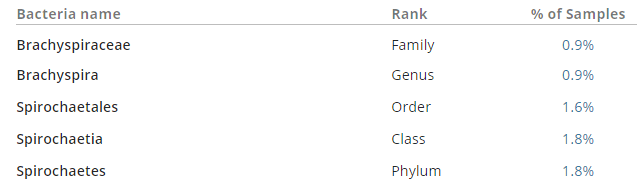
Brachyspira: RARE 1.69 0.20

Deep Dive References

The two highest ones I have not seen in other uBiome results.

I have not covered Brachyspira which is part of Spirochaetes -> Spirochaetia -> Brachyspirales -> Brachyspiraceae -> Brachyspira.   This single genus results in all of the rare results below (parents, grandparents, greatgrandparents….).

rare2

Since it has dropped so much already, I suspect there is no need to take explicit action

Bottom Line

The high Victivallis genus is a total pain and extremely high — we know that many antibiotics causes it to increase and I could not find any literature for antibiotics that causes it to decrease.  If it is to be treated by antibiotics then this bacteria must be cultured (which is not easy) and then different antibiotics tested to find one that works (and hopefully a paper published).

I have seen it high in only in one other ubiome analysis — after a fecal transplant where antibiotics were used in preparation.

The best path forward is to go on the assumption that the other high bacteria genus are supporting it, so reducing those would reduce victivallis as a side effect.

The lists below are done by merging the lists from the deep dives linked above. Some items may encourage one genus and discourage another genus — those are removed (unless it seems that it strongly predominates on one). The impact on Lactobacillus, Bifidobacterium and E.Coli are intentionally ignored [See this post for the logic]. This is all based on applying logic to the results of studies — thus theoretical. This is an addition (not a replacement) to this overview post.

Avoid

  • All antibiotics (due to Victivallis issue)
  • Berberine
  • Bifidobacterium longum
  • Bifidobacterium animalis
  • Fructooligosaccharides
  • High Fat Diet
  • Lactobacillus fermentum
  • Lysine supplements and foods
  • Minocycline
  • Penicillin
  • Saccharomyces boulardii
  • Vancomycin
  • Walnuts (and likely pomegranates)

Take

  • Bacillus licheniformis
  • Bifidobacterium Breve
  • Chitosan supplements
  • Enterococcus  faecalis probiotics
  • Fennel
  • Flaxseed
  • Gallate – Tea
  • Gluten free diet
  • Have Chocolate!
  • High resistance starch
  • Inulin
  • Lactobacillus casei
  • Lactobacillus kefiri LKF01
  • Lactobacillus rhamnosus probiotics
  • lycheerambutanguaranakorlanpitomba, Spanish lime and ackee. [fam-Sapindaceae]
  • Polymannuronic acid
  • Prescript Assist
  • Resistant starch (type II & IV)
  • Streptococcus Probiotics
  • Tannins
  • Tetracyclnes, Sparfloxaccin, Neomycin, Streptomycin

This is an education post to facilitate discussing this approach with your medical professionals. It is not medical advice for the treatment of CFS. Always consult with your medical professional before doing any  changes of diet, supplements or activity. Some items cites may interfere with prescription medicines.