Can ME/CFS, Long Lyme and COVID run in families?

My answer is simple: Yes — but the mechanism may be one of several possible. The most likely are:

  • Environmental influences.
  • Family behavior patterns (i.e. stress level run high)
  • Explicit DNA Mutations
  • Shared microbiome signatures

Despite a prevalence of ∼0.2-0.4% and its high public health burden, and evidence that it has a heritable component, ME/CFS has not yet benefited from the advances in technology and analytical tools that have improved our understanding of many other complex diseases. 

Genetic risk factors of ME/CFS: a critical review [2020]

Some paediatricians will have noted a family history of CFS/ME and may have wondered whether this was due to genetic heritability or an environmental factor.

Is chronic fatigue syndrome (CFS/ME) heritable in children, and if so, why does it matter? [2007]

A heritable component is implicated by the reported increased risk in relatives of ME/CFS patients [10,11,12], and genetic association studies are emerging in order to identify risk variants. We have recently reported associations with specific HLA alleles, HLA-C*07:04 and HLA-DQB1*03:03 [13], and individuals carrying either one or both risk alleles seem to more often respond positively to the immunosuppressive drug cyclophosphamide [14]

No replication of previously reported association with genetic variants in the T cell receptor alpha (TRA) locus for myalgic encephalomyelitis/chronic fatigue syndrome (ME/CFS) [2022]

Let us take these in reverse order.

Environmental influences

A simple example is a house with a mold issue. The parents may be impacted by the mold, and it is likely that the children will also be impacted. Recently I saw that mites (Chiggers) can spread disease causing bacteria. If one in the household has an asymptomatic infection, it may well spread to others in the family. The household may live in an area where there is pesticide drift. The sensitivity to these factors may be genetic or epigenetic. An environment factor that pre-dispose one child to ME/CFS will likely influence other children of the same family.

“Research to date has demonstrated the initiation of neurobehavioral sensitization by volatile organic compounds and pesticides in animals, as well as sensitizability of cardiovascular parameters, beta-endorphin levels, resting EEG alpha-wave activity, and divided-attention task performance in persons “

Illness from low levels of environmental chemicals: relevance to chronic fatigue syndrome and fibromyalgia [1998]

Family behavior patterns (i.e. stress level run high)

Domestic abuse can be both spousal and parental (and even siblings). Abuse (and stress) increases the risk of ME/CFS. A person that is abused is more likely to become an abuser (hence passing through generations) See Intergenerational Trauma: How Child Abuse Patterns Repeat Across Generations [2018]

An additional dimension is personality types, which also runs in families

Explicit DNA Mutations

This actually has at least two subsets. Defects causing hypercoagulation and general ME/CFS ME/CFS population is the one that I am more, if too familiar with. The general population is prone to a large amount of noise and typical finding is that a third or less of ME/CFS patients have a relevant mutation, while the same mutation is seen only half as often in the general population. This means that 2/3 of ME/CFS patients will not have this mutation – so limited value for making a diagnosis. If you have a specific mutation that is known to be treatable, then that should be factored in.

When more complex statistical methods are used, Prediction of complex human diseases from pathway-focused candidate markers by joint estimation of marker effects: case of chronic fatigue syndrome [2015] this “resulted in 80% accuracy, one of the best so far for CFS in comparison to previous prediction models.” This approach does not look for a single mutation but for combinations of many different mutations. Each one of these contributes a little.

The hypercoagulation SNP is different because you are not looking for a mutation shared by all ME/CFS patients but mutations already known to encourage coagulation. Dave Berg pioneered this work.

A partial list of these SNPs are in my 2015 post, Snps for Coagulation Defects. To these, we can add the following:

Shared microbiome signatures

Bacteria may be transferred by a kiss or even touching. Similar diets will encourage the same profiles. Like the environment, it may pre-dispose people in the same family because of the shared food, and the shared microbiome.

With this less documented dimension, the microbiome may be pre-disposed towards being dysfunctional. Similarly, the microbiome may pre-dispose a person to have high anxiety. Things become a bit more complicated because the microbiome is influence by DNA (and the reverse). There was a Chinese study that I remember reading where both COVID severity and Long COVID was associated with people’s pre-COVID microbiome (they happen to have been running a large time-lapse study on the microbiome)

Bottom Line: It does run in Families

My suggestion for action plans for those concerned:

  • Improve the environment as much as is possible.
  • If type-A personality or high anxiety is a factor, learning better coping mechanisms or lowering expectations may help. Do set expectations on other people!
  • Microbiome Analysis and changing diet to better normalize. The microbiome appears to influence anxiety greatly. Also Gut bacteria linked to personality[2020]
  • DNA testing — technically it could help, but still early days for research. The one exception is testing for inherited genetic coagulation factors.

Needless to say, I favor microbiome manipulation greatly — because it is the easiest factor to address (can be hard to give up favorite unhealthy foods).
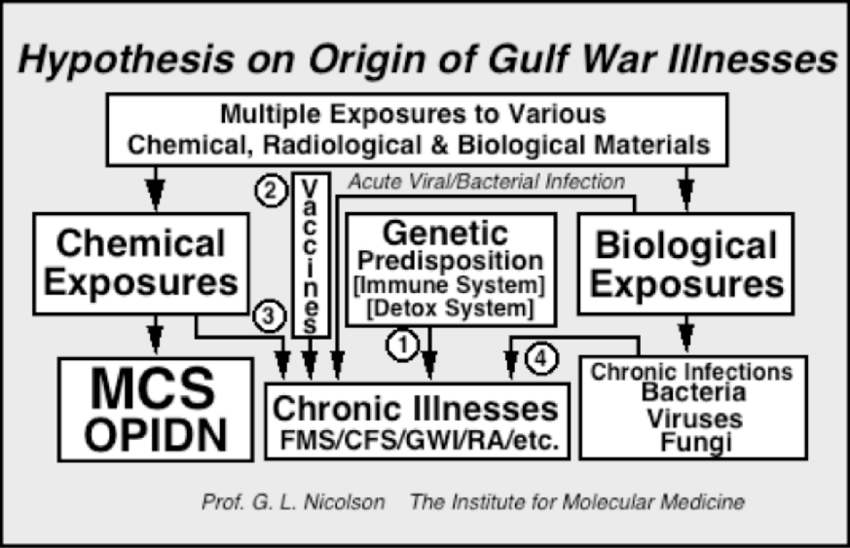
Prof. Garth Nicolson’s Protocol for GWS and ME/CFS failed.

Back in 1990, Garth Nicolson believed that mycoplasma was the cause of both. I actually appear on a news report with him as a sample patient doing antibiotics (but different ones). Some of his articles:

Follow up Study — FAILED

WASHINGTON, D.C.–A major trial has found no evidence that antibiotics help patients with Gulf War illness. Moreover, the outcomes of the $6 million study suggest that the hypothesis underlying it–that a microbe causes the mysterious set of complaints–is false.”

Antibiotic Fails in Gulf War Syndrome [Science] 2021-08-14

I am not surprised at the Failure

Back in 1999 when I had major ME/CFS, Nicholson’s protocol was one that I considered but did not take because I perceived Jadin’s Protocol to be significantly better [ Dr. Jadin’s Current Protocol for ME/CFS ]. I knew enough about antibiotic resistance to deem any monotonic(just one) antibiotic (or that matter, anti-viral) protocol to likely fail over time. The classic model of antibiotics is that it reduces the infection to the point that the body can take over bacteria suppression. If the immune system is misfiring, this becomes a major and wrong assumption.

Since those days, my understanding is that the cause of ME/CFS, Chronic Lyme and Q-Fever, and Long COVID is not a single bacteria (or virus) infection. It is an altered microbiome placed into a dysfunctional state by a bacteria, infection, stress or other environmental factor; and the microbiome was unable to return to normal. It is unlikely that a single antibiotic taken continuously will remedy this situation. Normalizing the microbiome is a complex thing and, IMHO, requires continuous intelligence (i.e. microbiome tests).

With the Remission Biome Project for ME/CFS we are seeing subject and objective (i.e. in follow-up microbiome tests) improvements.

The Remission Biome Project: Tamara Romanuk

For more information on this project see Health Rising post. Both participants has granted me to do a review with their real names. This is the second of a series of posts on this project, the first one was on Tess Falor.

Connected with review, you may wish to read Dr. Jadin’s Current Protocol for ME/CFS – Microbiome Prescription Blog, parts are being consider for incorporation into the Remission Biome Projects

The earliest use of antibiotics for treating ME/CFS that I am aware of, dates from the late 1990’s with articles in  Journal of Chronic Fatigue Syndrome (and conference reports prior)

My remission from ME/CFS was done by combining C.L. Jadin protocol with Dave Berg anticoagulant protocol.

A big thanks to BiomeSight.com for donating some testing kits to the project. If interested in using their kits, there is a discount code (“micro”). For another person in this project: The Remission Biome Project: Tess Falor

Overview of results

First, let us show the numbers and then talk about them. It is clear that there are significant changes. There are a lot of dimensions to consider. Some highlights:

  • The number of bacteria with abnormally high representation has gone from 123 down to 29
  • The number of bacteria with abnormally low representation has gone from 222, dropping down to as low as 19, before rebounding to 162 (still better than the start)
  • Most measure showed great improvement and then some relapse.
Criteria7-Mar23-Mar15-Apr22-Apr29-Apr
Shannon Diversity Index33.878.097.176.577.1
Simpson Diversity Index0.765.158.660.373.4
Chao1 Index91.361.672.089.414.8
Chi-Square (Lower is better)5547465030
Lab Read Quality8.67.15.42.26.9
Bacteria Reported By Lab755638628765461
Bacteria Over 99%ile271113565
Bacteria Over 95%ile72253010518
Bacteria Over 90%ile132466317829
Bacteria Under 10%ile2222186219162
Bacteria Under 5%ile1911951812144
Bacteria Under 1%ile17717903112
Lab: BiomeSight
Rarely Seen 1%843662
Rarely Seen 5%22242712814
Pathogens3932333129
Outside Range from JasonH88888
Outside Range from Medivere1818161616
Outside Range from Metagenomics99666
Outside Range from MyBioma1010666
Outside Range from Nirvana/CosmosId1818121212
Outside Range from XenoGene5252393939
Outside Lab Range (+/- 1.96SD)431517367
Outside Box-Plot-Whiskers146518322743
Outside Kaltoft-Moldrup251189105212158
Condition Est. Over 99%ile15003
Condition Est. Over 95%ile2140513
Condition Est. Over 90%ile112821121
Enzymes Over 99%ile76851937
Enzymes Over 95%ile22281209123250
Enzymes Over 90%ile58435361317409
Enzymes Under 10%ile2193545948201
Enzymes Under 5%ile1732653424144
Enzymes Under 1%ile13894131279
Compounds Over 99%ile34411316
Compounds Over 95%ile15186826887
Compounds Over 90%ile27297154153183
Compounds Under 10%ile882889985987875
Compounds Under 5%ile862859959963841
Compounds Under 1%ile845802935952820

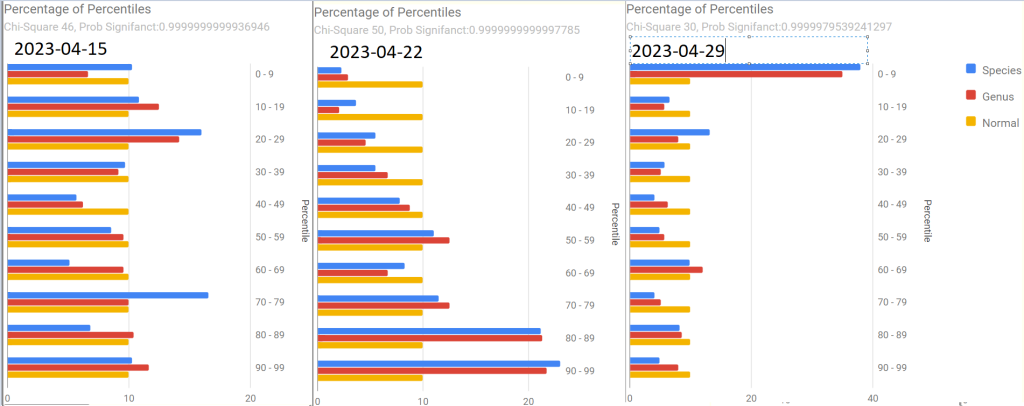
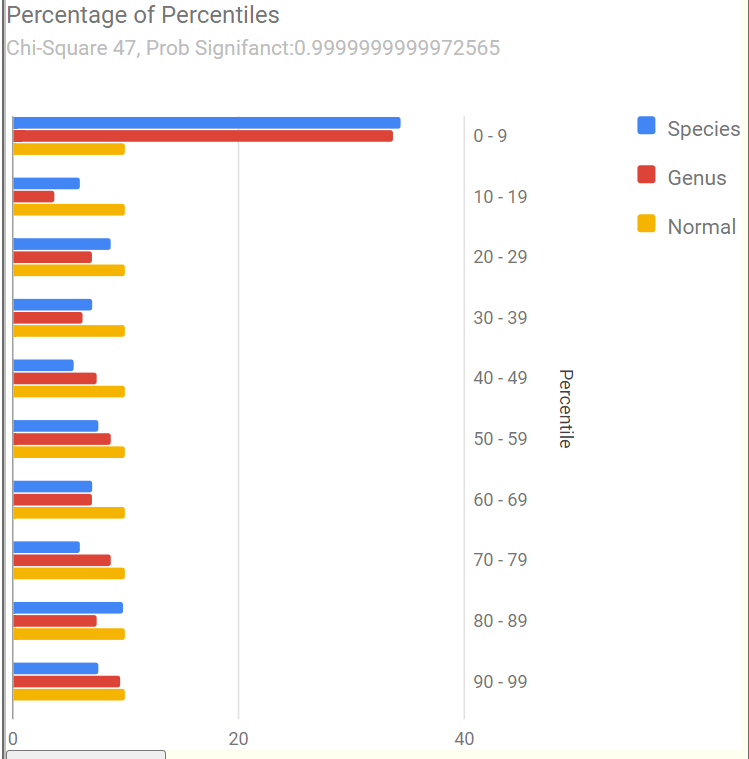
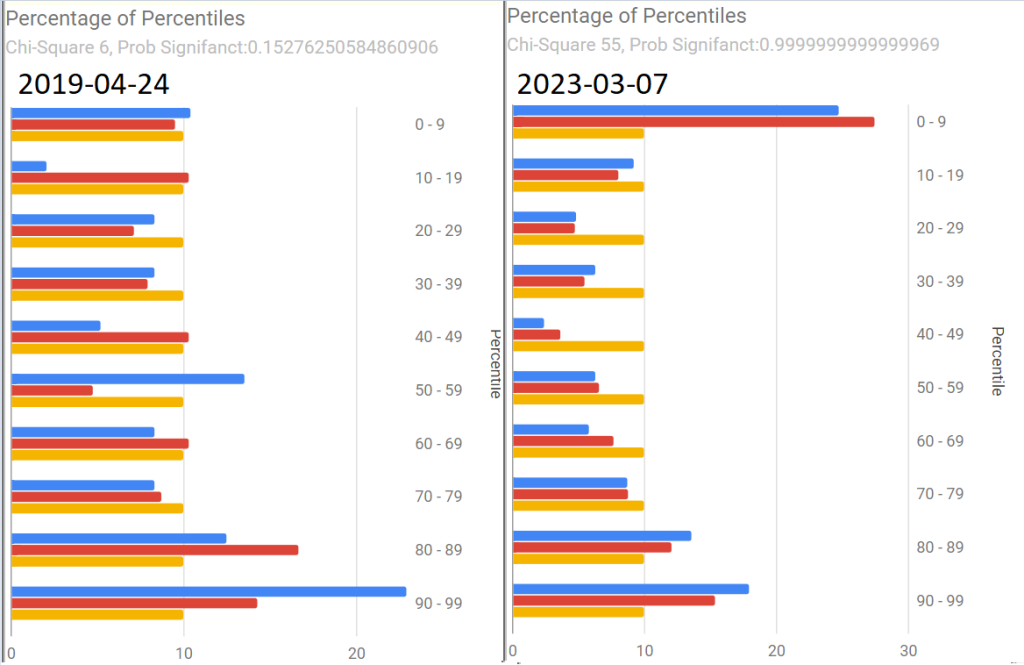
As with Tess, the percentages by percentile which I noticed tend to have over representation with ME/CFS and Long COVID in the 0-9 percentile. We see this pattern at the start, with improvement and then a bounce back to high numbers in the last sample

Tamara suggested that I convert the tables below to charts. Both are now available on the site.

Pretty Pictures

Tamara suggested that I convert the tables below to charts. Both are now available on the site.

First, an old sample that she happened to have where we see Chi-Square at 6. The first of the recent samples had it jumping to 55, A normal microbiome is expected to have a Chi-square < 13. A higher value indicates a statistically significant, abnormal microbiome.

The next three show the changes with antibiotics. Chi-square went from 46 to 50 with a dramatic shift and then drifted down to 30.

The latest sample increased upward again, with the pronounced spikes that are common with ME/CFS being there.

The raw numbers are also shown. I will spare your eyes by omitting them.

The Events Around the above Samples

  • 7 Mar – Before
  • 23 Mar – Day 4 AmoxClav
  • 15 Apr – More
  • 22 Apr – Final Day of AmoxClav (30 days of AC)
    • This sample has a low Lab Read Quality, this may account for the number of spikes in its report.
  • 29 April – After 3 days of Aprepitant + Erythromycin (this was a BIG difference from Tess and was the intervention that seemed to give me the baseline increase this time).

As with Tess, let us see how these items rank in each sample. As with Tess, imipenem is the most common best suggestion.

Criteria7-Mar23-Mar15-Apr22-Apr29-Apr22-May
Amoxicillin-10495276296432402
Erythromycin59253340236222228
Aprepitant 39329726032028080
Highest632497635610650594
cefaclor hydrateimipenemimipenemimipenemcefoxitincefoxitin

Going Forward

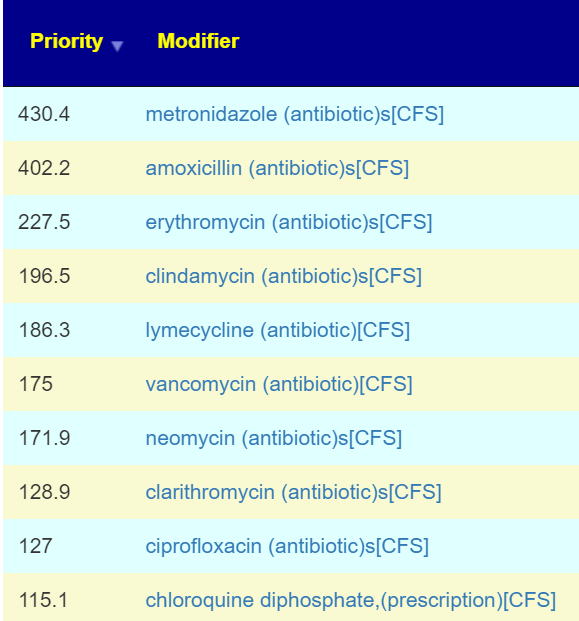
As a result of a conference call with some of the Remission Biome Project, and Dr. Jadin’s Current Protocol for ME/CFS. I annotated all of the antibiotics used in studies for ME/CFS, Lyme, and related conditions with [CFS]. This allows us to quickly see the “consensus” antibiotics (i.e. used in studies and suggested by microbiome prescription algorithms).

The top ones are shown before (Just enter “CFS” in the Search dialog)

Only two of these were negative for her (doxycycline and ampicillin) with docycline sibling, minocycline being just 21).

I would suggest using this list to pick 2 antibiotics to do a one week course and then take a 3 week break. After the course, then do some of these probiotics. I am inclined to omit L.Casei because the strain used in Yakult is a negative. Thus we end up with these three as top suggestions. P.S.

Note the weight of these are above many of the antibiotics above. I usually advocate single species. The Bifido is available from Custom Probiotics with their recommended dosages above the amount listed above.

Part Deux — More Samples!

Her description of subjective changes: generally keep improving in terms of PEM, function etc. (was definitely a dip around the 2nd ‘constipation’ sample)

  • 1st, [2023-06-14] in the series just a temporal sample, no additional treatments
  • 2nd, [2023-07-15] in the series I had a major episode of constipation – wanted to catch that 
  • 3rd, [2023-07-20]last one was was post my 2nd treatment of aprepitant+erythromycin

Sample Comparison

We include the prior one above for easy reference). The key change items are:

  • The new Anti inflammatory Bacteria Score has seen a dramatic increase from 17%ile to 73%ile. The four prior samples were 7.6%ile, 8.2%ile, 3.9%ile and 6.9%ile
  • Outside Kaltoft-Moldrup is dropping. In terms of %age of reported: 32% -> 28% -> 29% ->16%
  • The high and low Enzymes also seem to be dropping
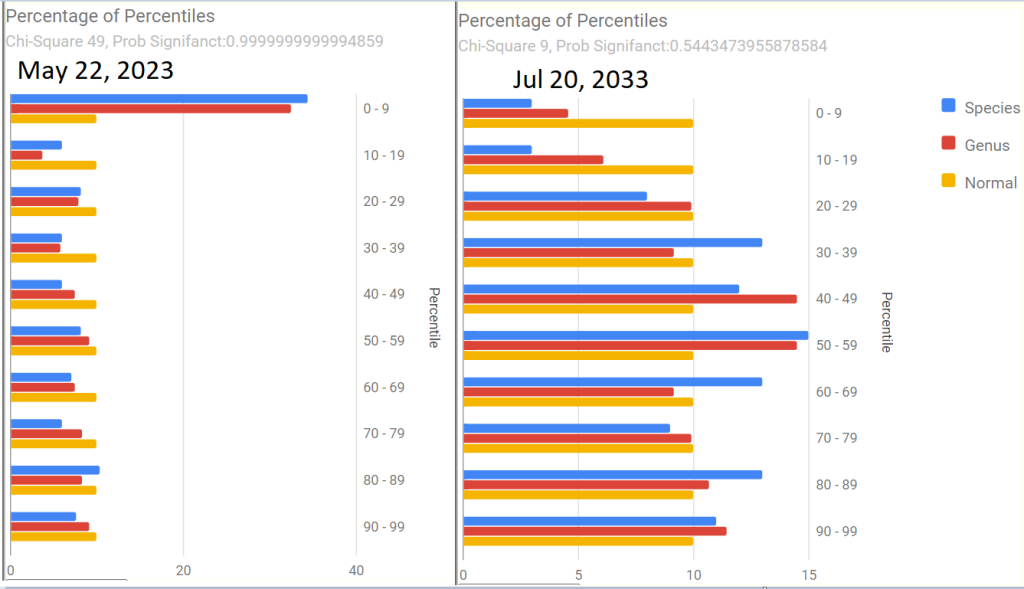
  • The last sample had a Chi-Square of 9, that is a probability of 0.54 instead of the .9999999… for all other samples. Unfortunately, the poor read quality makes this fuzzy.
  • Note: The last sample has a low read quality (thus less bacteria types are being reported)
Criteria22-May14-Jun15-Jul22-Jul
Shannon Diversity Index69.429.2043.0015.00
Simpson Diversity Index54.77.6027.5060.00
Chao1 Index72.40.8721.408.30
Anti inflammatory Bacteria Score17.030.9043.6073.20
Chi-Square Score4951329
Lab Read Quality7.210.96.62.3
Bacteria Reported By Lab659752512375
Bacteria Over 99%ile101214
Bacteria Over 95%ile2224220
Bacteria Over 90%ile45411339
Bacteria Under 10%ile19922918919
Bacteria Under 5%ile1862081843
Bacteria Under 1%ile1671651660
Lab: BiomeSight
Rarely Seen 1%251300
Rarely Seen 5%493771
Pathogens32343621
Outside Range from JasonH4774
Outside Range from Medivere14191914
Outside Range from Metagenomics6776
Outside Range from MyBioma4664
Outside Range from Nirvana/CosmosId18191918
Outside Range from XenoGene33343433
Outside Lab Range (+/- 1.96SD)1112113
Outside Box-Plot-Whiskers56752350
Outside Kaltoft-Moldrup20921215061
Condition Est. Over 99%ile0010
Condition Est. Over 95%ile0010
Condition Est. Over 90%ile1030
Enzymes Over 99%ile62152
Enzymes Over 95%ile13031811
Enzymes Over 90%ile215129933
Enzymes Under 10%ile429211171304
Enzymes Under 5%ile310146142211
Enzymes Under 1%ile152857347
Compounds Over 99%ile31031
Compounds Over 95%ile642911
Compounds Over 90%ile10674824
Compounds Under 10%ile959109610091015
Compounds Under 5%ile9091041981971
Compounds Under 1%ile8601009956922

Since we had a symptom of constipation, let us see how well the samples match that reported from Studies on PubMed — there were no matched. When we went to our Special Studies, we see that the microbiome followed the reported symptoms. We then look at the top value from Special Studies — which was Long COVID for all samples. We see the lost of ground around the constipation and then regaining the progress.

Criteria22-May14-Jun15-Jul22-Jul
Special Studies7%ile14%ile15%ile7%ile
Top Item
Long COVID
 35 %44 % 41 %36 %

Next we go and look at aprepitant and erythromycin

Criteria22-May14-Jun15-Jul20-Jul
Aprepitant80.4113.7205.8169.9
Erythromycin227.5-76.8 226.7194
Best CFS antibiotic
Priority / Max Priority
metronidazole
430 /549
lymecycline
176 /307
amoxicillin
424 / 527
amoxicillin
351 / 484

The Percentage of Percentile show quite a shift — unfortunately, it is unclear if this is a temporary after effect of constipation, poor lab read quality, or the above aprepitant and erythromycin. The next sample may resolve this issue.

Is the Project working — YES

We are seeing both subjective improvement and object improvements.

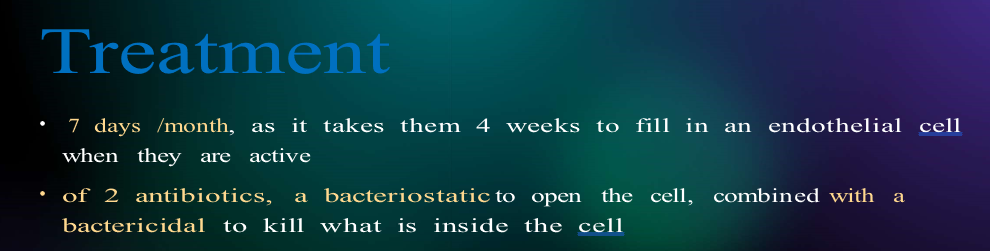
Personally, I like what appears to be a shift towards Cecile Jadin’s approach — not continuous antibiotics but a course (7-10 days) followed by a break (ideally 3 weeks). Often I find that ME/CFS people tend to be impatient and just want to keep pressing on hard… which I have observed often result in tripping and rolling down the hill to where they were (or worst).

Postscript – and Reminder

I am not a licensed medical professional and there are strict laws where I live about “appearing to practice medicine”.  I am safe when it is “academic models” and I keep to the language of science, especially statistics. I am not safe when the explanations have possible overtones of advising a patient instead of presenting data to be evaluated by a medical professional before implementing.

I can compute items to take, those computations do not provide information on rotations etc.

I cannot tell people what they should take or not take. I can inform people items that have better odds of improving their microbiome as a results on numeric calculations. I am a trained experienced statistician with appropriate degrees and professional memberships. All suggestions should be reviewed by your medical professional before starting.

The answers above describe my logic and thinking and is not intended to give advice to this person or any one. Always review with your knowledgeable medical professional.

Video Presentation of Dr. Jadin’s Current Protocol for ME/CFS, Q-Fever, Chronic Lyme and related conditions

Cécile Jadin, MD, has very graciously put together a power point on the state of her protocol and allowed me to share it. This protocol has been in use for over 25 years by her with a high success rate (90%). The protocol actually dates back around 50+ years (for a condition with a different name).

For earlier notes from her, see C.Jadin Resources which links to some of her earlier presentations.

My Experience

The basics of this protocol put me into remission around 2000 and has put me into remission for flares. Far more important, it resulted in my understanding the complexity of this condition’s treatment. Even today, I view many MDs keeping to a naïve one-shot magic-bullet approach: “we need to find the virus (i.e. EBV, HHV6, etc) or bacteria that triggered it; find a drug to treat it and the patient is cured!” I have read so many accounts of people being “cured by X, but it stopped working after N months and X does not work anymore”.

Dr. Jadin has many decades of clinical experience treating ME/CFS and related conditions. She built upon clinical experience treating this type of condition. I have decades of doing software development.

Jadin and I are two sides of a Treatment Coin

Cécile Jadin is a MD with decades of clinical experience treating ME/CFS applying and evolving a protocol that she inherited from her father’s time at the Pasteur Institute of Tropical Medicine. I am a high functioning autism person well trained in Artificial Intelligence and Statistics who has applied it to the microbiome. My AI algorithm very very often suggests the same set of antibiotics and supplements that she uses. The algorithm works off bacteria only (and thus ignores many other co-factors). We walk different paths and end up in the same treatment approach.

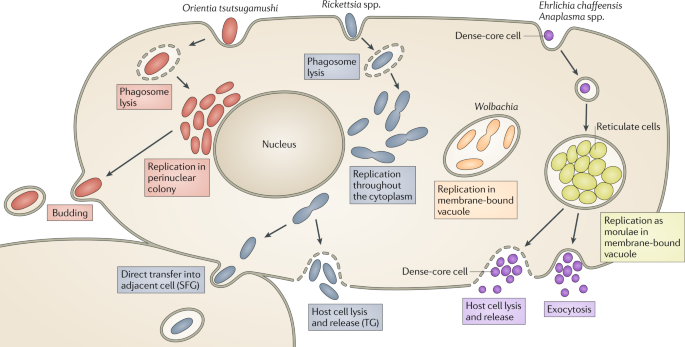
She talks about Obligated Intracellular Organism or OIO. This term may be unfamiliar to many, for some background readings see this Research Topic on Frontiers. I talk about the bacteria in the gut.

From: Cells within cells: Rickettsiales and the obligate intracellular bacterial lifestyle [2021]

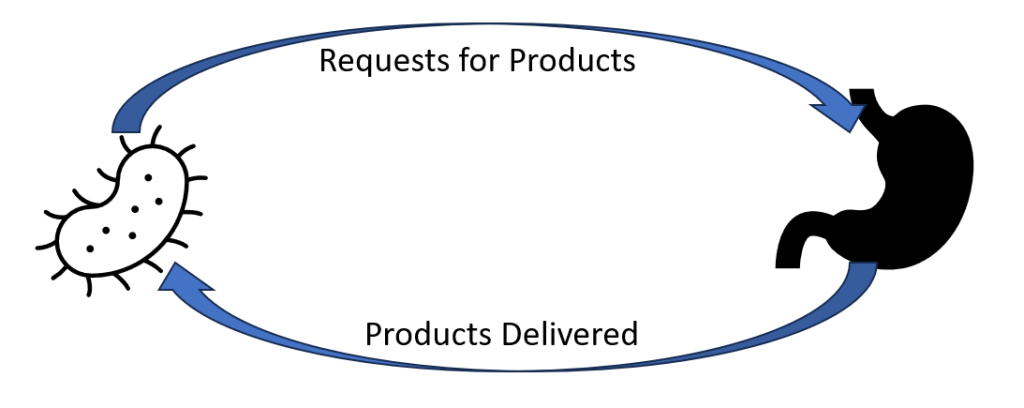
They are very interconnected with a lot of information exchanged between them. OIO sends mis-information messages to the gut to produce more of this or that enzyme, metabolites, compounds [Products]. There are over 26,000 different products potentially involved. The gut receives this information and fill these bogus orders. The OIO gets its supplies and proceed to prosper. A side effect of these bogus production orders are symptoms – they could be view as pollution from the production. The symptoms often depends on a person’s DNA.

This cycle needs to be broken. This may be done by attacking the command center (the OIO) or attacking the factories (the microbiome) or both.

Original Motivation

One of the goal of building my AI was to try to identify the factors for non-responders. To me, it appears to be due to variations in the microbiome. Recently there has been many studies reporting that the difference between responders and non-responders for both cancer treatment and the severity of COVID has been the patients microbiome. The AI can suggest what to take; Jadin’s clinical experience provides information on how to take it.

Remission is the Target, not who is right

Patients and their MDs can go down two path, the paths actually run besides each other.

  • Follow Cécile Jadin process and protocol precisely
  • Follow Cécile Jadin process but use iterative sets of suggestions from Microbiome Prescription. By that, pick 1-2 of the top CFS tagged antibiotics, then at the end of first month, take a new microbiome sample and start with the secondary CFS tagged antibiotics (while waiting for the results).

The latter approach can be tried without prescription antibiotics because it identifies probiotics (that often produces natural antibiotics) and herbs (with antibiotic characteristics) and thus allows self-treatment for those without a cooperative medical professional. This no-antibiotics approach will likely work slower for most people. I discourage self-treatment, but often there is no alternative. My first choice is keeping strictly to clinical experience using the microbiome suggestions to select between clinical alternatives.

The Cécile Jadin’s process of alternating substances with breaks is a critical factor. In terms of modelling effectiveness (my expertise) — there is no question, it is the rational approach that treats everything as living entities and not mechanical nuts and bolts.

Video Presentation by Cécile Jadin

Short Version (35 minutes)

The bare presentation.

Long Version (65 minutes)

This version includes questions and answers from participants(and chit-chat). Her presentation starts at 5 minutes into it. At the end a patient shares her experience after the first 3 months.

Power Point as a PDF

You may download her presentation below as a PDF file. Or listen to it on YouTube which is intended for people having difficulty reading (common symptom with ME/CFS).

Jadin_2023Download

Treatment Fundamentals

Antibiotics (with alternative names) and links to known microbiome impact and alternative names where available.

  • Doxycyl 100mg x 2/day + Ciprofloxacine 500 mg x 2/day x7 days– No exercise!
  • Lymecycline 300mg x 2/day x 7 + Metronidazole 400mg x 2/day x 7 days – No alcohol!
  • Minomycine 100mg x 2/day x 7 + Rulide 150 mg x 2/day x 7 days
  • Doxycyl 100 mg x 2/day + Tavanic 250mg x 2/day x 7 days– No exercise!
  • Clacid 500mg x 2/day x 7  + Augmentin 1.000 mg x 2/day x 7
  • Dalacin C150 mg 2 x2/ day x 7 days – Given alone for best results
  • Doxycyl 100 mg x 2/day + Avelon 400mg x 2/day x 7 days– No exercise!
  • Tetralysal 400mg x 2/day + Dapsone 100mg nocte (stop if blue lips) x7 days
  • Vibramycine 100mg x 3/day x 7 days – Given alone for best results
  • Nivaquine

“All those antibiotics MUST be taken: after food ( not only water ) and without any dairy products. Patients must avoid sugar intake and some supplements(for example magnesium, glutamate, vitamin D). Antibiotics should be taken in the morning and the evening”

“Duration of treatment: 1 – 3 years.” Symptom remission may occur sooner, but that is usually just a tactical victory and not a strategic victory. You won one battle, but the war is not over.

Probiotics:

“Taken at noon only. No specific ones, but they must also be rotated (like the antibiotics)”

The Testing Dilemma

Dr. Jadin pointed out there are no testing facilities for some types of OIO in the US, Australia or Europe. When patients samples are sent from these “OIO free zones” to labs that test for them, often the results come back positive. Today everyone knows about invasive species (ticks, plants etc) but frequently ignore biological human invasive species. A few are known: smallpox, polio and a small number of others are associated with travellers. These are old diseases that were known and eliminated. Tourists often pick up unfamiliar diseases that their personal physicians know nothing about: Ascariasis (hookworm), Buruli ulcer (Mycobacterium ulcerans infection), Chagas disease (also known as American trypanosomiasis), Dracunculiasis (Guinea-worm disease), , Trypanosomiasis, human African (sleeping sickness), Leishmaniasis, Leprosy, lymphatic filariasis, Onchocerciasis (River blindness), Schistosomiasis, Trachoma (Chlamydia trachomatis), and Trichuriasis (whipworm).

Many of these conditions can be transferred from human to human with someone who has never been to Africa having an OIO and those can be unknown in your country (without lab test facilities being available) but they are well known in Africa or South America. You may be told: “So, we have run tests for everything and everything came back negative — you have an atypical condition with no known treatment”.

Bottom Line

Medical treatment suffers from one dimensional linear thinking that often uses a “nuts and bolts” mechanical model. The model and understanding of Dr. Jadin assumes a living organization that changes and adapts. The problem bacteria (be it OIO or microbiome) will literally play hide and seek with treatments. I share this perspective.

Some Possible Paths Forward

Depending on the cooperation of your MD, availability of detailed microbiome tests, etc.

  • Follow Dr. Jadin protocol
  • Follow the path being discussed in the Remission Biome Project:
    • Using Microbiome Prescription to generate a list of candidate antibiotics and then take the highest ranked on that which is on Dr. Jadin’s list – following Dr. Jadin’s pattern of alternating and pulsing
    • Implement the non-prescription suggestions of to avoid or to take. That targets the factory side (that is the gut microbiome), not the OIO side of the cycle show above. It simply improves the odds.
  • Do not use antibiotics (either by choice or by lack of cooperating MD) and use the advanced suggestions based on your microbiome sample with a new microbiome test every 6-8 weeks. Each new test will alter suggestions (especially probiotics). All suggestions should be reviewed by your medical professional.
    See this post: We can suggest what to take, but not how to take! for a more explicit description.

Follow Cécile Jadin process but use iterative sets of suggestions from Microbiome Prescription. By that, pick 1-2 of the top CFS tagged antibiotics, then at the end of first month, take a new microbiome sample and start with the secondary CFS tagged antibiotics (while waiting for the results).

A quick apparent remission may occur after the first antibiotic, Dr. Jadin’s opinion is that you need to keep to it for at least a year, in some cases up to 3 years. Having a remission that lasts 3 months and then relapses makes the next remission much harder to obtain.

A current project using antibiotics has two analysis done showing significant subjective and objective improvement.

Questions and Answers

Q: “This doesn’t address the causes of ME/CFS. Also there’s no mention of any nutrient deficiencies typically seen in every case of ME/CFS I’ve seen, or genetic factors, or anaemia, or thyroid dysfunctions, or other causes and factors.”

  • Read this again, OIO is a valid cause for many ME/CFS cases and this has been reported in many studies. and there are many more. A microbiome shift is well documented in studies for ME/CFS and that by itself may be the cause of ongoing ME/CFS. Explicitly treating nutrient deficiencies is treating symptoms and not causes. Correcting the microbiome will likely resolve most, if not all, nutrient deficiencies. Microbiome dysfunction is well documented with anemia and thyroid dysfunction. A side effect taking the relevant antibiotic is microbiome correction. See Tess Falor’s experience above where remission came with concurrent normalization of the microbiome (corrected by the antibiotics — either directly or indirectly)

Q: Are you not aware of the black box warning of floxing [fluoroquinolone] with some of those antibiotics? Is this protocol target only for those who have lyme associated with the ME/ CFS. Cause most people in my medical community( not all have lyme)who took them have had horrible consequences from being floxed.

  • Jadin was asked this question (see long video). She has never encountered this issue. It is critical to note HOW she uses it. Never more than 7 days followed by 3 weeks without antibiotics. For safety, she advises not to exercise while using it. Note that the warning also cites INJECTIONS as well as being seen after weeks on fluoroquinolone

Dr. Jadin’s Current Protocol for ME/CFS

This post had been moved to: Video Presentation of Dr. Jadin’s Current Protocol for ME/CFS, Q-Fever, Chronic Lyme and related conditions due to editing issues.