uBiome sample from a recovering young person with CFS

This uBiome was different than others — age may be a factor dealing with microbiome shifts in CFS.

Short History of Key Points

  1. Original Onset appear to have been triggered by an amalgam being removed in grade 12
  2. Subsequent was sinus infection etc with likely an inappropriate antibiotics for this person
  3. Repeat when the amalgam was replaced again a year later
  4. At university, the dorm he was in appear to have had significant mold issue
    1. fresh fruit would go moldy in 1-2 days constantly
    2. room mate with autoimmune issues was having constant flares
  5. Today, he is back at university in a different dorm (does not appear to have mold issues)
    1. Has been doing variety of herbs etc that been suggested on this blog over this year
    2. Greatly improved compared to the last few years
    3. No stomach or digestive issues at present
    4. This uBiome was done in the last few weeks (his current state)

“Interestingly enough, I’ve also had a higher precedence of cavities since college started and they only got worse when my symptoms of fatigue began as well”

Current Status

Unlike most CFS patients, the ratio of Firmicutes to Bacteroidetes was close to normal.

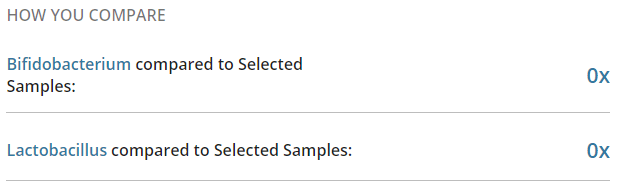
  • Bifidobacterium was 61% of normal
  • Lactobacillus was < 1% of normal
  • Akkermansia – none reported.

At the Genus level, there were several abnormal high:

  • Collinsella: 263% of normal (high seen in 25%)
  • Enterorhabdus: 326% of normal (only rarely seen)
  • Intestinibacter: 241% of normal (high seen in ~50%)
  • Roseburia: 247% of normal (high seen in 30%)

What do we find:

  • Collinsella and Enterorhabdus are reduced with smokers with Crohn’s Disease [2016]
  • “A lower abundance of Roseburia has been observed in patients suffering from inflammatory bowel disease.” [ubiome]
  • Higher level seen with diets with whole grain [2013]
  •  Metformin will “increases Escherichia and lowers Intestinibacter abundance” [2015]
    • “elevated levels of Roseburia may be associated with weight loss and reduced glucose intolerance.” [ubiome]

Pre-diabetic?

Looking at some articles, there is a possibility that being pre-diabetic may be a factor (hint: testing should be considered).  A pre-diabetic diet should be consider – see this WebMD page. Diabetes does run in his family.

Analysis

This reader abnormalities do not have any association with IBD etc. His values were high when a low value was associated. The uBiome agrees with his symptoms.

I was at my dentist recently and she gave me a list of supplements that help with dental gum health (will do a post on this) which almost looks like it was written for CFS patients — the same items occur constantly. One of my own crowns is a concern to her because the x-rays are unclear if I have grown a colony of bacteria under the crown (a location very hard to treat with antibiotics, but also a location which could re-infect the body). She was recommending removing the crown and send samples for analysis.

For amalgams, the traditional view has been the mercury has created health issues. There is an alternative explanation, the area under the amalgam may be an ideal colony site for some types of bacteria; bacteria that could be release slowly or in quantity when dental works occurs. This reader appear to have suffered multiple insults: Amalgam-bacteria onset, antibiotics that further shifted his microbiome, prolonged mold exposure adding more shifting of his microbiome.  He is getting his mouth into better shape, he found brushing with Alpha-Lipotic Acid helped his mouth(I love readers sharing successful experiments!) . His mouth appears to be a key source for his CFS.

Fortunately, he appears by symptoms and ubiome to be on his way to recovery.

Bottom Line

My usual criteria for probable CFS using uBiome is having two of the following three very low:

  • Bifidobacterium
  • Lactobacillus
  • Akkermansia

This uBiome made that criteria but not in the usual way. He appears to be on the way to recovery (but need to be wary of factors that could cause flares or worst)

  • The glucose/diabetes related issues hints that Lactobacillus Fermentum ME-3 should be tried. [2014][2016]
    • Consider breaking a capsule apart and leave the contents in your mouth for a while after brushing your teeth
    • You may wish to try this with other probiotics.
  • The chewing of various natural gums (myrrh, mastic, boswellia) should also be considered because of the dental issues (and the potential of the mouth being a reserve to re-introduce bacteria into the guts).
    • Do a variety of oral probiotics
  • Do appropriate herbal teas: Triphala, Neem, etc — we want their contents to hang out in your mouth area.
  • Redo uBiome in December to see what shifts has occurred

As always, consult with a knowledgeable medical professional before adding or changing supplements.


Post #700 – Roles in Treating CFS

This is my 700th post and at the same time, a reader asked

“Ken I’m writing my final degree project in CFS and I would like to know, in some phrases, what you think about the role of “official medicine” in the treatment of the disease.
What’s your goal with the blog and how it can help the patients”

Role of Official Medicine

I need to answer this based on my model and observations. Medicine is looking for simple cookbook solutions to a complex condition. Most practicing MDs are also greatly constrained by several nasty things:

  • “Standards of Care” –  “Practice guidelines assist the health care practitioner with patient care decisions about appropriate diagnostic, therapeutic, or other clinical procedures for specific clinical circumstances.” [NIH]
  • “Medicare Insurance” – this is very closely tied to above
  • “Peer pressure” – What would other doctors do in their region.

A professor once told me: “The ideal doctor or engineer is the person with a fantastic memory, strong sense of conformity and zero creativity”.

Give them a cookbook on how to treat an issue by a medical association, and they will follow it. Give them a ton of studies with conflicting results and they will either say “We will wait until there is clarification” or “It is probably psychological or best handled by a specialist”. Often the excuse can become “We need more studies”…. studies that may never happen. Most MDs do not want their rear side exposed to fellow MDs, local medical organizations and insurance companies  for some very hard financial kicks.

Bottom Line: Official Medicine will stay in a holding pattern for years, likely decades. They will provide symptom relief and ad hoc  random experiments (often repeating things tried unsuccessfully decades ago!). Only an extreme few would read any research on CFS regularly.

Research

My opinion based on seeing enough studies is that CFS/FM/IBS symptoms are interactions between DNA/SNP and microbiome (which has more DNA than a human). The appropriate research approach would be to take a large sample of patients (likely 100,000 or more) and record:

  • DNA
  • Microbiome
  • Symptoms and Lab results

Then push all of this data in appropriate artificial intelligence algorithms to break down/discover the associations. In the comments of my last post,  you would see that I identified several bacteria groups that are very high. When the reader tried any suggested herbs, they became severely depressed in days and stopped. A little research on PubMed discovered that most of these bacteria groups are strongly associated with depression. The die-off from the herbs was triggering the depression. One type of symptom==> a group of bacteria (and likely DNA also).

Current Researchers

Most researchers are trained in specialties. They do excellent work examining the leaves and twigs around their focus of interest.  The problem with CFS is that the issue is bigger, not just the branches of the tree or the whole tree — rather the entire forest. IMHO, an ideal CFS researcher would be trained in medicine, DNA/SNP, microbiology and machine learning. They would need to be a world class data scientist besides being an MD. They will also need a big budget and cooperative clinics to get an adequate data sample (I am talking 100,000 patients needing their DNA and microbiome done).

To me, one of the greatest problems with CFS research is that successful results from studies are rarely repeated. My favorite soap box is pointing out the Berg’s studies finding a high (80-90%) of CFS patients having an inherited coagulation condition have never been repeated. Having a single study results in those results being ignored because “they have not been repeated” — ignoring the fact that no one tried to repeat them…

My Role

What is my role? Basically, it is as a recovered former patient who remembers the pain and hurt that this condition caused. I looked at my strengths and weaknesses and realized that my best service to the community is simple:

  • Someone with a clear head who can read thru the literature, understand generally what the article actually says (i.e. cut thru researchers’ double speak). This arose from experience and training.
    • I started reading medical articles and presentations at 14 years old because I was one of 15 students from my grade level in one of the largest school districts in Canada for a special enrichment program, Berg Science Seminars.
    • I did an undergraduate and graduate degree in Statistics
    • My Master’s topic was working with the Justice Institute of BC looking at how various medical treatments influenced survival during medical transport.
    • I worked for many years as an Industrial Statistician and was a member of the American Statistical Association, as well as the American Mathematical Association, and a few other professional organizations.
  • My day-to-day job deals with very complex systems and data – literally world class Information Technology Systems including Microsoft, Amazon and Starbucks. I am one of those few people who doesn’t suffer from information or complexity saturation, rather, I sit down and slowly shift and re-shift the information to build out and then test a model as to cause and solution. I have been (and still am) successful in this area.  In July, 2017 I was the Edison Award Winner for the Starbucks Digital Platform Team.

My role is a citizen scientist modeler. It is “citizen” because I am not receiving any money for doing it. I have worked professionally as a scientist modeler.

My role is not:

  • CFS Life Coach
  • Action for getting more funding
  • Social Support
  • Treatment support

I could easily get involved with the above, but there are others who are more capable. My gifts are dealing with data and sketching out how the thousands of dots are connected. Taking these sketches and converting them into studies, treatment plans should be a role for the medical professionals. For example, Neem fits the model, but no one has done a clinical study on whether it is actually effective.

Bottom Line for Me

  • Continue to review studies, cutting thru the medical double talk
    • I am grateful for many readers who forward new studies to me for early review.
  • Continue to test and refine the model that seems to fit best against all of the data: microbiome x DNA/SNP interactions
    • Doing uBiome reviews help evolve the model
  • Continue to identify items which may help — based on applying the model to known literature.
    • Producing posts on these items with links to the research that I based it on (the keyword here is transparency)
    • Advising patients that these items should be discussed with their medical professionals before starting. I have blinkers on and have no idea if the same item may cause a different medical condition to get worse. Only your medical professional can determine if it is safe to try or not. I do not want to get sucked into time-consuming understanding of interactions, I would rather spend that time connecting more dots.


uBiome from a Hep Triggered CFS patient

Another uBiome result, as with other patients, low or no bifidobacterium and lactobacillus. Similar to most other patients, biodiversity was very high, 97%ile, with the usual many families at a very low (0.01 or 0.02) (trace) level compared to controls with the same families.

bb

Again, many rare ones show up

rare

Firmicutes to Bacteroidetes ratio was low 1.1: 1 instead of the normal 2.1:1. (about 1/3 have low ratios so far, and 2/3 have high ratios).

  • Akkermansia level is high (6.83) -seen in about 25% of the uBiome, the other 75% are low.
    • This subset of high patients also tend to be high in:
      • Alistipes, Bilophila, Intestinibacter,  Oscillospira, Intestinimonas,  Butyricimonas
      • This hints that 7 genus may be mutually beneficial to each other.

Notes on person: hepatitis triggered CFS over 20 years ago. Currently not doing any protocol.

The Low Amount of Abundance Bacteria Genus

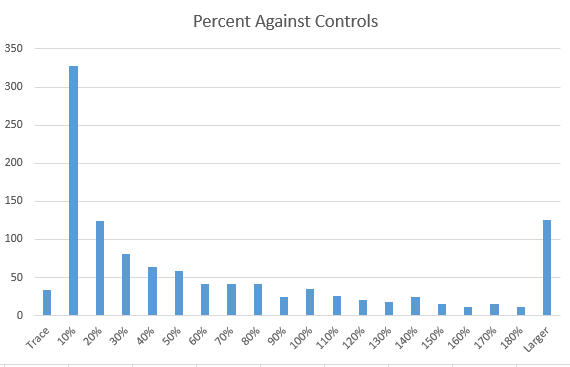
I have been recording the relative percentage (compare to controls) of different uBiome that I have reviewed. I took the numbers at the Genus (lowest) level, counted and plotted them.

spread

The expectation for a normal group of patients would be a bell/Normal-curve with the top of the bell being at 100. With CFS patients we find a large number of genus with a very low level compare to control.  In other words we have high biodiversity but it is very fragmented and made up of nominal populations. If the tests being applied to the microbiome was less sensitive than uBiomes, then a result of low biodiversity could be reported on the same sample because all of the trace, 10%, 20% may not be recorded.

Bottom Line

My best suggestion (especially since information on reducing Alistipes, Bilophila, Intestinibacter,  Oscillospira, Intestinimonas,  Butyricimonas is almost non-existent) is to discuss with their medical professionals the items on my “Cookbook Summary for the Brain Fogged“. The items are linked (eventually) back to the PubMed studies that provided dosage information.


uBiome with bioscreen results and an unwelcomed surprise

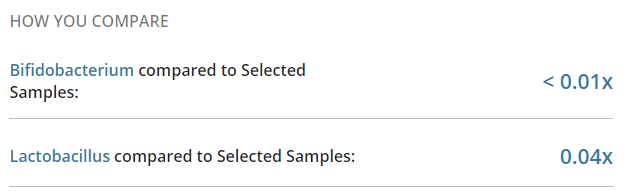
Another reader shared their uBiome results with bioscreen results (done the old fashion was of culturing bacteria). First thing is the classic “where’s the bifo and lacto!!” result seen with CFS/

cat

Looking at: Firmicute to Bacteriodetes ratio: 3.8 (double the typical ratio of 2.1), the volume of Bacteriodetes was the cause of the shift (50% of typical).

Over on Bioscreen, we see the rest of the normal story for CFS patients: Zero E.Coli and overgrowth (remember this is cultured, so only a few results will be shown — most gut bacteria cannot be cultured).

catl

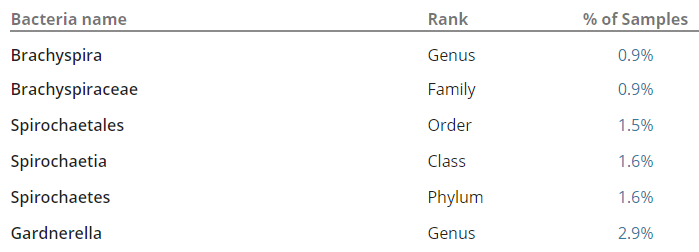
Going back to the uBiome results — we again see a fair number of rare bacteria appearing. There is no clear pattern beyond “a lot of rare ones appear”. For example, this is the first sample showing any of the Spirochaetia Phylum (The TOP level of bacteria tree). This family includes Borrelia burgdorferiB. garinii, and B. afzelii, which cause Lyme disease.

cat3

Drill Down

Phylum Level

  • Lentisphaerae was 19.21x the average where as most CFS patients have zero
  • Tenericutes was 4.31x the average where as most CFS patients have zero

Class Level

  • Mollicutes (under Tenericutes) was 4.30x the average where as most CFS patients have zero. The best-known genus in the Mollicutes is Mycoplasma.

Order

Family

  • Victivallaceae (under Lentisphaerae) was 20.17x the average where as most CFS patients have zero

Genus

  • Victivallis (under Lentisphaerae) was 20.32x the average where as most CFS patients have none

Bottom Line

There was two major surprises in this uBiome — beyond seeing the usual CFS pattern:

  • Overgrowth of the class that contains mycoplasma – Mollicutes 
  • Overgrowth of the phylum that contains lyme bacteria – Spirochaetia

I do not know if one or the other have been tested for. The prescription antibiotics for both of these classes also overlap the generic CFS antibiotics and would likely reduce the overgrowth. My own preference (for myself), would be [with regular rotation]:

  • Tetracyclines: for example:
    • Doxycycline
    • Chlortetracycline.
    • Clomocycline.
    • Demeclocycline.
    • Lymecycline.
    • Meclocycline.
    • Metacycline.
    • Minocycline.
  • Macrolides:
    • azithromycin (brand name Zithromax),
    • clarithromycin (brand names Klacid and Klacid LA),
    • erythromycin (brand names Erymax, Erythrocin, Erythroped and Erythroped A),
    • spiramycin (no brand), and.
    • telithromycin (brand name Ketek).

Normally, lyme and mycoplasma are done by blood tests. If their “first cousins” and thriving in your gut, then the metabolites that they produce may be similar to those produce by lyme and mycoplasma — producing similar symptoms.

The lab results concluded “mild neutropenia” – WebMD cites for this condition

  • “Antibiotics for bacterial infections, if the underlying cause is an infection”
    • There appears evidence from the uBiome that there are atypical gut infections.

Again, this is not medical advise — just inferences from the data and the model that I am using. These inferences should be discussed with your knowledgeable medical professionals.

I will add to my backlog posts looking for herbs/spices etc that have been demonstrated effective for these two abnormalities.


Ubiome result after recent Ross River Virus

A reader was very kind to share with me their uBiome results. Ross River Virus is an infection (one of many) associated with the subsequent development of CFS. In March 2017, the reader was positive for Ross River Virus (6 months after symptoms started). We have someone in possible early CFS (less than 1 year from onset).

Does the ubiome fit the CFS Pattern?

rr1

  • Low Bifidobacterium – Check
  • Low Lactobacillus – Check
  • Akkermansia is very high: 8.27x.
    • This is the bacteria that reduces inflammation. This may be a response to this being a recent infection/onset (the very low level seen later in most CFS patients, could be a result of ‘exhaustion’, i.e. the metabolites that this bacteria needs were badly depleted).
    • One earlier result had higher values
  • Firmicutes/Bacteroidetes ratio: 0.45 (both high and low ratios are seen)
    • Bacteroidetes: 1.33x
    • Firmicutes: 0.6x

Looking at some prior uBiomes from prior posts:  B and F uBiomes are vary similar with shared spikes in the same groups (not seen with other CFS uBiome results):

  • High Genus: Odoribacter, Parabacteroides, Sarcina, Intestinibacter, Allermansia
  • High Family: Peptostreptococcaceae, Porphyromonadaceae, Clostridiaceae 

New (not seen in others)

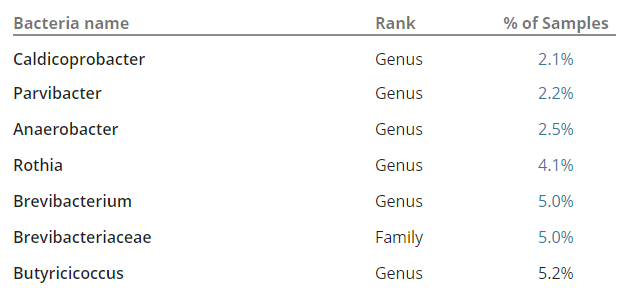
  • Class: Opitutae, Order: Puniceicoccalea, Genus: Butyricicoccus,

From Lab Reports

  • “Most essential and other elements are very low, suspected malabsorption issue. About half are below 16th percentile: calcium, magnesium, sodium, copper, manganese, lithium, phosphorus, strontium, cobalt, iron, zirconium.”
  • “Main symptom is fatigue. I can work on my computer from home 4 hours a day, … can walk comfortably in total in and around home about 1-1.5km in steps a day, 2km feels like a marathon. Wish I could sleep more, feel terrible in the mornings. Lately I’ve been feeling nauseous on and off. I need to rest regularly throughout the day. No pain thankfully, occasional headaches.”

Items to Discuss with Your Professional(s)

The nausea(and IBS) aspect is where I would start, and in that direction, I would suggest taking herbs and probiotics documented to work in this area. The goal is to adjust the gut while the dysbiosis is still fresh (and less stable). My short list would be:

  • Probiotics:
  • Herbs and Spices
  • Magnesium Malate
  • Consider Folinic Acid (the bioactive form of Folate), it may be more effective in the face of mal-absorption.

Bottom Line

You appear to match the uBiome of a subset of CFS patients. I recall from studies that lab tests for CFS start changing about 2 years after onset (the likely cause is cumulative mal-absorption). Given that it appears to be less than a year since you developed symptoms, there is a reasonable chance (likely 20-40%) that you may go into spontaneous remission over the next year. I believe that the above items will increase your odds.

If you can get Vitamin 1,25D measured, it will likely be very high (and should drop as you move towards remission). This is from my own personal experience and just 1 or 2 studies hinting at this.