Amy Yasko DNA Nutrigenomics

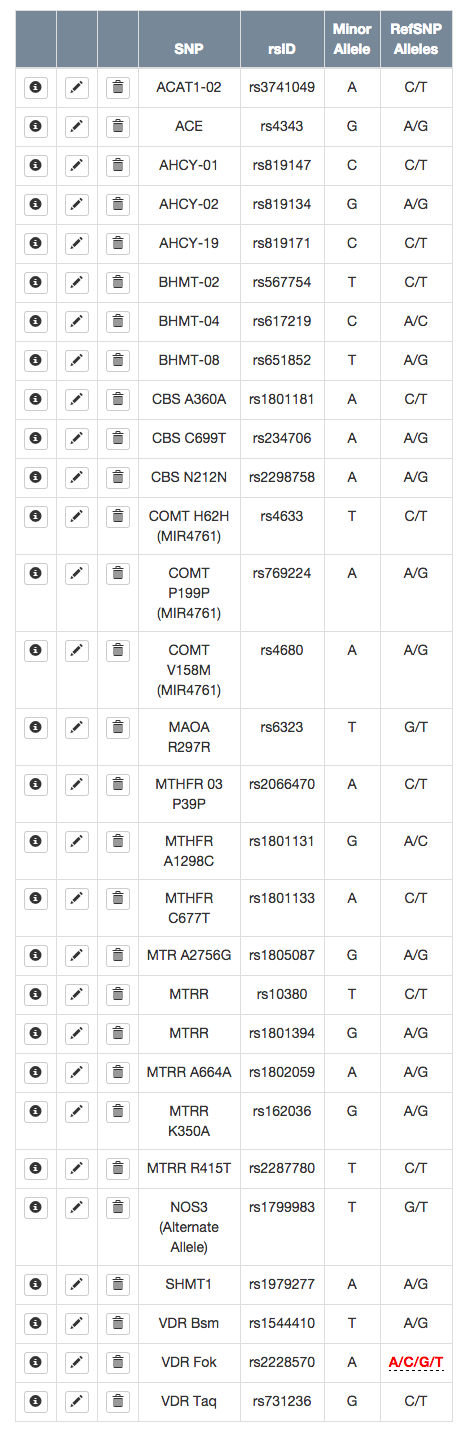
Livewello.com provides pre-written (and contributed) panels on DNA, for example,

NUTRIGENOMICS TEMPLATE WITH SUPPLEMENT RECOMMENDATIONS BY DR. AMY YASKO

To use them, you need to install it – which is easy:
Screen Shot 2015-01-05 at 9.46.41 AM
Then click the button. The results now appear. In my case — I am clear — the sole item listed is meaning less (DNA consists of (A,C,G,T) only so getting this match will happen to everyone!)
Screen Shot 2015-01-05 at 9.48.56 AM
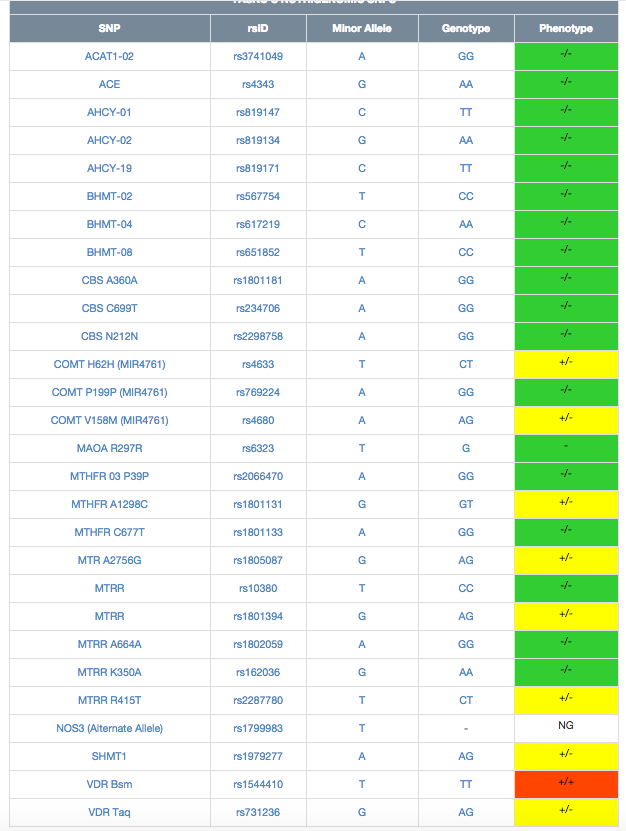
 Which you then need to click Screen Shot 2015-01-05 at 3.41.23 PM to see the results. Mine are below
Screen Shot 2015-01-05 at 4.02.51 PM

With only a single red (1 of 27 or 4%) and many greens (18 of 17 – 66%), the Yasko approach is unlikely to have significant impact on me. So instead of trying it, I move on to something that seems better connected to my DNA.

For the single item that is in Red, I can click the item (VDR Bsm) and read what it is associated with.

Normal function:

The VDR gene provides instructions for making a protein called vitamin D receptor (VDR), which allows the body to respond appropriately to vitamin D. This vitamin can be acquired from foods in the diet or made in the body with help from sunlight. Vitamin D is involved in maintaining the proper balance of several minerals in the body, including calcium and phosphate, which are essential for the normal formation of bones and teeth…..Most VDR gene mutations impair hair growth, leading to alopecia; ”

Whether this accounts for my 1,25D levels going through the roof while I had CFS (a common occurrence with many autoimmune illness) and return to the normal range with remission — I do not know.

So the process is very easy to get the information — what you do with it is another question which usually mean joining specialized groups dealing with these specific issues. Most MDs are not trained in this very new and rapidly developing area.

Snps for Coagulation Defects

Dave Berg of Hemex Labs back in 1990 reported that most CFS patients have a high incidence of coagulation problems — usually genetic in origin. Getting a MD to tested for these disorders is usually very hard, and made worst by most insurance (including national insurance) not willing to pay for them unless you are having a stroke.

The following is what I have been able to track down for Coagulation SNPs on PubMed. Tomorrow — we will look at a canned set of SNPs that a different site has available.

  • Magnitude: is the risk compare to normal people (0).
  • At present, some information is hidden from download by 23andMe, the value shown is “DI” Diagnostic information
    • Check download file and https://www.23andme.com/you/explorer/snp/ – often one will read DI and the other will give the value
  • Note on getting tested for most: “Factor V Leiden mutation testing should be reserved for patients with clinically suspected thrombophilia” – Mayo labs.
    • Australia Medical Insurance: “Medicare will pay only if the pathology request identifies in writing that the patient has a personal history of venous thromboembolism. A rebate for the proven defect(s) only can also be claimed for the first degree relative of a person who has a proven defect of any of the above. A family history of venous thromboembolism alone is not sufficient. The request must specifically identify the proven defect(s).” – AKA you can’t get there from here!
  • Readings Recommended:
SNP 23andMe Links – Comments (Magnitude) My values
rs1799963 i3002432 G20210A mutation of the prothrombin F2 gene G20210A, Positive: A:A(3). A:G(3) Normal G:G ( 0.293 when controlling for other SNPs) G:G
rs6025 yes Leiden mutation, R506Q, Positive: A:A 9x risk(3.5), A:G(2.3), G:G (0) (C=3.57).
common mutation.
C:C
rs7538157 n/a BLZF1 A->C (C=2.69) n/a
rs16861990 yes NME7   A->C (C=2.02) A:A
rs2038024 yes SLC19A2    C->A (C=1.53) (impacts absorption of B1) A:A
rs2519093 n/a ABO A->T, A->C (A=1.69) n/a
rs495828 yes T->G (T=1.65) G:T
rs8176719 yes ABO blood type O allele]  ?-> C DI
rs118203905 na FV Hong Kong R306G ( G=1.59)
rs118203906 na FV Cambridge R306T( T=1.59)
rs1801020 na C46T ( T=1.63)  A->G G:G
rs2232698 yes R67X ( T=1.59) C->G, C->A G:G
rs5985 Factor Protector yes Factor Protector (2-4)  C->A  A:A
rs121909548 n/a A3845 ( T=2.277) C->G,  C->A
rs9804128 yes SNP Interaction [G on this one] A:G
rs4784379 yes SNP Interaction [A on this one] A:G

As you can see, I have the expected genetic mutation to pre-dispose myself to coagulation. As I result, I can be more specific in searching for appropriate supplements to reduce the type of risk each one creates. I can also regularly search PubMed for new articles. For example, searching for rs495828 -found 8 articles at present. For example

  • associated with angiotensin-converting enzyme (ACE) activity and inflammation .. and with enalapril-induced cough [2014]

For Rs6025, there are 35 articles. One of which states “The goodness of fit of the genetic and combined scores improved when significant SNP-SNP interaction terms were included.”[2014], i.e. the more you have, the greater the combined effect.

Unlike the latter two vectors associated with CFS, I have significant activity here. The absence of those two other factors may be why I have been able to slip from CFS to remission three times — my recovery is not hampered by those other factors.

Analysis of uBiome Results for a CFS Patient

A reader asked me to review and comment on their uBiome results (site).  Finally, I have a few hours from excessive support activity to do it.

The Results Summary
Screen Shot 2014-10-26 at 10.06.27 AM

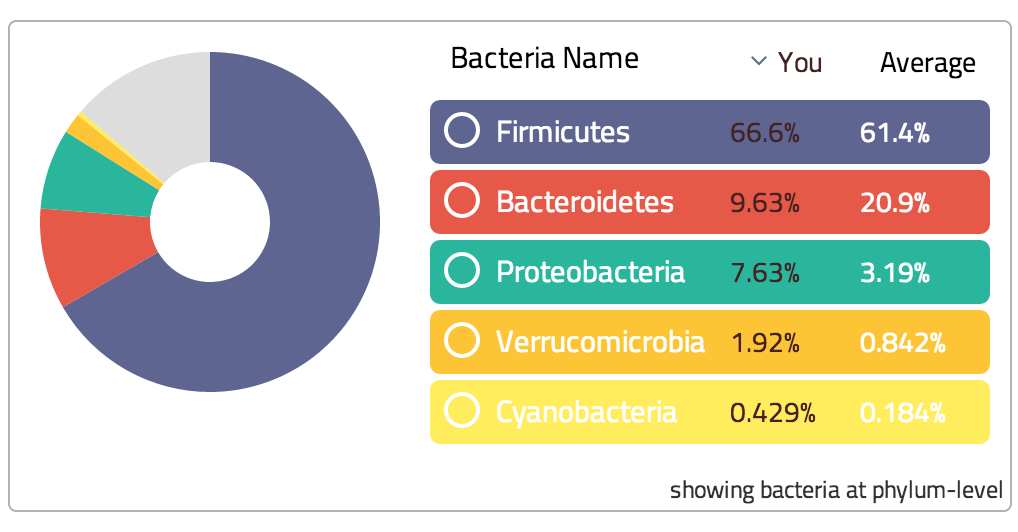
As you can see above, at a phylum level many groups have altered by a factor of 2 from normal healthy people:

  • Bacteroidetes are 1/2x
  • Proteobacteria, Verrucomicrobia, Cyanobacteria are  2.4x, 2.8x and 2.3x
  • For smaller phylums the numbers can be worst, up to a 7x difference.
  • Firmicutes are normal ( bifidobacterium and lactobacillus belongs to this family)

Clearly there is a dysfunction of the microbiome. This is not caused by diet, none of the diet groups are anyway close to this distribution. Nor is this causes by antibiotics (which some MDs would claim to dismiss dealing with this shift), uBiome provides a handy table to exclude this speculation.

Sample Site Group Bacteroidetes
1

gut

CFS Patient X 9.63%

gut

Vegetarians 19.03%

gut

Paleo Diet 20.61%

gut

Healthy Omnivores 20.67%

gut

Vegans 20.91%

gut

Heavy Drinkers 21.89%

gut

Weight Loss 21.17%

gut

Weight Gain 23.08%

gut

Antibiotics 18.31%

gut

All Samples 20.89%

Weight

The first item of interest is Bacteroides, which are significant for those CFS that have weight problems. “Bacteroidetes are the most prominent gut microbes in much of the world. They are thought to help protect against obesity because they do not digest fat well….Bacteroidetes are under represented in the guts of Europeans and North Americans” So not only are they low by world standards, they are low by the lowest population! Ok, my audience is brain-fogged so I will not go further into technical analysis but move on to the real concern — treatment! (Assuming that this patient is not vested in CFS and want to move towards remission)

Treatment

We will start with the biggest phylums that have shifts and proceed towards the smaller ones.

Increasing Bacteroidetes

This is a bit of a challenge because normally research is done on how to reduce bacteria (for this family, bad oral members of bacteroidetes). Bacteroides consists of three classes, with the class bacteroidia being the one is measured which breaks down into the following families:

One of the challenges is that most research is centered on killing/decreasing bacteria — not increasing them! I did find a video with suggestions on how to modify it by increasing the intake of polyphenols (for example, Rutin, Quercetin, Ginger ), for example:

  • Blueberries
  • Wine Vingears
  • Fruit

See wikipedia for a list of known foods.

Take

  • probiotic Prevotella bryantii 25A [2012] – this is an animal probiotic, may not be available in “human grade”
  • Probiotic Lactobacillus casei BL23 [2014]
  • Lactobacillus mucosae Dairy Product Culture Collection(DPC 6426) [2014]
  • Oligosaccharides 2-fucosyllactose and 3-fucosyllactose [2014] (found in human breast milk). Commercial source may be available soon (article)
  • Growth rates on polymerized carbohydrates were as fast or faster than on corresponding simple sugars,” [1990] aka polysaccharides: Chitin(chitosan), Pectins

Avoidance

  • Don’t take rhubarb root (Rheum officinale) [1987]
  • Simple Sugars “Growth rates on polymerized carbohydrates were as fast or faster than on corresponding simple sugars,” [1990]
  • ALL bacteriocin-producing probiotics know to impact the above, they include:
    • Lactobacillus salivarius [2013]
    • Bifidobacterium breve strain Yakult [2011]
    • Bifidobacterium longum [2011]
  • Antibiotics:
    • metronidazole; imipenem; amoxicillin/clavulanate and clindamycin [2014]

 Bottom Line:

The best single item after reading the literature is adding gum arabic to your diet (Recipes: ifood.tv) or make pills of it and take daily (up to 30 gm/day is reported safe! – I would suggest limiting to 8 gm) . There seems to be a significant number of articles on PubMed supporting this suggestion. It is also very affordable! Chicory forage (if available) seems very effective [2014, 2006] as well as high dietary fiber, xylose and non-starch polysaccharides. Tomorrow, I will move on to the next phylum.

As always, this is educational only — any changes of supplements, food, medications should be done in consultation with a knowledgable medical professional.

Memory Issues, Vitamin D and Chronic Fatigue Syndrome

I tend to view some of the processes involved with CFS to parallel (but are not identical) to Alzheimer’s Disease. Memory issues with CFS can remit with remission, AD has no remission.

Recently, the role of vitamin D with AD has had some research published (Journal Neurology, August 6, 2014). Low or very low Vitamin D levels double the risk of AD.  CFS research has found that the severity of symptoms increases with low levels of vitamin D and greatly reduce when patients are at the top of the recommended range (or slightly beyond).

One form of vitamin D, 1,25D (not normally tested for) appears to go up or down depending on severity of CFS symptoms.  By up, I mean very far above the normal range. When the lab did their first test of my 1,25 levels, it was so high they assumed a lab error. They repeated the test with the same result. With remission, I dropped down to the normal range of 1,25D.

A few years ago, there was a fad treatment, the Marshall Protocol, that promised remission if you pushed your Vitamin D level down to zero.  Bad idea. I know many people who tried it that are still addressing side-effects that arose during their attempt to do this protocol (under MD supervision).

And many many more!


How much, technically that needs to be done in consultation with your MD.  Most MDs will just want to get people into the bottom of the normal range. My physician wanted me to be near the top of the normal range. How much was I taking, around 20,000 IU of Vitamin D3 per day (as you get older, it takes more to maintain a level).


.

The Gut and Exercise

Exercise and Chronic Fatigue Syndrome tends to be a “hot button”  to many patients. The reality is that mild exercise is important. I have (and continue to) use WII Fit to track weight and monitor activity levels. There are some extremely mild exercises — just shifting balance, and progression up to yoga and step exercises.  The key is never to progress aggressively — just add a minute a day at most, or move up one more step for one exercise in their exercise scale for one exercise.

What does the literature say about Gut Bacteria and Exercise?

The first article of interest is not listed on PubMed, but may be read hereThe gut microbiota, dietary extremes and exercise  9 June 2014 doi:10.1136/gutjnl-2014-307305 which found “ The results provide evidence for a beneficial impact of exercise on gut microbiota diversity but also indicate that the relationship is complex and is related to accompanying dietary extremes.


  • Exercise induction of gut microbiota modifications in obese, non-obese and hypertensive rats. Petriz BA, Castro AP, Almeida JA, Gomes CP, Fernandes GR, Kruger RH, Pereira RW, Franco OL. “These data indicate that non-obese and hypertensive rats harbor a different gut microbiota from obese rats and that exercise training alters gut microbiota from an obese and hypertensive genotype background.” [2014]
  • Exercise attenuates PCB-induced changes in the mouse gut microbiome. Choi JJ, Eum SY, Rampersaud E, Daunert S, Abreu MT, Toborek M. [2013] “Our results show that oral exposure to PCBs can induce substantial changes in the gut microbiome, which may then influence their systemic toxicity. These changes can be attenuated by behavioral factors, such as voluntary exercise.” – this is significant to those who suspect some chemical like organo-phosphates is a contributing factor.

  • Exercise-induced splanchnic hypoperfusion results in gut dysfunction in healthy men. van Wijck K, Lenaerts K, van Loon LJ, Peters WH, Buurman WA, Dejong CH. [2011] “Splanchnic hypoperfusion is common in various pathophysiological conditions and often considered to lead to gut dysfunction. While it is known that physiological situations such as physical exercise also result in splanchnic hypoperfusion, the consequences of flow redistribution at the expense of abdominal organs remained to be determined. This study focuses on these effects” — this is double significant because hypoperfusion is seen in SPECT scans of CFS patients, as well as being the major part of Hemex/Berg model of CFS. Hypercoagulation contributes to the shift of gut bacteria!

So, hypercoagulation will make it harder for the gut to return to normal — and it will also cause you to tire faster when exercising.  Even mild short daily activity (I would not say exercise in the usual sense), will have a slow and positive effect on gut bacteria,