Chronic Fatigue Syndrome 101

A reader asked:

Out of curiosity, what tests can be taken for chronic fatigue? Because of it running in my family, and because of how exhausted I’ve become from recent events, I’m wondering if I’m in early stages of development of it as well. I’ve been lucky so far, but the right combo of triggers could certainly cause it to occur as well. I really need to find a way to get some extended time off, because I’m not gonna last long otherwise.

I will address the following key questions:

  • Are there any accepted-by-most MDs tests for Chronic Fatigue Syndrome?
  • What are the best tests available in your opinion?
  • What is the probable cause of Chronic Fatigue Syndrome?
  • How does onset happen?
  • What can be done to defend against full out CFS

Accepted Tests for CFS?

None — CFS is officially a diagnosis of having a set of symptoms with no known cause (and by inference, no test abnormality that would explain it).  While it is similar around the world, each country has a slightly different medical take on it. The unfortunate part is A CFS diagnosis requires that the patient has been fatigued for 6 months or more and has 4 of the 8 symptoms for CFS for 6 months or more. you have to be down with it for at least  6 months — by which time it may be well established and harder to prevent from becoming a permanent state.

Best Tests to Confirm CFS or indicating Increased Risk

There are three tests that I have found works as indicator of CFS status. In theory, they may be early predictors. Two require a MD to order, one does not require a MD. The best one (IMHO) does not require a MD.

  • SPECT Scan — not a MRI, but a SPECT. It will show major abnormalities in 80% of CFS patients. For myself, the radiologist read it as Alzheimer’s Disease (“Early” because I was too young). It was very similar to the results of SPECT scan done by Dr. Daniel Amen (seen on PBS) on a teenager with CFS that I am familiar with.
  • Abnormally high Vitamin 1,25 D levels (this is not the usual vitamin D lab). My readings were so high, that the lab repeated the test because they thought there must be a mistake. As I recovered, the level dropped back to normal levels. IMHO, an elevated level is a indicator of high risk. Article
  • Shifts of Microbiome — there is a very major shift with CFS. As the condition develop, the microbiome is expected to alter more and more towards the very distinct pattern seen with CFS. – This does NOT require a MD, you can buy the kit for $100 (in fact, I have a few kits on the shelf as a reserve if there is a concern).

If you are concerned — first step get the Microbiome testing done ASAP … it takes a few weeks to get the results. It is likely the most sensitive because the shift of microbiome is slow and progressive.

Probable Cause

Having been thru CFS three times and reading almost every summary on PubMed, my model of CFS meets the classic scientific criteria of the simplest model that explains all of the observations.

  • CFS (and likely many autoimmune conditions) is a shift of gut bacteria (microbiome) caused by bacteria, virus or chemicals that do not return to healthy-normal in a reasonable time.

The bacteria, virus or chemical does not directly cause CFS, it is a catalyst or trigger to the self-maintaining shift. The shifted bacteria population pumps inflammation signals and other chemicals into the body causing a host of symptoms. Gut bacteria is actually inherited and is very connected with your DNA.  Your DNA favors certain bacteria mixtures. My own experience is that some symptoms seems specific to certain species. Neem took away one group of symptoms. Ashwanganda removed other symptoms.

How does onset happens

The mechanism is some events that alters the chemical signals passed to the gut bacteria. Some species are encouraged and others are discouraged. Stress alters the chemicals flowing in the body and is often a contributing factor. A bacteria or virus can also trigger it. Recent studies suggests that the immune response to an infection alters the chemical signals so that certain chemicals are produced in greater quantities to fight the infection. The problem is that the chemical signals ends up establishing a feed back loop that results in those chemical signals not being turned off. In some cases, light can trigger an increase of these chemical signals, for example UV can trigger lupus [WebMd] and been reported to trigger other autoimmune conditions.

How to slow or reverse onset

Working from the model above and literature (plus personal experience) – the key is reduce the bad bacteria and increase the good ones.  Conceptually this is easy. In reality, it’s complex because we know so little on which ones are bad or good — or how to change them either way. My best suggestions(short list) is:

  • Probiotics:
  • Herbs and Spices (available in bulk at most East-Indian stores)
    • Neem
    • Tulsi — start drinking lots of Tulsi tea!
    • Ashwanganda
    • More items
  • Supplements:
    • Vitamin D3 — 20,000 IU/day
    • Magnesium supplements
    • B-12
  • Antibiotics
    • Only Tetracyclines are advised – they have been successfully used with CFS in the past.

I do not know how the microbiome shifts during onset, so if you suspect you may be developing CFS and get microbiome testing with abnormal results — please forward them to me.
Garlic, IBS, CFS, and the Microbiome

A reader wrote “Every time I eat garlic, both cooked and raw, I get a LOT of foul smelling gas… I don’t get this from onions for example…Do you have any idea why this is, what it might indicated as far as the microbiome go? I know garlic is rich in inulin…”

Inulin from garlic is well known, as well as from:

  • artichokes, garlic, beans, oats, onions and asparagus [ref]

I also recall that garlic has anti-biotic characteristics:

fresh garlic, but not aged garlic, can kill certain bacteria such as E. coli, antibiotic-resistant Staphylococcus aureus, and Salmonella enteritidis in the laboratory.” [WebMd]

Historically:

“From Roman antiquity through World War I, garlic poultices were used to prevent wound infections. The famous microbiologist Louis Pasteur performed some of the original work showing that garlic could kill bacteria. In 1916, the British government issued a general plea for the public to supply it with garlic in order to meet wartime needs. Garlic was called Russian penicillin during World War II because, after running out of antibiotics, the Russian government turned to this ancient treatment for its soldiers.

After World War II, Sandoz Pharmaceuticals manufactured a garlic compound for intestinal spasms, and the Van Patten Company produced another for lowering blood pressure.” [NYU]

Going over to PubMed

  • Garlic contains sulfur compounds like allicin, ajoene, allylmethyltrisulfide, diallyltrisulfide, diallyldisulphide and others which exhibit various biological properties like antimicrobial, anticancer, antioxidant, immunomodulatory, antiinflammatory, hypoglycemic, and cardiovascular effects.[2014]
  • ReducesInflammatory bowel disease (IBD) [2014]
  • Reduces  free-living (Hexamita inflata), and parasitic (Spironucleus vortens and Giardia intestinalis).[2014] Spironucleus vortens[2014]
  • garlic exhibits antibacterial activity against probiotic bifidobacteria. The aim of the current study was to elucidate the mechanism of action of garlic clove extract (GCE) on Bifidobacterium bifidum LMG 11041, B. longum LMG 13197 and B. lactis Bb12 [2014] – so do not take garlic with bifidobactra probiotics!

For more follow there links: Intestines and garlic and  garlic and antibiotics

Bottom Line

The foul smelling gas is likely release by species of bacteria being killed. Cross referencing species cited above I found that Giardia intestinalis is garlic sensistive and produces foul smelling faeces  [2014] as one possibility. Other possibilities include Aerococcus urinae [2013], Strongyloides stercoralis [2012] and likely many more.

A suggestion to discuss with your medical professional would be whether to try increasing dosage (fresh garlic – not capsules etc)  and see if the foul smell eventually clears (suggesting that the bacteria has been effectively reduced). It should be discussed with whoever lives with you… you could be a challenge to be around!.

Looking at the current Genova Diagnostics – GI Effects / Stool Profiles

A CFS reader asked me to review his results and provided a  masked copy of their report (Attached).

In looking at the report, I would describe it as better than the ones in the past.

Page 1

Summaries:

  • High IgA levels
  • Imbalance
  • Lower Diversity
  • Signifiant less abundance

Page 2

  • High Triglycerides – the odds of this with CFS is twice that of controls [2010]. It is also associated with some inherited coagulation defects.
    Fecal secretory IgA is in reference range which seems inconsistent with Page 1
  • n-Butyrate is slightly below the normal range, Propionate is higher. – which suggests IBS with CFS
    • “Patients with inflammatory bowel disease have lower numbers of Butyricicoccus bacteria in their stools. Administration of B pullicaecorum attenuates TNBS-induced colitis in rats and supernatant of B pullicaecorum cultures strengthens the epithelial barrier function by increasing the TER.” [2013]
    • ” Elevated levels of amino acids (alanine and pyroglutamic acid) and phenolic compounds (hydroxyphenyl acetate and hydroxyphenyl propionate) were found inIBS” [2011]

Page 3

  • High level of:
  • Low level of:
    •  Bifidobacterium – typical – See my earlier post
    • Firmicutes/Bacteroidetes Ratio – this is almost identical to the results of another CFS patient [Post]
  • Not detectable:
    • Anaerotruncus colihominis – just 3 pub med articles
    • Coprococcus eutactus – IBS marker [2014]
    • faecalibacterium prausnitzii. ” A reduction of enteric microbiota diversity has been observed in UC patients, mainly affecting the butyrate-producing bacteria, such as Faecalibacterium prausnitzii, which can repress pro-inflammatory cytokines [2014] which may explain the low butyrate levels.
    • Colinsella aerofaciens [ just one article]

Page 4

Gastroinstentinal Microbiome – one issue: Klebsiella pneumonia was high as seen in a prior reader’s lab

Page 5

Microscopic Exam Results – no issues

Page 6

Additional results – no issues

Page 7

Prescriptive Agents:

Only Klebsiella pneumonia was listed and the antibiotics effective against it. This is a histamine producing bacteria and thus over population can result in histamine sensitivity and many CFS like symptoms.

Bottom Line

The results are the same pattern of other CFS patients. The strong IBS indicators suggests that Prescript Assist (which has resulted in IBS remission for a significant percentage) is a logical course of treatment.

Anonomous Report Shared With Me 

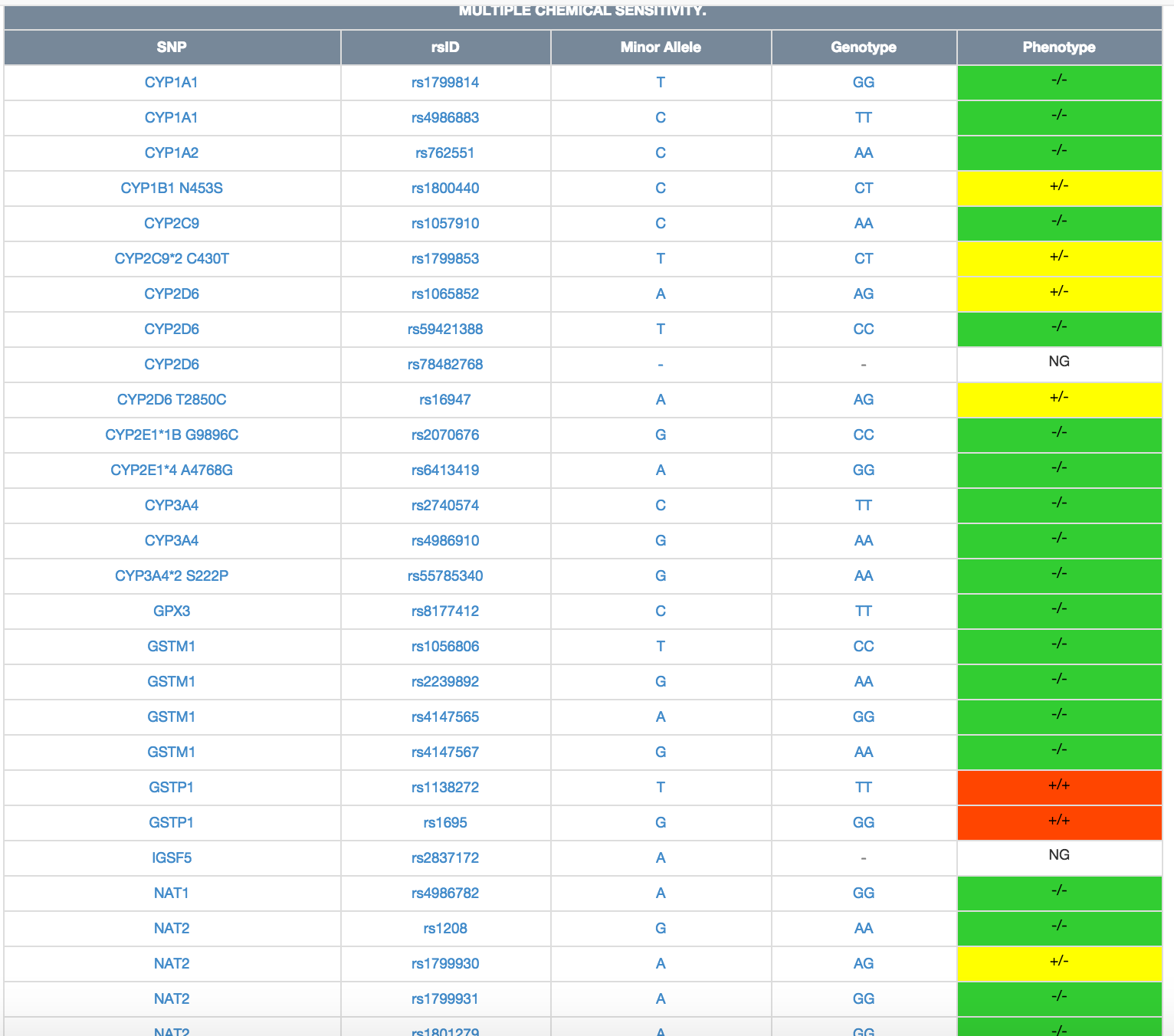
How to find treatment for a DNA Mutation: Treating GSTP1 as an example

A reader wrote ” I was surprised at how many reds and yellows I have [on Yasko and other panels]. But I’m not sure what the next step is to try and find info about and treatments relating to all of this info? I’m not well and maybe this could help.”

In an ideal world, you would take the panels into your MD and s/he would know exactly how to treat each mutation. The reality is that the vast majority of MDs would not know what to do with the panels, or how to treat different mutations. My own experience recently was with a recent graduate in Internal medicine and apart from a mutation(where she had a cookbook recipe to follow), she wanted to ship all of these issues to specialist (usually 20 years out of medical school and even less aware of DNA panels!).

With CFS, brain fog is common so I am going to write it out as a checklist.

  1. Got through all of the panels and list them from highest percentage of RED to lowest risk
  2. From the list above, write down in the same order all reds that have a named mutation for them (far left column)
  3. You will now start the search for information. Say that the mutation is “GSTP1“, which I used in my prior post on MCS.
    1. First, a mutation may cause many conditions — any thing that helps the condition for those with mutation is GOOD.
      1. If it helps a male with prostate cancer with this mutation, do not dismiss it because you are a woman. We want to treat the mutation and NOT the condition.
    2. For treatment, you will find a small number of actual professional studies, a few speculations from professionals on what could help, many suggestions from people trying to infer what will help from limited knowledge.  Ideally, we want reliable proven treatments, but if such information is not available then we need to tread carefully and make sure that there are no known negative effects from speculations.
  4. How to search for the most authoritative information, the best source is PubMed.
    1. GSTP1 Herb – 7+ articles
    2. GSTP1 Supplement – 19+ article
    3. GSTP1 Vitamin – 93+ articles
    4. GSTP1 Treatment -1399+ articles
  5. The next step is to work thru these articles, at least to scan them looking for gems. The sequence above is what I found produces the best results in the least articles… with luck I may only need to scan the first 26 articles.
  6. If the above fails to find gems, then I take the same phrases and add a “MD” to filter to more authoritative pages.


What did I find for treating GSTP1?

First, for some mutations you can be really lucky, for others you may not find a single bit of useful information. In the latter case, just smile and move on to the next red mutation. In a year, research may have found something.

  • roots of licorice (Glycyrrhiza species) [2014]
  • Indigofera suffruticosa Mill [2013]
  • Andrographis paniculata [2011] [2010][2008][2008]
  • tomato and broccoli.[2013] [2011]
  • the ability of α-tocopherol (vitamin-E) to affect IL-6 production was influenced by the GSTP1 313 polymorphism [2012]
  • supplement of recombinant GSTP1 [2009]
  • curcumin (turmeric) [2008]
  • “However, in multivariable conditional logistic regression models, we identified a significant interaction between GSTP1 and GSTT1 in relation to  Autism Spectrum Disorder (ASD)” [2014] – having a MCS parent seems to increase the odds of a ASD child greatly
  • “Herbicide exposure modifies GSTP1 haplotype association to Parkinson onset age” [2013] [2006]
  • alpha lipoic acid [2010] [2004] – but the 2004 study suggested a very narrow range of action.
  •  Lycopene [2008][2002]

While there were many people suggesting Glutathione supplementation (for example Amy Myers MD “Taking glutathione or the precursors (NAC, alpha lipoic acid, milk thistle) often help my patients dramatically with fatigue.”), I was unable to find any PubMed studies on the effectiveness of glutathione supplementation.

So this is my approach, typically it takes 1-2 hours to do a reasonable treatment of a single mutation.

Case Study on Using DNA: Multiple Chemical Sensitivity

One of the panels available on    deals with Multiple Chemical Sensistivy. One of my readers shared their profile and asked for suggestions on where to go from that. This shows how I would proceed. In this case the issue was simple and I could find suggestions.

First the results — we have two REDs

Screen Shot 2015-01-07 at 3.42.50 PM


We are actually lucky because both REDS are on the same mutation (but different SNPs): GSTP1

Click the link we get the usual type of information which lacks any information about treatment.


NCBI Gene Info

Telomerase is a ribonucleoprotein polymerase that maintains telomere ends by addition of the telomere repeat TTAGGG. The enzyme consists of a protein component with reverse transcriptase activity, encoded by this gene, and an RNA component which serves as a template for the telomere repeat. Telomerase expression plays a role in cellular senescence, as it is normally repressed in postnatal somatic cells resulting in progressive shortening of telomeres. Deregulation of telomerase expression in somatic cells may be involved in oncogenesis. Studies in mouse suggest that telomerase also participates in chromosomal repair, since de novo synthesis of telomere repeats may occur at double-stranded breaks. Alternatively spliced variants encoding different isoforms of telomerase reverse transcriptase have been identified; the full-length sequence of some variants has not been determined. Alternative splicing at this locus is thought to be one mechanism of regulation of telomerase activity. [provided by RefSeq, Jul 2008]


The next step is simple, take the gene mutation and google it with “treatment” and then “supplements” and see what you can find.

The first item to be aware of is to ignore the condition they are dealing with – if it is prostate cancer and you are a woman, you would normally stop reading.. WRONG… we are interested in compensating for the SNP/Gene/Mutation and not for a specific diagnosis. Some of the items I found are:

Some health professionals recommend individuals with GSTP1 SNP’s minimize their exposure to cigarette smoke, charred food, herbicides, fungicides, insect sprays, industrial solvents, and toxic metals. In addition to ensure GSH support it is important to supply GSH precursors and cofactor such as, methionine, NAC, glutamine, glycine, magnesium, and pyridoxal-5-phosphate (B6). It is possible to reduce GSH depletion by supplementing with alpha lipoic acid, milk thistle, and taurine.   Certain foods such as onions, leeks, garlic, broccoli, cauliflower, cabbage, kale, Brussels sprouts, and radish can increase GST activity.   It is always recommended to consume an antioxidant-rich diet to prevent oxidative stress..[link]

What! We have a supplement list provided. Checking carefully to the source and it was a forum — which is not my preferred information source. So while noting the above, I will move all to published studies….

PubMed Articles on Supplements and GSTP1

I found some 1250 articles on GSTP1 and grabbed two of the more well documented supplements.

High cruciferous vegetable (cauliflower, cabbage, garden cress, bok choy, broccoli, brussels sprouts) intake reduced the impact[book – 2008 Study]

Alpha Lipoic Acid

Lycopene