

The site is:
Cort and I go back 10 years and he invited me to do a series of posts. The posts will be less technical then the ones on this blog and a bit more personal and folksy.
The site is:
Cort and I go back 10 years and he invited me to do a series of posts. The posts will be less technical then the ones on this blog and a bit more personal and folksy.
A friend has CFS and had had severe herx from almost any probiotics. The result was a lack of willingness to take on my approach.
The other day she found that symptoms of Chlamydiae Pneumonia were starting to get bad, likely as a result of recent family stress. She was starting to have problems breathing, etc. She was feeling very bad and asked for help…
I re-explained to her how gut-bacteria and tissue infections set up a mutual beneficial feedback loop and recounted my experience stopping infections cold with a heavy probiotic dosage of mutaflor or prescript-assist. She took a single capsule of prescript assist at bed time… and that was all that I heard.
Three days later, she informed me that she was going to take it daily… I was surprised (and delighted). She explained why:
I look forward to hear her continuing reports — it appear effective for her Chlamydiae Pneumonia-like symptoms; I wonder what other symptoms will be reduced or disappeared from her doing a course… I also wonder if she will be able to tolerate other probiotics better after this course.
“Have you eaten your dirt today?” (i.e. prescript assist)
Rick Van Konynenburg’s passing was very unexpected and unfortunate, not only for the community but because he had just agreed to review a draft book on the Gut Bacteria model that I was working on. I had sent him a draft just 7 days before he passed.
In terms of recent papers, this [2012] paper appears to support the premise — especially if you consider the frequent co-morbid conditions of IBS and IBD with CFS.
“The gut microbiota, the intestinal mucosa and the host immune system are among the large biological networks involved in the development of inflammatory bowel disease (IBD), which includes Crohn disease (CD) and ulcerative colitis (UC). Host genetics and environmental factors can significantly modulate the interactive relationships among these biological systems and influence predilection toward IBD… Epigenetic changes, such as DNA methylation (the methylation of cytosines followed by a guanine in CpG dinucleotides) can be modified by environmental influences [gut bacteria]. Mucosal DNA methylation can also react to changes in the commensal microbiota, underscoring the intercalating relationships among the large biological systems involved in gastrointestinal disorders.
A [2000] paper on IBD states a situation of suspected infections factor similar to that seen with CFS: “A great number of bacterial and viral factors has been suspected of being infectious factors in IBD, mostly in CD. Mycobacteria, Yersinia, Campylobacter, Clostridium, Clamidias, etc. as well as bacteria and some viruses such as herpes and rotavirus and the primary measles virus. None of them has been proven as a real and exclusively pathogenic factor.”
Returning to CFS specifically, from the Aussie 1998 conference report, we know that escherichia coli populations is very low in CFS patients. E.Coli produces NADH, and this would account for the benefits of NADH supplements for CFS that have been reported from several studies.
E.Coli also impacts other metabolites. I did a query on PubMed for “Escherichia coli Methylation” and got 3244 hits today!
One paper from 1973 was very interesting:
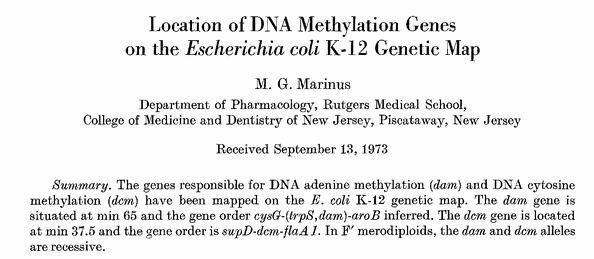
Location of DNA methylation genes on the Escherichia coli K-12 genetic map
Another study from [1972] found that Bacillus subtilis is also involved. B.subtilis was used in WW2 to treat dysentery (as was E.Coli Nissle in WW1). It should be noted that the use of such fell out of favor with the introduction of antibiotics. It is very interesting to note that Nattokinease is produced by a member of B.subtilis family (Bacillus subtilis natto).
My conclusion is that methylation issues in CFS could be explained as a result of a gut bacteria alteration. The methylation issues are down-stream from the gut (i.e. it would be much harder to argue that methylation issues causes gut bacteria alteration).
I find myself asking the same question that I ask of antibiotics use and CFS:
“Chronic illness can be physiologically due to blocked biochemistry of methylation.” – the question is What is blocking the methylation? It could be DNA, but I believe the greatest factor (which happens to also be correctable!) is gut bacteria…
This week’s edition of The Economist, had a very relevant article entitled “Malnutrition and the microbiome – Debugging the problem – Having the wrong gut bacteria can cause malnutrition“. We could substitute Chronic Fatigue Syndrome for Malnutrition and would likely end up with a substantially correct article. The article talks about things such as Krebs cycle going wrong, a topic that is very familiar to some CFS patients.
“And if a child has the wrong bacteria in his gut, that seems to be what happens.”
The key item they demonstrated was
“Having established that bacteria can be at least part of the cause of {some illness}, the team studied a few cases in greater detail. They worked out which bacterial enzymes are more, or less, active in the guts of children with {this illness} (or, rather, in the guts of mice into which the appropriate faecal samples have been transplanted), and which metabolic products are more, or less, abundant.”
CFS is viewed as a metabolic dysfunction by many researchers. Lastly, the treatment approach being suggested is similar to that which has been discussed on this blog
“ This might be a different form of therapeutic diet or it might be some way of “rebooting” the gut microbiome directly, by adding missing species or subtracting unwanted ones. This is an approach that is also being tested to treat people with a potentially lethal gut infection called Clostridium difficile.”
The article closes with:
“This study adds to the growing science of microbiomic medicine, in which the lives of the bacterial passengers that people carry around are given due weight and consideration lest they turn on their hosts and hurt them.”
The unfortunate aspect is that this is still preliminary research on the causes and not even looking at treatment yet.
In the last few years or so, there has been several citizen-science initiatives. Often these have been kick-start events
One of the earliest and most successful ones was 23 and me, which was funded by one of the co-founders of Google to help with DNA research on Parkinson’s Disease. The tests were done for free to Parkinson patients to get the data needed to do analysis. They have some 400,000 subscribers and have over $52,000,000 in financing. They originally charged $999 per test and have since moved the price down to $99 while increase the number of SNP (dna fragments) by a factor of 10 — effectively a 100x better deal. I have had me DNA done by 23andMe.com. The results are downloadable and searchable: this allows patients or physicians to compare patients DNA with the latest research.
Several kick-start or equivalent opportunities for people to find out more information about their microbiome or gut bacteria. Like DNA testing, they have great potential for learning more about risks or conditions that you have. I suspect that we will, with enough data, find that certain strains of bacteria results in certain symptoms in the CFS patient, including who may have MCS, IBS, pain, etc.
We are not there, to get there will likely need at least 500 CFS patients to be tested — as well as their symptoms and labs entered. There is a good chance that 5000 or more may be needed — why? because there are so many strains and species of bacteria in the human gut. With that said, I should review the main players
Funds raised $284K (1/200 of 23 and Me), with ~1900/6000 samples most at the lowest level of information. Costs from $99 to $25,000 depending on level of testing. There has been privacy issues raised by some and the man behind it all states “Is this going to diagnose your disease? Absolutely not. Is this going to change your life? You know, maybe, maybe not. “[NPR] which causes to wonder why Dr. Mercola recommends it. Getting a list of “dominant microbes [families]” in your gut has limited value
What you will get is details on the families (not species, nor strains) such as shown in this document. This project grew out of the Human Food Project(who has the same head) and most of the emphasis is on how diet changes the distribution of bacteria families.
IMHO: this approach has great potential if properly backed (say $10 – $30 million dollars with an initial target of some difficult disease (UC, IBS, Crohns, CFS..)) with all of those with a diagnosis being given a free kit — which is what happened with 23andMe. Equivalent (and probably better for treatment plans) work was done in the 1990’s by Butt and reported here. His sample was 27 CFS patients that meet a CFS criteria. The problem with citizen science with CFS is that many people believe they have CFS because they cannot afford the medical cost to exclude other conditions (and thus have a neglected treatable conditions) or have chronic fatigue (but not chronic fatigue syndrome) — this generates a lot of noise in doing analysis of the data and often will push sample size requirements to be 10 or 100x bigger than needed.
Medline provides a nice (technical) summary of the challenges in this article.
Expect limited if no zero treatment benefit from AmericanGut test (at least not more than just accepting Butt’s results as applying to you). You will get better knowledge of gut bacteria. It may encourage you to alter your diet (which as a CFS patient, you should be doing already).
 CFS Remission