Microbiome Outliers

I have just gotten back results from Thryve. I have processed them thru BiomeSight.com giving me two interpretations of my sample. To better understand why I prefer this, read The taxonomy nightmare before Christmas…. In this post, I will look at the Thryve interpretation.

Before starting an analysis, it is good to note what has happened between samples and any specific issues you are hoping to address. My last sample was in February 2020. At that point, I was likely close to full recovery from ME/CFS but still be careful. Subsequently to that sample:

  • Two hospitalization for sepsis with lots of antibiotics
  • Last sepsis residue included high blood pressure (hypertension).
  • Instead of using prescriptions to address high blood pressure (I am taking no prescription drugs of any type – making me an exception for someone in the late 60’s), I have been taking appropriate supplements for it (see Hypertension – What we know, where the items and studies are detailed) . Almost all of the items are anti-inflammatories also.
  • Some weight loss (15 kilos, 30 lbs) – possibly a side-effect of the antibiotics.
  • I have noticed that I am sleeping longer and deeper. Smart watch reports sleep quality as “Excellent”

Questions being asked:

  • Should I drop some of the supplements for hypertension? BP is often 100/70 today, so there is wiggle room.
  • Any new supplements that I should consider?

My impression is that I am in good health for my age. Still have weight to take off.

Analysis

I have added two massive sets of data from KEGG: Kyoto Encyclopedia of Genes and Genomes since February. For this post, I have had to add a few more pages to do this analysis. There are almost 4000 facets of your microbiome that are available. This is mentally overwhelming to most people. The outliers attempts to filter these down to a manageable number.

Bacteria, like people, allow substitutions for work function. We need to be careful not to get caught up in specific bacteria — “all of your beer brew masters must be born within 10 miles of Munich”. This Maori from New Zealand may be the equivalent or better job.

We need to focus on what they produce and not what they are.

I will start with pages that I call Outliers – that is, values that may warrant deeper examination.

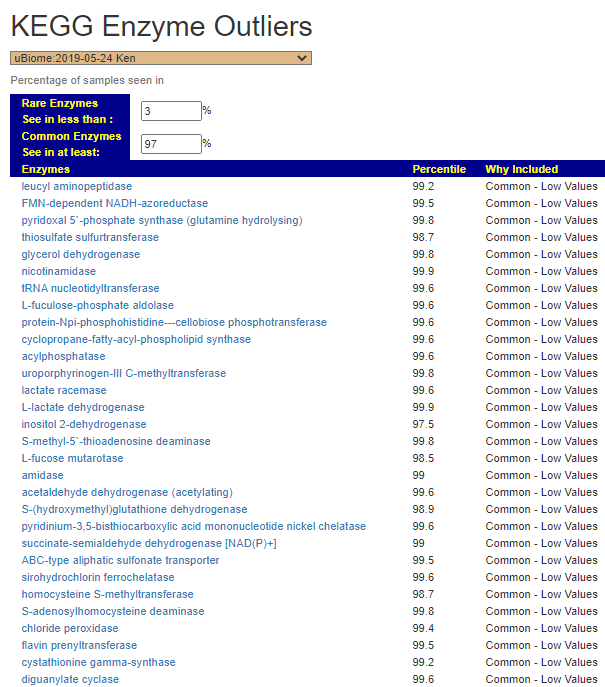
These are all located on the first dropdown menu as shown below.
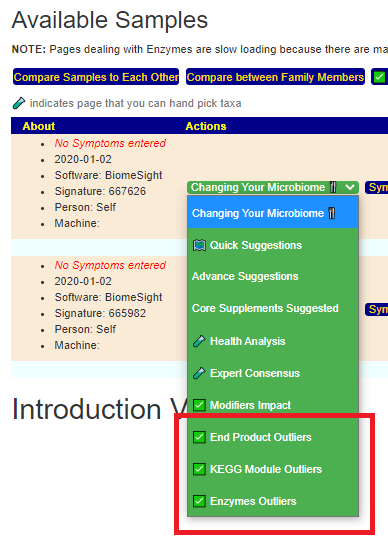
Outliers are values that are rarely seen

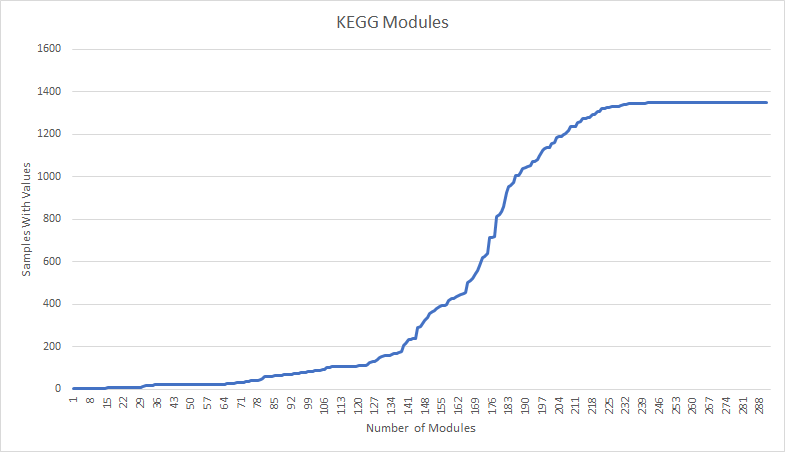
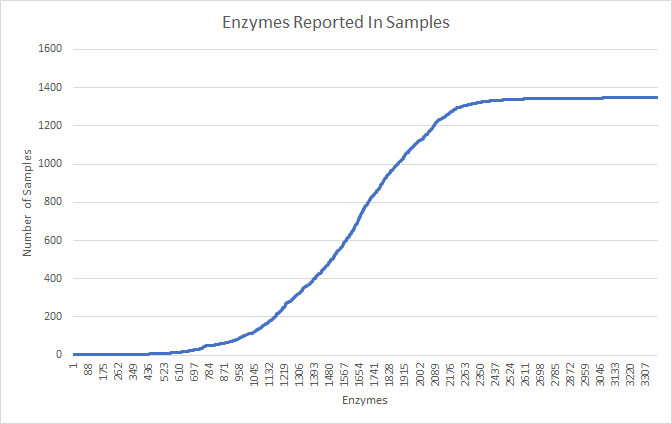
Values that shows up depends very much on what is reported by the software looking at the sample. There are two sets of results that I want to look at:

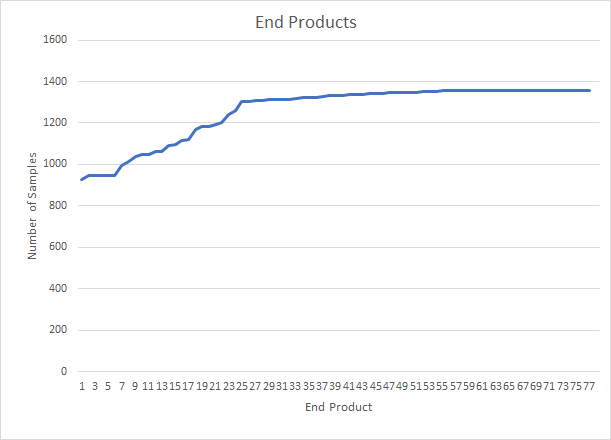
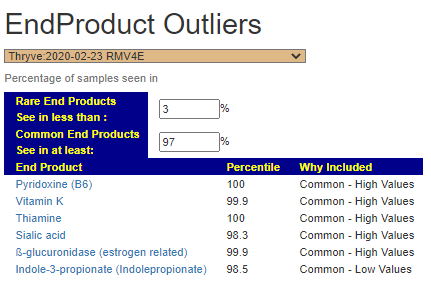
  • Those reported by almost everybody (i.e. 1300 samples or more). That is 97% shown above
    • For these I am concerned about very high and very low values (bottom and top 3%)
  • Those reported by few people (3% of 1300, or 40 samples or less). If the values are high or low is not significant because their presence is the oddity.

All of the outlier pages allow you is increase or decrease the ranges to be examined.
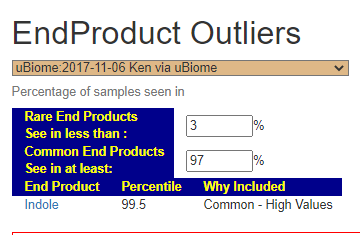
Items listed will explain why they were included in the list.

My goal is to identify these items for later follow up (Medical Professional or PubMed research)

End Products

Most end products are reported for most samples.
KEGG Modules
KEGG Enzymes
Actual Results – Using Thryve’s Data

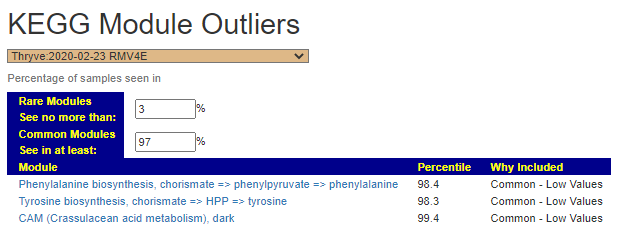
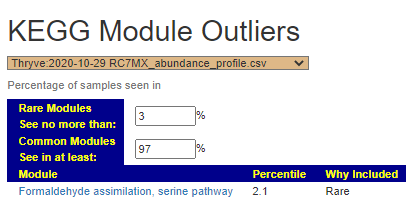
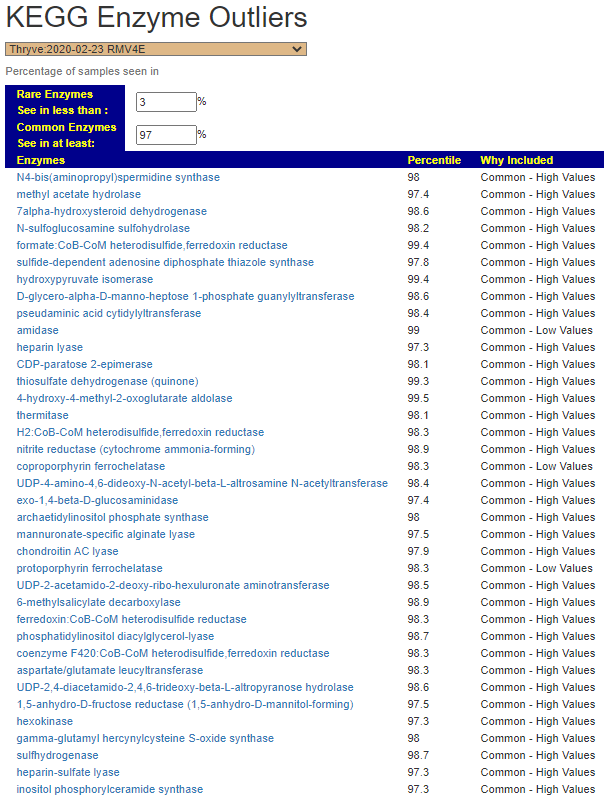
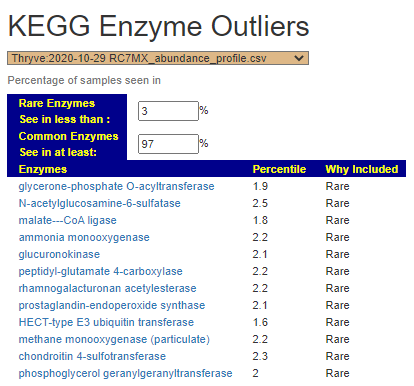
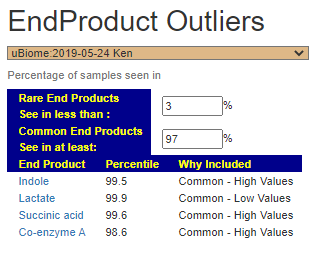
Compare to February, I expected things to improve. I was actually surprise at the degree of normalization seen across thousands of measures (literally!) as shown below. February results are shown first, followed by October.
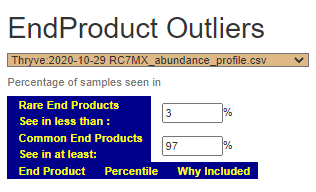
All items have normalized
All common values have normalized

Sick Me Results

If I hop back to a time that Chronic Fatigue Syndrome was active, we see a massive number of Kegg Module and Enzymes that were low (botton 3%ile)
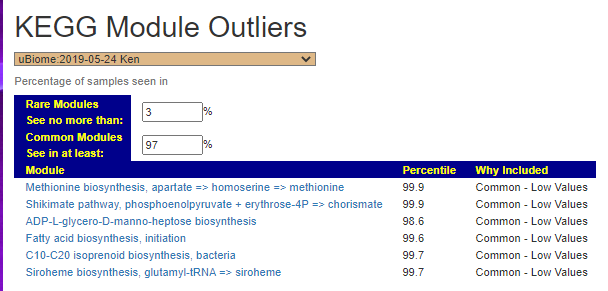
Bottom Line

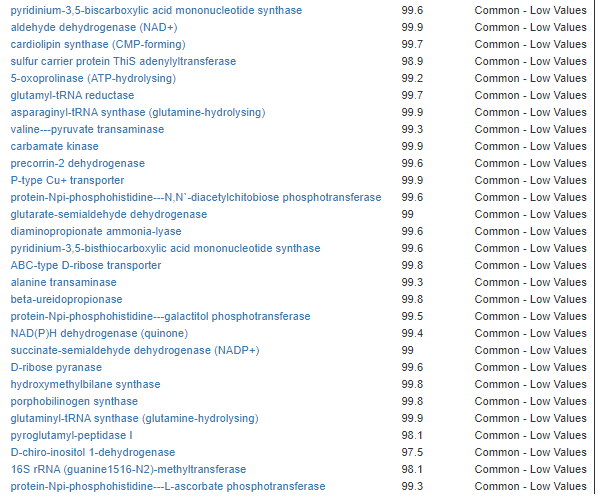
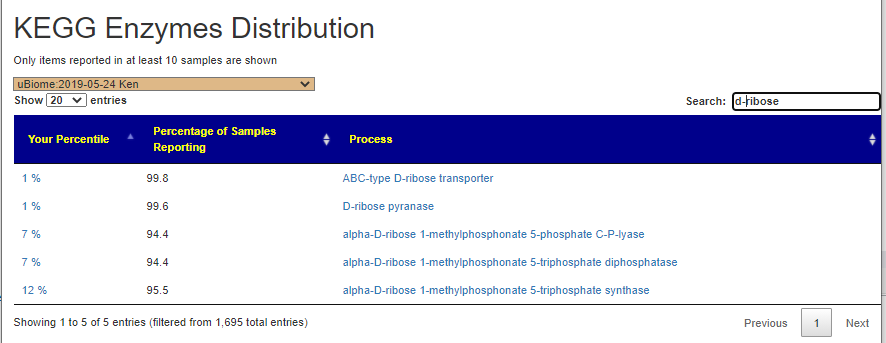
These new pages appear to work for identifying the processes that are off. Some of them can lead to immediate suggestions for supplements. For example, I noticed D-ribose enzymes on the list above, looking at more detail of this sample and filtering… I see that everything connected to d-ribose is low. Logical conclusion, supplement with D-Ribose. Surprise, surprise — the literature agrees!

Results: D-ribose, which was well-tolerated, resulted in a significant improvement in all five visual analog scale (VAS) categories: energy; sleep; mental clarity; pain intensity; and well-being, as well as an improvement in patients’ global assessment. Approximately 66% of patients experienced significant improvement while on D-ribose, with an average increase in energy on the VAS of 45% and an average improvement in overall well-being of 30% (p < 0.0001).

The use of D-ribose in chronic fatigue syndrome and fibromyalgia: a pilot study (2006)
Unfortunately, there is a lot of items that could be listed. Each one may take significant time to research.

This is enough material for a single post. More coming.
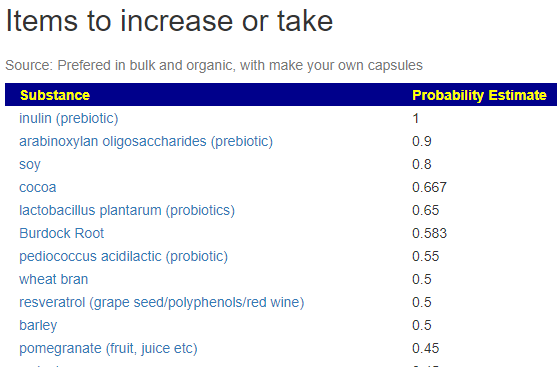
I know what I want to increase….

I received the following email:

Dear Mr. Lassesen,
As I am highly deficient in the following bacteria:

– Akkermansia
– Lactobacillus
– Roseburia
– Bifidobacterium
– Eubacterium

and pretty deficient in these two:

– Faecalibacterium
– Blautia

, I wanted to ask you for the best probiotic brands?

Another question would be: Is it beneficial to take prebiotics as well? And if not, why not?
Many thanks in advance for your help!

My answer is very simple and below:

 the best solution is to use the AI.
Go to http://microbiomeprescription.com/labs/definition?key=T And for each item above  mark them as down, 50% (exact amount is not important)

image.png

Then Click [Analysis] at the bottom of the page. This will takes you to a page like this:

image.png

Change choices as desired. It will then give suggestions based on the estimated probability of them making a change (not the amount of change, the probability of change).

There is a section on probiotics by commercial name.

image.png

Above that are specific items like prebiotics by explicit type. Some prebiotics may be on the avoid list. What is suggested with this combination of bacteria is partially below

This is generated by artificial intelligence based on a large set of facts obtained from gold-standard sources (studies on PubMed, KEGG, etc).

Data StoreCount
Microbiome with Symptoms683
Citations1,955
EndProducts-to-Bacteria Relationships8,223
Enzymes6,136
Enzymes to Bacteria5,396,780
KEGG Module to Bacteria274,712
KEGG Modules419
Medical Condition to Bacteria Associations4,306
Modifier-to-Bacteria relationships1,045,918
Modifiers of bacteria1,963
Probiotic Mixtures224
From http://microbiomeprescription.com/library/summary


Australia Microba Gut Test Uploads

I have implemented an upload for Microba, an Australian firms that claims “With the most comprehensive microbiome test available”. Instructions on how to do a download and upload is in this video:

I have tried several times in the past to do it. One of the biggest problems is that they do not use NCBI reference numbers or names. In fact, many of the bacteria they name — you will not find a single study on PubMed with that name. In other words — valueless information.

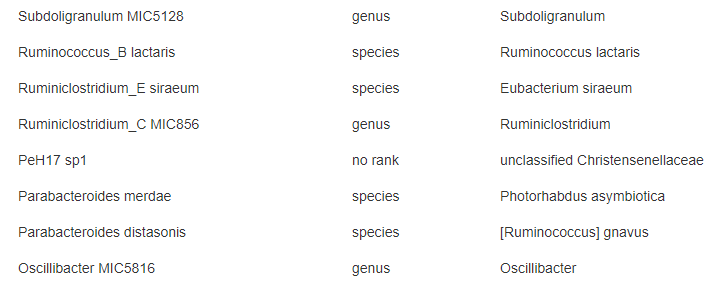
I have a mapping of their interesting names to NCBI names on line (and it will grow as samples are added and new names are added). The mapping is located here. I have repeatedly email them to make a download with NCBI taxon numbers available without success.

Left side is their name, right side is NCBI name. CAG-### is very vague.
Some additional “delights”

Only Selected Layers are Reported

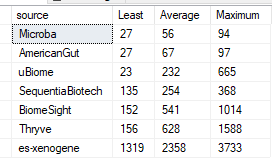
They report only on the Phylum, Family, Genus and Species levels. Excluded are Orders, Classes and Strains. After the mapping, we are typically left with less than 100 bacteria taxonomy versus many more from other providers. I do not know how they define “With the most comprehensive microbiome test available”. Most means better than ALL…

Number of different bacteria reported by Sample

In short:

  • the information available is far less.
  • This is made worse by the use of atypical names for bacteria. If you are high “Peh17” and go to PubMed to see what will lower it, or what conditions are associated with it — you hit a blank page. They may provide advice — but the basis of that advice cannot be independently checked.
  • The sum of all Species/Genus/Family is 100%. This implies that they have identified every bacteria — impossible. They have scaled the numbers of the bacteria that they detected to 100%. A person with actually 40% of one bacteria in their gut could see a report of 45%, 65%, 85% — depending on what other bacteria is the.
  • The report is to 0.01% that is 100 / 1,000,000, a coarse measurement than some other tests.

Bottom Line

For those of you who have already tested with Microba, you can upload and MicrobiomePrescription will do as much as it can with that information. If you decided to do a retest— I would not recommend using Microba for the reasons sited above. I have heard that the UK firm BiomeSight is making it easier for Australians to use their service. I have heard that duties and shipping costs makes  Thryve Inside more expensive than BiomeSight.

The upload page is at: https://microbiomeprescription.com/Upload/Microba

Expect it to be a few days before 100% of your sample is ready — any new odd-ball names has to be researched and entered into the mapping table. At upload, you will likely be 80+% processed immediately.

Deceptive Probiotic Labels

Every advertising agency will tell anyone manufacturing a product … include some probiotic and your sales will improve. There is no need to show any evidence that it makes any health impact, popular internet myth will sell it!

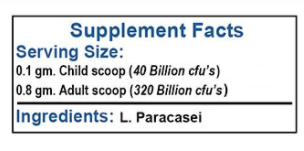
A reader toss this product at me– which to her looks good. It hits most of the advertising advice: cite organic. cite probiotics. cite human probiotics for extra selling power! Includes superatives with no real meaning — like potent.

No description available.

What should a label contain?

A 2011 study is a good starting point: Assessment of commercial probiotic bacterial contents and label accuracy which stated:

If an adequate label is defined as one that contains specific (and valid) bacterial names (genus and species), with no spelling errors and a clear statement of number of viable organisms that are expected, then only 8 (32%) products were properly labeled. If a more stringent definition of an adequate label is used, which includes a requirement that the product identify the specific bacterial strain that is present, then no products were adequately labeled.

Manufacturer can states that there is probiotics in a product without one single living probiotic bacteria being in the product after manufacturing. Food stabilizers, mishandling and preservatives will often kill off these bacteria quickly. “Only 4/15 (27%) products that had specific claims of viable organisms met or exceeded their label claim.” The rest of the products did not claim any viable organism (which the product shown above makes no claim for viable organism).

How much is needed to be healthful?

“It has been suggested that probiotic products should contain at least 107 CFU per ml or g ” [2001] . i.e. 10 million CFU

If we look at some probiotics on the market we see 400,000 million CFU/g

https://www.customprobiotics.com/l-paracasei-probiotic-powder.html

So, 1 gm of the above probiotic in 40,000 gm of ice cream (that is 40 kilograms or 88 lbs!) would reach that criteria – a very low bar.

They may be telling fairy tales about the contents!

“Organisms were improperly identified in 9/21 (43%) human and 8/23 (35%) veterinary products. Contents of 5/20 (25%) human and 3/17 (18%) veterinary products were misspelled. In only 9 human and 2 veterinary products were the contents adequately identified.” [2003]

“Studies organized worldwide and summarized in this article have shown that inconsistencies and deviations from the information provided on the product label are surprisingly common. Frequently strains are misidentified and misclassified, products are occasionally contaminated, sometimes with even facultative or obligatory pathogens, strains are not viable, the labeled number of colonies cannot be verified, or the functional properties are diminished to the extent that preclude the proposed health benefit. ” [2017]

My Source Choices

Given that most advertised probiotics are very questionable, I tend to single strain providers. Often they own the rights to their specific strains, have research papers published with their explicit product/strains and thus have a strong vested interest in keeping their product honest. They include:

Many manufacturers are focused on claims that results in better sales. They are not serious probiotics researchers or developers. They are serious entrepreneurs sensitive to what sells.

Example of a Good Label and Product

Biocodex Florastor® Daily Probiotic Supplement

Saccharomyces boulardii CNCM I-745 250 mg
Produced 38 suggested studies

My first step for evaluation is to search on PubMed for studies. The ones that interest me are:

etc… This is a yeast, not a bacteria, (thus viable units is not an issue). It does illustrate what you should demand to see before buying any probiotics. Hard studies with positive effect!

Contradictory Suggestions…

A reader asked:

Why are the quick suggestions I get very opposite the ones from the advanced suggestions?  soy is a top add in one and a top avoid in the other for instance.  Many other similar situations. 

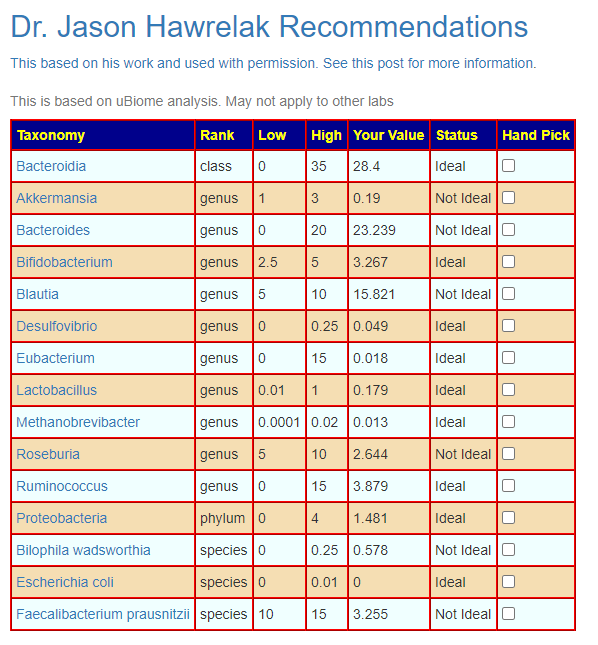
This is a good question. Quick Suggestions are based on the recommended ranges for a small group of bacteria from Dr. Jason Hawrelak, used with his permission. An example is below. This is not specific to any health issue.

For other suggestions, the bacteria picked determine the suggestions. Every bacteria has a different profile — so depending on which ones are selected, the suggestions will be different.

Some common ways of selecting the bactera:

  • Outliers – those too high or low compared to others. A crude method.
  • Bacteria which are high or low for a specific medical condition where your pattern matches
  • Bacteria which matches one or more symptoms where your pattern matches
  • Hand pick all of the bacteria using any criteria that you wish to apply.

We DO NOT KNOW what is the best way — it will likely be different for each person. We do not know which bacteria are “noise” and can be ignored in all cases.

If you look at the “Expert Consensus” page on your sample, you will see that there is disagreement. For some bacteria you will find some experts saying a specific level is too high and others for the same level saying it is too low.

I do not have a “safe suggestion” for anyone. I have built tools that allow various models of what is desired to be applied. I strongly recommend reading the following two posts to better understand the issues:

It means there are NO ABSOLUTE ANSWERS — they can never be…. it is like asking what is the height of a human (which varies by race and year of birth) and they asking what can I do to increase (or decrease) my height.

What you can get (especially if you are eating a ‘western diet’) is a feel of probable causes and things that will probably help. It has worked for me. It has worked for many readers who have tried it. Even in the face of “disagreement in technical details”, there can be strong patterns seen from the fuzzy data, see One Stool, Two Samples, One Lab — What the shit!.

You may wish to check my you-tube videos . I have plans to do a mini-course suite of them in the next few months.