Walk thru of the new feature.Example of discovered relationships
Updated Version
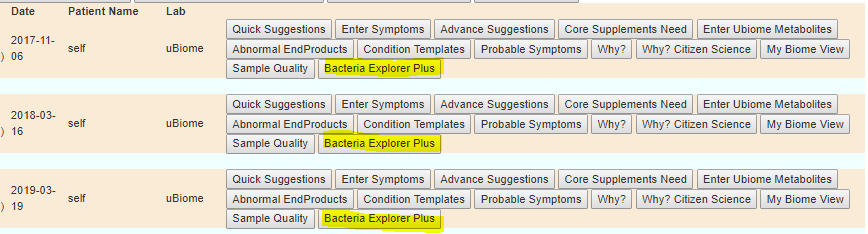
This is available from the Select Samples Screen as a new Button.
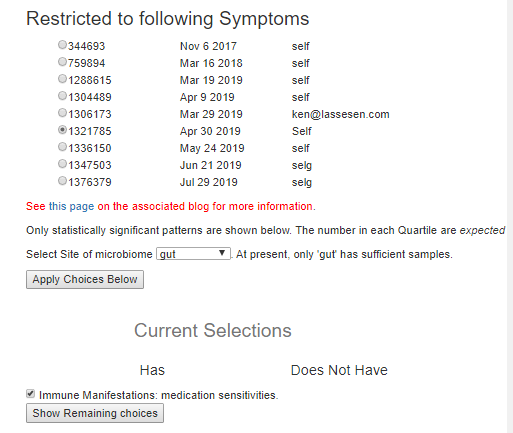
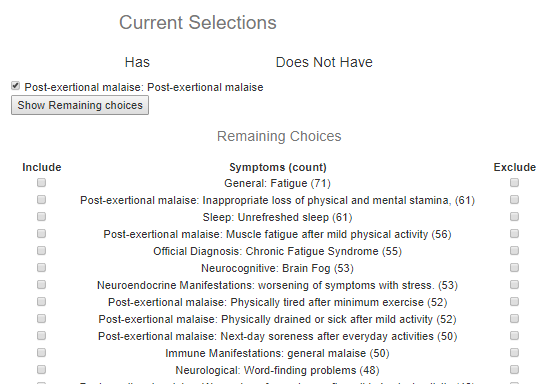
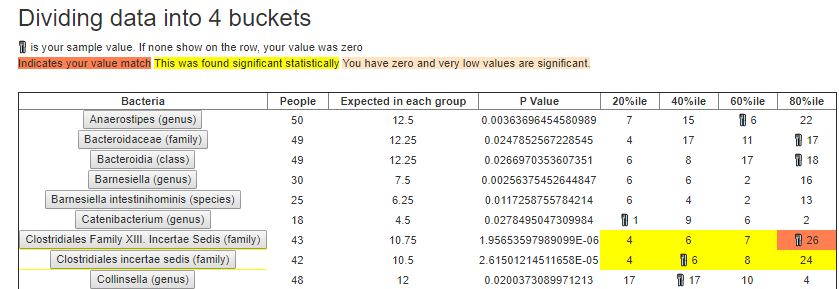
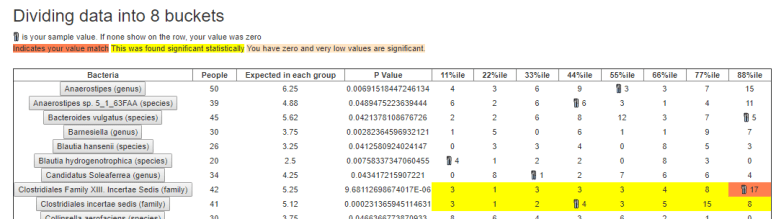
Accessing Symptom Bacteria Explore PlusAbility to select which sample you wish to add to the displayYou can select which symptoms to include or excludedYour values are shown on the table, if it matches the pattern, the background color is changed.You can increase the sensitivity by going to more buckets.You need to use common sense. I am not a precise match above, I am one above the precise match. Since we are dealing with very high values, being at the top level implies that it is an effective match.
Bottom Line
This is not prescriptive, i.e. directly suggesting actions. It is informative as to the cause. If you have not entered symptoms yet, consider doing so.
If you click on the bacteria button, you will be taken to the bacteria summary pages which may suggest changes desired. As always, changes of diet, supplements etc should always be reviewed with a knowledgeable medical professional before implementing.
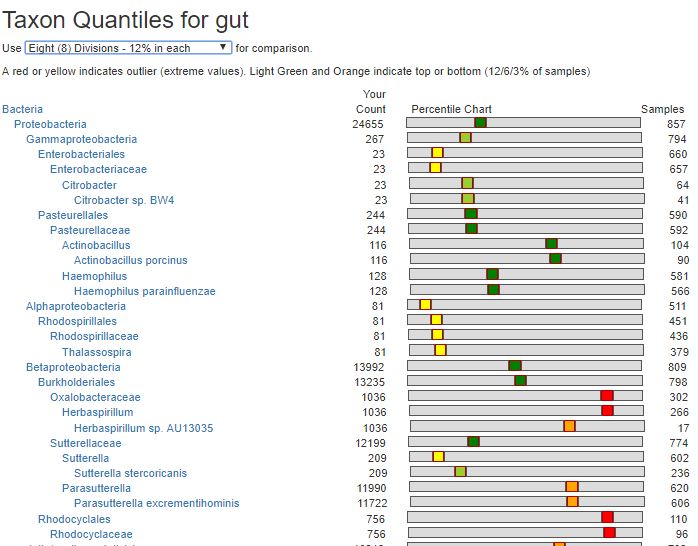
With the long weekend, I bite off some of the nastier refactoring. In the late spring, I did a trial run of quantiles non-parametric statistics with awesome results. I had arbitrarily picked 4. I have now implemented the data infrastructure to support 8 and 16 quantiles. To this, I added the site source so that mouth bacteria analysis will be automatically supported with more data uploaded.
Update of Taxonomy Data
This allows you to see how your numbers compare to others in terms of percentile buckets (3% of the population in each)
Updated My Biome View
The original version used canned images. This uses scaling and appropriate placement.
Site like mouth was been implicated in certain conditions (Chronic Fatigue Syndrome,
Data Size is sufficient that using the large quantiles should produce more meaningful results.
8 – quantile High Outliers are likely <3%ile chance (most medical tests use 5%ile for high threshold
16 – quantile takes it higher but with some caution being needed
For symptom analysis to microbiome, there is some extra magic needed (i.e. I must test with, 4-, 8- and 16- with too few samples forcing the lower quantiles.
That’s it. Been grinding away this weekend and about to do a 2nd revision of the code refactor.
I had an old Pebble Watch with heart rate monitor – unfortunately the battery was approaching end of life (i.e. watch needed to be charged daily). I went searching for an economical replacement and found a 2019 watch whose price was, was sweet. Ordered one to see how well it worked.
After a week, a second one was ordered for the wife.
The BP Pressure is not in most watches, this is a new 2019 model and using newer chips (the endless dropping of cost for features). There is a cheaper one (appears to be identical) for just $16.00.
The associated application shows your pulse thru out the day.
Having the blood pressure monitor is also sweet (you need to calibrate it using an external BP device- unless you are interested only in unexpected changes).
Bottom Line
Having automatic pulse tracking thru the day is sweet. Having BP being available when or after POTS happen is also informative. The cost is so low that arguments about how long will it last, etc… almost become moot.
Lately I have been getting a number of inquiries of parents with children with autism. I am a high function autism spectrum person myself, the degree of focus on the microbiome is likely a tell-tale ;-). I have done a few prior posts, and will keep my citations to studies after these posts.
If you find this informative, please share on groups you belong to.
Can we modify Autism by Microbiome adjustment?
Can we reduce autism-related gastrointestinal and behavior problems by gut microbiota based dietary modulation? A review. [2019] ” Published studies on the relationship of gastrointestinal and behavioral problems with gut microbiota in autism are very limited and contradictory. The fact that the results of the studies are not consistent with each other may be explained by the differences in the age of participants, geographical region, sample size, presence of GI problems in the selected control group, and feces or biopsy samples taken from different regions of GI system. ” – in short, poorly done studies
A Systematic Review of the Role of Prebiotics and Probiotics in Autism Spectrum Disorders.[2019] “Conclusion: Despite promising preclinical findings, prebiotics and probiotics have demonstrated an overall limited efficacy in the management of GI or behavioral symptoms in children with ASD. In addition, there was no standardized probiotics regimen, with multiple different strains and concentrations of probiotics, and variable duration of treatments. “
Long-term benefit of Microbiota Transfer Therapy on autism symptoms and gut microbiota. [2019] ” Notably, most improvements in GI symptoms were maintained, and autism-related symptoms improved even more after the end of treatment. Important changes in gut microbiota at the end of treatment remained at follow-up, including significant increases in bacterial diversity and relative abundances of Bifidobacteria and Prevotella. “
In short, the answer is yes — but apart from FMT, researchers/clinicians are tossing random diet and probiotics at the issue resulting is very mixed results.
Bacteria Shifts
” This meta-analysis suggests an association between ASD and alteration of microbiota composition and warrants additional prospective cohort studies to evaluate the association of bacterial changes with ASD symptoms, which would provide further evidence for the precise microbiological treatment of ASD. ” [2019]
For a good summary of current research see Table 2 in The Role of Gut Microbiota in Gastrointestinal Symptoms of Children with ASD [2019] or my condition summary page. In both of these you will see disagreement on some results: for example Lactobacillus to high compared to the controls used in one study and Lactobacillus is low compared to the controls used in another study. To me, this means that it is the metabolites being produced is the likely cause. Different groupings of bacteria can present with a similar metabolite profile. Often members in one of these grouping may be hostile to members of a different grouping — looking for a single bacteria or a single pattern of bacteria is a naive understanding of the microbiome.
” Serum levels of TNFα, TGFβ, NT, and SORT-1 increased in ASD patients. Fecal levels of HMGB1 correlated with GI sign severity in ASD children. ‘” [2019]
In terms of the microbiome site, we are up to 12 samples with autism uploaded. 16 is the threshold for it to showup in the symptom explorer (20-30 samples would be really nice!)
Attempts to date
Nowadays, there is lack of strong evidence about the effect of dietary interventions on these problems, particularly prebiotics. Therefore, we assessed the impact of exclusion diets and a 6-week Bimuno® galactooligosaccharide (B-GOS®) prebiotic intervention in 30 autistic children…. Following B-GOS® intervention, we observed improvements in anti-social behaviour, significant increase of Lachnospiraceae family, and significant changes in faecal and urine metabolites.
” The results showed that PS128 ameliorated opposition/defiance behaviors, and that the total score of SNAP-IV for younger children (aged 712) improved significantly compared with the placebo group. Additionally, several elements were also notably improved in the PS128 group after 28-day consumption of PS128. “
Consistent with previous studies, the microbiota of children with ASD contained a higher number of Clostridium spp. and a lower number of bifidobacteria compared with non-autistic children. B-GOS administration significantly increased bifidobacterial populations in each compartment of the models, both with autistic and non-autistic-derived samples, and lactobacilli in the final vessel of non-autistic models. In addition, changes in other bacterial population have been seen in particular for Clostridium, Rosburia, Bacteroides, Atopobium, Faecalibacterium prausnitzii, Sutterella spp. and Veillonellaceae. Furthermore, the addition of B-GOS to the models significantly altered short-chain fatty acid production in both groups, and increased ethanol and lactate in autistic children. “
It is clear that microbiome shifts impacts the severity and symptoms of ASD. Two studies showed improvements by trying to alter the microbiome, in one case by a probiotic and in the other case a prebiotic. IMHO, any drug that helps ASD, probably helps it by the microbiome shift it induces.
It is unlikely that the natures of the shifts are identical — we are dealing with different shifts for different patients. If you are the parent of an ASD child you have several paths before you:
Use the results of the two studies above, seeking out the specific strain and prebiotic used. Watching for further studies over the next decade
Suggestions included probiotics that are theoretically more likely to help than hurt.
The suggestions can be further refined by including symptoms (which highlights certain patterns in the midst of the noise).
Go with random suggestions from support groups. Often improvements reported are placebo effects or ‘hopeful glasses’ reports (you see what you need to see, not what is there).
As a FYI — my last post linked to an a priori suggestions for Autism (suggestion based on the shifts reported in the literature). The first probiotic on that list was Lactobacillus Plantarum. Also at the top of the lists were arabinoxylan oligosaccharides (prebiotic), fructo-oligosaccharides (prebiotic) . In other words, we have convergence of predicted to reported from studies.






 CFS Remission