What causes an autoimmune condition?

Some readers have asked me to explain my view of what causes a wide range of conditions – from diabetes to autism, from myalgic encephalomyelitis to parkinson’s.

At a high level, there are three dominant factors:

And genetics to microbiome:

And last, is consequences of infection and even immunization which can alter the microbiome — often in a long lasting way. The best study example occurred in Bergen Norway. 60% of CFS suffers developed the condition after a flu (or ‘flu-like’) illness.

Each factor interacts with the other factors and if you are unlucky, you have a struggle ahead of you. Of the above factors, the microbiome is the simplest to adjust.

Modifying epigenetic changes is more challenging – with stress being likely the only exception. Stress induced epigenetic changes may be reduced or reversed with full removal of stress (speculation) — which is not a trivial path. We may need almost 100% removal of stress, not just reducing it. We know that diet can invoke epigenetic changes – just do not know how. Science is still working on just detecting epigenetic, modification may be decades away.

This perspective is highlighted in this article:

The genetics of human longevity: an intricacy of genes, environment, culture and microbiome [2017].

At what microbiome level may we need to go down to?

Twins with identical DNA with one having a condition and another not, is the classic way of controlling for DNA variation.

” We collected fecal samples and clinical metadata from 20 monozygotic Korean twins … Finally, our unique study design allowed us to examine the strain similarity between twins, and we found that twins demonstrate strain-level differences in composition despite species-level similarities.

Sub-clinical detection of gut microbial biomarkers of obesity and type 2 diabetes. 2016]

Bottom Line

The microbiome is the easiest factor to address. It is not an easy to do. Just the easiest of the available choices. It is made more comlex by different diets, life style (yes, exercising regularly alters the microbiome) and even age (diversity decreases with age).

ME/CFS with and without IBS Microbiome

Doing a few more hours of reviewing PubMed studies, I came across “Fecal metagenomic profiles in subgroups of patients with myalgic encephalomyelitis/chronic fatigue syndrome” [2017] There were some interesting findings.

Increased abundance of unclassified Alistipes and decreased Faecalibacterium emerged as the top biomarkers of ME/CFS with IBS; while increased unclassified Bacteroides abundance and decreased Bacteroides vulgatus were the top biomarkers of ME/CFS without IBS. Despite findings of differences in bacterial taxa and metabolic pathways defining ME/CFS subgroups, decreased metabolic pathways associated with unsaturated fatty acid biosynthesis and increased atrazine degradation pathways were independent of IBS co-morbidity. Increased vitamin B6 biosynthesis/salvage and pyrimidine ribonucleoside degradation were the top metabolic pathways in ME/CFS without IBS as well as in the total ME/CFS cohort. In ME/CFS subgroups, symptom severity measures including pain, fatigue, and reduced motivation were correlated with the abundance of distinct bacterial taxa and metabolic pathways.

An external file that holds a picture, illustration, etc.
Object name is 40168_2017_261_Fig1_HTML.jpg
metagenomic profiles 

The differences in ME/CFS without IBS were driven by the increased abundance of members of Pseudomonadales order, the Clostridiaceae and Pseudomonadaceae family, and the ClostridiumPseudomonasPseudoflavonifractorEggerthella, and Coprobacillus genera and the decreased abundance of members of the Dorea genus. The 13 bacterial species driving the differences between the ME/CFS without IBS and control groups were D. formicigeneransC. catus, and P. distasonis, (all decreased in ME/CFS without IBS) and unclassified BacteroidesR. gnavusD. longicatenaP. capillosusE. lentaC. symbiosum and scindensC. bacterium, and Clostridium cf. (all increased in ME/CFS without IBS).

From the prior study (that did not separate with and without IBS), we have:

We observed reduced levels of members of the dominant phylum Firmicutes, also noted repeatedly in Crohn’s disease patients [133738]. Proteobacteria were more abundant in ME/CFS patients than in controls, observed as well in inflammatory bowel disease (IBD) patients [3940]. 
significantly lower levels of the genus Faecalibacterium, a member of the Ruminococcaceae in the ME/CFS population. For example, Faecalibacterium prausnitzii, which produces an anti-inflammatory protein [45], is reduced in ME/CFS cases relative to controls. ….  found a decrease in Bifidobacterium, previously observed in IBS [5357], IBD [58], and type II diabetes [59]. Bifidobacteria are a group of lactic acid-producing bacteria that are widely used as probiotics and as targets for prebiosis [60]. Treatment with Bifidobacterium infantis 35624 was reported to reduce CRP levels in a cohort of ME/CFS patients [61].

Reduced diversity and altered composition of the gut microbiome in individuals with myalgic encephalomyelitis/chronic fatigue syndrome [2016]

Bottom Line

This reinforced my hypothesis that symptoms (and perhaps official diagnosis) are strongly associated with microbiome dysfunction. It reinforces the 1998 study from Australia of microbiome dysfunction.

These reports will be incorporated into the condition profiles which need to be updated to the more sensitive Box-Plot code base.

A new soil based probiotic in the works

A reader forwarded a patent application ( 16701. (WO2019025573) TREATMENT OR PREVENTION OF GASTROINTESTINAL DYSBIOSIS ) to me and asked me to look at it. Patents are always interesting read because they often refer to unpublished studies and may include speculation.

This patent described the use of Methylococcus capsulatus or a lysate of Methylococcus capsulatus and “provides a method for the treatment or prevention of a disease or condition selected from small intestine bacterial overgrowth (SIBO), small intestine fungal overgrowth syndrome (SIFO), Gl tract cancers, breast cancer, neurological disorders, malnutrition, chronic fatigue syndrome, autism, cardiovascular diseases and Gl tract infections in a subject with Gl tract dysbiosis “.

Medical patents are interesting because while you can get them in a few countries, if there is no equipment involved with it somehow — the patent will not be enforced (see this post). For example, you can patent how you kill (lysate) this bacteria, but you can’t patent the use of it in a capsule.

What do we know about Methylococcus capsulatus

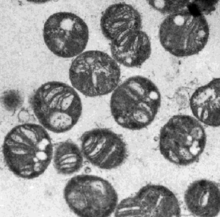
Wikipedia provides an image and it’s hierarchy. It is usually used industrially to produce animal feed.

Kingdom:Bacteria
Phylum:Proteobacteria
Class:Gammaproteobacteria
Order:Methylococcales
Family:Methylococcaceae
Genus:Methylococcus
Species:M. capsulatus
Methylococcus capsulatus.png
Almost look like coffee beans!

What PubMed says

A good start is this comparison to something like Mutaflor (E.Coli Nissle 1917) and Culturelle.

we showed that a bacterial meal of a non-commensal, non-pathogenic methanotrophic soil bacterium, Methylococcus capsulatus Bath prevents experimentally induced colitis in a murine model of IBD.  ….  we show that M. capsulatus, a soil bacterium adheres specifically to human dendritic cells, influencing DC maturation, cytokine production, and subsequent T cell activation, proliferation and differentiation. We characterize the immune modulatory properties of M. capsulatus and compare its immunological properties to those of another Gram-negative gammaproteobacterium, the commensal Escherichia coli K12, and the immune modulatory Gram-positive probiotic bacterium, Lactobacillus rhamnosus GG in vitroM. capsulatus induces intermediate phenotypic and functional DC maturation. In a mixed lymphocyte reaction M. capsulatus-primed monocyte-derived dendritic cells (MoDCs) enhance T cell expression of CD25, the γ-chain of the high affinity IL-2 receptor, supports cell proliferation, and induce a T cell cytokine profile different from both E. coli K12 and Lactobacillus rhamnosus GG. M. capsulatus Bath thus interacts specifically with MoDC, affecting MoDC maturation, cytokine profile, and subsequent MoDC directed T cell polarization.

The Soil Bacterium Methylococcus capsulatus Bath Interacts with Human Dendritic Cells to Modulate Immune Function. [2017]

 M. capsulatus Bath induced the highest levels of IL-6, IL-10 and IL-12 secretion from dendritic cells, suggesting that this strain generally the post potent inducer of cytokine secretion. These results show that M. capsulatus Bath exhibit immunogenic properties in mammalian in vitro systems which diverge from that of E. coli Nissle 1917. This may provide clues to how M. capsulatus Bath influence the adaptive immune system in vivo. However, further in vivo experiments are required for a complete understanding of how this strain ameliorates intestinal inflammation in animal models.

Effects of the non-commensal Methylococcus capsulatus Bath on mammalian immune cells. [2015]
  • ” significant production of hydrogen peroxide is observed” [2019]
  • “Our results show that a bacterial meal of the noncommensal bacterium M. capsulatus (Bath) has the potential to attenuate DSS-induced colitis in mice by enhancing colonic barrier function, as judged by increased epithelial proliferation and increased Muc2 transcription. [2013]
  • ”  Previous studies show that bacterial meal (BM) containing mainly Methylococcus capsulatus grown on natural gas is a suitable protein source for salmonids. The BM is rich in nucleotides, phospholipids, and small peptides that might be beneficial for intestinal homeostasis…. can be used to prevent SBM-induced enteritis in Atlantic salmon. ” [2011]

Bottom Line

It’s interesting that it appears that it is available today as fish meal.

Methylococcus capsulatus is a methanotroph, a bacterium that metabolises methane. Salmon will consume pelletised protein made from these bacteria. And that could be handy for fish farmers.
Calysta, a biotechnology firm in Menlo Park, California, proposes to take advantage of the rock-bottom price of methane, a consequence of the spread of natural-gas fracking, to breed Methylococci en masse as a substitute for the fish-meal such farmers now feed to their charges.
The EU and Norway have already approved the use of Methylococcus-based fish food. Though America has yet to follow suit, this means there is a large available market for the stuff.

Natural Gas Fracked bacterial fishmeal can save the worlds fish and enable a lot more farmed fish [2015]

This creates an interesting roadblock for getting it to the human market — it is uber-cheap, easy to produce, and not patentable. FeedKind™ Protein is the trade name, manufactured by http://calysta.com/

End Product Page Updated

I have updated the page to stop using averages (which can be very misleading for bacteria populations) and move to the box-plot approach to identify outliers (atypical values). End product is experimental because we do not have a good reference source for what each bacteria produces. We know some of them, but not all. Also, different strains produce different amounts adds to the uncertainty.

After you log on, you will see a new button by each sample:

Click Abnormal End Products

The initial report show only the odd numbers. In the case very below, we have 3 end products that are high.

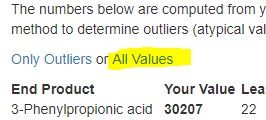
Clicking on All Values, will show some 100 end products.

For example, I want to see how histamines and hydrogen sulphide changed over time with the ME flare.

Oldest sample (in remission)
A year later (in remission)
On ME Flare start, I had IBS/SIBO symptoms
Several weeks in, IBS/SIBO fading
All IBS and SIBO symptoms disappeared.

Bottom Line

This is experimental. For myself, the end product levels computed for hydrogen sulfide appear to match my symptoms.

The last column is the number of samples that had a value for the end product. The user may have this end product but it is being produced by a bacteria that is not in our database as a producer…. hence experimental.

Suggestions to minimize impact of Drugs and Antibiotics

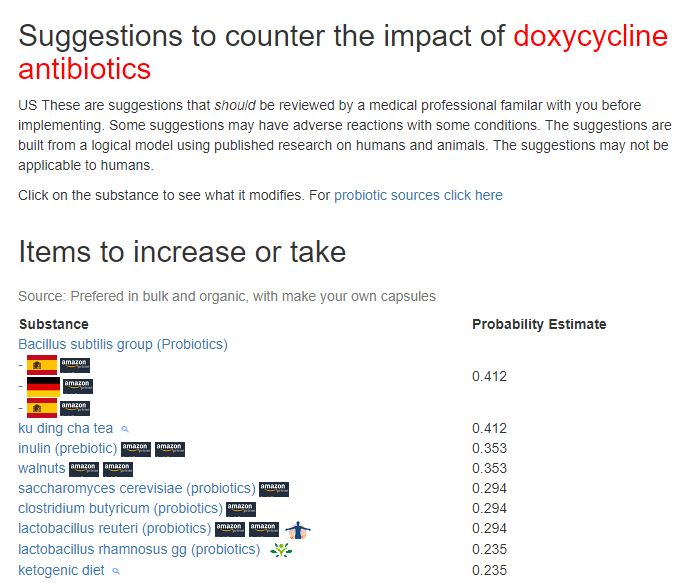
A friend asked about how to modify their diet to minimize the impact of doxycycline. I had an old page on that but discovered that it was both broken and inconsistent with revisions and new features. I have brought it up to standards.

Process

Step 1: Find the Drug

For a Find on the page (or scroll). All of the trade names should be included.

Step 2: Look at the Impact

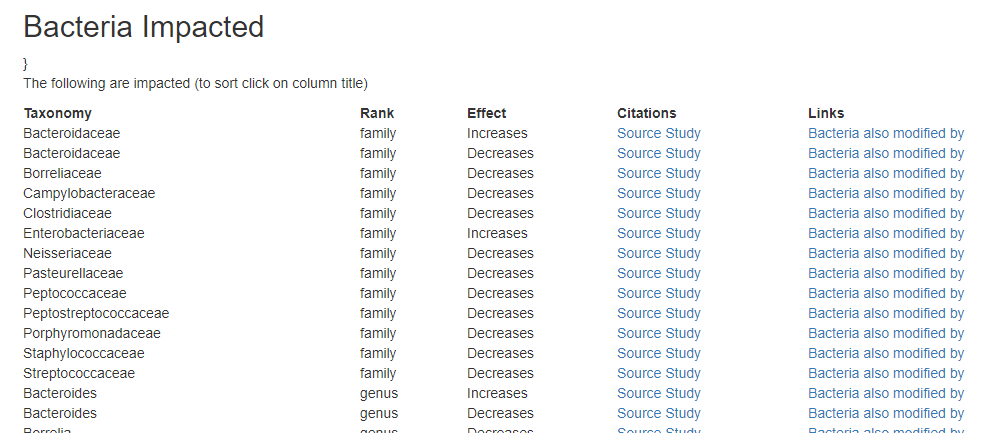
Just click on the item above. You will see a new page with LOTS of items often.

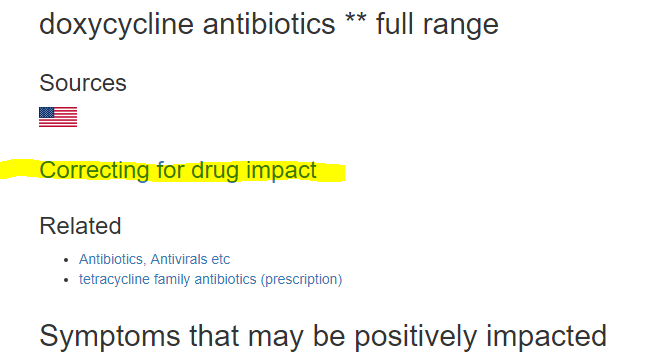
At the top of the page, Click on “Correcting for drug Impact”

Step 3: Review The Suggestions

The suggestions are ordered from most to least important factoring in the dozen of bacteria altered above.

You will see the new format of showing links to sources of each. I am attempting to match the search to the country that you are in. For example, if you are in Spain, a link may go to Amazon.es . Other links are to companies that ship world wide, for example: Swanson and CustomProbiotics. If there are NO country matches, then a country flag with a link to a source for that country will be shown. For example above: Bacullus subtilis (single strain) is available from Amazon.de in Germany and also Amazon.es in Spain.

Example: Finland has no Amazon but people in Finland may use Amazon.de. Only you can tell me where you shop, so email that to me at ken/at/lassesen.com and I will add that information.

Handling Multiple Drugs

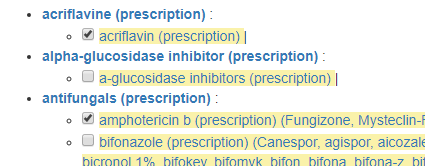
If you go to any page listing modifiers, you will see checkboxes.

Check all of the items that apply

At the top of the page, there is a Compare Impacts button

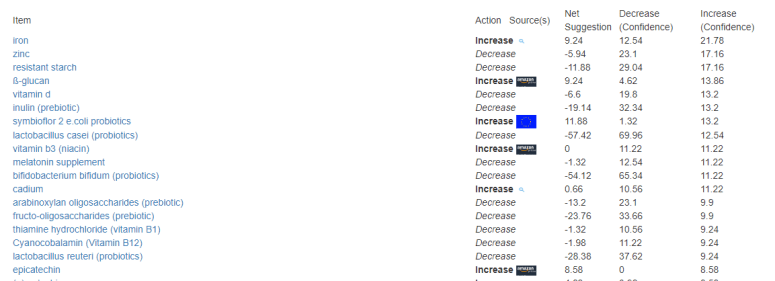
This will take you to a page showing the impact of each item

Again, we have a button [Get Suggestions for reversing impact on Microbiome]. Click it and you will be taken to a suggestion page (with actually more options).