Radio and Chemical Sensitivity

I was sent a December 2015 article looking at this. Before getting into it, I would like to share my own first hand observation:

A friend had the full panel of coagulation tests and a week later had a multiple chemical experience. Two weeks later, they were still suffering and the panel of coagulation tests were repeated. Everything was the similar except the measure of active coagulation occurring — it was literally through the roof (from the edge of high (2 StdDev above) to 10 Std.Dev. above). The chemical response triggered coagulation that the body was barely keeping in control. This was back in 2002.

To me, MCS is real. I had it for a short while during one of my MCS episodes.

My tradition view is simple: it is an allergic response that do not have the classic IgE response just a coagulation response. I read a PubMed (can’t located) article that found that something like 30% of people with IgE response also had increased coagulation. It seemed reasonable that there may be some with a coagulation response without an IgE response.

There are sites dedicated to this area such as MCSRR.ORG for MCS and WEEP for EHS.

Let us now get to the PubMed findings….

EHS – sensitivity to electromagnetic waves – for example, WiFi, Cell Phones, Wireless-In House phones, Radio Transmitters, etc.

  • “year 2000 such symptoms were identified in the Internal Code of Diagnoses, version 10 (ICD-10; R68.8/now W90), and have been since.”[2015]

MCS – sensitivity to some chemicals (which may not have a scent at all)

“Some people with environmental sensitivities reported having negative reactions to anesthesia of long duration; most common were nausea and vomiting, fatigue, and reduced cognitive ability.”[2015]


Reliable disease biomarkers characterizing and identifying electrohypersensitivity and multiple chemical sensitivity as two etiopathogenic aspects of a unique pathological disorder [Dec 2015]

“our preliminary data, based on 727 evaluable of 839 enrolled cases:

  • 521 (71.6%) were diagnosed with EHS,
  • 52 (7.2%) with MCS, and
  • 154 (21.2%) with both EHS and MCS.

Two out of three patients with EHS and/or MCS were female; mean age (years) was 47.” – MCS is 3x rarer than EHS.

“Finally, considering the self-reported symptoms of EHS and MCS, we serially measured the brain blood flow (BBF) in the temporal lobes of each case with pulsed cerebral ultrasound computed tomosphygmography. Both disorders were associated with hypoperfusion in the capsulo thalamic area, suggesting that the inflammatory process involve the limbic system and the thalamus.” – hypoperfusion is often associated with inflammation and/or coagulation. Strokes in this area are associated with language-vocabulary loss (i.e. why some people report a “loss of words”).

“Our data strongly suggest that EHS and MCS can be objectively characterized and routinely diagnosed by commercially available simple tests.  Both disorders appear to involve inflammation-related hyper-histaminemia, oxidative stress, autoimmune response, capsulothalamic hypoperfusion and BBB opening, and a deficit in melatonin metabolic availability; suggesting a risk of chronic neurodegenerative disease. Finally the common co-occurrence of EHS and MCS strongly suggests a common pathological mechanism.”

Another [2015] study found “Electrohypersensitivity (EHS) can be a precursor to, or linked with, multiple chemical sensitivity (MCS) based on reports of individuals who first develop one condition, then rapidly develop the other. Similarity of chemical biomarkers is seen in both conditions [histamines, markers of oxidative stress, auto-antibodies, heat shock protein (HSP), melatonin markers and leakage of the blood-brain barrier]. ”

How it happens is not established, but in [2013] it was suggested “Downstream responses of such EMF exposures may be mediated through Ca(2+) /calmodulin stimulation of nitric oxide synthesis.” and [2015] “Microwave/lower frequency EMFs were shown in two dozen studies to act via VGCC activation because all effects studied were blocked by calcium channel blockers. This mode of action was further supported by hundreds of studies showing microwave changes in calcium fluxes and intracellular calcium [Ca2+]i signaling. The biophysical properties of VGCCs/similar channels make them particularly sensitive to low intensity, non-thermal EMF exposures.”

“Based on our current understanding, a treatment approach that minimizes the adverse effects of peroxynitrite – as has been increasingly used in the treatment of multisystem disorders – works best.” [2015] however this document “The EUROPAEM EMF Guideline 2015, published on 27th November 2015 in the Journal Reviews on Environmental Health,
has been withdrawn by the authors on 11th December 2015 for editorial reasons.”[Link] It is available for download here and is worth a serious read for those with cognitive skills. The full document includes:

“According to 76% of the 157 respondents, the reduction or avoidance of EMF helped in their full or partial recovery. The best treatments for EHS were given as weighted effects: “dietary change” (69.4%), “nutritional supplements” (67.8%), and “increased physical exercise” (61.6%). The official treatment recommendations of psychotherapy (2.6%) were not significantly helpful, or for medication (–4.2%) even detrimental. The avoidance of electromagnetic radiation and fields effectively removed or lessened the symptoms in persons with EHS” – unfortunately, the type of diet change nor nutritional supplements used were specified. The paper does give advice (without any clinical studies on each effectiveness).

Radiation from wireless technology affects the blood, the heart, and the autonomic nervous system[2013] states “The symptoms of electrohypersensitivity (EHS), best described as rapid aging syndrome, experienced by adults and children resemble symptoms experienced by radar operators in the 1940s to the 1960s and are well described in the literature. An increasingly common response includes clumping (rouleau formation) of the red blood cells, heart palpitations, pain or pressure in the chest accompanied by anxiety, and an upregulation of the sympathetic nervous system coincident with a downregulation of the parasympathetic nervous system typical of the “fight-or-flight” response. Provocation studies presented in this article demonstrate that the response to electrosmog is physiologic and not psychosomatic.”

Replication of heart rate variability provocation study with 2.4-GHz cordless phone confirms original findings[2014].  Reported

  • 7% were classified as being “moderately to very” sensitive,
  • 29% were “little to moderately” sensitive,
  • 30% were “not to little” sensitive and
  • 6% were “unknown”.

and “Novel findings include documentation of a delayed response to radiation.”


Hypothesis: Assuming that calcium channels/calmodulin are involved and they have become hyper reactive due to microbiome shifts, we find 2000 hits on pubmed for  “calmodulin bacteria” and a single one with “calmodulin probiotic” dealing with a probiotic-fermented purple sweet potato yogurt“.

A full text article from 2013 identifies “artemisinin [wormwood] …affect operation of Ca2+ channels”

  • “Therefore, the ability of microbes to preferentially control host intracellular Ca2+ pathways enables them to optimize the timing and effectiveness of infection stages against barriers to invasion, pathogenesis, proliferation, and release”
  • “In the case of viruses, increased host free cytosolic Ca2+ levels may promote viral adsorption, structural stability, capsid uncoating, enzymatic activity, replication, assembly, transport, and fusion”
  • “in cases of bacteria, fungi, and protozoa, alterations of host intracellular Ca2+ homeostasis is critical for pathogen sensory transduction, cell energetics, infection sequences, stress adaptation, gene expression, toxin biosynthesis and secretion, molecular biomimicry, conjugation and true sexual reproduction, cell motility and tropisms, growth, biofilm formation and cell aggregation, antigenic variation, and morphogenesis and lifecycle transitions”

The last section of this article reads “Prospective Ca2+-modulating probiotic and other treatment strategies” but does not give any specific species or strains to consider. We do find some other articles

It is interesting to note that CFS tends to have a high incidence of EHS and MCS and is also associated with low/very low levels of L.Reuteri.  This suggests that significant (10 B CFU per day?) supplementation of L.Reuteri may have therapeutic value. There are no studies of this approach that I could locate.

Evidence for microbiome involvement?

“Many of those displaying symptoms caused by electromagnetic fields have fungus infections or have been living in fungus-contaminated environments for long periods. In animal studies mycotoxins have shown the same effects as those seen in the ‘electrohypersensitivity‘ syndrome.” [2000]


Bottom line

If you have MCS, you likely have a 75% chance of acquiring EHS. Read the WEEP site and follow their advice.

  • Be tested for fungal infection and take action against them
  • Use wormwood / Artemisia supplements – warning: this may produce a herx
  • Use probiotics containing L.Reuteri. I would suggest the following
    • Oral Probiotics  – see my last post
      • Swanson Oral Probiotic
      • PRO-Dental: Probiotics for Oral & Dental Health 3
    • Regular Probiotics
      • Jarrow’s fem dophilus (which contains NO ACIDOPHILUS!!) which contains 5 Billion CFU
        • L. Rhamnosus GR1
        • L. Reuteri RC-14
      • I would suggest 1 capsule with each meal (discuss with your medical profession always).
  • “reducing the electromagnetic irradiation of the computer can lessen the symptoms of electrohypersensitivity and permit working without problems.”[2012] – leads to the following:
    • Place computer unit as far away as possible (laptops should not be used as is unless a metal case – i.e. Mac)
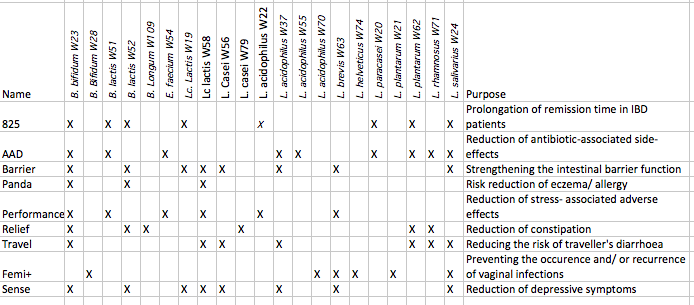
 

Ecologic (Netherland) series of probiotics

In doing my last posts, I became aware of this Dutch probiotic company, http://consument.winclove.nl/, which does canned probiotic mixtures as well as custom formulations from 100 strains they have. They declare and document every strain used — which is ideal.

They have nine canned probiotic mixtures which I have extracted a matrix of strains below:

Screen Shot 2015-11-08 at 12.45.05 PM

Their literature is available at: http://b2b.winclove.nl/Our-formulations/ecologic.html

Some of their products are available via these online seller (all in the netherlands)

Supplementus

supplementus.nl

Sorgente

sorgente.nl

Medireva

hulpmiddelwereld.nl

Depression

My last post looked at depression, which the Sense probiotic above is targeted at. It contains:

  • B. bifidum W23,
  • B. lactis W52,
  • L. acidophilus W37,
  • L. brevis W63,
  • L. casei W56 – other L.casei are associated with reduction of depression, Lactobacillus casei strain Shirota (LcS) [Yakult]  significant decrease in anxiety symptoms among those taking the probiotic [2009] and Actimel (DanActive) appear to share a common ancestor [2013]
  • L. salivarius W24,
  • Lc. Lactis W19,
  • Lc. Lactis W58

This mixture is cited in this Aug 2015 study, A randomized controlled trial to test the effect of multispecies probiotics on cognitive reactivity to sad mood. There were a few studies on some of the other strains in combination — but nothing on the individual strains.

When to take probiotics? – an actual study

Today I came across an actual study on PubMed.

“Enumeration during and after transit of the stomach and duodenal models showed that survival of all the bacteria in the product was best when given with a meal or 30 minutes before a meal (cooked oatmeal with milk).Probiotics given 30 minutes after the meal did not survive in high numbers. Survival in milk with 1% milk fat and oatmeal-milk gruel were significantly better than apple juice or spring water….We conclude that ideally, non-enteric coated bacterial probiotic products should be taken with or just prior to a meal containing some fats. ” [2011]

“Food intake led to a delay in yeast release and a two-fold increase in strain survival. Whatever the dose, yeasts were particularly sensitive to the large intestinal environment.” [2012]

“our results indicate for the first time that low-fat spread is a suitable carrier for these probiotic strains.” [2009]

“The objective of the study was to compare oral and faecal recovery during and after administration of a combination of Lactobacillus rhamnosus GG and LC705, Propionibacterium freudenreichii subsp. shermanii JS, and Bifidobacterium animalis subsp. lactis Bb12 as capsules, yoghurt, or cheese…. Yoghurt yielded the highest faecal quantity of JS and Bb12 strains (8.01 and 9.89log(10) genome copies/g, respectively). The results showed that the administration matrix did not influence the faecal quantity of lactobacilli, but affected faecal counts of propionibacteria and bifidobacteria that were lower when consumed in cheese.” [2010]

“Taken together, our findings indicate that the manner in which a probiotic is delivered – whether in food or supplement form – could influence how effective that probiotic is in delivering the desired health benefits,” said Marco, an associate professor in the Department of Food Science and Technology at UC Davis…. They discovered that mice fed L. casei in milk exhibited fewer symptoms of IBD than did mice fed milk alone or the same probiotic strain in a nonfood supplement format.” [2015]


Bottom Line

Taking probiotics with milk (assuming no lactose intolerance) appears to be best. If lactose intolerance, it should be taken with some food that contains fat, for example rye crisp with olive oil.

BIFIDO|MAXIMUS Histamine-Free and D-Lactate Free Probiotic – Review

This is a new on the market probiotic. In fact, shipped first only a few days ago (announcement). There are no PubMed studies on it yet (which I hope will change soon…). If what it claims is true:

  • Histamine-Free and
  • D-Lactate Free

This should result in the volume of D-Lactate producing and Histamine producing bacteria in the stomach to drop and for at least two probable subsets of CFS – improvement of symptoms (and for a few possible remission). I do not yet found any studies on Miyarisan (clostridium butyricum) and histamines on PubMed, nor clear results on D-Lactate — but suspect that Miyarisan is likely complementary to Bidio|Maximus.

So what is in it?

  • Bifidobacterium longum (40%)
    • Bifidobacterium infantis and Bifidobacterium longum reduces histamine levels [2008]
  • Bifidobacterium bifidum/Bifidobacterium infantis (20%)
    • Bifidobacterium infantis and Bifidobacterium reduces histamine levels[2008]
    • “Increases in the numbers of eosinophils and neutrophils in nasal cavity lavage fluid collected after a pollen challenge were almost completely suppressed by the Bifidobacteriumbifidum G9-1 treatment, whereas those in mast cell mediators, histamine, and cysteinyl leukotrienes were not.” [Sep 2015]
      • Earlier studies showed it reduce allergy and was speculated to be reduction of histamine. It is now unclear if this is the case. On the plus side, it is not reported to increase histamine (a feature claimed)
  • Lactobacillus rhamnosus (20%)
    • “The strains are neither haemolytic nor producer of biogenic amines such as histamine, putrescine, cadaverine and tyramine.”[May 2014]
    • “[Lactobacillus rhamnosus: strains: ] LGG and Lc705 were observed to suppress genes that encoded allergy-related high-affinity IgE receptor subunits α and γ (FCER1A and FCER1G, respectively) and histamine H4 receptor” [2011]
  • Lactobacillus salivarius (10%)
    • “isolates were classified into 5 different LAB species: Lactobacillus salivarius, Lactobacillus reuteri,Lactobacillus johnsonii, Pediococcus acidilactici, and Lactobacillus paralimentarius. None of the isolates produced tyramine or histamine.” [2012]
    • “detection of four genes involved in the production of histamine (histidine decarboxylase, hdc), tyramine (tyrosine decarboxylase, tyrdc) and putrescine (via eithers ornithine decarboxylase, odc, or agmatine deiminase, agdi). From examined strains only two chicken isolates (L. reuteri 14K; L. salivarius 15K) had no harmful β-glucuronidase, β-glucosidase activities connected with detrimental effects in the gastrointestinal tract and together no amino acid decarboxylase activities and no genes associated with biogenic amines production” [2014]
  • Lactobacillus gasseri (10%)
    • [Article] heat killed Lactobacillus gasseri TMC0356 (TMC0356) can modify the immune response in the elderly.
    • Reduce allergies (which can be ascribed to histamine reduction but could be other things) [2008] [2009] [2012]

Unfortunately no strains were provide (always on my wish list for probiotic). So time to summarize what each is known to do frequently (depending on strains) is shown above. During the research, I discovered that some strains of Lactobacillus reuteri do not produce histamines — L.Reuteri is the most common lactobacillus in a healthy human gut and also very low in CFS patients. This implies that the reduction of the L.Reuteri population would result in histamine increase from the bacteria that takes its place.  If there is production of D-lactate by L.Reuteri, I was unable to find on PubMed.

This is definitely worth trying for migraines, a lot of literature has association of histamines and migraines (361 hits on PubMed). For CFS and FM, it is likely a good candidate for some subsets (and to determine if you are in that subset, you need to take it).

The cost ($50/month) is like too much for those CFS/FMers on SSI to try as an experiment. I am hoping that some clinical trials for FM and CFS will start soon.

If you can afford it and inclined to try it, may I request that after 30 days you post your experience here as comments (both positive and negative). While your reports will be anecdotal, they will help other patients to determine if it is worth cutting other supplements to try this.


Update

It has been 2 years since this post and no one has delivered a report. I infer that “no significant change” has been people’s experience.

My thought has evolved that it is overgrowth of other genus that is the root of the histamine issue. A reader wrote that their histamine issues disappeared after a course of Erythromycin (macrolide).

Megasporebiotic – Preliminary Review

Several people have commented about this probiotic available at http://www.gomegaspore.com/ and I am in correspondence with them to get more information.

My usual criteria is PubMed studies on the actual probiotic (by brand) or the strains in the probiotics. With reports of herx and the mixture of species (and some potential characteristics), I thought that should do a preliminary review simply because it is easily available in the US (and the last two cited require a European facilitator to obtain).

Pure Bacillus Mixture

First, in terms of lactic acidosis, there are no major lactic acid producing species (i.e. no lactobacillus). I received an email from the manufactorer stating that it contained

  • Bacillus Indicus, HU36
  • Bacillus Subtilis, HU58
  • Bacillus Clausii (no strain specified)
  • Bacillus Coagulans (no strain specified)
  • Bacillus Licheniformis (no strain specified)

Histamine Risk

Two of the above (no strain specified) are known to be high histamine producers [2013] and thus if you are in (or close to) the subset of CFS patients with histamine issues, this should be a DO NOT USE.

Alternative Sources

There are actually many manufacturers who have licensed some of these(HU36,HU58) from from Royal Holloway London University

Bacillus Indicus HU36

  • A pigmented marine bacteria [2015]
  • “carotenoids from Bacillus indicus HU36 and Bacillus firmus GB1 were found to be interesting antioxidants to fight postprandial oxidative stress in the stomach.”[2013]
  • “suggests that the two pigmented Bacilli are adapted to the intestinal environment and are suited to grow in and colonize the human gut.” [2011]
  • No Wikipedia or MicrobeWiki page on family

Bacillus Subtilis, HU58

  • “B. subtilis examined here were HU58, a human isolate…Compared to a domesticated laboratory strain of B. subtilis both isolates carried traits that could prove advantageous in the human gastro-intestinal tract. This included full resistance to gastric fluids, rapid sporulation and the formation of robust biofilms.” [2012]

Bacillus Licheniformis

  • “The optimal temperature for enzyme secretion is 37°C.” – 98.6F (from wikipedia)
  • “has proven to be an unexpected tooth decay fighter as it has the ability to cut through plaque or a layer of bacteria
  • Bacillus licheniformis is commonly associated with food spoilage and poisoning. It causes bread spoilage, or more specifically, a condition called “ropy bread” (1). Contamination with this bacterium will make the bread sticky and stringy; the ropy bread will also start to develop a strong odor after contamination. Rope spores is what causes the spoilage; unfortunately these spores do not get killed during the baking process.B. licheniformis can also cause food-borne gastro-enteritis, which is infection of the gut that can lead to a life threatening condition called septicaemia. Septicaemia is blood poisoning, and is classified as having a large amount of bacteria in the blood. Dairy products are at increased risk of being contaminated with toxin-producing isolates of B. licheniformis. Cooked meats, raw milk, vegetables, and processed baby foods are also at risk. (4)The symptoms include stomach pains, (acute) diarrhea, and possible vomiting. These have an onset time of 2-14 hours and last no longer than 36 hours.B. licheniformis, although usually associated with the gut and gastrointestinal tract, can also cause distress in other parts of the body. It can cause ophthalmitis, which is the inflammation of the eye. It can even go as far as causing abortions in pregnancies and impair sperm motility. The toxins produced by B. licheniformis can cause damage to cell membranes, deplete cellular ATP, and cause the acrosome to swell; it is not found to have any damaging effects on the mitochondria.” microbewiki

Bacillus Coagulans

  • is a lactic acid-forming bacterial species…separately isolated in 1935 and described as Lactobacillus sporogenes in the fifth edition of Bergey’s Manual, [wikipedia]
  • No MicrobeWiki page

Bacillus Clausii

  • Bacillus clausii, has been found to produce antimicrobial substances that are active against gram positive bacteria including but not limited to Staphylococcus aureus, Enterococcus faecium, and Clostridium difficile. [wikipedia]
  • “The protease from Bacillus clausii strain 221, the H-221 protease, was the first enzyme to be identified in an alkaliphilic Bacillus. [1] The alkaliphilic nature of the organism has also proved it to be useful in preventing and treating various gastrointestinal disorders as an oral bacteriotherapy. [2] This organism can be found in many alkaline environments, including soil and marine habitat…Bacillus clausii resistance to many antibiotics makes it seem capable of harm to humans, but Bacillus clausii sporulated strains are actually used in the treatment of gastrointestinal illnesses to restore intestinal flora because of their antibiotic resistance and ability to stimulate immune activity” [WikibeWiki]

Bottom Line

The two strains that are listed are newly discovered which carries the risk of unknown side-effects (just like a new drug carries the same risks). I prefer strains that have been in use for 20+ years. Bacillus Licheniformis (without strains) raises the question whether any herx like effect is actually a herx and not toxins or histamines that some people may be sensitive to. Bacillus Coagulans being the rare member of the bacillus family that is a lactic acid producer raises concern if lactic acidosis is a significant part of CFS for some patients. Bacillus Clausii (without strain) has the appearance of being safe and good.

My preference is the 4 bacillus Clausii mixture, Enterogermina. Far less uncertainty and risk of unexpected side-effects.

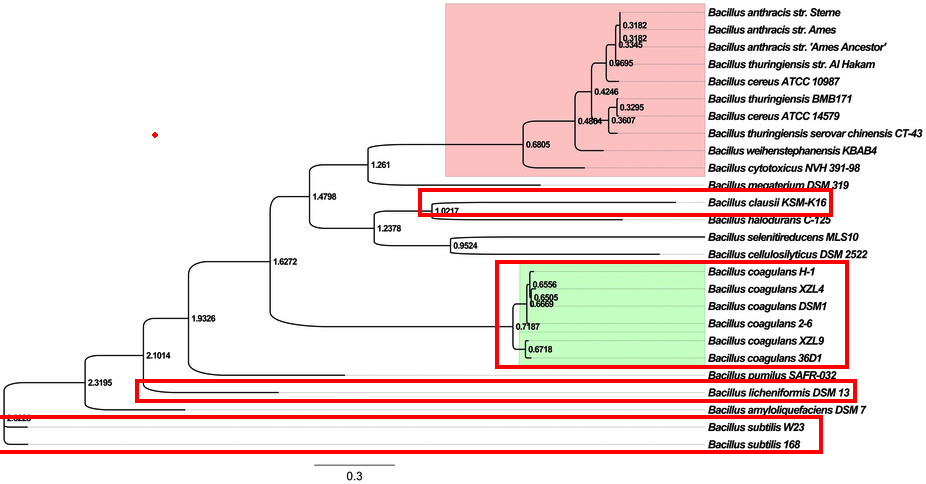
In terms of closeness in genetic distance

I came across a diagram showing how close (or far) apart the different ones are from each other in terms of genetics, The best one (IMHO) is clausii and it is a considerable distance from the rest.

Genetic Distance Apart

Genetic Distance Apart

Diagram source: Genomic analysis of thermophilic Bacillus coagulans strains: efficient producers for platform bio-chemicals [2014]