Fecal Matter Transplant for ME/CFS – 2023 Update

Just in, July 29, 2023 study:

FMT was safe but did not relieve symptoms or improve ... patients with CFS.

Randomized, double-blinded, placebo-controlled pilot study: efficacy of faecal microbiota transplantation on chronic fatigue syndrome [2023]

The earlier post from 2021 is below.

A reader wrote me with some good questions. My answer is focused on ME/CFS but the analysis applies to UC, Crohn’s, IBS, Sibo, Autism and every disease with distinctive microbiome shift (here’s a partial list).

My wife is considering a fecal microbiota transplant(FMT) because of her chronic (CFS/Fibromyalgia) complaints and tested leaky gut, SIBO and microbiome dysbiosis.

We’ve found a company that claims to deliver fully prepared stool of “super donors” for about $1900 all included. Do you know this company and do you think they are trustworthy in their claims? https://microbioma.org/en/home-eng/

Do you have any other advice for us in relation to FMT, for example other trustworthy companies maybe in the area that we live (Europe) or perhaps an evidence based warning that she should not do this?

Hope to hear from you.

A 2019 article is worth reading The potential and pitfalls of fecal transplants

FMT is effectively an Organ Transplant…

For conventional medicine, there is a 10-15% rejection rate with the use of medications to prevent rejection. The following are factors to consider for organ transplants and likely apply to fecal matter transplants.

  • Ensure recipient and donor have compatible blood types
  • Perform genetic testing to ensure compatible recipient and donor matches
  • In the case of living donors, donor organs from relatives are preferred

Blood Type

Not only should blood type be a factor, but secretor status. There should be a match – being a “super donor” implies a naïve understanding of FMT and transplants in general.

Generic Testing

There is little literature here. My own feeling is that we need at least strain level comparisons between donors and recipient having considerable agreement. The volumes may be different, but the strains should be similar for bacteria not associated with the condition (i.e. for ME/CFS those that are high in the species the list here ideally, those species will be missing). Adding a page to the website on this issue would not be too hard (when there is a demand for it).

Donations from relatives are preferred

Bacteriophage α-diversity is important!

In this retrospective analysis, FMTs with increased bacteriophage α-diversity were more likely to successfully treat rCDI. In addition, the relative number of bacteriophage reads was lower in donations leading to a successful FMT. These results suggest that bacteriophage abundance may have some role in determining the relative success of FMT.

The success of fecal microbial transplantation in Clostridium difficile infection correlates with bacteriophage relative abundance in the donor: a retrospective cohort study (2019)

Other Preparation tests

From Johns Hopkins: “A potential donor will need to be screened by their physician for infectious pathogens by undergoing the following tests:

  • Blood tests: Hepatitis A, B, and C serologies; HIV; RPR
  • Stool tests: Ova and parasites; C. difficile PCR; culture and sensitivity; giardia antigen”

Microbiome is a hot topic — hence money maker

Microbiome transplants, including “turkey baster DYI” are hot. A summary is given on WebMd. One of the few FDA approved sources is OpenBiome. You should note their scope of operation:
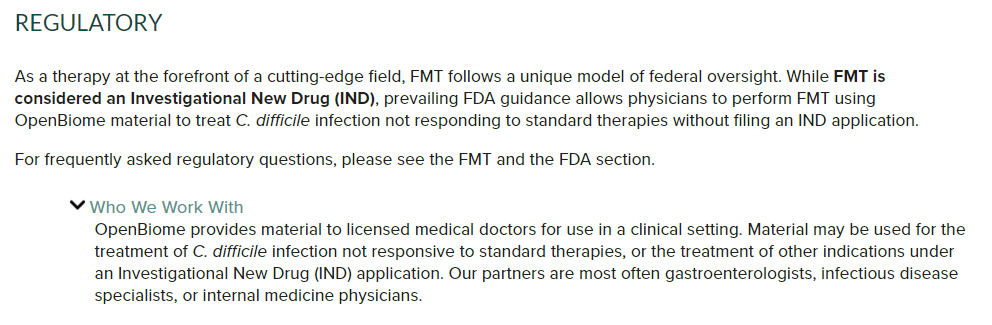
https://www.openbiome.org/regulatory

This reader cites, Microbioma.org. It is based in the Principality of Asturias, an  autonomous community in northwest Spain, I suspect that this is to avoid government oversight (i.e. “off-shore unregulated havens”). I could not find either hospital or universities or similar that are associated with them — there were no studies on PubMed citing this organization.

Ideally, this firm would provide 16s strain level data on all available donors. They claim using AI to match. While, having done AI for decades, I would want to see their algorithms because AI often is biased or simply wrong. With no publications (and thus peer review), there is no evidence that their AI works. Citing AI is a good marketing strategy.

A few years ago, the Dove Clinic for Integrate Medicine in the UK offered FMT for CFS. They no longer do but for leaky gut offers “Gut Flora Replacement Therapy

ME-Pedia on FMT

This page is current on FMT for ME/CFS. Australia allows it to occur for ME/CFS with Thomas J. Borody, MD and  Paul Froomes, MD being the best known. I observe the following:

Some of their patients have shared their experiences. It was not uncommon to hear “almost immediate remission that lasted about 6 weeks and then ME came back” followed by many additional FMT attempts.

Large treatment effects were observed for the intention-to-treat sample with a reduction in Streptococcus viable count and improvement on several clinical outcomes including total symptoms, some sleep (less awakenings, greater efficiency and quality) and cognitive symptoms (attention, processing speed, cognitive flexibility, story memory and verbal fluency). Mood, fatigue and urine D:L lactate ratio remained similar across time. Ancillary results infer that shifts in microbiota were associated with more of the variance in clinical changes for males compared with females.

Open-label pilot for treatment targeting gut dysbiosis in myalgic encephalomyelitis/chronic fatigue syndrome: neuropsychological symptoms and sex comparisons [2018]

“Based on the selected studies, the Adverse Effects(AE) rate of FMT is 39.3%, with most AE being mild and self-limiting. Severe Adverse Effects (SAE) were uncommon at 5.3%, and many were only possibly related to the FMT. ” i.e. 1/20 odds of SAE Adverse events of fecal microbiota transplantation: a meta-analysis of high-quality studies [2021]

“However, while current FDA regulations permit use of FMT for treating C. difficile infections that
have not responded to standard antibiotic therapy, use of FMT for any other indication requires
submittal and approval of an IND (investigational new drug) application to the FDA.”

Fecal Microbiota Transplantation, Washington State Health Care Authority

“[FMT Capsules] is an unapproved new drug and unlicensed biological product, which was introduced or delivered for introduction into interstate commerce in violation of the Federal Food, Drug, and Cosmetic Act (FD&C Act) [21 U.S.C. § 331(d)] and the Public Health Service Act (PHS Act) [42 U.S.C. § 262(a)(1)]. …statements indicate that your product is intended for use in the mitigation, treatment, or prevention of disease, your product is a drug under section 201(g)(1)(B) of the FD&C Act [21 U.S.C. § 321(g)(1)(B)]. 
Please be advised that to lawfully market a drug that is also a biological product, a valid biologics license application (BLA) must be in effect [42 U.S.C. § 262(a)]. Such licenses are issued only after a demonstration that the product is safe, pure, and potent. While in the development stage, such products may be distributed for clinical use in humans only if the sponsor has an investigational new drug application (IND) in effect as specified by FDA regulations (21 U.S.C. § 355(i); 42 U.S.C. § 262(a)(3); 21 CFR Part 312). “

From existing FDA warning letters for other biological products

IMHO: Both the seller and any medical person involved would likely have no viable defense against lawsuits (all types). Remember, ignorance of the law (and the FDA) is not an acceptable excuse to the courts. If someone attempts to sell, ask for a copy of their BLA.

Bottom-Line

As with clostridium difficile (C.diff), FMT should only be done after repeated attempts with antibiotics have failed. My preference for antibiotic protocol would be that of Cecile Jadin, MD. Alternatively, determine the antibiotics via a microbiome analysis and using Microbiome Prescription for suggestions (see this recent post on a 20 y.o, CFS male— the antibiotic suggested agreed with the Jadin protocol).

The idea of using FMT for ME/CFS is correct in my opinion. The problem is the naïve attempts done without approaching typing and matching of the “organ” to be transplanted. Current attempts are almost like saying – oh he has lost a lot of blood, just give him blood — from an human, a race horse, a pig, a cow etc. Blood is blood…

Remember that FMT for C.diff has around 70% success rate. That is trying to dislodge a single bacteria. With ME/CFS there are likely dozens to be dislodged…. if it is 70% success for one, then it may be 50% success for two, 35% for three etc.

Personally, I prefer going the 16s microbiome analysis route, ideally with antibiotics and diet/supplement changes. FMT is too experimental and prone to trial and error. The reported success rate for the Jadin protocol is higher than that reported for FMT.

Some prior posts on this topic:

Sun Genomics – Preliminary Thoughts

I have been getting several messages a day from readers about this firm that has started to aggressively advertise on facebook etc. I have had messages, emails and telephone conversations with Sunny Jain , M.S. (Molecular Medicine and Cell Biology) – the founder and CEO. His Linked In profile. and crunchbase profile Like me and my multiple sites, his business grew out of personal family issues with the microbiome.

Fortunately, there has been no NDA requested or “off the record” requests. I am a blogger, which means that I am also a Journalist (see this court ruling), thus whatever was share is technically free game.

Waiting for … from Sunny

The following is an existing request to him:

  • An example of some of their 16s samples with the probiotic mixture generated for each. Sample to be in ‘ubiome json’ format
    • Why? We are using different methods and our recommendations may be radically different.
    • This may open up a can of worms — I can provide citations for all of my recommendations to show my logic. SunGenomics may be working off a lot less citations.

Requests to Sunny

  • Can you custom mix probiotics from a formula created and sent from my site? This would solve a lot of challenges people have.
    • No, the issue of liability if they do not come up with the formula based on their analysis. This explanation makes no sense.
  • Can you provide single strain probiotics, especially for strains where there are no single source providers on the market?
    • He is looking at it. Probiotics are very high markup.

Another struggling Ubiome?

The financial basis of the company is Venture Capital (the same type of situation that drove Ubiome into ‘pushing things‘ to satisfy the venture capitalists.

https://www.crunchbase.com/organization/sun-genomics

For myself and my sites — it is totally self funding (i.e. my own wallet and paycheck from the day job); old school ‘garage startup‘. Garage startup worked for Amazon, Apple, Google, etc. (Reference).

SunGenomics was founded in 2016, Sunny and his wife are scientists (I do not believe either are physicians) working full time for the firm. There are 11 people showing on the team page. Three million divided by 11 over 3 years, means $90,000/employee. Translation: they may be running financially lean/under-funded/over-grown. A scenario similar to Ubiome. Sunny indicated that the team is stretched/stressed (a.k.a. under-staffed)

Speculation On Internal Process

Their technology appears overhyped and may be using alternative wordings to obfuscate what they do. This can be a good marketing ploy — their direct competitors use different terms — hence they are doing something different!

from https://sungenomics.com/

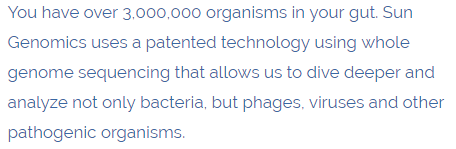
Some key points, they use a patented technology. There is no claim of having the patent on it. This will be missed by most people who will conclude that it is THEIR patented technology – it’s wordsmithing! They also emphasis “DNA” excessively, I believe it is actually rDNA (i.e. 16s)

Correction: Sunny emailed, they are not using 16s (72K) but Whole Genome Microbial Sequencing (2421). The numbers are the number of articles using each term on PubMed. 16s is more common and have had many more studies.

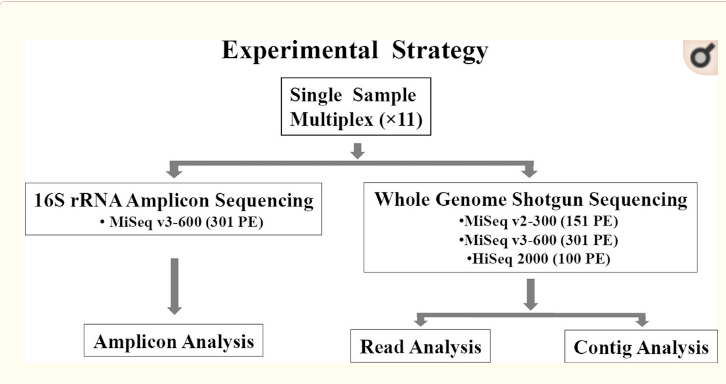
16s vs Whole Genome Sequencing

Analysis of the microbiome: Advantages of whole genome shotgun versus 16S amplicon sequencing

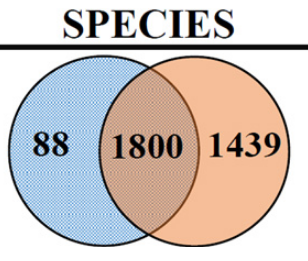
In terms of results, there can be differences. They agree on the ones that they have in common, but WGS reports about 50% more:

Analysis of the microbiome: Advantages of whole genome shotgun versus 16S amplicon sequencing

”  In summary, our study demonstrates that WGS has multiple advantages compared with the 16S rRNA amplicon method including enhanced detection of bacterial species, increased detection of diversity and increased prediction of genes. “

Analysis of the microbiome: Advantages of whole genome shotgun versus 16S amplicon sequencing

At 1888 species vs 3239 species, the differences appear to be major — the reality is that apart from names — we know almost nothing about how to increase or decrease these additional bacteria. For our purposes at hand, it gives academic knowledge but not practical clinical knowledge, IMHO.

Given the expressed concerned over liabilities; I believe they are ultra-conservative (a.k.a. Standard of Care) in their suggestions. I would not be surprised if their selection of probiotic strains and application to each consumer is just a rehash of information from either of these two excellent guides prepared by Dragana Skokovic-Sunjic .

These guides ranks what we know about each probiotic in a solid objective manner. I strongly recommend them.

Bottom Line

I have reservations about using this firm. If someone out there wishes to give them a trial ($800 to do below!l, I would love to get the following for a followup post:

  • Ubiome done from the same sample that is shipped to them.
  • List of probiotic strains in the probiotic delivered to them
  • Their report on your sample
  • Ubiome done on a followup same sample that is shipped to them.
  • Their report on your followup sample

I see too much risk of ‘resampling until you get positive results’ to report to the customer to show that an impact was made (a.k.a. Repeat business – which is what Venture Capitalist are looking for!). This risk is expected whenever a venture capitalist is backing a company.

I would love to give a thumbs up to this firm — conceptually it is on target. However I am an evidence based person and well aware of the reality of venture capitalist backed firm from years in Information Technology. Until there is evidence — I must give a thumbs down because of the costs involved and the risk of not targeting the entire microbiome due to following a conservative approach.

UPDATE – Oct 4, 2019

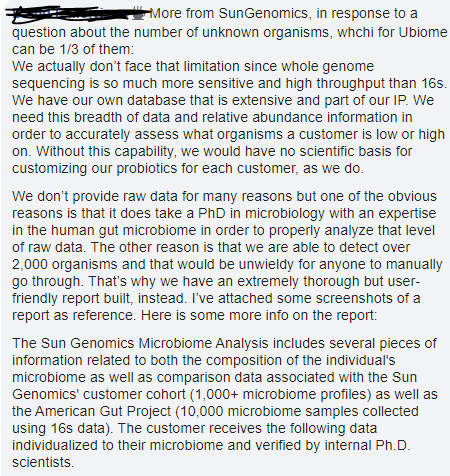
From a Facebook post: Content is from Sunny

This is interesting (putting on a M.B.A. hat), he indicates 1000 customers have used their service. Venture capitalist investment $3,000,000. That amounts to $3000 per customer to date. In an earlier post on Facebook he estimates well less than 1% repeat customers. My gut feeling is that this may follow the path of uBiome — a Venture Capitalist road to Chapter 7. I am old school and believe that a garage based start up without venture capitalists is the wiser path, especially for an emerging market product. It worked for Dell, Amazon, HP, Apple.

Review of Recent Probiotic News

  • “A recent study by Forslund et al. (1) adds another dimension for consideration by illustrating how medications may adversely affect the microbiome—an interaction often overlooked in post hoc analyses of disease-microbe relationships.” [2015]
  • “Early-life antibiotic use is associated with increased risk for metabolic and immunological diseases, and mouse studies indicate a causal role of the disrupted microbiome. However, little is known about the impacts of antibiotics on the developing microbiome of children. Here we use phylogenetics, metagenomics and individual antibiotic purchase records to show that macrolide use in 2-7 year-old Finnish children (N=142; sampled at two time points) is associated with a long-lasting shift in microbiota composition and metabolism. The shift includes depletion of Actinobacteria, increase in Bacteroidetes and Proteobacteria, decrease in bile-salt hydrolase and increase in macrolide resistance. Furthermore, macrolide use in early life is associated with increased risk of asthma and predisposes to antibiotic-associated weight gain. Overweight and asthmatic children have distinct microbiota compositions. Penicillins leave a weaker mark on the microbiota than macrolides. Our results support the idea that, without compromising clinical practice, the impact on the intestinal microbiota should be considered when prescribing antibiotics.” [2016]
  • Mother’s Microbiome Shapes Offspring’s Immunity [2016]
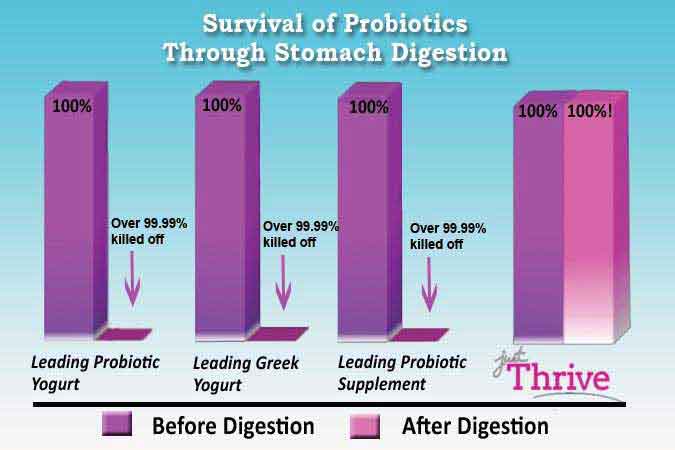
  • Thrive Probiotics – Claims that the bacteria produce antioxidants as well as that 100% survives (which  is because they are all bacillus).  Contains:

    • Bacillus Subtilis HU58 ” Two isolates of B. subtilis examined here were HU58, a human isolate and PXN21, a strain used in an existing commercial product. Compared to a domesticated laboratory strain of B. subtilis both isolates carried traits that could prove advantageous in the human gastro-intestinal tract. This included full resistance to gastric fluids, rapid sporulation and the formation of robust biofilms.” [2012]
    • Bacillus Indicus HU36 “Recently isolated spore-forming pigmented marine bacteria Bacillus indicus HU36 are sources of oxygenated carotenoids with original structures (about fifteen distinct yellow and orange pigments with acylated d-glucosyl groups)” [2015] ” Overall, carotenoids from Bacillus indicus HU36 and Bacillusfirmus GB1 were found to be interesting antioxidants to fight postprandial oxidative stress in the stomach” [2013]
    • Bacillus Clausii – strain is not identified, another probiotic does: Enterogermina
    • Bacillus Coagulans


    graph-slider-page-low

    • Note: Expensive and no studies for FM/IBS/CFS for the species or strains.
  • “Increased proportions of the Fusobacteriaceae family correlated with increased disease activity and levels of C-reactive protein in patients with UC who underwent pouch surgery. In contrast, proportions of Faecalibacterium were reduced in patients with pouchitis vs controls; there was a negative correlation between proportion of Faecalibacterium and level of C-reactive protein. There was an association between antibiotic treatment, but not biologic or immunomodulatory therapy, with reduced proportions of 11 genera and with increased proportions of Enterococcus and Enterobacteriaceae.” [2016]
  • “Gut microbes produce a chemical that enhances clotting in the arteries, increasing the risk of heart attack and stroke.” [2016] … i.e. hypercoagulation!
  • ” But with hundreds of microbial species crammed together in tight quarters, new research suggests that our intestinal innards might resemble a battlefield more than a conference room. Researchers have found that gut bacteria continually wage war on their neighbors, perhaps as a way to stake out space. The team injected different strains of Bacteroides fragilis, the species of gut-dwelling bacteria (pictured here), into mice that lacked their own microbes. When they analyzed the rodents’ stools over time, they found evidence that the strains were attacking each other. Different strains of B. fragilis inject different combinations of toxins into neighboring bacteria. Bacteria within the same strain fight back: They’re immune to the toxins secreted by their strain-mates. But different species or strains of bacteria can succumb to the assault, giving the attacking strain more room to spread out.” [2016]
  • Pylopass, a non-viable L.Reuteri probiotic  (i.e. killed) [2013] was found effective against H. Pylori.
  • “Iron replacement therapy in patients with inflammatory bowel disease alters gut microbiota depending on how it is administered, suggest scientists… oral treatment (instead of IV) was associated with decreased abundances of operational taxonomic units assigned to the species Faecalibacterium prausnitzii, Ruminococcus bromii, Dorea sp. and Collinsella aerofaciens.” [2016]
  • “A chronic lack of dietary fibre has been found to reduce the diversity of bacteria in the guts of mice. This effect is not fully reversed when fibre is reintroduced, and increases in severity over multiple generations” [2016]
  • “Smart gas sensing pills developed at RMIT University can measure intestinal gases inside the gut and send the data directly to a mobile phone.” [2016]

“In the United States, the described benefit of a substance impacts how it is regulated. In the case of beneficial bacteria (i.e., probiotics),

  • if the probiotic is added to food “primarily for taste, aroma or nutritive value” but also providing an added beneficial effect to a healthy individual, the probiotic will be regulated as a food.4
  • If the probiotic is marketed to help maintain the structure or function of the body and to “supplement” the diet, the probiotic will generally be considered a dietary supplement (when labeled according to dietary supplement labeling regulations) and the associated claim is termed a “structure/function” claim. A structure/function claim does not need pre-market approval, but does need to be substantiated with “competent and reliable” scientific evidence proving the claim is “truthful and not misleading.”5 Recent claims indicate a wide variety of effects of consumed probiotics on the body, including effects on the skin that consumers regard as a “cosmetic” effect.6 Probiotics have also been added directly to cosmetic products to modulate the cutaneous microbiota.7 However, cosmetic manufacturers must keep in mind that any product that affects the structure or function of the body when applied to the skin is considered a drug, and therefore claims for cosmetics must be limited to the beautifying or attractiveness effects.8
  • In general, claims for foods and dietary supplements that discuss the nutritive value or maintenance of the body do not need pre-market approval, but claims that relate a food or dietary supplement ingredient to the reduction in risk of a disease, termed “health claims,” do require pre-market approval by FDA, which regulates claims stated on food and dietary supplement labels.
  • However, if a probiotic is claimed to “prevent, treat, cure or mitigate” disease, the probiotic will be regulated as a drug and the associated claim is a drug claim. Even if a probiotic is added to a food product or dietary supplement, but the claims on the packaging (or other media such as websites or social media) state the probiotic prevents or treats disease or symptoms characteristic of a disease, then FDA or FTC, the latter of which has jurisdiction over advertisements for food, drugs and medical devices, would consider the probiotic a “biologic” drug, and therefore misbranded as a food or dietary supplement.” [2016] This is why Mutaflor is deemed a drug in the US. It also means any effective probiotic for CFS/IBS/FM may end up being deemed a (prescription) drug in the US.

Sulfur may be significance

One of my readers have their own blog, Il diario di Fable. Today, he facebooked me with “I am so happy!” – wait a minute, this is someone with CFS — how can they be happy?  We had an excellent skype session and his latest post cites a WestonAPrice.org topic on sulfur-deficiency. This is interesting coincidental because earlier this week we found that sulfur vegetables encourages the growth of E.Coli (post) which CFS patients are low in (E.Coli is a dominant family in healthy individuals). A sulfur deficiency may lead to an E.Coli reduction to almost zero seen in CFS patients.

This blogger has been taking various probiotics , L Rhamnosus, Saccharomyces Boulardii, Mutaflor — but none had significant effect until sulfur was added. He is excited, he sees signs of remission — I am interested because it makes sense.

His post is in Italian but it translated into very clear English using Google Translate. There are tie in with Vitamin D3, ATP etc.

He identifies our love of soft water is likely a part of why we may have deficiency, as well as association between soil sulfur levels and the rate of many illnesses. An issue echoed by WHO scientists.

  • “Cooking food in soft water also tends to remove magnesium, calcium, and other essential elements from food, making matters worse.” [2008]

Methylsulfonylmethane (MSM) is a supplement that he suggests and provides a link to another blogger, “HealthbBenefits of MSM: Microflora“.

Pub Med?

There has been zero studies on MSM and Chronic Fatigue Syndrome, IBS. Two studies on fibromyalgia, none reporting on actual studies.

  • ” the combined administration of MSM and boswellic acids ….significantly reduced patients need for anti-inflammatory drugs.” [2011]
  •  “Sulfur is the sixth most abundant macromineral in breast milk and the third most abundant mineral based on percentage of total body weight.” [2002]

Bottom Line

Taking MSM alone may have little effect. Taking it with a  E.Coli probiotic would appear to be a reasonable approach. The E.Coli will both grow from it, but it will also transform it into other sulfur compounds in the body.

This is theoretical — there is no significant evidence for or against it.


.

The Heart and Blood of CFS

Today, there was a post in a local CFS group dealing with a variety of heart issues.  I believe that many patients and their physicians are unaware of a set of interacting conditions that often cannot be successfully treated in isolation. I though that a review of what we know about the CFS heart and blood may be a good review for myself and my readers.

POTS:

Postural orthostatic tachycardia syndrome (POTS) is a heterogeneous disorder of the autonomic nervous system in which a change from the supine position to an upright position causes an abnormally large increase in heart rate or tachycardia (30 bpm within 10 min of standing or head-up tilt). This response is accompanied by a decrease in blood flow to the brain and hence a spectrum of symptoms associated with cerebral hypoperfusion.” [2016]  – SPECT scans of CFS patient usually show moderate to severe  cerebral hypoperfusion

Low Blood Volume

David Bell, M.D. did a study in 1995 (twenty years ago) finding about low blood volume. Cort Johnson has an 2015 update by Dr. Bell that is worth reading. “In contrast, ME patients have a volume that can be as low as 50% of normal.”

Change of Red Blood Cell Shape

Back in 1997, Dr. Les Simpson in New Zealand wrote “Myalgic Encephalomyelitis (ME): A Haemorheological Disorder Manifested as Impaired Capillary Blood Flow” observed this in CFS patients. “So it has been proposed – first at the Cambridge Symposium on ME in 1990 and in another article in 1998, that ME is a dysfunctional state resulting from reduced rates of capillary blood flow due to the presence of shape-changed, poorly-deformable red cells” [source]

Hypercoagulation – Thick blood

In 1999, Dave Berg, Hemex Labs published Chronic fatigue syndrome and/or fibromyalgia as a variation of antiphospholipid antibody syndrome: an explanatory model and approach to laboratory diagnosis. Thick blood means that instead of flowing like water, the blood may flow like maple syrup or ketchup.

Small heart size

“A considerable number of CFS patients have a small heart. Small heart syndrome may contribute to the development of CFS as a constitutional factor predisposing to fatigue, and may be included in the genesis of CFS.” [2008]

” Echocardiographic examination revealed that CFS patients with “small heart” had an actually small LV chamber and poor cardiac performance. Cardiac functional changes evaluated by repeated examinations appeared to be directly associated with the severity of their symptoms. Small heart syndrome with impaired cardiac function may contribute to the development of CFS through low cardiac output as a constitutional factor.” [2009]

SPECT – Hypoperfusion in the Brain

Single-photon emission computerized tomography (SPECT) scans are the most reliable for CFS. Cerebral blood flow is reduced in chronic fatigue syndrome as assessed by arterial spin labeling[2011]. Full Text

Low Iron

Hemoglobin is the iron-containing oxygen-transportmetalloprotein in the red blood cells of all vertebrates  Hemoglobin in the blood carries oxygen from the respiratory organs (lungs or gills) to the rest of the body (i.e. the tissues). There it releases the oxygen to permit aerobic respiration to provide energy to power the functions of the organism in the process called metabolism. [wikipedia]

Iron insufficiency and hypovitaminosis D in adolescents with chronic fatigue and orthostatic intolerance. Restless leg syndrome (RLS) is  negatively correlated with ferritin / iron [2012] and RLS is also co-morbid with CFS (i.e. the less iron, the more likely you will have RLS)

Condition Summary

Volume of red blood cell has decreased significantly. Red blood cells are less pliable so there are harder to move along. Coagulation has increased, making the blood harder to push along. Inflammation and vascular constriction has happen in blood vessels. Compounding this is a smaller pump (heart) size!

The body actually appears to try super-saturating the available (less than normal volume ) hemoglobin – “, a significant increase in oxyhemoglobin content, and a significant increase in the oxidation of heme a+a(3) and copper in cytochrome c oxidase in CFS patients.” [2009]

“This study has shown that there are objectively measured abnormalities of blood pressure variability in CFS and that these abnormalities have the potential to be a bedside diagnostic tool.” [2012]

Effectively the body is screaming from low oxygen (hypoxia). Rapid heart beat in an attempt to push through more blood. Restless leg is also an attempt to push more blood through by using the leg muscles to boost the heart. Pain in FM, brain fog in CFS are all symptoms of low oxygen delivery.

With the heart having to work harder constantly, side-effects will eventually show up.

Treatment Possibilities

Dr. Bell in his 2015 article describes positive experiences from blood transfusions. Posterior reversible encephalopathy syndrome secondary to blood transfusion[2015].

Reducing coagulation, reducing inflammation, vascular dilators, and a diet rich in the chemicals needed to produce red blood cells.

Symptom Reduction

Hypobaric chambers, changing blood pH (acidity/base)  and oxygen masks will increase oxygen levels somewhat — but the root problem is not how much oxygen gets into the body (i.e. how much coal is mined) but the speed and quantity of delivery.

Personal Experience

Early in my treatment for my second episode with CFS, I pushed  my MD to take the coagulation aspect seriously. I read what the maximum safe dosage on an aspirin bottle was and proceeded to do exactly that every day  for the 10 days on the bottle.

After 5-6 days, I was running up the walls with energy. What is aspirin?:

  • blood thinner
  • reduces inflammation

At the same time, I had switched from expensive NADH tablets to regular flushing niacin (a vascular dilator) and had been satisfying a strong craving for peanut butter (i.e. eating lots of it!)

Peanuts are rich in the ingredients needed to produce hemoglobin, including:  niacin, folate, pantothenic acid, thiamin, roboflain, choline, Vitamin B6, Iron, magnesium etc…

Of course, staying on high dosage aspirin was not viable. The energy burst faded when I stopped. The MD proceeded with a full coagulation panel done by Dave Berg’s Hemex lab and we started down the anticoagulation path while continuing doing minocycline (an anti-inflammatory antibiotics) to address what was then believed to be the root cause.

Alas…

Heart transplants and regular blood transfusions are unlikely to be accepted as treatment for CFS…..