Do an email subscription — see top right of this page.
Why not do the sample anyway?
The microbiome is always changing and evolving. The shorter the time from the sample to the report to the changing supplements and diet, the better it is. By better, I mean a more accurate set of suggestions for your current microbiome.
But I need results NOW!
Then there are several alternatives that my site supports:
I have also emailed XenoGene, in Spain, about getting their report downloadable as JSON. No response yet.
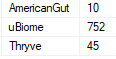
If you go with other companies — ask for an example of their download as JSON or CSV before ordering the test. Then send it to me and I will see how easy it is to make uploadable. American/British Gut was a bit of a pain. Below is how many uploads from each at present:
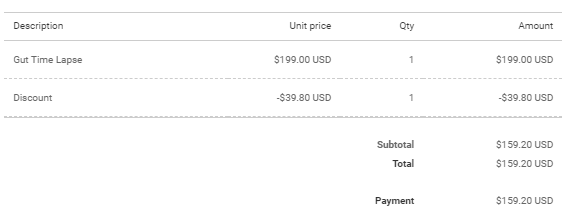
As a FYI on cost: I usually buy the uBiome Three pack, apply discount codes, and average around $53 per test. Much cheaper than the two above.
Bottom Line
uBiome is in recovery mode. It was originally a citizen science startup that went commercial. Worst case scenario, some one will replace them.
I have been doing non-parametric analysis of relationships between bacteria and came up with statistically very significant relationships. Unfortunately (and as expected) not simple straight line ones always.
The result is that there are now two Why? pages available.
Why? – based on reported in the literature
Why? Citizen Science – generated by my analysis of relationships
On Your Select Sample Page
How do they compare?
I thought that doing a few charts each way may be informative
Conventional StudiesCitizen Science
Bifidobacterium
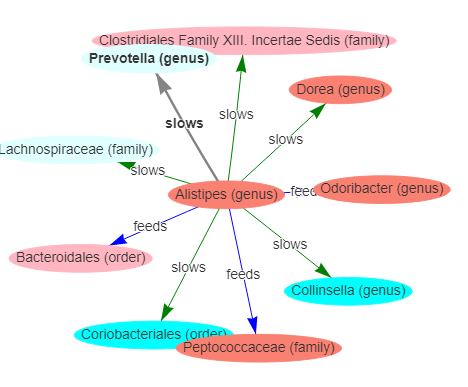
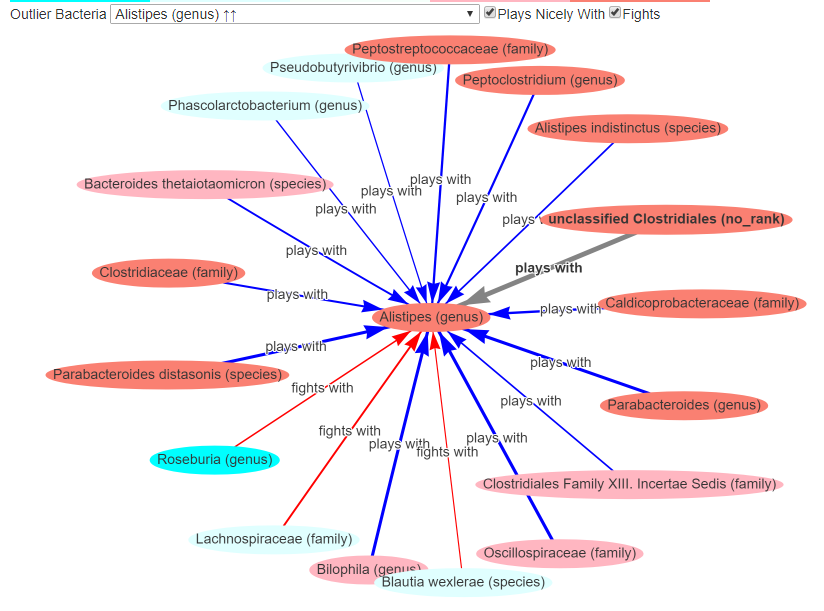
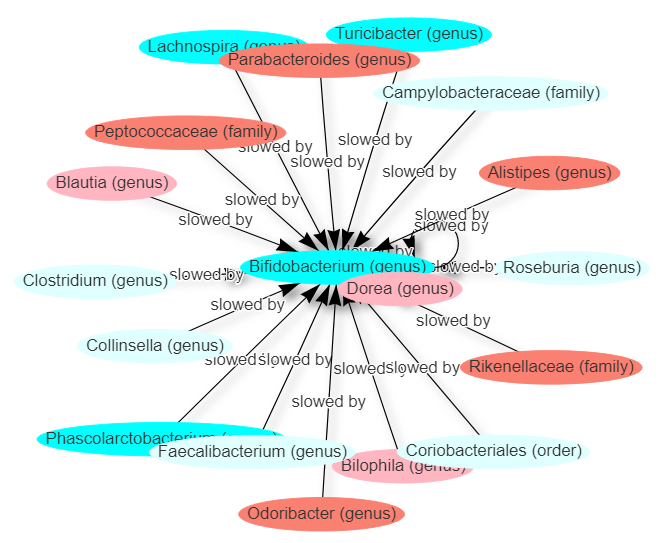
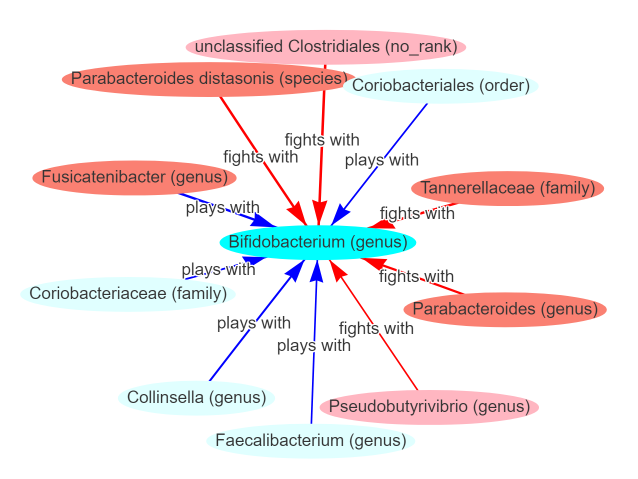
For this one, conventional science only reports what inhibits/fights with it. Citizen Science show bacteria that cooperate with it also. In some cases, we have opposite reports: Faecalibacterium slows Bifidobacteria in one case, and plays with it in the other case!
Conventional StudiesCitizen Science
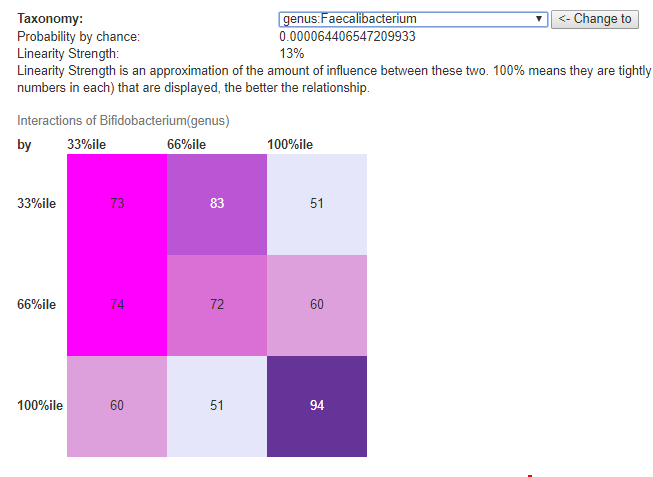
Going over to the new heatmap feature, we see a weak relationship, but the two tend to increase together and both are happiest when they are both high
Note the numbers in each column and each row add up to approximately the same value (205-207). If things were random, we would get almost the same number in each cell.
Bottom Line
I find the citizen science version cleaner. Convention studies can report A inhibits B with B having no impact on A (often because no study was done). With citizen science we deem it to always be two way… they increase/decrease together (plays well) or increases when the other decreases (fights with).
I will leave it up to readers to explore more on the site.
Below is a video with some more explanation of the process used with citizen science.
A reader emailed me with the report below and granted permission to share it.
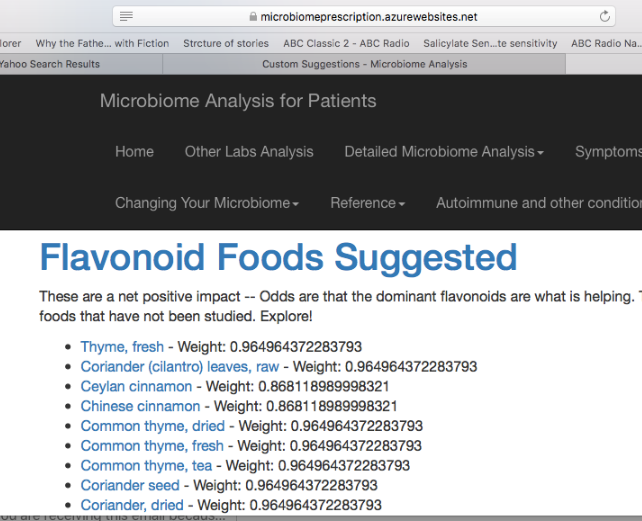
Dear Ken, I write to report our early success through your new site, tailor-made for followers who log on. My daughter (CFS 5-6 years, house-bound) rigorously follows the diet suggestions. Four weeks ago she began on the Jadin regime for a first cycle of two weeks of Doxycycline with miserable results, and straight after, giving up on probiotics because she reacts to all the fillers, went on her tailor-made Flavonoids suggestions (as in screenshot) and after a week of lashings of Thyme,(tea, raw and as a herb), began to “wake up”, staying awake most if not all of the day, chatty, sociable, clear-headed, able to more fully participate in ordinary life , and suddenly showing more physical strength than she’s had for years put together. We live on a muddy river, boat-access only, and coming home on a dark night, she, the only person in the appropriate place, strained out to reach our jetty and single-handedly pulled our 18 foot cabin cruiser across the mud to its berth! She had no punishing delayed exhaustion next day. Who would’ve predicted those tiny leaves could do so much good? (She also has lashings of D ribose to counter the bitterness of the Thyme). It’s not remission yet, but I want to thank you.
Emailed sent Tuesday Jul 9th, 2019
Image included in the email
Walk thru to the Flavonoid page
Before starting I should clarify that flavonoid do NOT mean chemicals related to flavor. The two words sound similar.
Flavonoids are a large family of polyphenolic plant compounds. Six major subclasses of flavonoids, namely anthocyanidins, flavan-3-ols, flavonols, flavanones, flavones, and isoflavones, flavonols are the most widespread in the human diet. Many of the biological effects of flavonoids appear to be related to their ability to modulate a number of cell-signaling cascades. Flavonoids have been shown to exhibit antiinflammatory, antithrombogenic, antidiabetic, anticancer, and neuroprotective activities through different mechanisms of action in vitro and in animal models.
The reason is simple: usability! Studies will often give the name of the flavonoid with no information on what food it occurs naturally in. I prefer natural food sources for supplements over prepared commercial supplements with all sorts of risky fillers. By adding a database of foods with associated flavonoids to the site, it means people can see the related food or spice . We know from studies that specific flavonoids has specific impacts. Often, there has been no studies on the food(s) containing that flavonoid — so we are inferring the benefit from eating foods with those flavonoids will have a similar effect on the gut.
So, instead of seeing a chemical name that you have no clue about, further down the page you will see the name of foods etc. containing those chemicals.
The Walk Thru
Bottom Line
These are person specific suggestions based on THIS individual’s personal microbiome (often 600 -1300 bacteria involved). The above suggestions may not work for you, or may do you harm. You need to have a ubiome or thryve (or American/British Gut) analysis available and uploaded to get the best suggestions.
There are other labs that can be used. They report a lot less information and thus not as specific to your needs. These include:
This is part of the ongoing tracking of the flare or loss of remission from myalgic encephalomyelitis through microbiome studies. You may view my prior reports below:
I have added a lot to the site and analysis over the last month — so this will be a very long post.
First Symptom Prediction – almost 100% accurate
The artificial intelligence agent that does prediction continues to astound me for it’s general accuracy. The results of the latest microbiome uploaded is below:
#1 is reasonably correct, I live with two of them (excluding myself) — and #3 comes in because both have histamine and mast cell issues… Does this mean no more snogging with the wife?. #2 and #4 (confirmed by conventional lab tests) are definites, as are 5,7,8,9 (been known for 30 years), 11,12,13,14,15. The only possible miss is #6. So 14/15 for correctness (for AI that is awesome).
Some symptoms missed that it got right on earlier samples:
For Data Science Nerds out there, there are 161 1-tuple symptoms (covering 77 symptoms) . That is, some symptoms are associated with different shifts in different bacteria — but still the same symptoms.
Why is this important?
If we can predict symptoms accurately from bacteria, this implies (does not prove) that the bacteria are causing the symptoms. This implies if we shift the amount of the bacteria we may reduce symptoms. Getting a high success rate on predicted symptoms (in spike of some nasty issues with having good samples) means that not only is this viable — but that the method being used is reliable and not vaporwear or speculation.
I have gotten rid of symptoms by following the suggestions
If you read the prior reports, I have a lot less symptoms now. I have been following the suggestions determined by the same artificial intelligence process. It appears to be working.
Back to MY Symptoms
The physical fatigue is massive after any activity. I would not attempt to walk to the local bus stop — or even down and back on our long driveway. If I am in town, I figure that I am good for about three city blocks. Symptoms when I push things include massive sweats, hiccups, clumsiness etc.
On the bright side, there were no neurological symptoms like brain fog predicted — and as you can see by recent enhancements and these posts. There is no sign of cognitive issues — purely physical issue. For someone in information processing — that means working remotely is viable. Doing a commute into the city for work is not. “If it ain’t in my Zipcode, it is too far!”
Key Bacteria Shifts
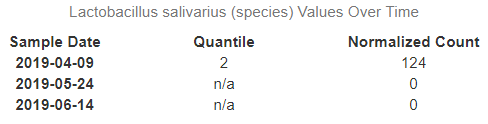
I have covered Lactobacillus and Bifidobacterium in my post on Seed Probiotics failing to persist. I will switch to selective charts for this section:
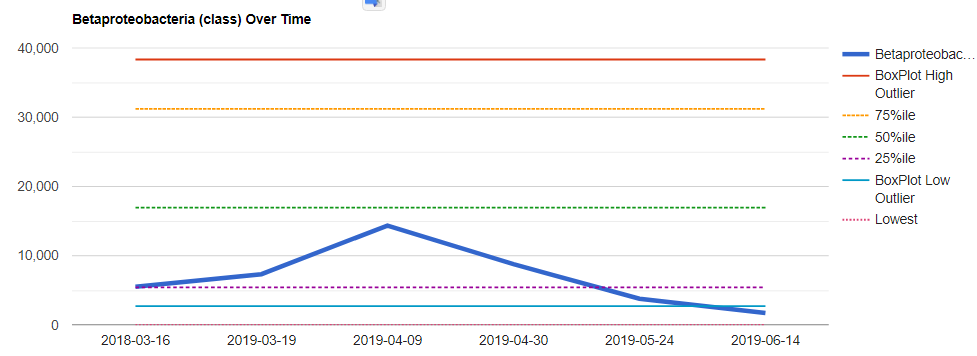
I have zero of Akkermansia muciniphila (35.27% of Samples) just other speciesHigh levels are associated with super athletes and it converts lactic acid into fuel for the body. … I have almost zeroLactobacillus collapsed and making some comebackBifidobacterium went from median levels to zero and still has not returnedBetaproteobacteria attempted to rally and then collapsed. Sutterellaceae (family) followed a similar pattern Actinobacteria class (class) also collapsedFaecalibacterium boosts the immune system. It’s collapse result in increased risk of multiple conditions. Candidatus Soleaferrea went sky high while on Seed Probiotics.
Some Ubiome Charts
Anti-inflammatory Microbes
Butyrate producing microbes are starting to recover, quite a distance to goPolyamine producing microbes are back to prior rangePropionate producing microbes are moving upwards (traditionally I have been high for this one). So some distance to go stillSerotonin has made a good recovery, but GABA is way below my past levels
Incidental Charts
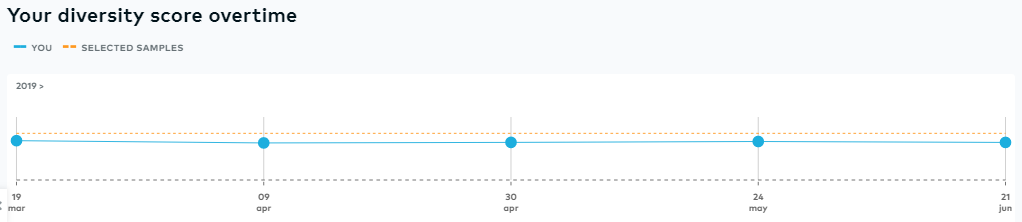
Diversity did not change — there was a shift in the population.
Firmicutes/Bacteroidetes Ratio
This is a ratio that is often cited in research articles — I view it as a hang over from pre-16s data when measuring bacteria was much harder. I did a post on this ages ago and have largely ignored it due to a statistical gut feeling that it was not very useful. I decided to look at these numbers manually and perhaps automate a chart or report in coming days.
Bottom 95% of samples — remaining values were huge
From this chart, I computed the percentile for each measure and got the chart below for my samples.
Dramatic Changes with onset, reversed and perhaps, overcorrected
Commentary
When I added the probiotic mixture feature to the site, I saw that Seed was a bad choice. I took a sample (the one above) and sent the ubiome sample off. The next day I stopped taking it because if was NOT on my recommended probiotics list for my specific microbiome.
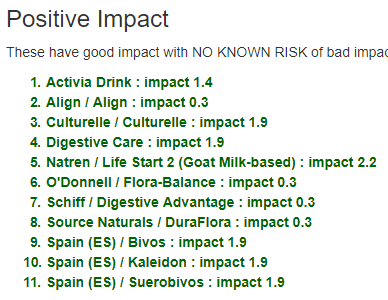
The ones on the list FOR ME are shown below. I find that I must remind people that this is specific suggestion for MY MICROBIOME results — your list may be very different.
I also added AOR / Probiotic-3: the best of the Mixed list with a net value of 3.0
Where as Seed was negative
What happened when I changed probiotics?
I was definitely willing to change because symptom improvement had stopped. The main symptom was having a 15-20 minute window of even mild physical activity before severe fatigue sets in.
Switching to the above probiotics, a lot of changes within 48 hours:
Sore throat (same as when I started with Barley porridge) – my body is fighting something
Niacin flushes whenever I take some (suggesting that vascular constriction is happening from toxins released by dying bacteria)
Night sweats stopped. Running hot at night but without sweats.
Nose started running, sneezing
Groggy feeling starting about 1 hr after taking them and lasting for 2-3 hours. Reminds me of an antibiotic herx.
You will have to wait until the next installment for the microbiome changes.
With both, I slept hard and had night sweats when I took them (but none if I did not). This has been reported also by another reader.
What is next?
There were a few significant changes on the suggestions from this sample, so I will do those for 7-10 days and then take another sample. Each sample results in a change of course, especially when additional data has been added to the artificial intelligence database.
I am not happy with the very limited physical activity. My three dogs are even more unhappy — they have not had any of their customary weekend walks in the Cascades for months.
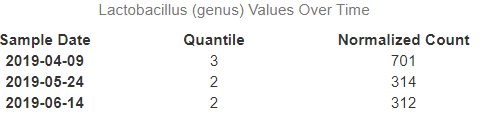
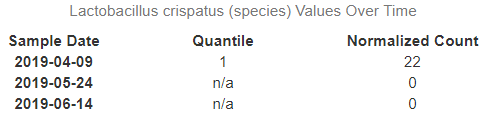
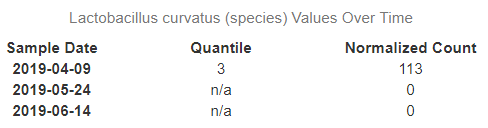
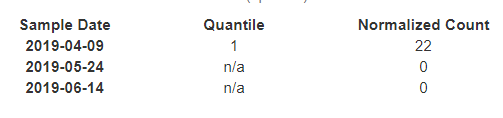
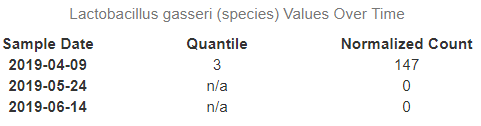
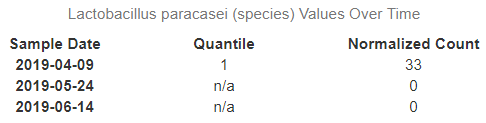
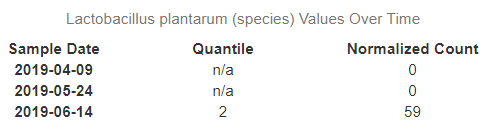
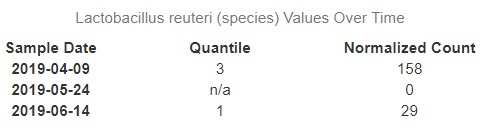
The conclusion is clear using the recent enhancements to the https://microbiomeprescription.com/ site, “My Taxon Time Line” available to those who have uploaded two or more (you need two samples to get a time line!). Below are before and at the end of each of the two months with Seed.
By Lactobacillus Species
Bottom Line
If this probiotic shows up on your recommended list — then take it. It’s effect should be to shift the balance — but do not expect persistence. If you wish to increase Lactobacillus, you should be taking bacillus probiotics, see this earlier post by someone with high lactobacillus and bifidobacterium.












 CFS Remission