I have been on long term disability for ME/CFS, had to deal with school boards for children with ME/CFS and often seen ad-hoc reports created by well meaning MDs. These situations are often legal situations and not medical treatment scenarios — I have seen reports missing the mark — often, making it more difficult to get needed and appropriate support.
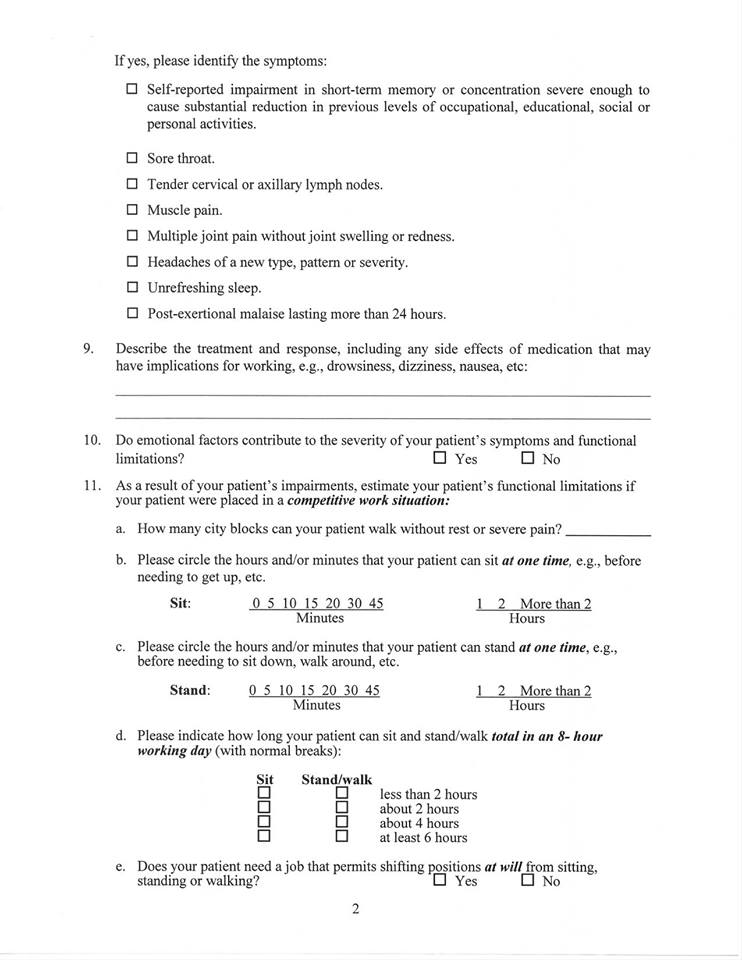
Personally I really like page 4: “11.l To what degree can your patient tolerate work stress?”
The 4 page form below was shared by a friend, and I am reposting it here because I believe many people would benefit from it. I would love to see it translated into other languages (if you translate it — please send it to me as a word document and I will include it on my site).
Given how long this program been running, I would expect studies and results on PubMed — there are ZERO — opps wrong, see bottom.
Their site banners: “Gupta Program Brain Retraining™ Is A Powerful Revolutionary New Program For Chronic Conditions.”
ah, brain retraining — these conditions are all in your head!
Success stories — two key phrases: Placebo Effect, Lack of external verification of testimonies,
Testimonies are meaningless without a control study (ideally published on PubMed — where there is nothing). Of 1000 people who signed off, with MD verified medical condition X, what was the result? For many published studies, I see 15% of control group improved (your testimony!!) and 28% of those on treatment.
Bottom Line
Lack of peer-reviewed published control studies – means a big thumb down for the scientist writing here..
Addendum
A reader found some studies were on pubmed which I could not filter from studies done by other Guptas!.
“a novel hypothesis for chronic fatigue syndrome (CFS) is proposed…. followed by the patient’s experience of the illness. ”
Note that this is proposing a hypothesis based on a single patient’s experience.
Of the 44 patients randomly assigned who completed baseline assessments, 21 patients completed the study (14 in the standard care group and 7 in the study group). Median age was 48 years (range, 27-56 years), and female subjects comprised 91% of the group. Analyses demonstrated statistically significant improvements in scores for physical health, energy, pain, symptom distress, and fatigue in patients who received the amygdala retraining compared with standard care.
So, 7 of 44 completed the study. All of the measures were subjective self reporting (thus very prone to placebo effect)
I suffered from ME (chronic fatigue syndrome) for three years. I spent years researching this mysterious illness to understand the causes, focusing on the brain neurology of conditioned traumas in the amygdala. I cured myself of the condition and wrote a medical hypothesis as to the cause of ME which was published in 2002. …
LimitationsNo control group or placebo group was used, and future studies would need to incorporate this. No standardised tools were used, and randomised collection was not employed. Researcher bias, and the effects of researcher/ practitioner enthusiasm, were significant confounding factors, as were participants’ possible use of concurrent therapies. Sample bias was significant in that those completing the programme may have shown more motivation and commitment.
A decade ago the “Salt and C” protocol was very popular with a few being helped by it. A reader sent me a study link, so it may be time to update my 2013 post on Salt And C. I have been watching ME/CFS treatment trends (? Fads? ) for almost 20 years — especially pre-facebook when eGroups.com CFSFMExperimental (Est. 1997!) was the place for cutting edge theories and discussion and over 3000 posts in a month.
Salt and C was taking mega-dosages of both.
Sodium Chloride
The article that the reader shared was “High-salt diet throws microbiome out of whack” [Nov 2017]. It you have a healthy microbiome, you don’t want to do it./… but if you have an unhealthy one… it may be worth tossing the dice with it!
You will find details on what bacteria salt is known to impact on my microbiome site.
The actual study is “Salt-responsive gut commensal modulates TH17 axis and disease [Nov 15, 2017]” ” In line with these findings, a moderate high-salt challenge in a pilot study in humans reduced intestinal survival of Lactobacillus spp., increased TH17 cells and increased blood pressure. Our results connect high salt intake to the gut–immune axis and highlight the gut microbiome as a potential therapeutic target to counteract salt-sensitive conditions.”
“Sodium intake is associated with changes in circulating metabolites, including gut microbial, tryptophan, plant component, and γ-glutamyl amino acid-related metabolites.” [2017]
“Recently it was shown that high salt conditions promote pathogenic T-cell responses and aggravate autoimmunity in an animal model of MS, suggesting that high dietary salt intake might promote central nervous system (CNS) autoimmunity. ” [2016]
“Within the gastrointestinal tract, increased exposure to dietary salt causes an increased inflammatory milieu (25). Dietary changes may also influence both the function and composition of the gut microbiome, which in turn could impact both innate and adaptive immunity through inducing increases in inflammatory cells while causing loss of Treg function (55, 56).” [2015]
Vitamin C
As above, we have details on it’s bacteria impact on my microbiome site.
Nutritional Correlates of Human Oral Microbiome [2017]
“vitamin C were rather consistently correlated with alpha (within subjects) diversity indexes in both richness (Chao and number of operational taxonomic units) and diversity (whole-tree and Shannon). “
” Vitamin C and other vitamins with correlated intakes—for example, B vitamins and vitamin E—exhibited positive correlations with fusobacteria class, its family Leptotrichiaceae, and a clostridia family Lachnospiraceae.”
Vitamin C intake had more pronounced effects on the presence of Lepto-trichiaceae and Lachnospiraceae, with estimated effect of 5.94
“Intakes of beta-carotene equivalents, vitamin C, vitamin E, niacin equivalents and riboflavin correlated negatively with Bacteroides and/or its corresponding higher level taxa.” [2017]
A recent study found a lot of complexity on Vitamin C impact.
We know that high salt intake causes hypertension (high blood pressure) which for people with Postural orthostatic tachycardia syndrome ( POTS) can be a good thing (in theory). We see above that it also alters the microbiome. — unfortunately we only know that it decreases lactobacillus.
There is no sufficient information to recommend or issue cautions about salt for specific microbiome.
If your bacteroides level is high, you may wish to increase Vitamin C
In general, it was unsuccessful BUT some folks may try to revive it (it’s been long enough that people are not aware of the past results).
Last week at my work place weekly coffee tasting, we did not have coffee. We had juice from Evolution Fresh (https://www.evolutionfresh.com/ ) sold by Starbucks, Target and other stores. The presenter mentioned it contains probiotics — and I immediately asked for the specific strain that it contains! After some emails, and the presenter beating the bushes (perhaps it was her fellow workers that she was beating!), I was informed that it was Bacillus coagulans GBI-30, 6086 (No information on CFU per bottle).
Off to Pub Med Land
“The results provide evidence that probiotic supplementation in combination with protein tended to reduce indices of muscle damage, improves recovery, and maintains physical performance subsequent to damaging exercise.” https://www.ncbi.nlm.nih.gov/pubmed/27547577
“ Once active in the small intestine after germination, it has been shown to aid the digestion of carbohydrates and proteins. Co-administration of B. coagulans GBI-30, 6086 with protein has been shown to increase protein absorption and to maximize the health benefits associated with protein supplementation.” https://www.ncbi.nlm.nih.gov/pubmed/29196920
“Thus, the enhanced protein digestion by BC30 showed a dual benefit: enhanced amino acid bioavailability from plant proteins in the upper GI tract, and a healthier environment in the colon.” https://www.ncbi.nlm.nih.gov/pubmed/28504581
“Consumption of BC30 significantly increased populations of Faecalibacterium prausnitzii by 0.1 log10 cells/mL more than during consumption of the placebo (P = 0.03), whereas populations of Bacillus spp. increased significantly by 0.5 log10 cells/mL from baseline in volunteers who consumed BC30 (P = 0.007). LPS-stimulated PBMCs showed a 0.2 ng/mL increase in the anti-inflammatory cytokine IL-10 28 d after consumption of BC30 (P < 0.05), whereas the placebo did not affect IL-10, and no overall difference was found in the effect of the treatments.” https://www.ncbi.nlm.nih.gov/pubmed/25948780
” Samples from volunteers having ingested the BC30 also increased populations of C. lituseburense, Eubacterium rectale and F. prausnitzii more so than in persons who had consumed the placebo, this also resulted in significantly higher concentrations of butyrate, acetate and propionate. ” https://www.ncbi.nlm.nih.gov/pubmed/25219857
For myself, when I buy a fruit juice, I tend to have it by itself. This is not the best use of this juice with probiotics. With this fruit juice, you should also have protein (Starbucks also sells Protein Boxes) and plant proteins (which are already in the juice). This probiotics is also available in capsules:
A CFS friend had a dental cleaning two weeks ago — she knows that she reacts to fluoride (it appears to trigger coagulation in her) so the fluoride treatment was skipped but it appears that there was fluoride in what was used for cleaning her teeth. She has been out-of-it for 2 weeks now, sleeping excessively. A quick check of PubMed revealed that there was some new material so a summary would be a good to share.
PubMed Literature
“a number of countries including Sweden, The Netherlands, Germany, and Switzerland stopped fluoridating their water supplies due to concerns about safety and effectiveness [8, 9]. Currently, only about 5% of the world’s population—350 million people—(including 200 million Americans) consume artificially fluoridated water globally. Only eight countries—Malaysia, Australia, USA, New Zealand, Singapore, and Ireland, more than 50% of the water supply artificially fluoridate. Over the past two decades many communities in Canada, the USA, Australia, and New Zealand have stopped fluoridating their water supplies and in Israel the Minister for Health announced in April 2013 the end of mandatory water fluoridation” [2014]
“The only demonstrated positive impact of fluoride on human health is its contribution to prevention of dental caries (infection of teeth enamel). “
“While early studies of water fluoridation suggested substantial benefits in terms of reduced levels of dental caries, these results have always been contested. “
” No fluoride deficiency disease has ever been documented for humans.”
“In the USA, a study in Iowa found that 90% of 3-month-olds consumed over their recommended upper limits”
“This review identified a number of potential and established adverse effects including cognitive impairment, hypothyroidism, dental and skeletal fluorosis, enzyme and electrolyte derangement, and cancer [49].’
” found strong indications that fluoride may adversely affect cognitive development in children [50]….approximately equivalent to seven IQ points “
” 47% of children living in a New Delhi neighbourhood with average water fluoride level of 4.37 ppm have evidence of clinical hypothyroidism attributable to fluoride. “
“Iodine-deficient children ingesting fluoridated water have been found to demonstrate intellectual deficits even at water fluoride levels of 0.9 ppm [54].”
“Fluoride is a known enzyme disruptor… There are 66 enzymes which are affected by fluoride ingestion, including P450 oxidases, “
“fluoride can interact with a wide range of enzyme-mediated cellular processes and genes modulated by fluoride including those related to the stress response, metabolic enzymes, the cell cycle, cell-cell communications, and signal transduction [66].”
“One of the major effects of fluoride on oral bacteria is a reduction in acid tolerance, and presumably also in cariogenicity….Even the fluoride-resistant enzyme of isolated membranes of Lactobacillus casei ATCC 4646 could be rendered fluoride-sensitive through addition of Al3+. ” [1990]
“Spore suspensions of Bacillus megaterium…. was significantly inhibited by sodium fluoride.” [1954]
“It was found that, compared with those in the control group, the counts of Lactobacillus spp. and Bifidobacterium spp. were markedly decreased(P < 0.01 or P < 0.05), whereas the counts of Escherichia coli and Enterococcus spp. were significantly increased (P < 0.01 or P < 0.05) in the high fluorine groups II and III. ” [2016]
“fluoride-associated changes in oral community composition resulted in depletion of gene families involved in central carbon metabolism and energy harvest (2-oxoglutarate ferredoxin oxidoreductase, succinate dehydrogenase, and the glyoxylate cycle).”[2017]
“This suggests that fluoride treatment does not have a large effect on the global structure of the oral or gut microbiota in mice. However, it remained possible that fluoride treatment could selectively alter the abundance of individual microbial taxaand functions in these environments.”
“Curiously, unclassified species of Bacteroidales and Burkholderia were significantly depleted only in the low-fluoride group compared to the control group, possibly due to more extreme depletion of other taxa in the high-fluoride group. A similar mechanism would explain the expansion of another obligate anaerobe (an unclassified Ruminobacter species) in the high-fluoride group relative to the control group”
Coagulation Dimension
Above we see that some bacteria families are altered by fluoride. How do bacteria and coagulation tie together?
Increase of bacillus subtilis (available as a probiotic) may cause blood thickening
Bottom Line
Consumption of water enriched by fluoride may significantly contribute to existing health issues. If you live in the US, tap water may be a risk — but worst, bottle water produced from a municipal source (which may be fluoridated) is not require to disclose this — they are only require to disclose if they add fluoride as part of their processing.
Water may be spring sourced, go through municipal processing with the addition of fluoride and then bottled. No label is required.
What are safe bottled waters — simple, those originating in countries where fluoride is banned. Our family preference is Gerolsteiner – available at Trader Joe. Not only is the source Germany, it is in glass and not plastic.




 CFS Remission