Theoretical Supplements for CFS etc

With CFS, SIBO etc we see no or low Lactobacillus, Bifidobacteria, E. Coli. This means we have diminished production of their end products. The absence of these end products can cause a variety of symptoms.  Imagine a diet where all citric fruit was removed — you could get scurvy; or for Vitamin D sources, rickets; or Iodine, goiter.

Whether symptoms develop often is dependent on DNA/SNPs.

The table below comes from DataPunk.Net and shows the known end products.

Bifidobacterium Lactobacillus E. Coli

Known Supplementation

Bottom Line

It is interesting to note that various uptake inhibitors have positive effects.  This would be consistent with low levels — the alternative approach would be supplementation to replace the non-production by the missing bacteria.

Several items are toxic in larger amount — I suspect that these items are produced to control other bacteria types (likely the ones that are now overgrown).

What is available as supplements over the counter?

Note: The above shortages will likely have knock-on effects to other chemicals, but they are likely the underpinnings of most of the symptoms seen.

This is strictly informational and no supplementation should be started without first consulting with your knowledgeable medical professionals.

Turning Antibiotics Upside Down

The usual purpose of antibiotics is to kill off one specific infection. CFS Researchers and physicians also
have spent decades looking for one specific infection.

Note: More detail information on the impact of antibiotics is being assembled at our analysis site.
For example: for Vancomycin

This is very much not in agreement with uBiome results and my model. We have at least three specific bacteria genus that have been eliminated and these genus have been replaced by dozens of rare genus.

In this post I want to first look at the three bacteria genus and what antibiotics they are resistant to! Why— because we want to reduce dozens of of bacteria but not to impact those — we want to make space for the three missing bacteria genus to resettle.

Again, my data from from DataPunk.Net (from Peter D’Adamo, a Distinguished Professor of Health Sciences at the University of Bridgeport)

pda-tie

  1. Bifidobacteria:
  2. Lactobacillus (genus) 
  3. Escherichia (genus) 

ANTIBIOTIC RESISTANCE OF THE ABOVE

So if you do not want to kill off the above BUT want to kill off other bacteria… the choice is obvious….

  • Acriflavin 3
  • Amikacin 3
  • Aminoglycoside -3
  • Apramycin -3
  • Astromicin 3
  • Bacitracin -3
  • Beta lactam -3
  • Carbapenem -3
  • Carbenicillin -3
  • Cefoxitin -3
  • Ceftazidime -3
  • Ceftriaxone -3
  • Cephalosporin -3
  • Cephamycin -3
  • Chloramphenicol – 1, 3
    • “Common side effects include bone marrow suppression, nausea, and diarrhoea.[3] The bone marrow suppression may result in death.[3] To reduce the risk of side effects treatment duration should be as short as possible”
  • Cloxacillin -3
  • Deoxycholate -3
  • Dibekacin 3
  • Doxorubicin -3
  • E cephalosproin 3
  • E penicillin -3
  • Enoxacin -3
  • Erythromycin -3
  • Fluoroquinolone 3
  • Fosfomycin -3
  • Gentamicin 3
  • Glycylcycline -3
  • Isepamicin 3
  • Kanamycin 3
  • Kasugamycin 3
  • Lincomycin -2
  • Lincosamide -3
  • Lividomycin 3
  • Macrolide 2, 3
  • Monobactam 3
  • N cephalosproin 3
  • Neomycin 3
  • Netilmicin 3
  • Norfloxacin 3
  • Paromomycin 3
  • Penicillin 3
  • Polymyxin 3
  • Puromycin (mdtn)
  • Ribostamycin (aph3ib)
  • Ribostamycin 3
  • Sisomicin 3
  • Spectinomycin (ant3ia)
  • Streptogramin -2
  • Streptomycin
  • Sulfonamide 3
  • T chloride (mdtn)
  • Tetracycline – 1,2, 3
  • Tobramycin 3
  • Trimethoprim 3

WAIT A MINUTE!

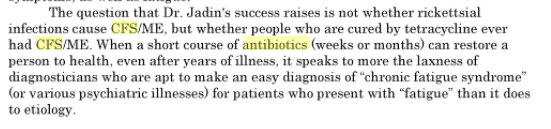
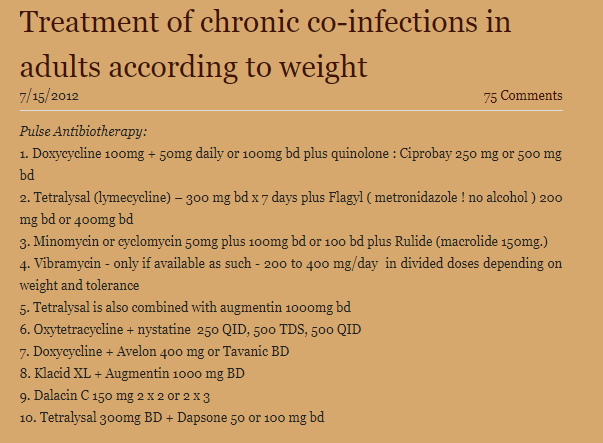
What antibiotics are being used with some success?  I will look at two — one believes that mycoplasma is the cause, the other believes rickettsia infection. I believe the ones above that effects other bacteria BUT NOT Bifidobacteria, Lactobacillus, E.Coli are the ones…

THEY ARE THE SAME ONES

From  Chronic Fatigue Syndrome Treatment Guide, 2nd Edition by Erica Verrillo

cfs

And from http://cecilejadin.info/blog.html

Tetracylines include: Doxycycline, Lymecycline, Minomycin, Vibramycin, Tetralysal.

Older description included macrolides and Fluoroquinolone ( Cipro or Avelox)  [Patient Notes]

cfs6

From Prof Garth Nicholson,

Click to access Treat.considerations.11.1.pdf

“6-week on 2-week off antibiotic cycles (doxycycline[Tetracycline], ciprofloxacin[Fluoroquinolone], azithromycin[Fluoroquinolone], minocycline[Tetracycline], clarithromycin[Macrolide] or others work best as oral capsules without starch fillers).”

What about Metronidazole?

“One hundred and twenty-two strains of Bifidobacterium and Lactobacillus species have been tested against 12 antibiotics and two antibiotic mixtures by a commercial system (Sensititre Anaero3; Treck Diagnostic Systems). … most of the strains were resistant to metronidazole.”  [2005]

“The minimal inhibitory concentration (MIC) of metronidazole was lower for strains of Escherichia coli … The drug-induced decrease in viable numbers of E. coli was followed by an increase. Most cells in this ‘recovery’ population were found to be anaerogenic and were relatively unaffected by subsequent exposure to metronidazole. ” [ 1984]

Bottom Line

All roads lead to the same antibiotics! They do not effect Bifidobacteria, Lactobacillus or E. Coli (after first exposure).

We do not want to use these antibiotics to kill a specific bacteria — the opposite!! We want it to kill many things EXCEPT three bacteria genus. We want to make room for these to repopulate!

This is an educational/information post intended to be discussed by you with your medical professional. Note also that taking probiotics with these antibiotics is fine (and likely a good thing).


What happens with no Lactobacillus, Bifidobacterium and E.Coli?

SIBO and CFS/FM/IBS constantly shows a pattern of low or no Bifidobacterium, Lactobacillus and E.Coli. With these bacteria missing — how does it impact items like amino acids etc…

This is a technical post attempting to illustrate why things go wrong when they are missing — and why their absence leads to various supplements being needed (causation!)

All data is from datapunk.net ( Peter D’Adamo, currently a Distinguished Professor of Health Sciences at the University of Bridgeport, where he direct the Center of Excellence in Generative Medicine.)

ENDPRODUCTS For Bifidobacterium Genus

ENDPRODUCTS for Lactobacillus

ENDPRODUCTS for E.Coli

Involved with the following KEGG Pathways (Escherichia genus used)

Bottom Line

This is likely far above most readers brain-fog levels, but I believe it does illustrate that it is not just some inconsequential bacteria that you are missing. These three groups impact a lot of stuff and missing end products cascade across the body’s system.


American Gut Example Report

A few years ago American Gut and uBiome were both new kids on the block. It seems that uBiome is the dominant one at the moment.  I was delighted when a reader forwarded their gut results because every lab result is interesting in what is there and what is not there.   See this page on what is or is not on various ones.

Both report at the genus level.

Data Visualization Report

agut

Looking at the above we clearly see the over-dominance of Bacteroidetes from the left chart and almost extermination of several others.

There are NO OTHER reports.

Patient History

  • Childhood and pre-CFS days: lots of penicillin and septrin ( trimethoprim and sulfamethoxazole)
    • Comment: Those antibiotics appear to be counter-indicated for CFS.
  • 1979 — flu whose symptoms persisted
    • Severe vertigo attacks
    • Severe anxiety with agoraphobia
  • Started teaching career
    • Picked up infections and more antibiotics
  • 2001 Tested positive for heavy metal poisoning (nickel and mercury).
    • 13 amalgams replaced.
    • Andy Cutler’s protocol
  • 2006 Tested normal for mercury

Current state:

  “I was able to do small amounts of voluntary work for a few hours each week and also walk my dog for around 25 minutes most days.  However I have never been able to walk for longer than 30 minutes maximum at a time before my energy runs out and once my blood sugar drops to say 5 all energy is gone and there is nothing left in my legs.  Using a oxygen concentrator for 30 minutes at a time helps me to feel better and I tend to do this 3 times daily.”

“I guess I have about 60 g carbs daily which are mainly nuts and seeds, a small amount of Sourghan crispbread, lots of vegetables including daily salad, a tiny amount of mixed organic berries from the garden just once daily, a small portion of meat or fish.  I am ok with dairy but not gluten so have a small quantity of whole milk yoghurt most days together with things like flax seed, chia seeds and psyllium.  Have been doing this since the Genova report in late 2015.”

I have taking various Probiotics over the years but none of made a difference to how I feel.  One interesting thing is that I made my own Kefir for a long time this past year but it seemed to make my gut a lot worse which lots of rumbling and rolling and very loose bowel movements so I have stuck with the natural yoghurt which is fine.  I am in the process of trying a small amount of Sauekraut each day to see if that will help me.

My main problem is the severe almost daily migraine, very little dizziness now and bp is fine whereas it used to be so low before treatment.  Still energy runs out and I have to PACE very carefully.  During the winter I can pick up many viruses which always start in my throat.  Echinacea Augustraflora does help this if I drop it frequently down my throat btw.


Earlier Analysis

Genova Diagnostics 2008

  • High pH: 8.1
  • High Acetate
  • Lactobacillus:  – “in lower than optimal levels”
  • Eschericha coli  4+ (Mucoid E.Coli)
  • Bifidobacterium  – “in lower than optimal levels”

Genova Diagnostics 2015

  • Low Diversity (remember this varies according to test sensitivity)
  • High Verrucomicroba Phylum
  • High Fusobacteria Phylum
  • Low Proteobacteria Phylum

Commensal Bacteria

  • Bacteroides vulgatus – High. see below Bacteroides (genus) 
  • Odoribacter spp. High
  • Pseudoflavonifractor – Spp High
  • Veillonella spp High
  • Bifidobacteria Low
    • B. Longum – None
  • E.Coli – High
  • Akkermansia – None
  • Lactobacillus – None
  • Citrobacter Freundi – High,
    • antibiotics suggested: Ciproflozacin, Tetracycline, Trimethoprom/Sulfa,

Bacteria Genus of interest

  1. Bacteroides (genus) 
  2. Peptococcaceae (family) 
  3. Clostridium (genus)
    1. Part of
  4. Lachnospira (genus) 
  5. Ochrobactrum (genus) 
  6. Rubellimicrobium (genus) 
  7. Rhodospirillum (genus) 
  8. Citrobacter (genus) 
  9. Odoribacter spp
  10. Pseudoflavonifractor –

NUTRIENTS/ SUBSTRATES


INHIBITED BY

ENHANCED BY

INHIBITS

Bottom Line

I would not recommend AmericanGut because the amount of information available to the patient is very little compared to uBiome results (a test that cost less than $100 and does not need a prescription or MD involvement). uBiome has occasionally offered them for free.

Microbiome

Most of the sugar substitutes encourages growth of the above bacteria – bad (Aspartame, Saccharin, Stevia) where as high sugar diet or Sucralose (Splenda) reduces the growth. Sugar substitutes are conceptually nice — but they have major risk for maintaining a bad microbiome.

Citrobacter is still high — there are two paths: Pomegranate ellagitannins or the antibiotics cited above (I would start with minocycline first if you go the antibiotic route — one of the tetracycline family).

There are no apparent clustering of inhibited by or enhanced by, so just try working off the lists.

Regular Breakfast Suggestion: Barley porridge and some walnuts (without Aspartame, Saccharin, Stevia). For a month avoid flax seed, chia seeds and psyllium as an experiment — I was unable to find reliable information on what types of resistant starch these could be.

Occasion Supper: Navy beans with a high fat content meat.

Patient History

It was interesting to read that home-made Kefir made her worst — this is likely because it contains lactic acid producing bacteria (which is why I advocate avoiding most Lactobacillus bacteria — see this post “D-lactic Acidosis -Sauerkraut is not good for you if you have CFS!“). A list of strains in Kefir is here. In general, avoid most yogurts and kefirs — use Activia (bifidus regularis) if you wish to continue having yogurt (See Confusion At The Yogurt Aisle? Time for Probiotics 101).

She also wrote: “I changed my diet to lower carb and higher protein and fats because I had such swings of blood sugar in 2001. This helped and because of the steroid I have to be very careful with the carbs or my blood sugar will stay a bit too high unless I am active which of course I cannot do all the time. “ which are inhibitors of the overgrowth bacteria cited above. ” I feel better on a lower carb diet because otherwise I get extremely high blood sugar readings and feel generally horrible, sluggish, headachy, muzzy and falling asleep.

It is also interesting that we have a lot of the bacteria associated with sugars and there are challenges maintaining sugar levels.

Probiotics: The patient did not specify what she has tried.  I suspect they are the typical health food stores ones high in lactobacillus species (which can actually make you worst). I would suggest trying at least one from each of the following two groups:

Subject for future post MSG:

“One thing comes to mind is if I ever I eat MSG by mistake in a restaurant it hits my brain almost immediately like a gun going off in my head.  I will pour with sweat, be dizzy and then get a 2 day migraine.  I have often wondered if I produce too much glutamate and some of the meds I have had for migraine prevention do work on the conversion of glutamate to GABA and have been slightly effective until the side effects kick in and I cannot tolerate them.”

As always — this is education information and not intended to treat. Always consult with a knowledgeable medical professional.


uBiome with low diversity and significant recovery

Most CFS uBiomes show high diversity — but CFS can be a progressive condition which would imply that the uBiome can change it’s profile over time.

Patient History

  • A year of antibiotics for a prostate infection was the probable cause
  • Fatigue, tendonosis, exercise fatigue, muscle twitching, dry eyes, joint pain, ibs, mcs.  The worst of which is the fatigue.
  • What helps:
    • Tai chi,
    • Sleep,
    • Equilibrium,
    • Align (B. infantis),
    • Amino acids (Tyrosine in particular),
    • 5htp,
    • Vitamin D (but causes sleep problems, so can’t take),
    • Regactive [Lactobacillus Fermentum (but causes sleep problems–probably the b vitamins?),
    • cocoa powder,
    • low starch diet (helps with pain, but carbs give more energy so I avoid most carbs and live with the lower energy).
    • Mutaflor helps but can make sleepy.
    • Bifido strains make sleepy.
    • L. Acidophilus makes dry eye worse.
  • State:
    • I would say that I’ve recovered about 40%, which has allowed me to work every day but hasn’t allowed me to have the energy to socialize, exercise or stand for long periods of time.
    • My IBS symptoms have been cured, however.

Basic Criteria for CFS/FM

E.Coli’s Parent:

Conclusion: Every basic criteria is a match. The low diversity is not typical but has been seen in some other uBiomes.

Overgrowth of Bacteria Genus

High

Rare Bacteria

Analysis of Over Growth

  1. Holdemania (genus) 
  2. Bacteroides (genus) 
  3. Akkermansia (genus) 
  4. Lachnospira (genus) 
  5. Bilophila (genus) 
  6. Anaerotruncus (genus) 
  7. Bacillus (genus) 

Items struck out below appear on both inhibits and enhances — so a toss up!

NUTRIENTS/ SUBSTRATES

INHIBITED BY

ENHANCED BY

INHIBITS

Bottom Line

My first question was why was there low diversity, there is no report of taking antibiotics? A good night sleep revealed the probable cause – because the right probiotic to reduce the high diversity was taken. The one that I suspect most as being the cause was:

  • RegActiv (Lactobacillus Fermentum)
    • “Up to the present no strain of lactobacilli with an extensive anti-microbial effect against numerous pathogens and opportunistic pathogens has been described.” – this one does!!!!
    • “The innate resistance of Lactobacillus fermentum ME-3 against antimicrobial preparations (TMP-SMX, ofloxacin, aztreonam, cefoxitin and metronidazole) allows to use it as a preparation accompanying antibiotic treatment in case of gastrointestinal and uroinfections”
    • Mutaflor is also possible, but seems less probable.

Wish List: Some patient with high diversity in uBiome try Lactobacillus Fermentum for 4-6 weeks and then get another uBiome done. This will provide some evidence if the above speculation is correct. If it is, then we may have discovered a key probiotic for remission.

Unexpected Scattering

Usually I have seen clustering (multiples) of some items across the bacteria genus. In this case, there is little, what there is:

One interpretation of the lack of clustering in the overgrowth is that the microbiome is moving towards normal. The highest overgrowth is just 2.74x well below most CFS uBiome results.

Patient Reports

I suspect that the sleepiness is a form of herx. RegActiv (Lactobacillus Fermentum) produced strong antibiotics and does Mutaflor. If there is an opportunity to take a week+ off from work for a ‘sleep vacation’, I would suggest loading up on one of them to try to the corner (but do not take together — they will disagree with each other). I recalled sleeping 12-14 hrs a day during my second episode from antibiotics for a few weeks, then it stopped.

An alternative would be to use Symbioflor-2 (US Source, World Wide Source) , another E.Coli probiotic and slowly work up the dosage – balance the dosage with the amount of sleepiness.

Dry eye: I have had dry mouth, and found that mastic gum cleared it up within a few days (not permanently). A reader provided an interesting comment on an earlier post:

“a treatment I developed for myself decades ago. During my late teens and early twenties I suffered from chronic ear infections. I eventually discovered that if I broke open an acidophilus capsule and left the contents between my cheek and gum overnight after brushing my teeth when I first felt an infection coming on, it would be cleared up by morning. Eventually, after a couple of years, I noticed that I no longer suffered from chronic ear infections.”

  • A very unorthodox approach (definitely needs medical review) is to use Symbioflor-1 or Symbioflor-2 as eye drops….

CAUTION: With prescription antibiotics, if you stop then the herx effect disappears within 24 hrs. With bioactive antibiotics (i.e. probiotics), a herx can go on for weeks. See this patient experience post and also this post.

As always, this is strictly an informational/education post of items that should be discussed with your knowledgeable medical professional before starting.