Comparison between labs

A reader asked for a comparison between various labs (apart from ubiome).

The table is below (also available here as a PDF file)
CompareLabs

Row Labels Bioscreen Biovis Microbiome Plus Diagnostic Solution GI-Map Genova Gi Effects Genova Parasitology Kyber Kompakt Medivere: Darm Mikrobiom Stuhltest Medivere: Darn Magen Diagnostik Medivere: Gesundsheitscheck Darm Metagenomics Stool (De Meirleir) Smart Gut Verisana Viome Grand Total
Acetanaerobacterium 1 1
Acetivibrio 1 1
Acidaminococcus 1 1
Acinetobacter 1 1
Actinobacteria 1 1 1 3
Actinomyces 1 1
Adlercreutzia 1 1 2
Akkermansia muciniphila 1 1 1 1 4
Alistipes 1 1 1 1 4
Anaerofustis 1 1
Anaerostipes 1 1
Anaerotruncus colihominis 1 1 2
Asaccharobacter 1 1
Atopobium 1 1
Bacillus 1 1
Bacteroides 1 1 1 1 1 1 1 1 1 1 10
Bacteroides fragilis 1 1 1 3
Bacteroides intestinalis 1 1
Bacteroides ovatus 1 1
Bacteroides vulgatus 1 1 2
Bacteroidetes 1 1 2
Barnesiella 1 1 1 3
Bifidobacterium 1 1 1 1 1 1 1 1 1 1 1 1 12
Bifidobacterium longum 1 1
Bilophila wadsworthia 1 1
Blautia 1 1
Butyricicoccus 1 1
Butyrivibrio 1 1
Butyrivibrio crossotus 1 1 1 3
Campylobacter 1 1 2
Catenibacterium 1 1
Christensenellaceae 1 1
Citrobacter 1 1 1 1 4
Citrobacter freundii 1 1 2
Clostridia 1 1 2
Clostridium 1 1 1 1 1 1 1 7
Clostridium butyricum 1 1
Clostridium perfringens 1 1
Clostridium sporogenes 1 1
Collinsella 1 1 2
Collinsella aerofaciens 1 1
Coprobacillus 1 1
Coprococcus 1 1 2
Coprococcus eutactus 1 1
Cyanobacteria 1 1
Desulfovibrio piger 1 1 1 3
Dialister 1 1
Dialister invisus 1 1 2
Dorea 1 1 2
Eggerthella 1 1
Eggerthella lenta 1 1
Enterobacter 1 1 1 3
Enterobacteriaceae 1 1
Enterococcaceae 1 1
Enterococcus 1 1 1 1 1 1 6
Erysipelatoclostridium ramosum 1 1
Escherichia 1 1 1 3
Escherichia coli 1 1 1 1 1 1 1 1 8
Escherichia coli Biovare 1 1 2
Ethanoligenens 1 1 2
Eubacterium 1 1 1 1 1 5
Eubacterium hallii 1 1
Euryarchaeota 1 1
Faecalibacterium 1 1
Faecalibacterium prausnitzii 1 1 1 1 4
Faecalitalea 1 1
Firmicutes 1 1 1 3
Fusobacteria 1 1 2
Fusobacterium 1 1 1 3
Gordonibacter 1 1
Haemophilus 1 1
Hafnia 1 1 2
Hafnia alvei 1 1
Holdemania 1 1
Howardella 1 1
Klebsiella 1 1 1 1 1 1 6
Klebsiella pneumoniae 1 1 1 3
Kluyvera 1 1 2
Lachnoclostridium 1 1
Lactobacillus 1 1 1 1 1 1 1 1 1 1 1 1 12
Lactococcus 1 1
Lactonifactor 1 1
Leuconostoc 1 1
Megamonas 1 1
Megasphaera 1 1
Methanobrevibacter smithii 1 1 2
Morganella 1 1 1 3
Morganella morganii 1 1
Moryella 1 1
Odoribacter 1 1 1 1 4
Olsenella 1 1
Oscillibacter 1 1 2
Oxalobacter formigenes 1 1 1 3
Papillibacter 1 1
Parabacteroides 1 1 1 3
Peptoclostridium 1 1
Peptoclostridium difficile 1 1
Prevotella 1 1 1 1 4
Proteobacteria 1 1 1 3
Proteus 1 1 1 1 1 1 6
Proteus mirabilis 1 1
Proteus vulgaris 1 1
Providencia 1 1 2
Pseudoflavonifractor 1 1
Pseudomonas 1 1 1 1 1 5
Pseudomonas aeruginosa 1 1
Roseburia 1 1 1 1 1 1 6
Rothia 1 1
Ruminococcus 1 1 1 1 1 1 6
Ruminococcus albus 1 1
Serratia 1 1 1 3
Slackia 1 1 2
Sporobacter 1 1
Staphylococcus 1 1 2
Streptococcus 1 1 1 1 1 5
Streptococcus anginosus group 1 1
Streptococcus parasanguinis 1 1
Streptococcus salivarius 1 1
Subdoligranulum 1 1
Sulfuricurvum 1 1
Sutterella 1 1
Syntrophococcus 1 1
Syntrophus 1 1
Tannerella 1 1
Tenericutes 1 1
Tistrella 1 1
Turicibacter 1 1
Veillonella 1 1 1 3
Verrucomicrobia 1 1 2
Xylanibacterium 1 1
Grand Total 17 42 14 27 7 11 16 16 17 52 23 11 30

Viome Report Recommendations are now available

A reader forwarded a copy of their Viome report and I have created an entry form for it. It is at: http://microbiomeprescription.com/Kyber/Viome

  • Assume Normal is not 1.5 x higher than “healthy” or 2/3 of healthy

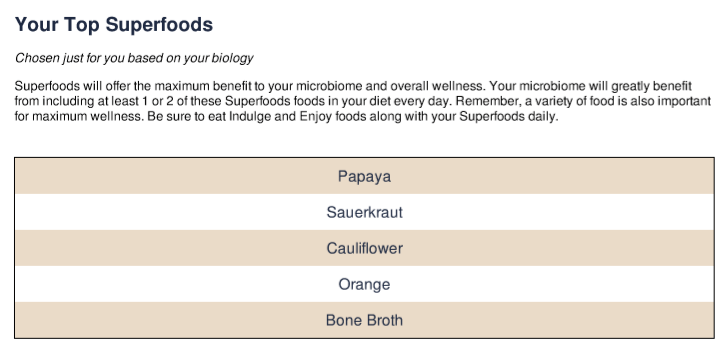
The report looks like this:

v1

I assume that “Activity” is what the person has.

The report also recommends some food (without providing studies backing them 😦 )

v2

The top recommendation from our site is below. Note that only certain lactobacillus are recommended.

Item    Action    Confidence value
chitosan supplements Take 4.159
gluten free diet Take 2.911
sulfites food additives Take 1.871
no carbohydrate diet Take 1.664
lactobacillus kefiri probiotics Take 1.664
garlic Take 1.664
neem herb Take 1.525
sucralose sugar Take 1.248
flaxseed Take 1.248
bifidobacterium longum probiotic Take 1.248
lactobacillus paracasei probiotics Take 1.109
lactobacillus casei probiotics Take 1.109
rosemary herb Avoid -1.109
pomegranate fruit Avoid -1.248
olive oil Avoid -1.248
rhubarb Avoid -1.248
candida albicans yeast Avoid -1.248
chrysanthemum morifolium herb Avoid -1.248
cocoa Avoid -1.248
high fat diet Avoid -1.525
oligosaccharide Avoid -1.664
mediterranean diet Avoid -1.664
magnesium supplements Avoid -1.664
soy Avoid -2.079
almonds Avoid -2.079
bifidobacterium animalis lactis probiotic Avoid -2.495
high fiber diet Avoid -2.495
vsl #3 probiotic mixture Avoid -2.495
resveratrol Avoid -2.634
beta-glucan foods Avoid -2.724
whole grains Avoid -2.773
inulin prebiotics Avoid -3.417
lactobacillus plantarum probiotics Avoid -3.466
arabinoxylan Avoid -3.466
barley Avoid -3.556
lactobacillus acidophilus probiotics Avoid -4.02
resistant starch Avoid -4.298
pulse / legumes Avoid -7.07

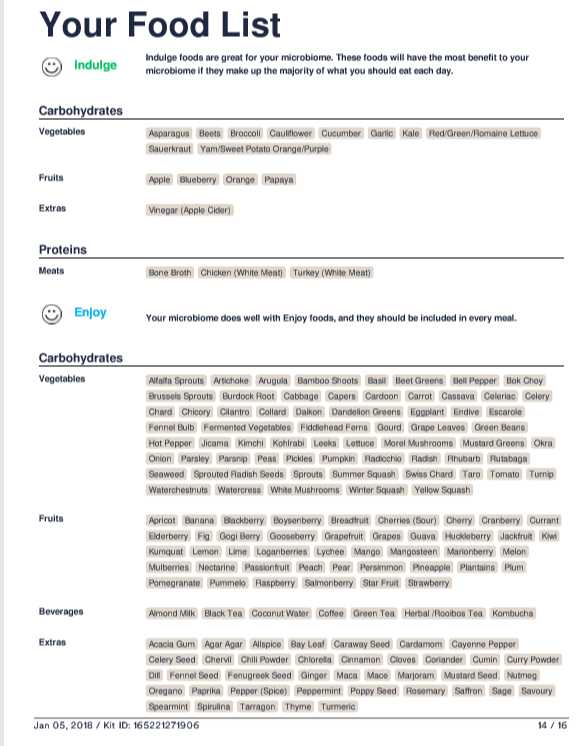
Their Food List

v3

which goes on for several pages. Several items were listed which my analysis suggest should be avoided (barley, almonds, etc) My general impression is their customized for the individual food list is a general healthy living list with perhaps a few minor changes.

Bottom Line

I will be researching papaya, cauliflower, orange and bone broth on PubMed to see if there are studies. If they are, I will add them to our database.

Updated Recommendations Algorithms are live

Both the other Labs Analysis and Ubiome recommendations have had the revised algorithm applied.

The Values are not how strong it works, but the probability that it will have impact (works)

A higher number means more and more studies have found that it has modified the bacteria.

Ubiome Example

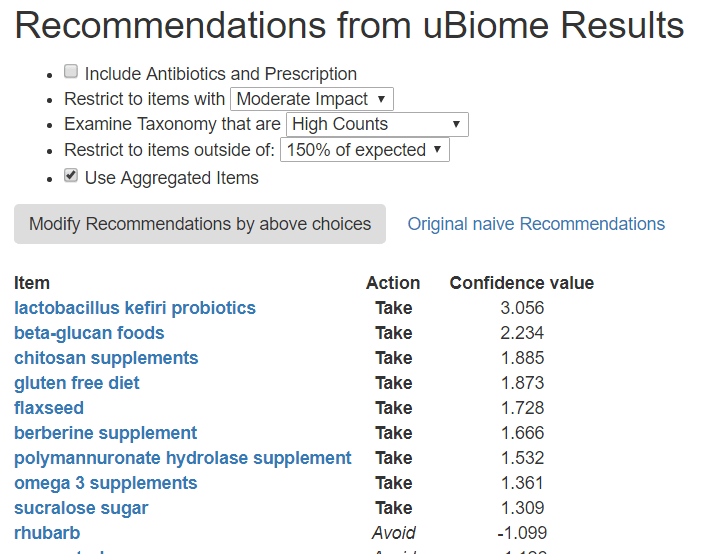
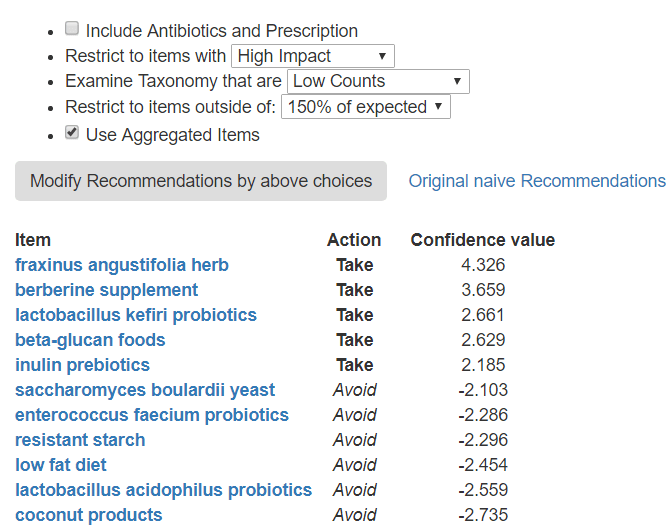
The default recommendations look at:

  • High counts > 150%
  • Items with moderate impacts
  • No antibiotics or prescription drugs
  • Aggregated items

r1

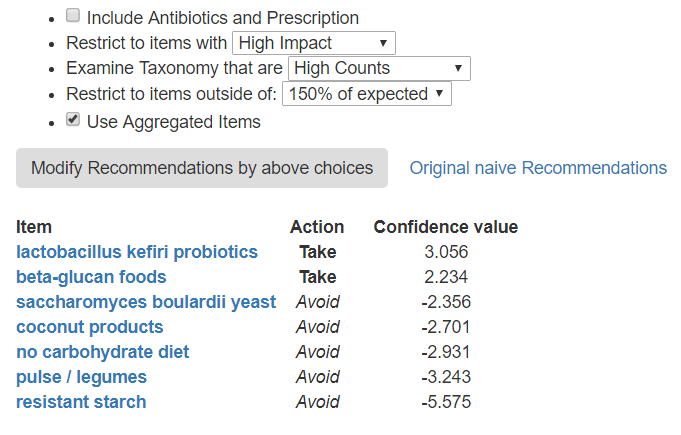
If there are too many items, you may wish to change it to High Impact

r2

If you are concerned about UNDER GROWTH..

r3

Note that there can be some agreements between the High and Low. For example: avoid coconut products and saccharomyces are on both lists.

If you are interested in an item like ‘beta-glucan foods’, just click on it to see the break down.

r4

Bottom Line

This revision should produce better recommendations and be easier to understand. It also provides a tool for those who are concerned about under growths. It also allows people to explore different approaches.


This is an education post to facilitate discussing this approach with your medical professionals. It is not medical advice for the treatment of any medical condition. Always consult with your medical professional before doing any  changes of diet, supplements or activity. Some items cites may interfere with prescription medicines.

MicrobiomePrescription Site Revision – Stage 1a

Another portion of the revision has been completed.  This consists of two parts:

  • Displaying the percentage of gut samples that have a specific bacteria level
  • Refactor of information on each bacteria level

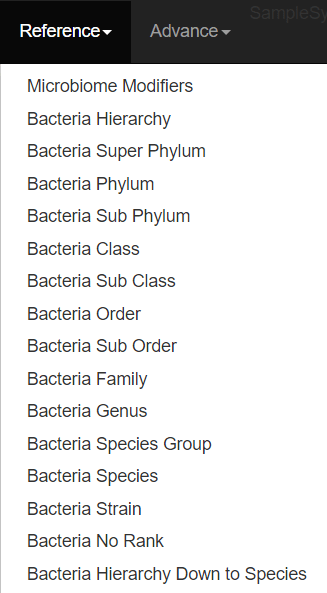
I have expanded the reference to every level of the hierarchy

choices1

Bacteria Level

An example is shown below

Bacteria Species_group

Click the appropriate link if you have an overgrowth or undergrowth

Bacteria (% of samples with it) Modifiers Data Punk NCBI Taxonomy
Acinetobacter calcoaceticus/baumannii complex (0.6% of Samples) Modifiers Bacteria Information Literature
Bacillus subtilis group (3.59% of Samples) Modifiers Bacteria Information Literature
Enterobacter cloacae complex (1.8% of Samples) Modifiers Bacteria Information Literature
Lactobacillus casei group (7.78% of Samples) Modifiers Bacteria Information Literature
Pseudomonas aeruginosa group (3.59% of Samples) Modifiers Bacteria Information Literature
Pseudomonas fluorescens (0% of Samples) Modifiers Bacteria Information Literature
Streptococcus anginosus group (1.8% of Samples) Modifiers Bacteria Information Literature
Streptococcus dysgalactiae group (1.2% of Samples) Modifiers Bacteria Information Literature

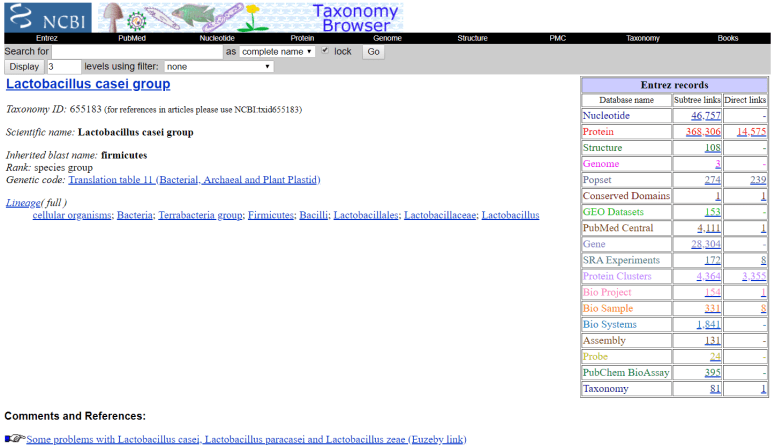
The literature link takes you to the National Institute of Health site, where you have many additional links of a technical nature.

ncbi

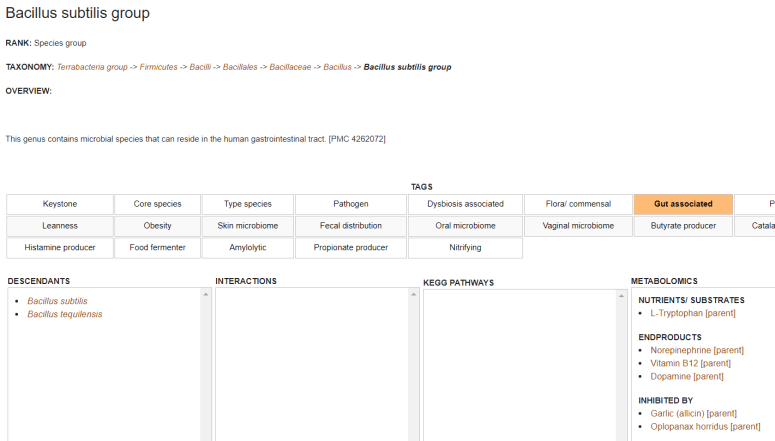
And DataPunk for the other

dp

Hierarchy Tree

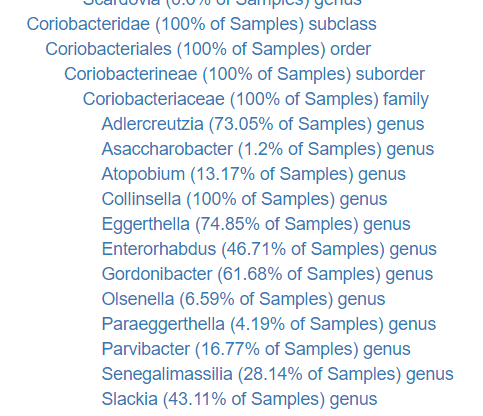
If you go to Bacteria Hierarchy or  Bacteria Hierarchy Down To Species you will see the percentage of gut samples that have a specific bacteria.

tree1

This is important because my long standing question is which low or no count bacteria should we be concerned about to increase. A low Olsenella level is likely not a concern, because most people have none of it. A low Coriobacteriaceae level may be a concern.

If you have a very high level of Olsenella, then this may be a concern. The pending refactor of recommendations will allow have a default (my own assumptions) filtering and the ability for readers to modify it to suit their own assumptions.

Bottom Line

These enhancements allow easy access to additional technical information and also allow us to see which bacteria we expect to see normally. This means we can include bacteria that should be there but which are at an abnormally low level in the revised recommendations.

MicrobiomePrescription Site Revision – Stage 1

This week I have taken off from work to do some serious refactoring on the recommendation site. The first phrase is to simplify recommendations and make items clearer for the brain fogged. At present we have 6,977 different relationships for modifying bacteria in our database.

Example:

  • One of the recommendations was for  naringenin. This is mainly found in grapefruit fruit . Very few of my readers would discover this.
  • Often the same item would have multiple names, common name, scientific name or the dominant chemical in it.

The apparent change in Stage 1 is on a single item “Modifiers”, http://microbiomeprescription.com/Library/GutModifiers

Stage1

You will see that the old items are clustered into groups.

Picking an aggregate

You will see what they appear to impact overall. Often we lack appropriate studies — but ‘similar items’ can be inferred to have similar effects. This allows us to make a reasonable guess when we lack studies.

bacillus probiotics

The following are impacted

Taxonomy Rank Effect Citations Links
Betaproteobacteria class Decreases Studies Also modified by
Acidaminococcaceae family Decreases Studies Also modified by
Bacillaceae family Increases Studies Also modified by
Bacteroidaceae family Increases Studies Also modified by
Clostridiaceae family Decreases Studies Also modified by
Lachnospiraceae family Increases Studies Also modified by
Methanobacteriaceae family Decreases Studies Also modified by
Pasteurellaceae family Increases Studies Also modified by
Rikenellaceae family Decreases Studies Also modified by
Ruminococcaceae family Increases Studies Also modified by
Veillonellaceae family Increases Studies Also modified by
Verrucomicrobiaceae family Increases Studies Also modified by
Acidaminococcus genus Decreases Studies Also modified by
Akkermansia genus Increases Studies Also modified by
Alistipes genus Decreases Studies Also modified by
Bacillus genus Increases Studies Also modified by
Bacteroides genus Increases Studies Also modified by
Clostridium genus Decreases Studies Also modified by
Faecalibacterium genus Increases Studies Also modified by
Haemophilus genus Increases Studies Also modified by
Megamonas genus Increases Studies Also modified by
Methanobrevibacter genus Decreases Studies Also modified by
Roseburia genus Increases Studies Also modified by
Methanobrevibacter smithii species Decreases Studies Also modified by

Picking an original citation

This shows the various aggregations that it has been placed into and the specifics..

bacillus subtilis natto

The following are impacted

Taxonomy Rank Effect Citations Links
Betaproteobacteria class Decreases Studies Also modified by
Clostridiaceae family Decreases Studies Also modified by
Rikenellaceae family Decreases Studies Also modified by
Alistipes genus Decreases Studies Also modified by
Clostridium genus Decreases Studies Also modified by

Studies

Clicking Studies, shows where this information came from.

  1. Effect of Feeding Bacillus subtilis natto on Hindgut Fermentation and Microbiota of Holstein Dairy Cows.
    Asian-Australasian journal of animal sciences (Asian-Australas J Anim Sci ) Vol: 27 Issue 4 Pages: 495-502
    Pub: 2014 Apr Epub:

    • Song DJ
    • Kang HY
    • Wang JQ
    • Peng H
    • Bu DP

Links

This takes you to other things that modifies the bacteria.

In the example below, we see high fat diet increases and low fat diets decreases (results from different studies agreed). BUT we also see that  ketogenic diet  has a contrary effect — possibly due to the low carbohydrate component. (The ketogenic diet is a high-fat, adequate-protein, low-carbohydrate diet that in medicine is used primarily to treat difficult-to-control epilepsy in children. The diet forces the body to burn fats rather than carbohydrates.Wikipedia)

Betaproteobacteria

General Specific Effect
bacillus probiotics bacillus subtilis natto Decreases
bacillus subtilis natto probiotic bacillus subtilis natto Decreases
bacillus subtilis probiotic bacillus subtilis natto Decreases
cellulose carboxymethyl cellulose Increases
emulsifiers (additives) polysorbate 80 Increases
fraxinus angustifolia herb fraxinus angustifolia Increases
high fat diet high fat diet Increases
ketogenic diet Decreases
low fat diet low fat diets Decreases
polymannuronate hydrolase supplement polymannuronic acid Decreases
pulse / legumes navy bean Increases
taurine amino acid l-taurine Decreases
walnuts nuts walnuts Decreases

On the above, if you click the links under effect,

ketogenic diet

Decreases

You will again be taken to the list of studies

  1. tion
    Acta neurobiologiae experimentalis (Acta Neurobiol Exp (Wars) ) Vol: 77 Issue 1 Pages: 18-30
  2. Effects of diet on gut microbiota profile and the implications for health and disease.
    Bioscience of microbiota, food and health (Biosci Microbiota Food Health ) Vol: 32 Issue 1 Pages: 1-12
  3. Short-term impact of a classical ketogenic diet on gut microbiota in GLUT1 Deficiency Syndrome: A 3-month prospective observational study.
    Clinical nutrition ESPEN (Clin Nutr ESPEN ) Vol: 17 Issue Pages: 33-37
  4. Effects of Consuming Xylitol on Gut Microbiota and Lipid Metabolism in Mice.
    Nutrients (Nutrients ) Vol: 9 Issue 7 Pages:
  5. Ketogenic diet poses a significant effect on imbalanced gut microbiota in infants with refractory epilepsy.
    World journal of gastroenterology (World J Gastroenterol ) Vol: 23 Issue 33 Pages: 6164-6171
  6. Gut Microbiome-Induced Shift of Acetate to Butyrate Positively Manages Dysbiosis in High Fat Diet.
    Molecular nutrition & food research (Mol Nutr Food Res ) Vol: 62 Issue 3 Pages:
  7. Curated database of commensal, symbiotic and pathogenic microbiota
    Generative Bioinformatics (Center of Excellence in Generative Medicine ) Vol: Issue
  8. Influence of diet on the gut microbiome and implications for human health.
    Journal of translational medicine (J Transl Med ) Vol: 15 Issue 1 Pages: 73
  9. Sodium butyrate attenuates high-fat diet-induced steatohepatitis in mice by improving gut microbiota and gastrointestinal barrier
    World Journal of Gastroenterology (World J Gastroenterol ) Vol: 23 Issue 1 Pages: 60-75

Bottom Line

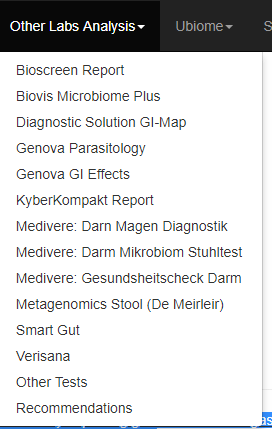
This is stage 1, reorganizing the data. Stage 2 will be adding a second recommendations choice to use the reorganized data.  The second phrase will be on the “Other Lab Analysis” reports to test that the results are similar.

OtherLabs

The third phrase will be applying it to the uBiome data.

Quality Assurance Needed!

I have done my  best guess at aggregations. I may be missing some or have some incorrect. Please email me at Ken /at/ lassesen.com with recommendations/corrections.