A Spanish Microbiome Test and Analysis

A reader in Spain forward the results they received from Estudios Analiticos Aplicados a la Clinica, Madrid, Spain. I have done two other reviews using sample reports recently (A US Microbiome Test: GI-MAP and Another German Microbiome Test Review), It is nice to do one  with actual patient data.

Evaluation

Criteria: Look at the current list of deep dives of 69 bacteria genus(which comes from high values seen in uBiomes from CFS readers) and count the number of matches, just like I did in posts above. We get 8 or 12% covered by this test (discussion at bottom).

This Report Result

First — I like this report visually and it’s content

  • There are ranges based on Spanish population
    • Less variation due to genetics
    • Less variation due to differences in diets
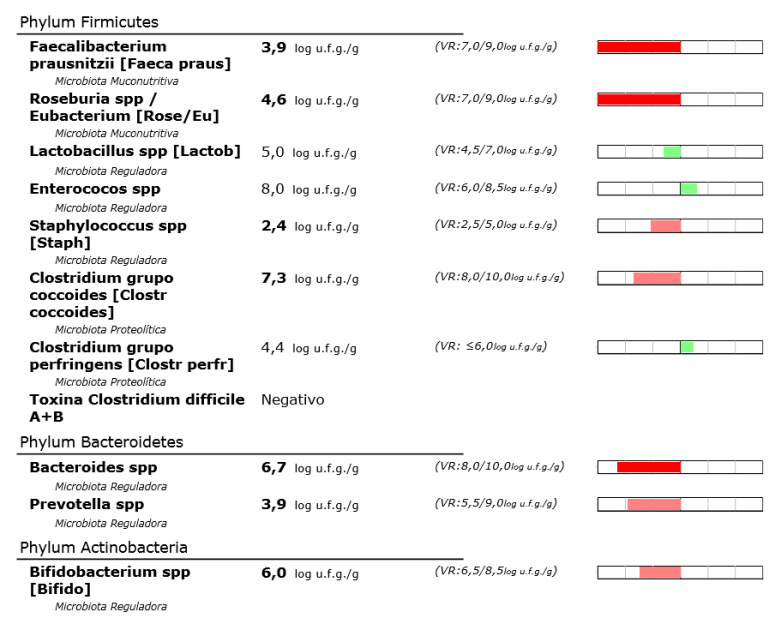
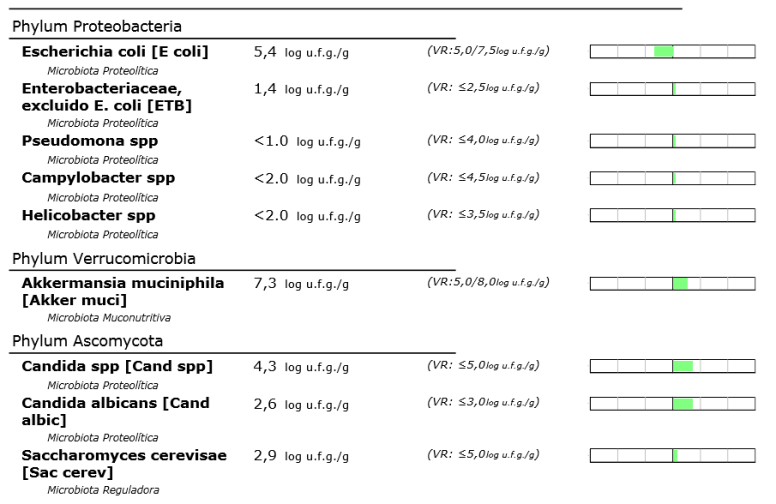
  • There are RANGES, if you look at the first chart below we see some ranges are huge and some ranges are small.
    • Because uBiome lacks ranges, I have arbitrary picked 1.5x as a threshold. Looking at Bacteroides below we see the normal range is 8-10. A 11 would be an abnormal high. Using my rule of thumb we have 9 x 1.5 = 13.5 as the threshold for abnormal high so a value of 12 would be deemed normal for me but abnormal using ranges (the correct answer).
es1.PNG


es2es3

es4

es5

es6

es7

Bottom Line

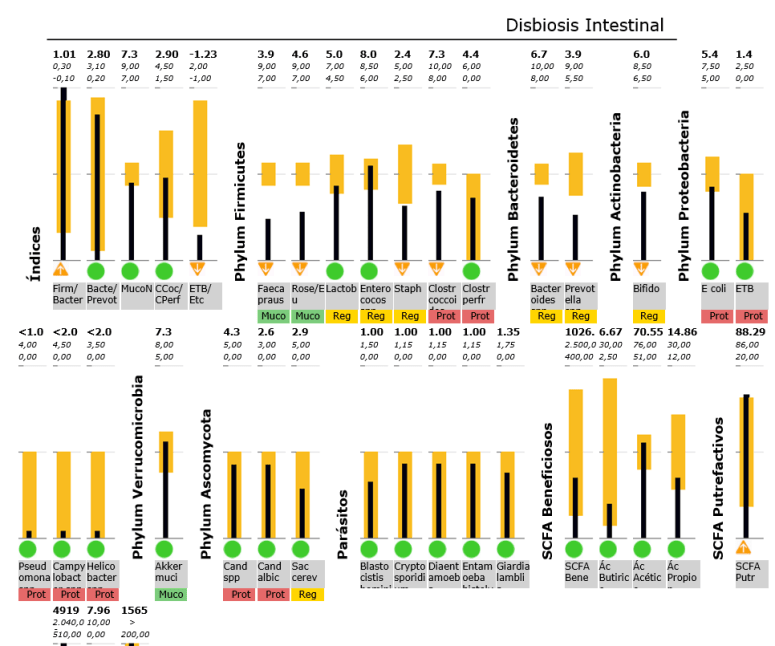
A nice summary is provided at the bottom of abnormalities. Some abnormalities are not cited because they are clinically significant by traditional standards:

  • E.Coli is low normal:  5.4 on a range of 5-7.5
  • Bifidobacterium is low: 6.0 on a range of 6.5-8.5
  • Lactobacillus is low normal: 5 on a range of 4.5-7
  • Firmicutes is low: 8 on a a range of 8.5 -11
  • Akkermania is normal: 7.3 on a range of 5-8
  • Bacteroidetes is low: 7.04 on a range of 8 – 11
    • Note: the Firmicutes:Bacteroidetes normal ratio on this test would be 1.02 to 1 NOT 2.1:1 reported on uBiome — we may have differences of lab process being involved 😦
    • The ratio here is 1.09, high (ALTO)
  • We have significantly low pH (5.5 vs normal range of 6.0- 7.2) – thus excessive acid.

All of the items below are for low (BAJO) bacteria genus – not overgrowths (ALTO)!

es8

The short coming

The report is centered at the Phylum (50’000 meter view) level with a few specific genus being checked (i.e. Enterobacteriaceae, Pseudomona, Campylobacter, Heliobacter, Akkermansia, Saccharomyces, Bacteroides, Prevotella, Clostridium, Staphylococcus, Enterococos, Roseburia, Eubacterium, Faecalibacterium). Of these, 8 or 12% are on the list of bacteria genus seen with CFS. This means that there is about a 50% chance of seeing any highs bacteria genus (assuming 8 genus are high in a CFS patient’s ubiome).

In other words, you may have major overgrowth causing the low bacteria genus detected by this test but not a single high bacteria genus reports!

Personal View

The test presentation and information is a big positive. The very limited coverage of bacteria genus is a negative — but it is a lot better than the two prior tests that I reviewed.

I would say that taking this test PLUS uBiome would be a good combination. If you happen to be high in one of the 8 covered bacteria genus — then having the local population based ranges is superior to my rule of thumb of 1.5x.

Advise to the reader – this is tough because I can only give advice to alter the Firmicutes:Bacteroidetes ratio, see this post

Avoid

  • capsaicin [2016] Chili Peppers
  • Dairy products [2016]
  • Proton pump inhibitor [2016]

Take

  • Resveratrol [2014]
  • Lactobacillus Fermentum [2017]
  • Pea Fibre [2017]
  • Melatonin [2017]
  • Cranberry [2017]

… and get a uBiome done.

This is an education post to facilitate discussing this approach with your medical professionals. It is not medical advice for the treatment of CFS. Always consult with your medical professional before doing any  changes of diet, supplements or activity. Some items cites may interfere with prescription medicines.


ubiome analysis of a friend in Seattle

Reader Summary

ONSET:

Gradual onset (or as I call it, “Gradually Sudden”).

  • Began high-stress job 9/1994 managing a large old apartment building where I worked with pesticides, fungicides, paints, paint thinners, and was exposed to mold from plumbing leaks on many occasions.
  • 4/1996: Came back from Mexico w/montezuma’s revenge.  Noted ‘never felt this weak in my entire life’ a week later, before herbs (haritaki, etc) stopped it.  But didn’t really recover 100%.
  • Continued with stressful 24/7 job, managed to stay afloat, but stressors took theirtoll by fall ’97 and I ended up in ER June 3rd, 1998.
  • After that got worse each year until a little rebound in early 2015, and a distinct one in March 2016 (thanks mainly to niacin – a two-edged sword – helps w/triglycerides, but can make histamine issues worse). I was so bad in Feb 2016 that I needed a cane to get out of bed, and after falling into the bedroom window, used a walker – inside my apartment – probably 85-90% of the day, as I was just unbelievably weak and my balance unstable.  After 2 weeks of niacin, I needed the walker maybe 20-25%…)
  • Hindsight is always 20/20.  I started to develop reddish-brownish, semi-crusty patches/rashes in a couple spots on my legs in early 2008.  By late 2010-early 2011, I stopped sweating and my skin started really drying out.  By late 2011 to present day, I have at times overall body dandruff – mostly on my lower legs though, but can be anywhere.  This is no doubt due in part to not being able to bath or take a shower since about mid-2012 – so I dry brush or do spot bathing – but it’s mainly due to insulin resistance/metabolic syndrome/pre-diabetes. No one could tell me what the patchy reddish-brown areas were, so I googled and came to a site w/55 different types of rashes.  The one that matched my main ‘patch’ was called “stasis dermatitis”.
  • More googling revealed stasis dermatitis is connected to venous insufficiency, which can be connected back to diabetes, along with other vascular issues.  It might be a tiny bit better than a year ago – I’ve been taking quercetin w/vitamin C and the main spot doesn’t seem to be so bad, but the circulation to my feet is still BAD.
  • Rich Van Konynenburg reviewed for me back in September of 2010(!).  And my muscle has definitely broken down.  My calves are basically jelly-like, what’s left of them anyway.
  • And Medicaid doc agrees I definitely have developed fatty liver.  My legs are like sticks, but my gut looks like I’m six months pregnant(Update, now I’m maybe 4 months pregnant.)  B. longum to the rescue?:
  • I also had a test for gluten sensitivity back in 2007.  Looking at it in hindsight,only one of the four-part test was positive, and mildly so.
  • Can only tolerate a few spices, mainly because of the histamine issue.  But nothing pungent (dries me out, and sometimes causes severe muscle cramps) or anything too bitter (makes me constipated).  But can do dill, some small amounts of basil from time to time, small, very small amounts of onion.
  • Also, in addition to the l. plantarum for histamine and dust mites above, I want to mention two other probiotic strains that I know have been helpful:  b. infantis, and b. longum BB536.  Both helped w/histamine issues.  And now in 10/2017, the b. longum – at a higher dose – 4-6 10billion caps/day – seems to be helping w/the chronic constipation.

Standard Items:

  • Diversity: 76%ile
  • Lactobacillus:  0.19x
  • Bifidobacterium: 0x
  • Akkermansia: 0x
  • Firmicutes:Bacteroidetes: 2.8:1 (Normal  2.1:1)
    • More bacteriodetes undergrowth than firmicutes overgrowth.

Typical CFS profile

Uncommon Bacteria

None – 8.6% common was the rarest (threshold is 5%)

High Bacteria

Bacteria
Ratio
Sarcina: 2.23 X
Phascolarctobacterium: 3.03 X
Dorea: 2.51 X
Sutterella: 2.04 X

Reference


Bottom Line Suggestions

The lists below are done by merging the lists from the deep dives linked above. Some items may encourage one genus and discourage another genus — those are removed (unless it seems that it strongly predominates on one). The impact on Lactobacillus, Bifidobacterium and E.Coli are intentionally ignored [See this post for the logic]. This is all based on applying logic to the results of studies — thus theoretical. This is an addition (not a replacement) to this overview post.

Avoid

  • Animal-based diet
  • Barley
  • Berberine
  • BPA bottles
  • Helminth infections
  • High Fat Diet
  • Lactobacillus rhamnosus
  • Polydextrose
  • Saccharomyces boulardii
  • Soluble corn fiber
  • Stress
  • Walnuts (and likely pomegranates)

Take

  • Acarbose
  • Bifidobacterium Longum
  • Enterococcus  faecalis
  • Fennel
  • Flaxseed
  • Fructooligosaccharides (FOS)
  • Fumarate
  • Galactooligosaccharides (GOS)
  • Gluten free diet
  • High Protein Diet
  • High resistance starch
  • Lactobacillus Casei
  • Lactobacillus paracasei
  • Lactobacillus plantarum
  • l-glutamine
  • lycheerambutanguaranakorlanpitomba, Spanish lime and ackee. [fam-Sapindaceae]
  • Metronidazole
  • Oral Iron Supplements
  • Polymannuronic acid
  • Resistant starch (type II)
  • Sodium chloride (Table Salt)
  • Vitamin D3
  • β-glucan

Personal Comment

The reader has self-discovered two probiotics that helped him: (Bifidobacterium Longum and Lactobacillus plantarum) — both were on his Take list, as well as three more suggestions:

  • Enterococcus  faecalis
  • Lactobacillus Casei
  • Lactobacillus paracasei

Other easy supplements are: L-Glutamine, Vitamin D3, oral Iron Supplements, beta-glucan. He should see if he tolerate Fennel and Flaxseed in low dosages and work up.

  • Acarbose is a prescribed medication that is often used with pre diabetes — he may be amble to get a physician to prescribe it.

I should note that some of the studies found that 24 BCFU/day of a specific probiotic was often needed to get effective results — you need enough of them to overwhelm the cartels (at least temporarily).

This is an education post to facilitate discussing this approach with your medical professionals. It is not medical advice for the treatment of CFS. Always consult with your medical professional before doing any  changes of diet, supplements or activity. Some items cites may interfere with prescription medicines.

A US Microbiome Test: GI-MAP

As the microbiome become a more main stream medical tool, there will be more and more providers. A reader forwarded me an example from Diagnostic Solutions – GI-MAP. This is the only test that their physician are willing to accept.

Their 2015  literature state “Diagnostic Solutions Laboratory is pleased to offer you the GI Microbial Assay Plus (GI-MAP). The GI-MAP includes the first comprehensive pathogens assay that is FDA approved, the GPP assay by Luminex Corp. The pathogen targets include bacteria, parasites and another first for the market, viruses!”

Evaluation

Criteria: Look at the current list of deep dives of 69 bacteria genus(which comes from high values seen in uBiomes from CFS readers) and count the number of matches, just like I did in my last microbiome test review.

As with the prior report, we do get Lactobacillus, Bifidobacterium and Escherichia species.

GIMAP2

We have 3 of the overgrowth bacteria genus listed on this report. 3/69 or just 4%. Statistically, the reader may have major over growths of a dozen bacteria genus and the test will report no issues.

Redeeming Aspects

This test does report on common parasites and Fungi/Yeast issues

GIMAP

Bottom Line

The reader has a potential problem — their physician wishes to keep to familiar ground, and thus tests that they know what to do with the results.

The reader may wish to bring this paper to their physician to expand the physician perspective.

GIMAP3

Another German Microbiome Test Review

As the microbiome become a more main stream medical tool, there will be more and more providers. A reader wrote:

“I have another question. Do you think this German test might be beneficial? https://www.vimedics.de/media/pdf/Musterbefund_Florastatus.pdf

In contrast to KyberKompakt (that you recommend) they don’t test: Akkermansia muciniphilia, Faecalibacterium prausnitzii, H2O2 Lactobacillus. But it is cheap and easy to get as there is no doctor necessary to order it. 

Do you think that I will get enough information from it to start with probiotics? “

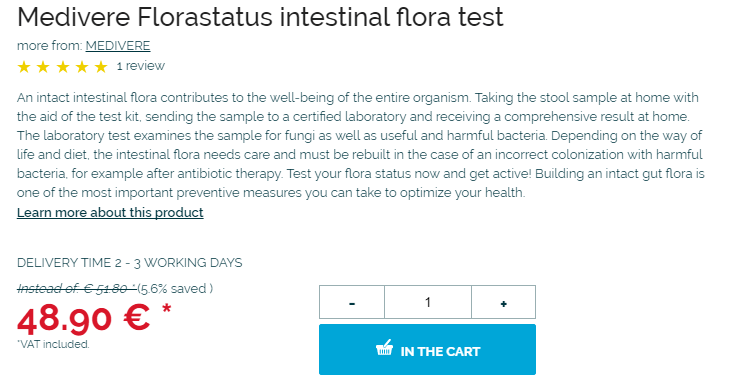
Analysis of Medivere Florastatus intestinal flora test

Medivere Florastatus intestinal flora test

floras

Criteria: Look at the current list of deep dives of 69 bacteria genus(which comes from high values seen in uBiomes from CFS reders) and count the number of matches – we have just 4 or 6%.  It does has explicit reading for Escherichia coli, Bifidobacterium and Lactobacillus — as such, it is good as a indicator of prs obable CFS/IBS/FM.

Bottom Line

The cost is about $60 US, uBiome is $89 for one time purchase ($72 for subscription). The slight reduced costs for significant reduction of information is not a wise decision.

Revisiting old Ubiome’s “L”

A year ago, several readers shared their ubiome for me and I did a series of post looking for patterns. See this post on the Genus Numbers.

It is time that I do deep dives for these early sharers.

Results L:

  • on Canadian consensus criteria1) post-exertion fatigue and malaise I meet all criteria (A B and C)
    2) both unrefreshing sleep and a new pattern (trouble getting to sleep and staying asleep and some nights without sleep
    3) yes muscular aches and pains in legs and arms face neck and head, and headaches, forehead back of head and sides + of course the migraine
    4) A, B C (issues with noise and sound, re perhaps also anxiety I find it very hard to watch tv and often have to skip anxiety inducing bits or things that are too emotional.) D if vertigo and tinnitus count (but I had these before and associate them with migraines) . E  lots of brain fog type confusion.
    5)A: 2(POTS) 3 (Vertigo) 5 (IBS the alternate type but mostly D) 6 (palpitations), , 8 respiratory irregularities, I seem to overbreathe a lot and often find I am overinflated.
    B:I think 1 and 5, I have had low auxiliary basal body temperature clustering around 35C; and I do not handle stress at all.
    C:1 2 3 and 4
    6) yes 13 yrs
Genus L
Erysipelatoclostridium 3.29
Adlercreutzia 3.1
Bifidobacterium 2.86
Clostridium 2.41
Marvinbryantia 2.26
Flavobacterium 2.2
Anaerostipes 1.8
Dorea 1.71
Roseburia 1.63
Blautia 1.54

Deep Dive References

Bottom Line Suggestions

The items from each of the deep dives aligned very nicely for this microbiome, for example, Inulin was listed many times.

The lists below are done by merging the lists from the deep dives linked above. Some items may encourage one genus and discourage another genus — those are removed (unless it seems that it strongly predominates on one). The impact on Lactobacillus, Bifidobacterium and E.Coli are intentionally ignored [See this post for the logic]. This is all based on applying logic to the results of studies — thus theoretical. This is an addition (not a replacement) to this overview post.

Avoid

  • Animal-based diet
  • Arabinoxylans
  • Bacillus probiotics
  • Bacillus subtilis
  • barley
  • Bifidobacterium adolescentis
  • Bifidobacterium longum
  • Bifidobacterium animalis
  • brown rice
  • Butyrate producing probiotics
  • Chicory root
  • Chili pepers
  • Cholic acid
  • Dairy
  • Dietary fiber
  • Dopamine
  • flavone
  • Fluoroquinolone
  • Fructooligosaccharides
  • Getting Cold
  • Glucose foods (fructose [fruit sugar] appears to be fine)
  • Helminth infections
  • high grain diet
  • inulin
  • Isoniazid-
  • Lactobacillus plantarum
  • Lactobacillus rhamnosus
  • Lactobacillus salivarius
  • L-sorbose
  • Metformin
  • Minocycline
  • N-Acetyl-D-glucosamine
  • Omega 3
  • Penicillin
  • Polymannuronic acid
  • Pyrazinamide
  • Raspberries
  • Resistant starch (type II, IV)
  • Rifampin-
  • Rosemary
  • Saccharomyces boulardii
  • Safflower oil
  • Sleepless nights
  • Sodium butyrate
  • Stress
  • Walnuts
  • Walnuts (Omega 3)
  • xylitol


Take

  • Bacillus licheniformis
  • Bifidobacterium longum
  • Bifidobacterium Breve
  • Bile acid
  • Chitosan supplements
  • Chocolate!
  • Epinephrine
  • Flaxseed
  • Fructo-oligosaccharides
  • Galactooligosaccharides
  • Grape seed polyphenols,/ Wine
  • High animal protein diet
  • High meat diet
  • Ketogenic diet
  • Lactobacillus Casei
  • Lactobacillus kefiri LKF01
  • Lactobacillus paracasei
  • Lactobacillus rhamnosus probiotics
  • L-glutamine
  • Low carbohydrate diet
  • Mutaflor (E.Coli Nissle 1917)
  • Oral Iron Supplements
  • Oranges (pectin/flavanones)
  • Polymannuronic acid
  • Prescript Assist
  • Streptococcus Probiotics
  • Tea
  • Vitamin D3
  • Vitamin K2

This is an education post to facilitate discussing this approach with your medical professionals. It is not medical advice for the treatment of CFS. Always consult with your medical professional before doing any  changes of diet, supplements or activity. Some items cites may interfere with prescription medicines.