Short note on LDN (low dosage naltrexone) possible mechanism

A reader wrote: “Hi Ken. I take LDN. Latest research shows that it blocks TLR-9 receptor. Would the regular bad bacteria in the microbiome causing over expression of TLR-9?” [2017 study]

I did an earlier post on LDN. The LDN –> TLR9 <– Lactobacillus connections was not known then.

In researching this with the microbiome, I found:

The reader responded “Wow. Lactobacillus is what I am deficient in, so explains why LDN works well for me.”

Bottom Line Updated

Surveys found: Low-Dose Naltrexone: Better 62% Worst 11%;

There is now a connection established with missing lactobacillus bacteria and what LDN impacts. We have a “how it works” model.

  • Definitely a thumbs up now to try.
  • This is an “off-label” mechanism for naltrexone

Post Script:

Every drug, supplement, probiotics etc have multiple effects. We typically simplify it down to just one effect when there are many. Take aspirin — it remedy headaches. It is also a blood thinner. It is also helps with gram-negative bacterial pneumonia, User for primary and secondary prevention of preeclampsia. etc. Aspirin is a single stable chemical. Herbs and spices are complex chemical compositions. Probiotic bacteria are even more complex producing dozens of metabolites — often depending on what is available.

We have 62% being positive and 11% being negative for the impact. The 11% likely have an additional effect coming into play.


uBiome changes after a year

A reader for over a year did a 2nd uBiome recently. I have included some of their notes over the last year.

Summary

“As always I’m enjoying and learning much from your latest posts. I’ve been on some version of your basic cookbook/protocol off and on for a few years now. While I’ve had some symptom relief and a few extended weeks and even a month or two of improvement, I keep having setbacks. I am still disabled to the point of not being able to work more than 5-10 hours a week. …. I’ve had parvo, coxsackie, both confirmed via blood tests, and then influenza-a confirmed via nasal swab. The doctor who diagnosed the influenza immediately put me on Tamiflu, which I took for ten days. I honestly felt better on Tamiflu than I have in years. By day three of the Tamiflu course, after being bedridden and sick with very high fever and some of the worst body pain I’ve ever experienced, I was full of energy and strength. I did things that haven’t been possible for me for years, like take down and pack up the Christmas tree and lift the entire thing and haul it out to the street alone. I traveled across the country alone with my daughter and felt fine the next day, even energetic the same day I got home, unpacking and doing more chores. I even wanted to exercise. This level of physical exertion would normally have me, at best, resting for a few days to recover. More than likely they would result in a full week of pain and exhaustion before finally returning to “normal bad”. I was wondering how Tamiflu might fight in your model? Or, if you think that its effects aren’t microbiome related, that I may see more health gains by pursuing and possibly even rotating antivirals.”

—— a month later ———-

“Here’s some more grist for the CFS Remission mill. I had been much improved by upping my Vitamin D and adding Symbioflor-2. I was even working 20+ hours a week, a huge amount for me over the last five plus years. On top of those two mainstays, I rotate in another probiotic. Since I’m always low in Lactos and Bifidos via many stool tests over the years, three of which are featured on your blog, I aim for your recommendations on those. I’m no longer usually that sensitive to most supplements and probiotics and usually react well to Bifidos, especially for a slight but very elusive change in brain fog. But last Friday night I took ONE of these puppies and have been suffering ever sense. The next day I could barely move and had to resort to pain killers, the histamine reaction is still going strong with blocked sinuses and runny nose and constant sneezing. Here is a link to the Bifido only probiotic I took, which I believe is mentioned on one of your posts. There are several versions of this 25 Billion Bifido only option from Renew Life, but they seem to contain the same ingredients. http://www.renewlife.com/probiotic-supplements/ultimate-flora-daily-immune-probiotic-25-billion.html

————- a month later ————

“As part of my monthly or so rotation of herbs, I added in Black Cumin seed a few days ago. Big mistake. I swore I read about it on your blog, but could actually only find one reference to it on your site and that was on the Bibliography
————-2 months later———
“I had been taking Symbioflor-2 off and on for the last six months. I didn’t think it was doing much and didn’t reorder. What a big mistake! My pain and stiffness has come roaring back. I of course ordered more but it’s a two week wait to get it shipped from Germany. Is there anything else I can do in the meantime? I’m in so no access to Mutaflor either “
———————- this month —-
My symptoms haven’t been getting better overall, though they have been changing over the last year, more towards muscle cramping, rigidity and spasms as well as a continued worsening of my brain fog towards major difficulties in thinking and understanding. I went to see a neurologist because of this and had an MRI with contrast. The results weren’t enough to confirm MS, but there were several white matter lesions and I was told it was a “somewhat worrisome” finding for someone my age (38) and possibly early MS.

uBiome Results

2016 2017
16

Enterobacteriaceae:  0.01X

Biodiversuty 69%ile

17

Enterobacteriaceae: not reported

Biodiversity: 59%ile

Bacteria
Ratio
Thalassospira: 2.30 X
Parasutterella: 2.27 X
Subdoligranulum: 2.14 X
Faecalibacterium:  1.83 X
Anaerostipes: 1.45 X
Hespellia: 1.40 X
Anaerostipes: 3.24 X
Alistipes:  1.95 X
Subdoligranulum: 1.76 X
Thalassospira: 1.71 X
Oscillibacter: 1.48 X
Bacteroides:  1.47 X
Faecalibacterium:  1.45 X
Parasutterella: 1.38 X
Bacteria name Rank % of Samples
Anaerobacter Genus 2.5%
Acidobacteriia Class 3.5%
Acidobacteria Phylum 3.7%
Asteroleplasma Genus 9.0%
Bacteria name Rank % of Samples
Anaerobacter Genus 2.5%
Cloacibacillus Genus 6.3%

I must admit that I was disappointed not to see major change in the uBiome. The reduction of rare bacteria, decrease of several over growths(4 went down, 1 went up), decrease of biodiversity (as measured by uBiome) — I view as an improvement. While significant changes in the uBiome did not happen the impact of the probiotics was significant according to their reports.

Bottom Line Theoretical Items

The lists below are done by merging the lists from the deep dives linked above. Some items may encourage one genus and discourage another genus — those are placed in inconclusive. The impact on Lactobacillus, Bifidobacterium and E.Coli are intentionally ignored [See this post for the logic]. This is all based on applying logic to the results of studies — thus theoretical.

Inconclusive:

In general, should try to avoid (helps some, inhibits some — we do not know the balance). These could be tried in isolation to other changes to infer their impact on your own uBiome.

Avoid:

Take:

Concerning  Multiple Sclerosis concerns , none (not one) of your high bacteria genus are reported to be high with MS. I was read as early Alzheimer’s disease on my SPECT scan. The bacteria induced changes appear to mimic some other autoimmune diseases (which may be caused by different bacteria shifts).

In my own experience, I ascribed my brain scan clearing to the following:

  • Nattokinease (note the Bacillus subtilis natto cited above)
  • Lumbrokinease
  • Serrapetase
  • Minocycline

See  THE NEUROPROTECTORS: REMEMBER YOUR SUPER HEROES FOR COGNITIVE ISSUES!

This is an education post to facilitate discussing this approach with your medical professionals. It is not medical advice for the treatment of CFS or any other condition. Always consult with your medical professional before doing any  changes of diet, supplements or activity. Some items cites may interfere with prescription medicines.


Another (dead) E.Coli source

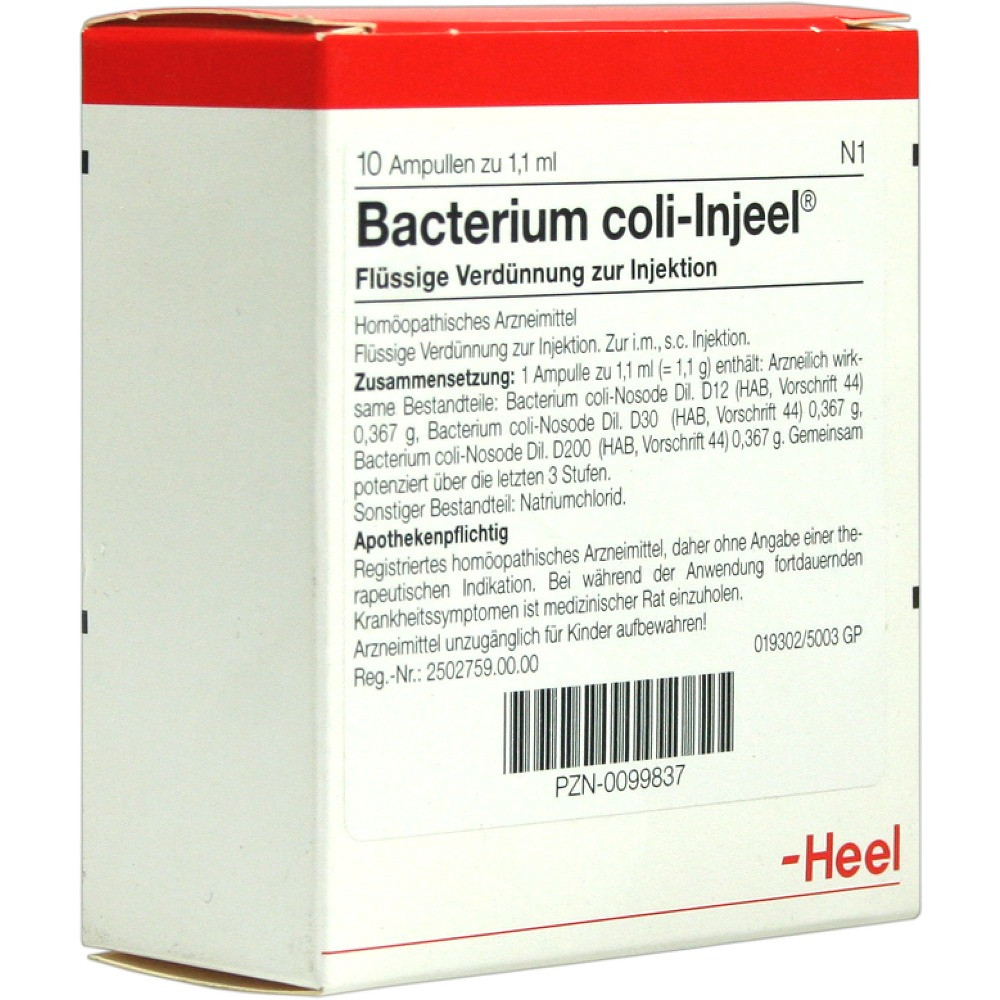
A reader forwarded me a link to “Escherichia coli-Nosode” which is available on German Apotheke (ships world wide) This is a sterilized/dead E.Coli. The manufacturer’s page is here.

(Translation by Google)

“Fatigue. Physical and mental exhaustion. Use of wrong words. Memory loss for recent events. Timidity and indecisiveness, often associated with meteorism. Shivering after the meal. Tongue white-yellowish with red line in the middle. Also with urinary problems and cloudy, nauseating urine. Aggravation by damp cold. Julian points to good effects in salpingitis, cystitis, kidney stones, cholangitis and in depressive psychoses.”

It appears to come in ampules — I assume for oral consumption and is described as homeopathic.

A 1991 article on it. There is negative press claim it is quack medicine.

It appears to have a similar history as another killed E.Coli product Colibiogen (see post) which had a few positive studies on pubmed. There appear to be many more suggesting that Colibiogen does have positive effects.

For this specific product we found:

  • “Piglets of the homeopathic treated group had significantly less E. coli diarrhoea than piglets in the placebo group (P < .0001). Especially piglets from first parity sows gave a good response to treatment with Coli 30K. The diarrhoea seemed to be less severe in the homeopathically treated litters, there was less transmission and duration appeared shorter.” [2010] – Homeopathy Journal
  • ” None of the homeopathically treated groups differed significantly with respect to any of the parameters from the non-medicated, infected control group. It is concluded that the results of this study do not justify use of these homeopathic remedies for treatment of colibacillosis in broilers. ” [2004] Research in Veterinary Science Journal

Bottom Line

No firm evidence of benefit. No evidence of risk (except to pocket book). In theory, the metabolites could have a positive effect, especially if a person cannot tolerate Symbioflor-2 or Mutaflor (live E.Coli).


Reducing Thalassospira genus

For updated information see Microbiome Prescription

DataPunk.Net Data

Nothing

PubMed Data

There are 50+ studies on PubMed. Many dealing with it in sea water.

  • Diet
    • “Berbine reduces, high fat diet reduces ” [2017]

Bottom Line

Avoid

Take

  • Berbine
  • High Fat Diet

Enhanced uBiome analysis of person from Europe

This is my second enhanced uBiome analysis. The main difference is that I no longer rely only on DataPunk.Net data but have extended that by reviewing more recent studies on PubMed etc.

Patient Background

Travel to the US in 2013 and got a difficult virus,  returned home

  • took 4 weeks to recover
  • start exercising/working as soon as I felt a little better
  • exercise/work too hard, get sick again
  • Then ME/CFS symptoms arose
    • 3 months later I’m slowly getting better
    • Then get a stomach bug with all sorts of weird symptoms
      • Can’t sleep
      • constipation with a lot of gas
      • Cortisol starts crashing
      • lots of fatigue
      • brain fog gets worse and worse
    • Tried all remedies under the moon
      • eventually try fecal transplants, and symptoms start improving
        • sleep & energy production especially
        • increased energy
        • can work and exercise again
        • but cognitive problems still very strong
        • spect scan shows bad results
          • brain doesn’t look good
          • bad blood flow in a lot of areas.

CFS Diagnosis confirmed by one of Europe’s leading CFS Researchers/MD.

Standard Items

This set of improvements agrees with the improvements he described above.

Hit List for Bacteria

Prime List

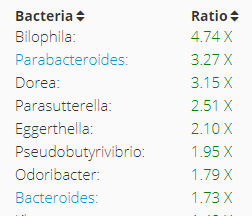
Bacteria > 1.5x all samples

hitlist1

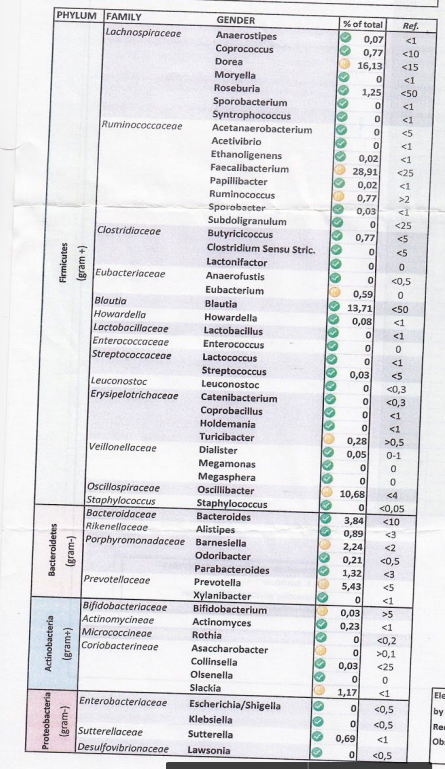
Items with {X} below were also see as abnormal on their RED Metagenomics Stool Analysis Report done earlier. {-} indicated normal. {?} indicated not tested.

So 50% of the genus reported by uBiome are NOT reported by RED test. Only 25% of those tested by both were in agreement.

The transplant etc could account for the difference (they were not done at the same time). I would put greatest emphasis on the bacteria genus in common with both of tests: Dorea https://atomic-temporary-42474220.wpcomstaging.com/2017/10/18/reducing-dorea-genus/

Avoid

Take

  • Galactooligosaccharides 
  • Vitamin D3
  • Oral Iron Supplements
  • l-glutamine – 1 gram capsules with 3 each night came from their physician
  • β-glucan
  • Flaxseed [parent]
  • Polymannuronic acid

Secondary List

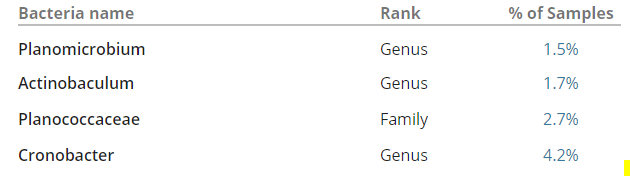
Bacteria that are found in < 5% of samples

list2

Bottom Line Theoretical Items

The lists below are done by merging the lists from the deep dives. Some items may encourage one genus and discourage another genus — those are placed in inconclusive. The impact on Lactobacillus, Bifidobacterium and E.Coli are intentionally ignored[See this post for the logic]. This is all based on applying logic to the results of studies — thus theoretical.

Inconclusive:

In general, should try to avoid (helps some, inhibits some — we do not know the balance). These could be tried in isolation to other changes to infer their impact on your own uBiome.

Avoid:

Take:

  • Lactobacillus reuteri
  • Lactobacillus kefiri
  • Lactococcus lactis
  • Bacillus licheniformis
  • Bifidobacterium bifidum
  • Possibly: B. infantis, B. adolescentis or B. breve
  • L-glutamine
  • β-glucan
  • Vitamin C
  • Black Tea
  • Tea Tree Oil
  • Oral Iron Supplements
  • Flaxseed
  • Capsaicin (chili peppers)
  • high-fat diet
  • Ketogenic diet
  • Vitamin D3
  • Metronidazole antibiotics
  • Alchohol
  • Oligosaccharide prebiotics
  • Walnut
  • Sucralose (Splenda)
  • Garlic
  • Chitosan
  • Tea
  • Cinnamon,
  • Lemongrass,
  • Oregano,
  • Clove

Personal Note

This reader brain’s scans sounds very much like what my own SPECT scan, and my daughter’s (done by Dr. Daniel Amen) saw. What helped me the most with brain fog actually came from a Russian study of pilot functioning in low oxygen: heparin and piracetam taken together. Regular heparin (low dosage) is taken sublingual (instead of injection) and held in the mouth for 2-4 minutes and then spitted out. The heparin will improve the lactobacillus (I suspect the anticoagulant action may also apply to some bacteria) according to this  [2013] study.

Other items taken for brain function was minocycline, see this post for more discussion.

This is an education post to facilitate discussing this approach with your medical professionals. It is not medical advice for the treatment of CFS or any other condition. Always consult with your medical professional before doing any  changes of diet, supplements or activity. Some items cites may interfere with prescription medicines.