Whey, Colostrum and Goat Milk

Back around 1999-2002, the use of whey, colostrum and goat milk for CFS was popular. A friend was positive for EBV and after 2 months of an EBV specific colostrum, became negative. This was a pre-antibiotic treatment: You infect a pregnant cow with infection X and once the cow calved, you collect the milk which will high in antibodies programming against infection X.  This method was far more expensive than antibiotics and did not scale well…. hence it was forgotten once antibiotics came along. Unfortunately, this EBV specific form of colostrum is no longer available.

Colostrum and milk are rich in proteins and peptides which play a crucial role in innate immunity when transferred to the offspring and may accelerate maturation of the immune system in neonates.” [2005]

A reader asked about these, so a fresh look at the literature is done below.

Human versus Cow Milk

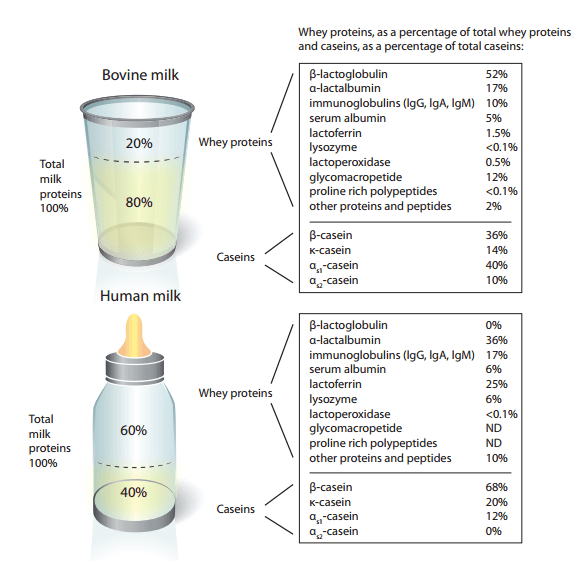
The chart below illustrate well the difference [source]. They are VERY different.
Milk

Colostrum

Colostrum (known colloquially as beestings,[1] bisnings[2] or first milk) is a form of milk produced by the mammary glands of mammals (including humans) during pregnancy. Most species will generate colostrum just prior to giving birth. Colostrum contains antibodies to protect the newborn against disease. In general, protein concentration in colostrum is substantially higher than in milk.” [Wikipedia]

It is heavily promoted in some alternative health circles [Example by a provider with citations to studies]

Whey

Whey protein is a mixture of globular proteins isolated from whey, the liquid material created as a by-product of cheese production. [Wikipedia]. As you can see from the figure above, why content varies according to source.

Back in 2000, “Non-denatured Whey” was a hot topic. “Undenatured whey protein isn’t heat-treated, so the fragile bonded cysteines that later form glutathione aren’t broken down in pasteurization.”[source] — so no pasturization (or homogenization) so the chemical structures of the whey are not damaged. At a philosophical level, this appears logical.

Other Non-Cow Milks

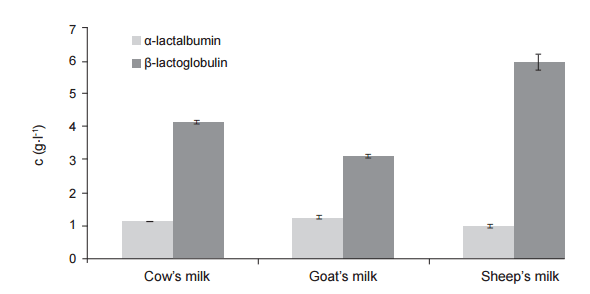
Looking at other milks, we find that Goat’s milk has less β-lactoglobulin (closer to human milk in a weak sense).
othermilk

“Because an increase in the plasma Trp-LNAA ratio is considered to be an indirect indication of increased brain serotonin function, the results suggest that dietary protein rich in alpha-lactalbumin improves cognitive performance in stress-vulnerable subjects via increased brain tryptophan and serotonin activities.” [2002]

” The main components of whey proteins in camel milk and colostrum were similar to that in bovine, except for the lack in β-lactoglobulin.” [2007]

Bottom Line

There are no PubMed studies on whey and CFS/FM/IBS. There was one study for FM and one for IBS, one for CFS (by a questionable author – conflict of interests)

  • “The objective of this clinical pilot study was to examine the induction of apoptosis in mononuclear cells on treatment of patients with chronic pain syndrome with oral immunoglobulin produced from bovine colostrum (BCC)….These results were accompanied by a relief of the pain symptoms [in 3 out of 4 patients]” [2009]
  • “After 4 weeks (i.e. immediately after treatment), the endotoxin levels of [IBS] patients in the colostrum group showed a decrease in 44.4% (4/9) patients, no interval change in 11.1% (1/9) patients, and an increase in 44.4% (4/9) patients.” [2014] – helps some, makes other worst!
  • Inconclusive (but positive) study for Gastrointestinal Infections[2008]

I would recommend trying them, especially the high alpha-lactalbumin whey Isolate because of it’s impact on cognitive function and also improvement of sleep.  Please be aware that results are mixed — it’s a for better or for worst supplement.

I wish the infection specific colostrum were still available, and would love to see one specific for staphylococcus aureus [post].


“”

 

Hyperacusis, Phonophobia and DNA SNPs

I have done summary of different DNA variations associated with CFS/IBS/FM before:

My model has DNA + microbiome shifts –> Symptoms. The DNA reduces tolerances for swings of metabolites produced the microbiome and with a dysfunctional microbiome, some people are pushed over a threshold and develop symptoms. Fixing the microbiome is possible today, fixing DNA is likely a few decades off.

I happened to stumble across some PubMed studies involving hyperacusis, phonophobia and DNA Snps. This post looks at what I found for other conditions with hyperacusis or phonophobia.

Phonophobia (light sensitivity)

  • “Dopamin Beta Hydroxylase gene +1603C>T polymorphism” [2016]

Hyperacusis (noise sensitivity)

The recognized associated conditions [2003] are

Peripheral Central
Bell’s palsy Migraine
Ramsay-Hunt syndrome Depression
Stapedectomy Post-traumatic stress disorder
Perilymph fistula Head injury
Lyme disease
Williams syndrome
  • ” The most informative marker (69%) was D7S1870, followed by Hei (55%) and ELN 17/exon 18 (44%). The microdeletion was present in 56% and absent in 22% of patients….Two of the syndrome characteristics (an overfriendly personality and hyperacusis) were more frequent in the microdeletion group and these differences were statistically significant (p = 0.006 and p = 0.02, respectively).” [2010]
  • ” OCRL gene deletion revealed involvement of several flanking repeat elements… hyperosmia and/or hyperacusis were reported recurrently.” [2015]
  • “hemizygosity for a chromosomal deletion at 7q11.23…  hyperacusis [1999]


A new uBiome Result

A reader asked me to look at the results they just got back. I was pleasantly surprise to see some significant improvements in their report

Lactobacillus and Bifidobacterium is now reported

bif

This is a classic CFS profile!

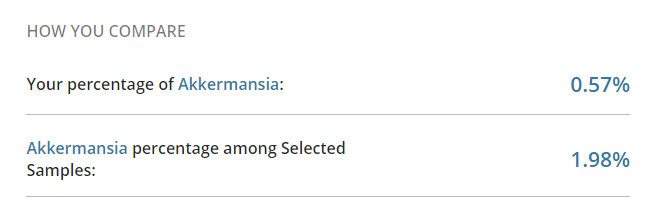
Akkermansia is cleanly reported

akk

Again, a classic CFS result. See this post on Increasing Akkermansia I did earlier.

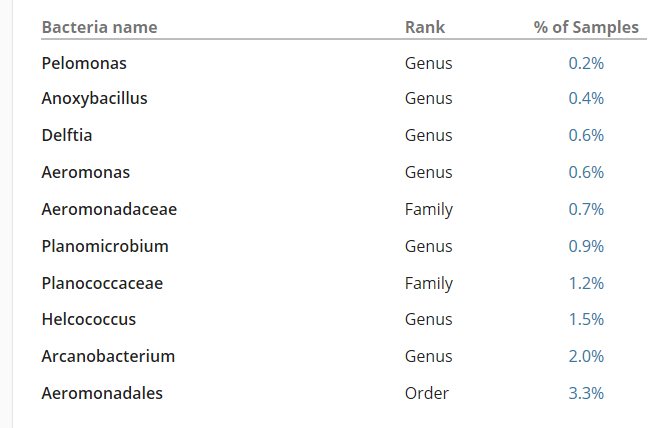
Rare Bacteria are listed simply

rare

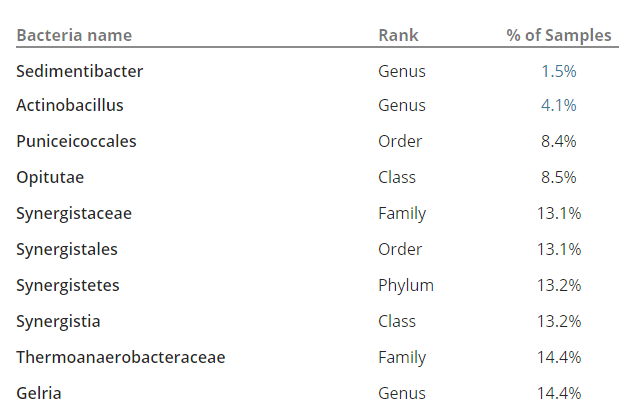
Checking a few other uBiome results that I could access, we did find a strong pattern for three. And an over representation (25% of the CFS samples versus 13% of general samples)

  • Thermonaerobacterales 2/8
  • Gelria:  2/8
  • Synergistaceae: 2/7
  • Low Akkermansia 6/8
  • Low Lactobacillus 8/8
  • Low Bifidobaceria 7/8

One reader was very rich in rare results:

veryRare

Bottom Line

Three groups appear to be very common as low to non-existent

  • Akkermansia  75%
  • Lactobacillus 100%
  • Bifidobaceria 87%

There is work going on in getting an Akkemansia probiotic approved for sale. Remember to avoid most lactobacillus because it will push out bifidobacteria… instead, focus on only bifidobacteria probiotics.

Metabolism Reports

Another new set of reports have been added, as shown below. This is done using data derived from the KEGG Pathway Database,

Mata

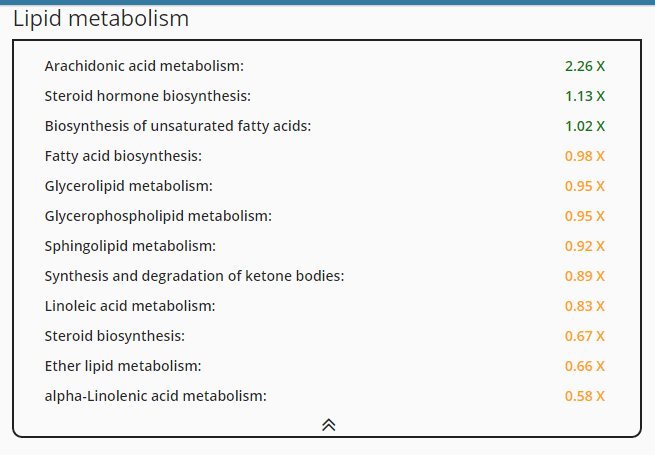
Each of these can expand, for example:

lipid

We see two items of interest, ALA (alpha-linolenic acid metabolism) is low and Arachidonic acid metabolism is high. See ALA article and Arachidonic acid metabolism: role in inflammation (1991)

  • So, taking ALA supplements would be strongly suggested

Spot checking other ubiome results, I saw one reader had

  • D-arginine and D-ornithine metabolism being a very low 0.09x
  • Flavonoid biosynthesis a low 0.27x

Again, this hits at specific supplements in lieu of gut bacteria doing their jobs.

Bottom Line 2

The ubiome results give much more friendly data and at a low cost. If you are unsure that you have CFS/IBS/FM, then comparing your results to the above may answer the question. Of greater interest is the additional tables of what part of the KEGG pathway may suggest supplementation.


Genetic Thick Blood Tests for ME/CFS and Long COVID

Back in 1999, Dave Berg (Hemex Labs) publised “Chronic Fatigue Syndrome (CFS) &/or Fibromyalgia (FM) as a Variation of Antiphospholipid Antibody Syndrome (APS): An Explanatory Model and Approach to Laboratory Diagnosis. and stated “We have found that 3 out of 4 CFS &/or FM patients have a genetic deficiency”. A reader wrote yesterday:
  • “I have APS.  Positive on Lupus Anticoagulant. …and now some clogged veins (ischemia disease) and perivascular tunnels. Having POTS also doesn’t help…Latest to tack on is Sojogrins to all the others… Dad had three strokes”
Hemex has been sold, Berg has retired, and their specialize suite of coagulation for CFS is no longer available 😦 . The reader asked for what tests to get to detect these defects. I had testing from Hemex, and had a known defect — fortunately one that was easy to compensate for with Piracetam and Tumeric(with pepper). In fact, 4 out of 4 that went for testing were positive, with some 5 different defects (one had three of them!).

A Lab that appears to offer a reasonable set of tests

A reader asked me about this lab, and reviewing what they are doing, it’s a reasonable panel. I would suggest doing BOTH tests There are likely other labs that offer similar.

Allergy of what may be occurring

Your body is like a family. Job and expenses are balanced, in fact, the family may be able to do some savings. A sickness comes along and the body/family deals with loss of income for a few weeks and higher medical expenses. The savings are gone and the family borrows. The family gets over the sickness and get back to work. Unfortunately, the family debt keeps growing and growing. Similarly, the body’s coagulation system is working as it was before. The sickness triggers coagulation (expenses) and the available income is not enough to clear it. The sickness is gone, but the side effect persists. Some families may be able to get rid of the debt over time (spontaneous remission), others gets deeper into debt, going down here.
These are the tests that should be done for hypercoagulation (thick blood) and how often they are found in the general population.

Update

A 2001 description of various defects is in this JAMA article from 2001. The reported rate in the literature is 75% or more [1999]. The problem in getting these tests is showing evidence that they are warranted. The usual symptoms required are ” Symptoms include blood clots in the veins or arteries in the leg, arm, kidney, liver, lung, brain, heart or other organs, recurrent miscarriages and low platelet counts” [src]. Brain fog is not normally regarded as a sufficient symptom.  Dave Berg was doing testing due to recurrent miscarriages (his specialty), when he aggregate treating physician reports on CFS and FM patients going into remission from treating low grade coagulation that was causing the miscarriages. Some of the patients with low grade coagulation causing miscarriages included Olympic Athletes. If you mother had repeated miscarriages (my own had 5 miscarriages and varicose veins [Blood coagulation in varicose complexes].), then the odds increases significantly that you have an inherited coagulation defect. The rate for the general population is estimated to be 5%[src]  compared to 75%+ for CFS/FM)

Coagulation Panels

The hypercoagulatbility Panel from Machaon Diagnostics appears close to what Hemex tested. Tests included :
Anticardiolipin Antibody (IgG, IgM, IgA)
Antithrombin III Activity
aPTT-LA (Lupus Sensitive Reagent)
Factor V (5) Leiden Gene Mutation
Factor VIII (8) Activity
Homocysteine
Protein C Activity
Protein S Activity
Prothrombin Gene Mutation
Russell Viper Venom Time (dilute)
The following are some of the hypercoagulation states listed in ICD 9
  • Activated Protein C resistance
  • Anticardiolipin syndrome
  • Antiphospholipid syndrome
  • Antithrombin 3 deficiency
  • Antithrombin III deficiency
  • Factor 5 Leiden mutation
  • Factor 5 Leiden mutation, heterozygous
  • Factor 5 Leiden mutation, homozygous
  • Factor V Leiden mutation
  • Factor V Leiden mutation, heterozygous
  • Factor V Leiden mutation, homozygous
  • Hereditary antithrombin III deficiency
  • Hereditary heparin cofactor II deficiency
  • Hereditary protein C deficiency
  • Hereditary protein S deficiency
  • Hereditary thrombophilia
  • Heterozygous Factor V Leiden mutation
  • Heterozygous protein C deficiency
  • Heterozygous protein S deficiency
  • Heterozygous prothrombin G20210A mutation
  • Homozygous Factor V Leiden mutation
  • Homozygous protein C deficiency
  • Homozygous protein S deficiency
  • Homozygous prothrombin G20210A mutation
  • Hypercoagulability state
  • Hypercoagulable state
  • Hypercoagulable state (tendency to form clots)
  • Hypercoagulable state, primary
  • Lupus anticoagulant
  • Lupus anticoagulant disorder
  • Postpartum antiphospholipid syndrome
  • Protein C deficiency disease
  • Protein C deficiency disorder
  • Protein C resistance
  • Protein S deficiency disease
  • Protein S deficiency disorder
  • Prothrombin G20210A mutation
  • Prothrombin gene mutation
  • Resistance to activated protein C due to Factor V Leiden
  • Thrombophilia due to acquired antithrombin III deficiency
  • Thrombophilia due to acquired protein C deficiency
  • Thrombophilia due to acquired protein S deficiency
  • Thrombophilia due to antiphospholipid antibody

 Bottom Line

There have been no followup study done on CFS/FM patients to see how their incidence of the above conditions compare to the general population. In theory, the incidence would be much higher with likely 80% having at least one of the above.

There is usually difficulty getting testing for the above until after a blood clot happens. A CFS/FM patient with apparent blood circulation issues (i.e. face and skin being ‘grey’, brain fog) would likely benefit from such testing.


Inherited dimensions for CFS/FM/IBS

A reader forward me a link to “Find the cause of fibromyalgia” article (Spanish) which states:

  • “Thanks to a study carried out with 3,000 people – of which two thirds of them were affected by fibromyalgia and chronic fatigue – it has been possible to determine that there are 90 polymorphisms in the DNA of the patients that affect the nervous and nervous system.” I have a few of them listed in this 2016 post.

The problem with DNA causing FM/IBS/FM etc, it the tendency towards resignation (“It’s in my DNA — how can we fix it!!!”).  This is very wrong, a very important concept to remember is epigenetics – “In simplified terms, epigenetics is the study of biological mechanisms that will switch genes on and off.”[A Super Brief and Basic Explanation of Epigenetics for Total Beginners]. The key factors of turning genes on and off are items like stress and diet (including availability of minerals, amino acid etc – often a by product of the microbiome).

Microbiome is also inherited in two ways

“microbes (and their genetic material, collectively known as the microbiome) within the body can influence all kinds of traits as disparate as digestion and behavior, and can be passed down to offspring, he says. Just like a person’s own DNA.” [Newsweek]

“A genome-wide association analysis of over 1,000 twins in the UK supports that some parts of our microbiomes are inherited and shaped–not through a spread of microbes from parent to child, but through our genes. The results, revealing new examples of heritable bacterial species–including those related to diet preference, metabolism, and immune defense — appear May 11 in Cell Host & Microbe‘s special issue on the “Genetics and Epigenetics of Host-Microbe Interactions….The investigators used the genome-wide association approach to look for connections between genetic variations between twin pairs and certain bacterial types that were present and stable in the study subjects.” [Science Daily]  So DNA impacts the microbiome … but the microbiome is much more changeable than DNA!

Model

  • “Events” trigger DNA to turn some FM/IBS/CFS genes ON (epigenetics)
    • Same event to someone else with different DNA has no problems.
  • The change of genes may also result in alteration of the microbiome

Model prediction

  • Create an epigenetic event by altering microbiome, supplements.
  • Epigenetic events shuts down the genes.
    • Remission (NOT cure).

Bottom Line

There is no defined universal protocol possible for CFS/FM etc. We have at least 80 SNPs for FM, likely a similar number for IBS, CFS etc. Each person has some combination (not all of them), which supported the epigenetic change/microbiome change. The microbiome changes are likely even more complex.

There are commonality that most patients have in common. You may be high in one bacterial genus and the CFS person next to you may be low in the same genus.  What is common are low lactobacillus, low bifidobacterium, low in typical E.Coli (possibly high in atypical E.Coli), low in typical Enterococcus (possibly high in atypical Enterococcus).

With this complex situation, we have very little research, extremely few tools,  and the tools tend to be crude. In one way we have a big box of nuts and bolts in front of us and a bunch of metal connectors with different size holes in them. Some nuts and bolts are metric and some are SAE. This does not mean we are helpless — it means we need to be patient to find the right nut to match with the right bolt and then find the right metal connector where it is a tight fit. There is no handy IKEA assembly manual with all of the parts nicely bagged.

The stuff goes together if we approach it in an organized manner. Take one nut at a time, try different bolts until you have some possible matches. If frustrated, go on to the next nut (or bolt).

What are these nuts, bolts and connectors — herbs, spices, supplements, probiotics and antibiotics. Not all will be needed by everyone. Trying too hard to fit a nut to a bolt may end up jamming it.