Decreasing Bacteroides Xylanisolvens

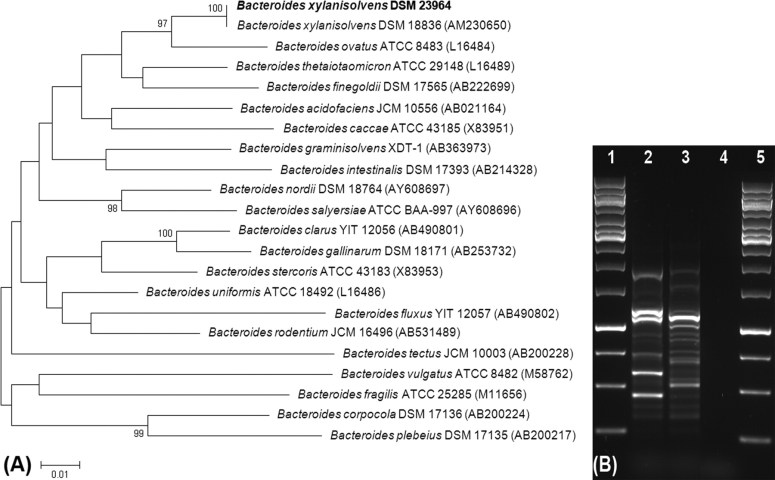
In Ian Lipkin et al 2017 study, high Bacteroides Xylanisolvens was reported (on average). [Index to all posts on Study] . “ The human intestine is the only location that Bacteroides xylanivsolvens has been isolated….one of the species involved in breaking down xylan in the human gut, …  and ”Bacteroides fragilis” subspecies A.”[microbewiki]
f1-large

  • Being considered as a probiotic [2011] – not for CFS/FM/IBS please!
  • ” The investigation of the antibiotic susceptibility indicated that strain DSM 23964 was sensitive to metronidazole, meropenem agents, and clindamycin. Resistance to penicillin and ampicillin was identified to be conferred by the β-lactamase cepA gene… Some of them, like B. xylanisolvens, that are not classified as opportunistic pathogens can be expected to contain strains with a favorable safety profile…his strain may possess immune-modulatory properties and is able to produce short fatty acid chains (propionate, succinate) with potential health-beneficial effects. ” [2011]
  • ” utilised the xylan in different ways, and differently from their use of wheat arabinoxylan.” [2017]
  • “while soy, pulse and nut intake was positively associated with the relative abundance of bacteria related to Bacteroides xylanisolvens.” [2016]
  • ” the metabolic plasticity of B. xylanisolvens towards dietary fibres that contributes to its competitive fitness within the human gut ecosystem” [2016]
  • “The bacteria having a pronounced ability to degrade Alginate, mannuronic acid oligosaccharides and guluronic acid oligosaccharides were isolated from human fecal samples and were identified as Bacteroides ovatus, Bacteroides xylanisolvens, and Bacteroides thetaiotaomicron” [2016]
  • ” In gout, Bacteroides caccae and Bacteroides xylanisolvens are enriched yet Faecalibacterium prausnitzii and Bifidobacterium pseudocatenulatum depleted.” [2016] – This is almost the same pattern as reported by Lipkin (3/4 having the same shift). Gout is  too much uric acid in the blood
    • “Ethanol increases production of uric acid by increasing production of lactic acid, hence lactic acidosis.” [wikipedia]
  • “B. xylanisolvens GH99 reveal the structural basis for binding to D-mannose – rather than D-glucose-configured substrates.”[2015]
  • xylanisolvens XB1A cultured with glucose, xylose or xylans,” [2010]
  • ” bacteria grew well on all the substrates chosen to represent dietary fibres: wheat and corn bran, pea, cabbage and leek fibres, and also on purified xylans.” [2010]
  • “. Xylan and sugars were converted by strain XB1AT mainly into acetate, propionate and succinate.” [2008]


Consumes: xylan, unable to utilize starch or to produce indole

Produces: acetate, propionate, succinate

Bottom Line

Reduce food containing xylan or reduce xylan producing bacteria. Soy. nuts and pulse should be reduced or eliminated.
Decreasing Ruminococcus Lactaris

In Ian Lipkin et al 2017 study, high Ruminococcus Lactaris was reported (on average). [Index to all posts on Study] . 

  • “a widespread mechanism of bacterial competition. CDI(+) bacteria deliver the toxic C-terminal region of contact-dependent inhibition A proteins (CdiA-CT) into neighboring target bacteria and produce CDI immunity proteins (CdiI) to protect against self-inhibition…the Ntox28 domain from Ruminococcus lactaris is significantly more thermostable” [2016]
  • “produces acetate, ethanol, succinate, lactate and formate, but very little butyrate, as end products of glucose metabolism.” Isolation and whole genome sequencing of a Ruminococcus-like bacterium, associated with irritable bowel syndrome.[2016]
  • “Enterolactone production was linked to the abundance of two molecular species identified as Ruminococcus bromii and Ruminococcus lactaris…Flaxseeds increase enterolignan production” [2015]

Bottom Line

Avoid

Flaxseed


Decreasing Prevotella Buccalis

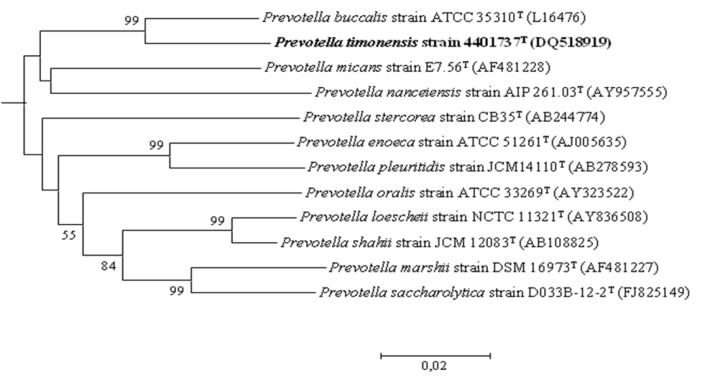
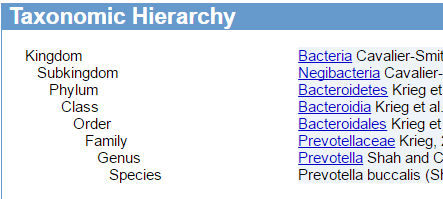
In Ian Lipkin et al 2017 study, high Prevotella Buccalis was reported (on average). [Index to all posts on Study] . Originally identified in 1982. It appears to be associated with periodontitis and the mouth.

tax

sigs-5098948-f1

  • “In a study of gut bacteria of children in Burkina Faso (in Africa), Prevotella made up 53% of the gut bacteria, but were absent in age-matched European children.”[2010]
  • “All Prevotella strains tested were susceptible to imipenem and amoxicillin/clavulanate, whereas 78.6% of the pigmented Prevotella species and 46.4% of the non-pigmented species were resistant to penicillin (MIC >0.5 μg/ml).” [2015]
  • ” lactamase production was observed for 1 Prevotella buccalis strain.” [2014]
  • “The beta-lactamase positive species Prevotella loescheii, Prevotella buccae, Prevotella buccalis and Actinomyces spp were recovered from the selective amoxicillin plates.” [1997]
  • “Cefpodoxime was found to be active at concentrations of less than or equal to 0.125 mg/l against Prevotella oralis, Prevotella buccalis” [1991]

Betalactamases (β-lactamases) are enzymes (EC 3.5.2.6) produced by bacteria (also known as penicillinase) that provide multi-resistance to β-lactam antibiotics such as penicillins, cephamycins, and carbapenems (ertapenem),” [wikipedia]

Decreasing Anaerostipes Caccae and Eubacterium Hallii

In Ian Lipkin et al 2017 study, high Anaerostipes Caccae and Eubacterium Hallii was reported (on average). [Index to all posts on Study] in CFS patients WITH IBS. ” butyrate-producing and acetate and lactate-utilising bacterium” [Wikipedia]. PubMed has some 18 citations on A.Caccae. It was discovered in 2002.  E. Halli occurs very often in those same articles — so I am doing two strains in one post.

  • “Whereas E. hallii and A. caccae strains used both D- and L-lactate, the remaining strains used only the d form.” [2004] –NOTE: E. hallii was also reported high with IBS in Lipkin’s study. These species being high may be because they are well fed due to D-Lactic Acidosis.
  • “The potential for metabolic cross-feeding between Bifidobacterium adolescentis and lactate-utilizing, butyrate-producing Firmicute bacteria related to Eubacterium hallii and Anaerostipes caccae was investigated in vitro. E. hallii L2-7 and A. caccae L1-92 failed to grow on starch in pure culture, but in coculture with B. adolescentis L2-32 butyrate was formed, indicating cross-feeding of metabolites to the lactate utilizers. Studies with [(13)C]lactate confirmed carbon flow from lactate, via acetyl coenzyme A, to butyrate both in pure cultures of E. hallii and in cocultures with B. adolescentis. Similar results were obtained in cocultures involving B. adolescentis DSM 20083 with fructo-oligosaccharides as the substrate.” [2006]
  • ” The patient was initially treated with vancomycin and piperacillin-tazobactam on admission and with amoxicillin-clavulanate upon discharge. The slow-growing organism was subsequently found to be susceptible to metronidazole and ertapenem.” [2016]
  • Anaerostipes caccae DSM 14662T on oligofructose, the latter strain converted lactate (produced by the former strain[Lactobacillus acidophilus] from oligofructose) into butyrate and gases, but only in the presence of acetate.” [2017]
  • ” only A. hadrus and A. caccae demonstrated augmented butyrate production from L-sorbose or xylitol. These findings suggest that L-sorbose and xylitol cause prebiotic stimulation of the growth and metabolic activity of Anaerostipes spp. in the human colon.” [2017]

Bottom Line

Update on how to reduce the genus

However, eliminating   L-sorbose and xylitol from the diet seems warranted.

Increasing Coprococcus Catus

In Ian Lipkin et al 2017 study, low Coprococcus Catus was reported (on average). [Index to all posts on Study] comparing all CFS patients against normal controls. As with many families, it is little studied in the past with just 5 PubMed citations despite being discovered in 1974.

  • “the capacity to produce propionate or butyrate from hexose sugars resided in different species (C. Caus) [1974]
  • Coprococcus catus, and Streptococcus mitis that were strongly ureolytic on isolation later lost this ability.” [1974] – produces urease.
  • “On teat skin… but not in milk”[2012]
  • “uses lactate …known to be able to switch from butyrate ( butyryl-CoA:acetate CoA-transferase route when grown on fructose) to propionate(acrylate pathway) production on different substrates.” [2014]
    Slide 1
  • “Next-generation sequencing revealed that obese and non-obese subjects had different gut microbiota compositions and that certain bacterial species were significantly associated with each group… C.Catus ..significantly associated with the obese group: ” [2015]
  • “with Preeclampsia ….a reduction in probiotic bacteria Coprococcus catus” [2017]

The chart below shows its relationship to similar bacteria.

Bottom Line

To grow more, we need to feed more — and acetate producing bacteria (upstream) are likely desired.

  • E.Coli is an acetate producer [1990] and also reported low in CFS
  • Bifidobacterium longum subspecies: longum JCM 1217T (BL), infantis 157F (BF), or longum NCC 2705 (BN). are acetate producers [2012] Other bifidobacterium are not.

What is the general impact of acetate?

  • Reaches the portal vein and is metabolized in various tissues
    Intestinal effects
  • Is a minor energy source for the colon epithelial cells
  • Decreases the pH of the colon (which decreases bile salt solubility, increases mineral absorption, decreases ammonia absorption, and inhibits growth of pathogens)
  • Has anti-inflammatory effects
  • Increases colonic blood flow and oxygen uptake
  • Is used by cross-feeding species as a co-substrate to produce butyrate
    Other effects
  • Is a substrate for cholesterol and fatty acid biosynthesis in the liver
    Is an energy source for muscle and brain tissue

Oh boy! low acetate levels appears to be happening in CFS… and hence the low level of the bacteria consuming it.  Two major families producing acetate (E.Coli, Bifido) are also known low, hence this appears to be a downstream cascade.

THIS IS NOT MEDICAL ADVICE — this post is an education summary of what has been reported on PubMed. Always consult with a knowledgeable medical professional before changing diet, supplements and prescription drugs.