Decreasing Clostridium Methylpentosum

In Ian Lipkin et al 2017 study, high clostridium methylpentosum was reported (on average). [Index to all posts on Study] . This bacteria was first identified on 1989.

  • “An intestinal bacterium isolated from a human subject utilized only two methylpentoses (L-rhamnose and L-fucose) and two pentoses (L-lyxose and D-arabinose) as fermentable substrates, among many compounds tested..This organism may participate in intestinal digestive processes by metabolizing rhamnose released via the enzymatic depolymerization of dietary pectin.” [1989]

Bottom Line

We do not know if any antibiotics are effective. The only option is starvation by reducing intake of two methylpentoses (L-rhamnose and L-fucose).

Increasing Bacteroides Caccae

In Ian Lipkin et al 2017 study,  low bacteroides caccae was reported (on average). [Index to all posts on Study].

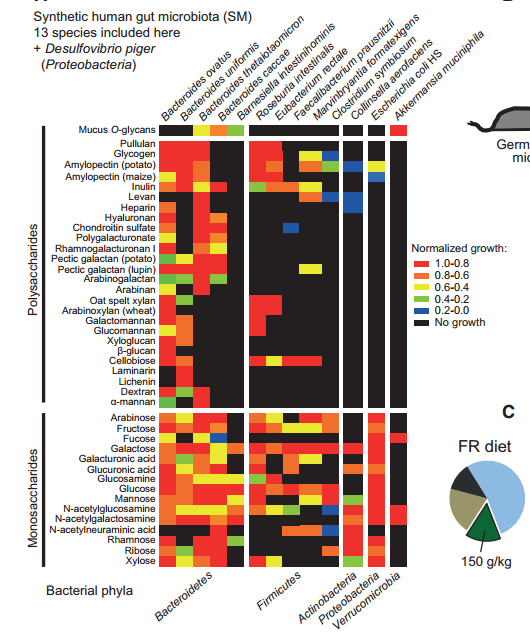
I almost gave up on finding more information until I found the diagram below (which also contains Faecalibacterium prausnitzii which is also low!)

From A Dietary Fiber-Deprived Gut Microbiota Degrades the Colonic Mucus Barrier and Enhances Pathogen Susceptibility (2016)

bc

The best growth medium are:

  • Xylose Amazon
  • Ribose (shown to help CFS in studies) Amazon
  • Rhamnose – very expensive
  • N-actylneuraminic acid
  • Glucuronic acid
  • Arabinose Amazon
  • Inulin
  • Mannose  –  Amazon
  • Glucose (which also is liked by two other low bacteria)
  • Chondroitin sulfate
  • Pectic galactan (potatoand lupin)

Bottom Line

It looks like Inulin and Ribose are again on our list, and many of the above are also available on Amazon etc.

Decreasing Anaerotruncus Colihominis

In Ian Lipkin et al 2017 study, high Anaerotruncus colihominis was reported (on average). [Index to all posts on Study] . “The species is found only relatively infrequently in the human gut. The presence of Anaerotruncus colihominis does not appear to be associated with any particular health disorder.” [uBiome]. It was identified in 2004.

cp31773-f2

  • “It produces Indole and utilises glucose and mannose…It produced indole and β‐gluocosidase, and used glucose and mannose but not arabinose, cellobiose, glycerol, lactose, maltose, mannitol, melezitose, raffinose, rhamnose, salicin, sorbitol, sucrose, trehalose or xylose.” [2006]
  • “Cells are sensitive to vancomycin (5 µg) and kanamycin (1000 µg), but resistant to colistin sulphate (10 µg)”[2006]
  • The major fermentation products from glucose include acetate, ethanol, hydrogen, and carbon dioxide; lactic acid, propionate, and succinate are not produced.” [2015]

Bottom Line

Antibiotics or trying to starve them (without starving other low bacteria).

Decreasing Bacteroides Vulgatus

In Ian Lipkin et al 2017 study, high bacteroides vulgatus was reported (on average). [Index to all posts on Study

  • refined wheat breads .. the abundance of bacteria related to Bacteroides vulgatus, decreased..” [2013].
  • PolydextroseBACTEROIDES: species (B. fragilis, B. vulgatus, and B. intermedius) decreased” [2000]
  • “Rats on the all-rice diet had significantly lower faecal concentrations of the main menaquinone-producing bacterial species (Bacteroides fragilis and Bacteroides vulgatus) than animals on either of the other two diets ( a rice + beans diet or a stock diet)” [1990]
  • The suppressive effect of bifidobacteria on Bacteroides vulgatus, a putative pathogenic microbe in inflammatory bowel disease[2003].
    • Bifidobacterium infantis 1222 highly inhibited the growth of B. vulgatus in the coculture”
    • bifidobacteria-fermented milk…showed a significant reduction in the relative proportion of B. vulgatus” [2003]
  • L. reuteri strain…Bacteroides vulgatus were decreased,” [2014]
  • “Lactobacillus rhamnosus GG or Lactobacillus plantarum 299v ..did not prevent colitis in B vulgatus” [2003] — technically no effect
  • “pulverized petal of Rosa rugosa… the growth of Bacteroides vulgatus, Escherichia coli, Staphylococcus aureus, and Bacillus cereus was completely inhibited” [2008]

Bottom Line

Above we see a lot of items to avoid. In terms of items to take, we have just a few

  • L. Reuteri probiotics
  • Bifidobacteria probiotics
  • Reduce consumption of beans

THIS IS NOT MEDICAL ADVICE — this post is an education summary of what has been reported on PubMed. Always consult with a knowledgeable medical professional before changing diet, supplements and prescription drugs.

Increasing Sutterella Wadsworthensis

Another low bacteria is sutterella wadsworthensis reported by Ian Lapkin et al 2017 paper [Index to all posts on Study]. Identified in 1996.

  • (Lactobacillus acidophilus NT and Bifidobacterium longum NT) and type strains (L. acidophilus JCM1132(T) and B. longum JCM1217(T) ) …inhibit the growth of Sutterella wadsworthensis.” [2015]
  • Doripenem, a synthetic 1-beta-methyl carbapenem, has a broad-spectrum of activity against almost all species of anaerobic bacteria, including all Bacteroides fragilis group species,..(with the exception of Sutterella wadsworthensis). [2009]
  • “No metronidazole resistance was seen in gram-negative anaerobes other than S. wadsworthensis (18% resistant);” [2002] [1999]
  • ” Over 95% of S. wadsworthensis are susceptible to amoxicillin“[2004]

This is a patent for using S. wadsworthensis to treat Rheumatoid arthritis as a probiotic. [Patent filed 2014]

Bottom Line

We may have a probiotic available (at least in China) that may increase this bacteria in the near future.