Increasing Akkermansia

LOW Akkermansia is associated with a variety of conditions according to the Smart Gut test, including Crohn’s Disease and Obesity.

A reader asked explicitly how to increase akkermansia bacteria in the body, is there a probiotic available? Low levels of akkermansia is associated with obesity.

  • Melatonin: “… melatonin supplementation reversed 14 operational taxonomic units OTUs [of 69]…in particular through its ability to decrease the Firmicutes-to-Bacteroidetes ratio and increase the abundance of mucin-degrading bacteria Akkermansia, which is associated with healthy mucosa.” [2017]
  • Capsaicin (CAP) – found in cayenne peppers! “reduces body weight…showed a higher abundance of Akkermansia muciniphila, a mucin-degrading bacterium with beneficial effects on host metabolism.” [2017]
  • Lingonberries [IKEA stocks often] “The relative abundance of Akkermansia and Faecalibacterium, genera associated with healthy gut mucosa and anti-inflammation, was found to increase in response to lingonberry intake.” [2016]
  • Increased gut microbiota diversity and abundance of Faecalibacterium prausnitzii and Akkermansia after fasting: a pilot study.“Akkermanisa and Bifidobacteria increased in abundance due to intervention. The inflammation-associated gut microbes Enterobacteria and Lactobacilli increased during the first week and then declined by the end of the intervention.” [Human study — full text]
  • Table Grapes: Table grape consumption reduces adiposity and markers of hepatic lipogenesis and alters gut microbiota in butter fat-fed mice [2016]. ” tended to increase the abundance of the beneficial bacterium Akkermansia muciniphila compared to controls”
  • “First day: breakfast: Pernegg muesli (prunes, dates, raisins, flaxseed, water); lunch: potatoes and vegetables; dinner: vegetable soup.
    Second day: breakfast: herbal tea, Glauber’s salt, lunch: fresh squeezed fruit and vegetable juice, dinner: fasting soup.
    All other fasting days: breakfast: herbal tea, lunch: fresh squeezed fruit and vegetable juice, dinner: fasting soup.”

  • A probiotic for use with lab animals is cited [2017] [2016]
  • “We observed a low abundance of the mucin-degrading bacterium Akkermansia muciniphila in the mice that were fed Enterococcus faecium  NCIMB 10415 for 8 weeks.” [2012] — So Enterococcus faecium  probiotics (like symbioflor-1) should not be taken concurrent with above approaches to increase Akkermansia. 😦
  • [in terms of infants] ” In Finland probiotics were given to mothers (n = 79) for 2 months prior to and 2 months after delivery. In Germany probiotics were started in infants (n = 81) at weaning, at the latest at 1 month of age, and continued for 4 months …n breast-fed infants a trend toward higher counts of bifidobacteria was detected in Finland (p = 0.097) as against Germany, where a more diverse microbiota was reflected in higher Akkermansia (p = 0.003),”[2012] Again, an interaction between probiotics(bifidobacteria) and Akkermansia
  • ” High Fat feeding significantly reduced (P < 0.05) 1 operational taxonomic unit (OTU) of the genus Bifidobacteria (64-fold) and 5 OTUs of the genus Akkermansia (≥16-fold).”  [2016] Reduce the amount of fat in your diet!
  • “pH 5.5–8.0, with optimum growth at 37 C and pH 6.5″ [2004] – thus an alkaline environment would inhibit it some what.

Bottom Line

A shift reduce fat content and increase fiber content, especially fiber from fruits which in  polyphenol, appears to be an effective pattern. Table grapes and lingonberries are known to benefit. Increased tea consumption (increased polyphenols) and trying a fasting diet or Ma-Pi 2 diet are additional approaches.

I suspect that an Akkermansia probiotic could first appear in the US — given the current push for deregulation —  as long as there are no claims of actual benefits from it on the label…
 

Methylation revisited

A reader asked me about my hypothesize about methylation and antibiotics. I will respond to the first item in this post. The hypothesis is that DNA impacts methylation and is thus connected to some symptoms.

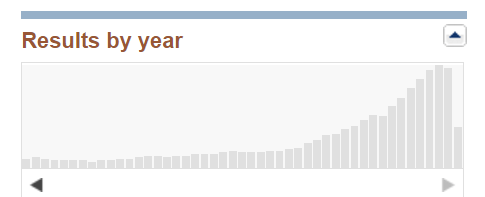
I have done one post on methylation in the past, Methylation, CFS and the microbiome [2016].  Methylation was a hot research topic reaching a peak in 2015 when interest started to drop according to PubMedmeth

Irritable Bowel Syndrome

Fibromyalgia

  • ” Epigenome-wide analysis of DNA methylation was conducted…three CPGs reached significant p-values in the replication sample, including malate dehydrogenase 2 (MDH2; p-value 0.017), tetranectin (CLEC3B; p-value 0.039), and heat shock protein beta-6 (HSPB6; p-value 0.016)…we found evidence for the involvement of epigenetic factors. ” [2016]
  • “The majority of differentially methylated (DM) sites (91%) were attributable to increased values in the women with FM. The DM sites included significant biological clusters involved in neuron differentiation/nervous system development, skeletal/organ system development, and chromatin compaction. Genes associated with DM sites whose function has particular relevance to FM included BDNF, NAT15, HDAC4, PRKCA, RTN1, and PRKG1.” [2013]

Chronic Fatigue Syndrome

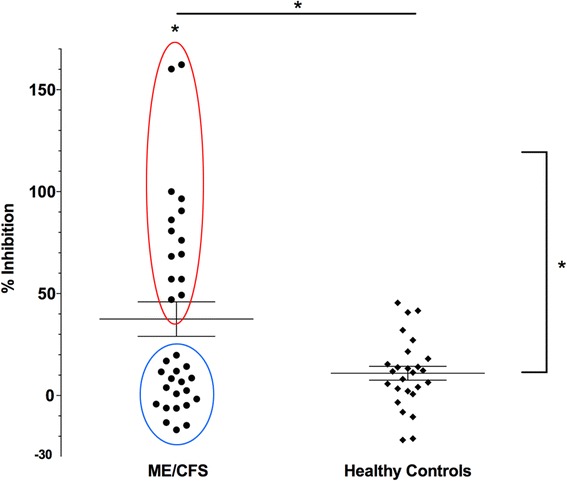
  • Epigenetic modifications and glucocorticoid sensitivity in Myalgic Encephalomyelitis/Chronic Fatigue Syndrome (ME/CFS) [2017].
    12920_2017_248_fig1_html
    ” we report DNA methylation differences in PBMCs of ME/CFS patients, some of which were significantly associated with overall quality of life as well as glucocorticoid hypersensitivity in a subgroup of ME/CFS patients. … we found that genes such as GSTM1, MYO3B, GSTM5, and ATP6V0E2 showed significant epigenetic modifications in ME/CFS. “
  • Epigenome-wide DNA methylation patterns associated with fatigue in primary Sjögren’ssyndrome [2016]. “Some genes involved in regulation of the immune system and in inflammation are differently methylated in pSS patients with high vs low fatigue…. the most pronounced hypomethylation in pSS high fatigue annotated to the SBF2-antisense RNA1 gene.”
  • “Overall NR3C1-1F DNA methylation was lower in [female] patients with CFS than in controls.” [2015]
  • ” We found an increased abundance of differentially methylated genes related to the immune response, cellular metabolism, and kinase activity. Genes associated with immune cell regulation, the largest coordinated enrichment of differentially methylated pathways, showed hypomethylation within promoters and other gene regulatory elements in CFS.” [2014]

Bacteria

While we are dealing with DNA – the changes are epigenetic (relating to or arising from nongenetic influences on gene expression — i.e. the environment, food, stress and most important, the microbiome). This page describes it better.

In summary:

“The human microbiota and epigenetic processes have both been shown to play a crucial role in health and disease. However, there is extremely scarce information on epigenetic modulation of microbiota members except for a few pathogens. … It would thus appear likely that such mechanisms are widespread for most bacterial members of the microbiota.” [2016]

Bottom Line

Yes, methylation is a significant factor for a subset of CFS patients, likely more common among female patients than male patients.  The problem is epigentic: induced issues (environment). We know very little about what  influences these epigentic changes. We know that some amino acids have an impact.

My preferred hypothesis is that the epigenetic shift is caused by a shift of metabolites (chemicals, including amino acids) produced by the microbiome. This would explain why some people with CFS and the same genes do or do not have epigenetic changes influencing methylation. It is preferred also, because it is actionable to correct the root cause! What is the root cause — a microbiome (gut bacteria) shift.  Yes, methyl-b12  (1000 mcg/ 1 mg seems to be the effective ongoing dosage, see this postmay help a subset but this is treating the end result and not the root cause.


Addressing High Streptococcus: Bioscreen Report

From a reader: “Bioscreen result. I have seen a few other CFS patients’ Bioscreen data. Almost always have high streptococcus. Also, X…(… on Phoenix Rising) in 2013 had similar scores to what I currently have, when he was ill. Trying to get in touch with X… as well. Once again, thank you Ken 🙂
I gather due to your own experience multiple times with the illness; you also are an adherant of CFS being largely caused by gut bacteria/ dysbiosis? Starting to affirm this, as this is the last area of inquiry I have taken after trying to rule out all other factors. Strep overgrowth and potential D-lactate excess, in all manner of testings I’ve undergone, has of yet been the only confirmed factor.”
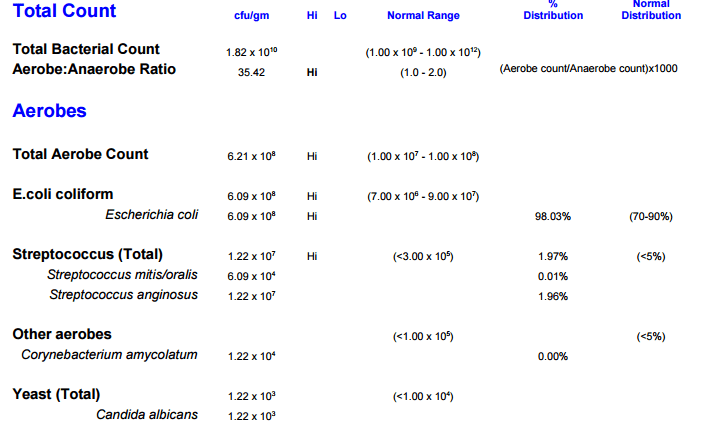
I’ve cited a Bioscreen result before, see this post from 2014. That report had high Streptococcus, Aerobe, and Clostridium, with low Coliforms (which include E.Coli). The results from different labs can vary greatly on what is reported. This can almost force you to become a microbiologist to make sense of the reports.
report1
Note on above report: Only two types of streptococcus are being measured.
In this post, I will look at what can be done to reduce streptococcus without prescription antibiotics. The list is short, so I will assume that the first goal is to kill streptococcus without consideration of side effects (a.k.a. tunnel vision).

Concerning antibiotics, there is a lot of antibiotic resistance reported.

  • “A total of 2.4% (95CI%: 0.1-4.7%) of the [Streptococcus] pneumococcal strains were highly resistant to both phenoxymethylpenicillin and macrolides, whereas the highest resistance rates were to cefaclor (53.3%), followed by tetracycline (20%) and cefuroxime (12.1%).”[2017]
    • “penicillin – 5.41%, erythromycin – 8.1%, clindamycin – 4.05%, amoxicillin-6.76%, tetracycline 28.38%.” [2017]
  • “The rates of resistance and reduced sensitivity of the isolates for penicillin and ampicillin were determined at 61.2% and 55.1%, respectively. However, all isolates were found to be susceptible to vancomycin” [2016]
  • “a substantial group of strains is resistant to macrolides and the majority of strains are resistant to tetracycline.” [2016]
  • Note: Wikipedia states differently (likely old studies) “Most Streptococcus milleri strains are resistant to bacitracin and nitrofurazone, and sulfonamides are totally ineffective.[8] However, most strains studied have been shown to be susceptible to penicillin, ampicillin, erythromycin, and tetracycline.[9]

Rosehip and  pomegranate blossom teas reduces K.pneumoniae (but do not take with antibiotics) [2017


Bottom Line

Discuss with your medical professional, starting with licorice (especially Spezzata), then I would suggest Triphala because its long history of treating digestive disorders. Magnolia Bark and Olive leaf would be the next wave of supplements to try (remember to rotate!).

Because you are high in E.Coli (atypical for CFS), then Lactobacillus acidophilus LA-5 would likely do double duty. Lactobacillus acidophilus inhibits most E.Coli.

D-Lactate Excess

Concerning D-lactate excess see these two post:

Last but not least… Vitamin D3

This has slow impact. You want to move yourself into the top 10% of the “normal range”. This often means 10,000 IU/day of Vitamin D3 for a younger person. More for an older person. Amount depends on degree of malabsorption.


Reminder: Probiotic can cause major herx!

“Hi Ken,

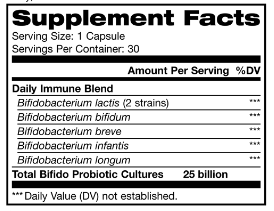
Here’s some more grist for the CFS Remission mill. I had been much improved by upping my Vitamin D and adding Symbioflor-2. I was even working 20+ hours a week, a huge amount for me over the last five plus years. On top of those two mainstays, I rotate in another probiotic. Since I’m always low in Lactos and Bifidos via many stool tests over the years, three of which are featured on your blog, I aim for your recommendations on those. I’m no longer usually that sensitive to most supplements and probiotics and usually react well to Bifidos, especially for a slight but very elusive change in brain fog. But last Friday night I took ONE of these puppies and have been suffering ever since. The next day I could barely move and had to resort to pain killers, the histamine reaction is still going strong with blocked sinuses and runny nose and constant sneezing. Here is a link to the Bifido only probiotic I took, which I believe is mentioned on one of your posts. There are several versions of this 25 Billion Bifido only option from Renew Life, but they seem to contain the same ingredients.
Forgot to mention that I used some of the techniques you mentioned on your blog, I think from a post about a friend having a tough reaction to a probiotic. I’m bombarding myself with probiotics I know I can tolerate as well as antihistamines (OTC, quercetin, turmeric, anything I have on hand) and that has helped. Without your blog, I wouldn’t have even know that a probiotic can cause such a herx or histamine response and probably would’ve just kept taking it and chalked it up to a “flare” or bad seasonal allergies.”

On a related note, a reader asked about which version of Reg’Active (L. Fermentum ME3)

The answer is simple, start with the lower dosage one.  Some readers have reported major herx from this probiotic. If you have capsule making equipment, consider splitting the capsules into smaller dosages.

Back to the above issue. The herx/histamine causing bacteria consisted of:

Flora

First, remember that doing single species probiotics is the safest path when practical (ideally with the strain named — above lack any strain information 😦 )

Second, search pubmed, it is not hard, just enter the words!

https://www.ncbi.nlm.nih.gov/pubmed/?term=bifidobacterium+lactis+histamine

pubmed

  • “Human peripheral-blood-derived mast cells were stimulated with Lactobacillus rhamnosus (L. rhamnosus) GG (LGG(®)), L. rhamnosus Lc705 (Lc705), Propionibacterium freudenreichii ssp. shermanii JS (PJS) and Bifidobacterium animalis ssp. lactis Bb12 (Bb12)” [2011] mast cell stimulation releases histamine.
  • Bifidobacterium bifidum G9-1… whereas those in mast cell mediators, histamine and cysteinyl leukotrienes were not [suppressed].” [2015]
  • Bifidobacterium infantis and Bifidobacterium longum… Prolonged treatment …significantly suppressed both the allergy-like behaviors and all of the above mentioned factors involved in histamine signaling.” [2008]

In other related articles, bifidobacterium reduced allergies over 2-4 months.  It appears that this may be due to this bacteria displacing higher histamine producing  bacteria over time. It does not mean that these probiotics do not produce histamine.

Bottom Line

Go slow and gentle with probiotics.  Antibiotics, herbs and spices flow thru the body with a drop of 50% (half-life) in a few hours usually.  Probiotics are living creatures that may not drop, but increase!! When you have too severe a probiotic herx, it can become a challenge to moderate it. A high dosage of probiotics that you do well with, may help — you are trying to displace the herxing probiotics.

In some cases, there are other probiotics known to be hostile. For example, lactobacillus and Clostridium butyricum (Miyarisan) will moderate E.Coli probiotics.

Start with low dosages and slowly work up — if you slip into a herx, it may last a much longer time than expected.

Atypical Crohn’s Disease – later stage CFS?

A reader commented that she, like a friend, evolved into atypical Crohn’s Disease from CFS. On the surface, it means something that looks like Crohn’s Disease but does not behaves typically or appears typically how Crohn’s disease respond to treatment.

For example and to establish definitions.

An Atypical Presentation  [2004]
In this case, the patient only exhibited a few of the traditional signs, symptoms and clinical findings associated with Crohn’s disease. The patient presented with an acute GI bleed, which is seen in only 20% of patients with Crohn’s disease. In this case, the disease’s onset was acute and severe, which sharply contrasts to the typical insidious onset of Crohn’s. Additionally, the patient did not experience weight loss traditionally associated with Crohn’s disease. The histology of all four specimens taken at the time of colonoscopy was similar and did not fit the usual histologic picture of ulcerative colitis or ischemic colitis. The location of the ulcers is unusual for the initial manifestation of Crohn’s disease.
….Crohn’s disease is an inflammatory bowel disease marked by patchy areas of full-thickness inflammation anywhere in the gastrointestinal tract, from mouth to anus…. Crohn’s disease is mediated by T lymphocytes, which arise in genetically susceptible individuals as a result of a breakdown in the regulatory constraints on mucosal immune responses to enteric bacteria.

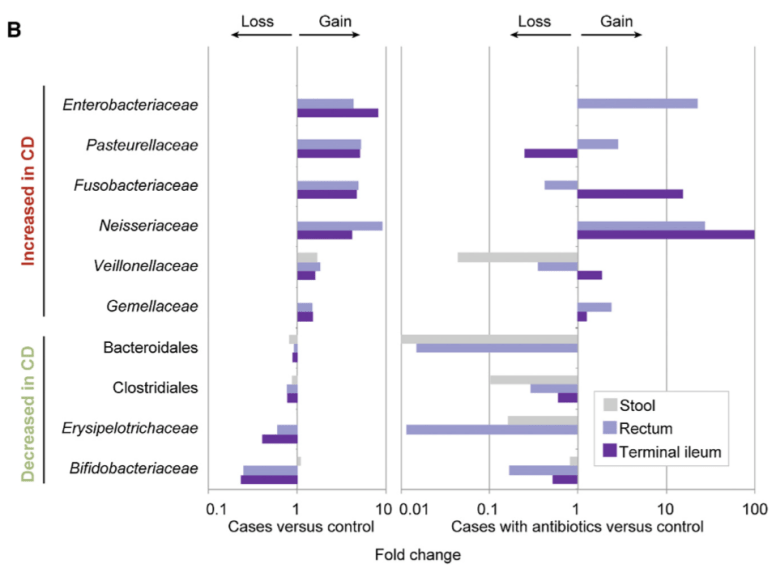
This is a nice study,  The Treatment-Naive Microbiome in New-Onset Crohn’s [2014] Disease which shows a both any treatment and what happens with treatment with an antibiotic.

crohn

Note some factors shared with CFS and FM microbiomes:

  • Major decrease if bifidobacteria [Kyberompact Post]
  • Increase of Enterobacteriaceae as seen with IBS  [2016]

The differences:

  • Pasteurellacease are normal or low in CFS [Post], high in Crohn’s disease
  • Fusobacteriaceae are normal in CFS, high in Crohn’s disease
  • Some species of Veillonellaceae  are low in CFS [post], the entire group is high in Crohn’s disease

The two biggest shifts (the biggest increase and the biggest decrease) in Crohn’s disease are also seen with CFS.  The difference is that other families have not shifted yet. How the body responds to further shifts is influenced by DNA.

This study also illustrate the effect of antibiotics — they appear to make the total shift worst (but may result in some symptom relief).


Bottom Line

As I wrote earlier: Autoimmune = DNA + Microbiome shift. The more that shifts, the worst the autoimmune condition can become. Which autoimmune disease is likely a function of your DNA. If you are unlucky, you may end up with several pages of diagnosis.  The final problem is how to shift the microbiome back to normal. The first step is to inhibit further shifting: for CFS, given what is available, it appears to be E.Coli probiotics and bifidobacteria probiotics as a starting point.