Probiotic News Dec, 2016

This is my periodic review of news on probiotics (not always CFS specific)

  • “Proteins secreted by a strain of E. coli suppress bad gut bacteria – posted in Immunology Products: There are both good and bad bacteria in our bodies. The balance of the intestinal bacteria group is essential for health. Now, a new research from University of California Irvine has identified that the beneficial bacterium Escherichia coli Nissle 1917 (EcN) secretes small proteins called microcins that limit the growth of harmful gut bacteria during intestinal inflammation.” [2016]
  • “The researchers compared the gut microbiota of healthy Chinese centenarians, and nonagenarians (90-99 years old) (n = 67), with younger individuals (including 54 elderly and 47 young adults) and with the results from the previous study of gut microbiota in Italian centenarians (n = 15) and semi-supercentenarians (n = 24) by Biagi et al.Datasets from the Chinese and Italian studies were combined and re-analyzed. Significant differences in overall community membership and structures between the Italian and Chinese long-lived groups were observed. Despite these differences, common features that discriminated long-lived from younger individuals were identified in both groups.

    A total of 50 features (including bacterial operational taxonomic units OTUs and alpha-diversity measures) from the combined Chinese and Italian dataset differentiated long-lived individuals from others. Specifically, 11 features were shared by the older individuals in the Chinese and Italian studies, including community richness, members of Blautia, Clostridium XIVa, Faecalibacterium, Escherichia_Shigella, and unclassified Lachnospiraceae, Ruminococcaceae, and Erysipelotrichaceae. Alpha diversity – an estimator of within-community diversity – was among the top features that distinguished long-lived people from younger ones. Besides this, both community richness and community diversity were greater in the long-lived group than in the younger group.”[2016]

  • ” In a new study, scientists developed a new tool to examine genetic differences within bacterial species and uncover novel transmission patterns in mother-infant microbiomes” [source]
  • “Gnotobiotic mouse model is generally used to evaluate the efficacy of gut microbiota. Sex differences of gut microbiota are acknowledged, yet the effect of recipient’s gender on the bacterial colonization remains unclear.” [source]
  • ” bacteria also live in a woman’s breast tissue-and the mix of those microbes may have an equally important effect on health, according to a new study in Applied and Environmental Microbiology.” [source]
  • “Bacteria from celiac patients influence gluten’s digestion and its ability to provoke an immune response” [source]
  • “A specific strain of Lactobacillus acidophilus may relieve symptoms of lactose intolerance” [source]
  • “Dietary fibre/short-chain fatty acids and vitamin A may protect mice against peanut allergy via gut microbiota” [source]
  • “Mucosal Inflammation, and the Environment in Post-Infectious Chronic Gut Syndromes”[source]
    • “It is known that infection may trigger post-infectious chronic gut syndromes for example, post-infectious irritable bowel syndrome and post-infectious functional dyspepsia. This sequence of events is likely dependent upon a myriad of other host and environmental factors and an inherent inflammatory response of the gut mucosa to pathogens, which may be regulated by the genetic background. This review topic aims to unravel genetic influences on host response, which lead to differing clinical outcomes in enteric infection preceding chronic gut syndromes.”
  • “Chronic sleep fragmentation (SF) commonly occurs in human populations, and although it does not involve circadian shifts or sleep deprivation, it markedly alters feeding behaviors ultimately promoting obesity and insulin resistance. These symptoms are known to be related to the host gut microbiota.” [source]
  • “The results of our study demonstrated that 17.7% chicken protein diet promoted the beneficial genus Lactobacillus in young rats, but the opposite effect were found in the middle-aged group [decreased Lactobacillus]. To evaluate the linkage between diet and host health, age effect should be considered in the future studies.” [2016]
  • “Dietary modification has long been used empirically to modify symptoms in inflammatory bowel disease, irritable bowel syndrome, and a diverse group of diseases with gastrointestinal symptoms. There is both anecdotal and scientific evidence to suggest that individuals respond quite differently to similar dietary changes, and the highly individualized nature of the gut microbiota makes it a prime candidate for these differences.” [source]
  • “Princeton researchers have for the first time revealed the mechanics of how bacteria build up slimy masses, called biofilms, cell by cell. When encased in biofilms in the human body, bacteria are a thousand times less susceptible to antibiotics, making certain infections, such as pneumonia, difficult to treat and potentially lethal.” [source]
  • “Researchers … found an association between migraines and microbes that reduce nitrates….suggests that migraine suffers avoid eating nitrate-filled foods if they suspect it is causing them migraines.” [source]
  • “certain proteins produced by gut bacteria may be linked to neurodegeneration in rats.”[source]
  • “the FDA announced<https://www.federalregister.gov/articles/2016/03/01/2016-04372/enforcement-policy-regarding-investigational-new-drug-requirements-for-use-of-fecal-microbiota-for> that it intended to tighten its rules on the procedure, known as fecal microbiota transplantation (FMT), making it harder for doctors to buy stool from banks,”
  • “the immune system programmes itself on the spectrum of strains that are presented to it in the first months of life and thereafter rejects anything that is not exactly the same strain as an early resident.”
  • ” Several studies have also found an association between the receipt of antibiotics and an increased incidence of psychiatric disorders, perhaps due to alterations in the microbiome. Studies to characterize the intestinal microbiome of individuals with these disorders are in progress.” [2016]
  • Identification of an Intestinal Microbiota Signature Associated With Severity of Irritable Bowel Syndrome[2016]” – ” In our study, the LASSO procedure identified 90 bacterial OTUs that could be used as a composite gut microbial signature for IBS severity.
  • ” find that mice carrying a mutant version of the Foxp3 gene show changes in their gut microbiome at around the same time that they develop autoimmune symptoms. In particular, the mice have lower levels of bacteria from the genus Lactobacillus. The researchers discovered that by feeding the mice with Lactobacillus reuteri, they could “reset” the gut bacterial community and reduce the levels of inflammation, significantly extending the animals’ survival.” [2016]
  • “reports that short-chain fatty acids produced by a mouse’s gut microbiome can affect the epigenetics[how DNA is activated] in the animal’s cells: The compounds change the activity of enzymes that help add acetyl and methyl groups to histone proteins, thereby altering the availability of nearby DNA for transcription” [2016]
  • “”We conclude that Faecal Microbiota Transplant can transfer not only microbiota but also the donors’ intestinal innate immune status and improved intestinal integrity”.” [2016]
  • “Previously, we demonstrated that Lactobacillus salivarius was more abundant in patients with rheumatoid arthritis (RA), an inflammatory autoimmune disease wherein the gut microbiota is altered, than in healthy individuals.” [2016]
  • “Optimization of culturing techniques has allowed the identification of 1,057 prokaryotic species within the human gut microbiome repertoire, doubling the previous number of isolated species from the human gut.” [2016]
  • New members of the human gut

    New members of the human gut

Amino Acids and CFS /FM /IBS

Recently I came across some articles dealing with how some amino acids influences bacteria growth. This is a exploratory post.

I will be examining 4 aspects using PubMed:

  1. Has this been measured in CFS patients and reported? It may have been measured and found in the normal range and not reported —
  2. Have supplementation been tried with CFS patients? If so, what are the results
  3. Do we know any impact on the microbiome (specifically probiotics) with supplementation (not CFS specific)

As a general finding, we see a reduction of amino acid — which could be attributed to reduce appropriat bacteria to make these amino acids.

  • “The overnight urine output and rate of amino acid excretion were both reduced in the CFS group (P < 0.01).” [2007]
Role Names CFS Labs results Supplementation Comments
Essentiial Histidine (H) increased [2007] . .
Essentiial Isoleucine (I) . . .
Essentiial Leucine (L) . . .
Essentiial Lysine (K) . . .
Essentiial Methionine (M) . . .
Essentiial Phenylalanine (F) decreased [2007]

higher [2006]

Patients improved [2002] .
Essentiial Threonine (T) . . .
Essentiial Tryptophan (W) higher in urine[2006]

lower [2012]

no improvement [2010] [2014] .
Essentiial Valine (V) . . .
Alanine (A) low [2016]

low and decreases with symptom severity [1996]

helps [2016] .
Arginine* (R) higher in urine[2006]

low [1993]

. .
Asparagine* (N) decreased [2007] low [2016] helps [2016] .
Aspartic acid (D) . . .
Cysteine* (C) “homocysteine (HCY) levels were increased in the cerebrospinal fluid” [1997]

higher [2006]

. .
Glutamic acid (E) . . .
Glutamine* (Q) low [2016]

low [2012]

Likely harms, see this post .
Glycine* (G) . . .
Proline* (P) . . .
Pyrrolysine** (O) or CFSUM1 increased[1996]
CSFUM1 – low and decreases with symptom severity [1996]
. .
Selenocysteine (U) . . .
Serine* (S) . . .
Tyrosine* (Y) increased [2007] . .

Other:

  • “The level of L-carnitine was 6.4336 +/- 3.4225, significantly lower than that of the control group (7.6666 +/- 3.5819, t = 2.025, P = 0.045) and the L-carnitine level was increased 2 weeks after supplementary treatment, together with improvement of symptoms.” [2005]
  • “Results from this study indicated that supplemental guanidinoacetic acid (GAA) can positively affect creatine metabolism and work capacity in women with CFS, yet GAA had no effect on main clinical outcomes” [2016]

Amino Acids and Probiotics

  • “Most microorganisms such as E. coli can synthesize the entire basic set of 20 amino acids, whereas human beings cannot make 9 of them.” [2002] With low or no E.Coli being found in CFS — a shift of Amino acid production levels would be expected.
  • “The most abundant amino acid fermenting bacteria in the human small intestine are bacteria belonging to the Clostridium clusters, the Bacillus-Lactobacillus-Streptococcus groups, and Proteobacteria [32]. In the large intestine of healthy humans, bacteria belonging to the Clostridia and Peptostreptococci appear to be the most prevalent species involved in amino acid fermentation [23,32,33]. ” [2015]
  • “consumption of the probiotic Lactobacillus plantarum (which decarboxylates ornithine to produce putrescine) resulted in a reduced body mass index and lower arterial blood pressure [46].”[2015]
  • “Though the causes of the amino acid derangements within T2DM still have to be elucidated, gut microbiota have been shown to be important factors for the supply of both aromatic amino acids and BCAAs including leucine, phenylalanine, isoleucine, and valine to mammalian hosts [28].”[2015]

Bottom Line

The following supplements improved symptoms for many CFS patients according to the above studies:

  • Carnitine – Available alone: Yes, i.e. Amazon as low as 5 cents/gram
  • Glutamine – Available alone: Yes, i.e. Amazon as low as 3 cents/gram
  • Asparagine – Available alone: Yes —  http://www.jomarlabs.com/l-asparagine.html (Thanks Barb for the reference)  – 22 cents/gram
  • Alanine – Available alone:  Yes, i.e. Amazon as low as 3 cents/gram
  • Phenylalanine – Available alone:  Yes, i.e. Amazon as low as 6 cents/gram

“Complete Amino Acid” products contains Histidine (i.e. converts to histamine) and should be avoided.

It would be sweet if someone started to produce “Amino Acids for Chronic Fatigue Syndrome” as a product…

What to take after a course of Antibiotics?

A reader wrote:

“QUESTION:  What are the best probiotics/doses to take post-Xifaxan to repopulate/maintain gut? “

What I am going to do in this post is use this question to work logically thru the process in a step by step manner.

  1. Know the alternative names and the family of antibiotics that it belongs to –
    1. Xifaxan, aka. Rifaximin. a semisynthetic antibiotic based on rifamycin.
  2. Start with a general query of pubmed for “rifaximin microbiome” – why, you want to see if they have been any general studies done on it effects. In this case, I got 94 hits. See section below
  3. Follow up with queries for specific bacteria that are available as probiotics. I used this post as reference
    1. Rifaximin e.coli
      1. Synergic Interaction of Rifaximin and Mutaflor (Escherichia coli Nissle 1917) in the Treatment of Acetic Acid-Induced Colitis in Rats[2016].
      2. Effecive against enteropathogenic Escherichia coli [2016]
    2. Rifaximin Bacillus
      1. rifaximin possessed best activity against…Bacillus cereus” [1993]
    3. Rifaximin Freudenreichii – nothing
    4. Rifaximin Enterococcus
      1. rifaximin possessed best activity against…Enterococcus spp. ” [1993]
    5. Rifaximin Clostridium
      1. Some are resistant. Some are not.
  4. If you do not find specific information, then repeat the search using the family that the antibiotics belong to. (Minocycline –> Tetracycline)
    1. Beware of assuming that only the bad is killed off — likely the good and the bad are diminished.

Microbiome Inpact of Rifaximin

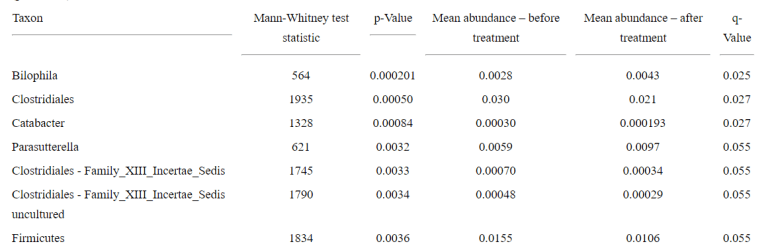
A [2016] study had a nice table of before and after. Because there is so little that we know, I will assume that any decrease seen was of bad strains and if you can supplement with good strains — then that is the direction

beforeafter

  • “B. longum W11 could be used in combined therapy with rifaximin,”[2016]
  • ” It is still not clear to what extent rifaximin can be able to modulate gut microbiota composition and diversity in different clinical settings. Studies based on culture-dependent techniques revealed that rifaximin treatment promotes the growth of beneficial bacteria, such as Bifidobacteria and Lactobacilli.”[2016]
  • Rifaximin appeared to influence mainly potentially detrimental bacteria, such as Clostridium, but increasing the presence of some species, such as Faecalibacterium prausnitzii. A decrease in the Firmicutes/Bacteroidetes ratio after 14 days of treatment and bacterial profiles with higher biodiversity were observed during the follow-up compared to baseline… It was not possible to speculate on differences of fecal microbiota modification between responders vs nonresponders” [2015]
  • “Studies of changes of intestinal flora during therapy and the health implications of these changes are also needed.”[2015]

Bottom Line

My suggestions are:

  • Broad Spectrum non-Lactobacillus Probiotics
    • General Biotic Equilibrium
    • Prescript Assist
  • E.Coli Probiotic (Mutaflor, Symbioflor-2)
  • A Bacillus Probiotic (see this post — are you histamine sensitive?)
  • A Enterococcus probiotics (Symbioflor-1 or Biofermin+S)
  • Possibly Kyo Dophilus 9 (contains 2 different B. longums)

Both Mutaflor and Kyo Dphilus 9 can be taken while on Rifaximin and would appear to increase it’s effectiveness.

See this post as reference.

As always, consult with your knowledgeable medical professional over these suggestions and the literature supporting them.

We know very little about the microbiome!

This year we saw a considerable increase in the number of studies published on the microbiome, especially those done using 16S ribosomal RNA (16S rRNA) gene sequencing (for example uBiome.com).  The 16S rRNA gene is relatively short at 1.5 kb, making it faster and cheaper to sequence than many other unique bacterial genes, and is found in all bacteria. RNA is similar to DNA — providing a unique identifier. [source]. It is the most reliable way of identifying bacteria. Earlier methods can be compared to looking at a person’s hair color, build, eye color etc to determine which ethnic group they are. Visual examination(for example with dark field microscopes) cannot tell if they are good or bad strains. 16S rRNA can identified almost exactly what they are — but whether they are bad or good species or strains is unknown until studies can be done.

  • “Overall, between 16S gene based and clinical identities, our study shows a genus-level concordance rate of 96% and a species-level concordance[agreement] rate of 87.5%. We point to multiple cases of probable clinical misidentification with traditional culture based identification across a wide range of gram-negative rods and gram-positive cocci as well as common gram-negative cocci.” [2015] i.e. 1 in 8 species were incorrectly identified by visual examination.

Looking at a human, we knew in 2008, that there was over 5,600 separate species or strains [source].

The key question is what is a normal microbiome. The microbiome is associated to a person DNA. So the question becomes — what is “normal DNA”? Someone with blonde hair? Brown eyes? Freckles? High caffeine metabolism? DNA is further complicated by epigenetics (changes in organisms caused by modification of gene expression rather than alteration of the genetic code itself).

This is further complicated for the microbiome by diet. So what is normal?

If you are in Copenhagen, then you may easily conclude that a tall, blonde, white, blue-eye, slim person is normal. If this “normal” person is dropped in a small village in Ethiopia they are abnormal. Their microbiome will likely be even more abnormal — comparing a frequent fish and meat eater to a subsistence villager.

CFS Microbiome

The original report on finding a shift in CFS patients dates from 1998 in Australia. One of the gotcha in comparing microbiomes of CFS patients to controls is diet. CFS has a high incidence of IBS which will result in diet changes for the CFS patient compared to controls. So do we definitely know the changes are due to CFS and not a response to the shift of diet from IBS? The answer is no, it is the most probable cause and the simplest explanations of all of the observations.

In my last post, I found there has been no published studies on the use of baking soda/sodium bicarbonate supplementation or l-arginine supplementation with CFS/IBS/FM. Nothing! 

When we move to the microbiome, we have even less know information. Many studies have been done not with specific strains (gold standard), or even species (containing dozens of strains — each different) but at the family level (containing hundreds of strains!!).

Every day in my work life, I deal with statistics and see problems dealing with “naive understanding”.  The greatest problem is using an average — average is good only if the distribution of data has been shown to be “normal”.

Lab Ranges

Normal laboratory certification require that each test be validated against a local group of normal individuals. the high and low values are typically at the lowest 1-5% and the highest 1-5% (i.e. 2-10% of normal people will be out of range!) [reference]. In some cases, naive oversimplification happens — for example: body temperature — a high temperature indicate sickness/infection … and only a high temperature!

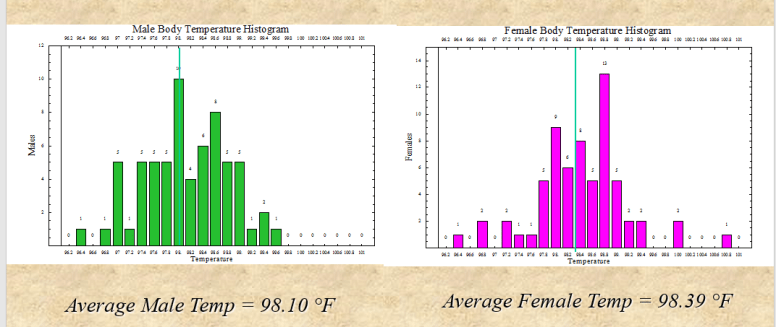
Looking at a recent study (image below) and finding 5%-95%ile, we find reality is different (and MDs working of ancient oral traditions!) . A temperature of 99.5 is outside of the normal range!

temp

  •  Male: 97F – 99F
  • Female: 97.4F – 99.2F

In dealing with statistics at work,  I have encountered cases where the average is 250, the 50%ile (half of the values are above or below) of 80. A value of 250 was actually abnormal and occurred only 2% of the time!

The source for 98.6F is from a European study finding that the average temperature was 37C (from 97.7F to  99.5F) which was literally translated and made 3 times more accurate in translation than the original stated.

Issue with uBiome results

Care must be taken on two fronts:

  • Results are given as a ratio against the average. This may or may not be significant, that is the numbers that may look extreme can actually be inside the normal range.
  • We are often dealing with families that are optional – not occurring in all individuals.
  • The ranges are one sided.

I have written my contacts at uBiome to see if we can get better statistics.

Another Reader Lab Results

A reader forward results from RedLabs.be. The results are very similar to those from uBiome.com

Red Lab Microbiome Results

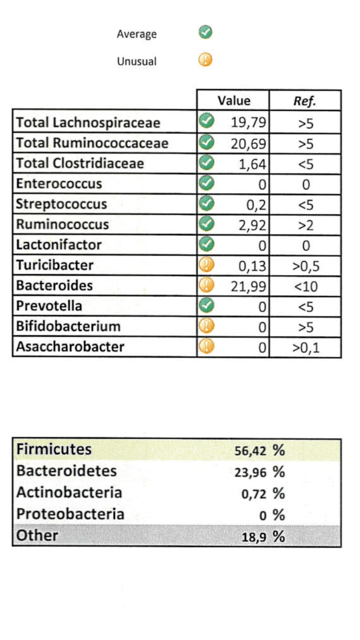
One of the tables sent, is shown below indicated 4 abnormal results. Looking at the Genus post for each of these, we see ‘reference values’ which are unfortunately one-way.

img_0116

  • Turicibacter was below 0.5 in 9/12 reports — but had an average of 0.54 (due to one having a high value)
  • Bacteroides  was below 10 in every report  – this high value appears to be an abnormal result for CFS
  • Bifidobacterium was below 5 in every report – this matches the CFS profile
  • Asaccharobacter (Coriobacterinease) was not reported in any report – this matches the CFS profile

Another table indicated

  • Eubacterium — which is normally not expected to be found by the lab, was found, this also occurred in 5/12 reports. This suggests, that it may be a subset indicator.

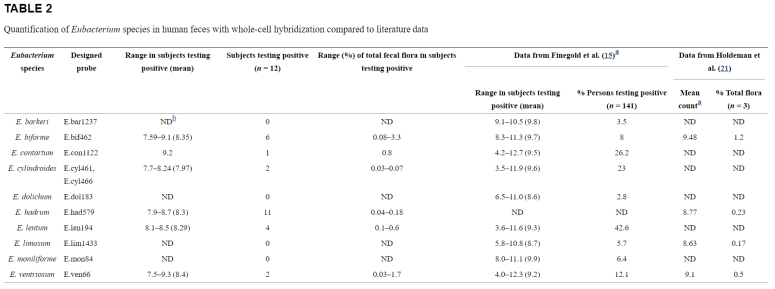
On the other hand, this seems at odds with the literature “In the human intestinal tract, Eubacterium is the second most common genus after the genus Bacteroides and is more common than the genus Bifidobacterium ” [2000], table below:

eubac

As you can see above — there is a major difference between studies. One study had 94% (11/12) positive for  E.hadfrum and another study had 0% (o/141). In short, we really do not know what is normal. If E. hadfrum a regional or ethnical associated species of Eurbacterium?

Similarly, Escherichia was deemed normal because the test results was ZERO and the reference range was  < 0.5. Again, the literature suggests that is not the case “E. coli is used as an indicator is due to a significant larger amount of E. coli in human feces than other bacterial organisms.” [source]

Bottom Line for Microbiome tests

The problem with the existing microbiome tests is the absence of use of local reference populations – especially with reference to diet and DNA. The main issue is over analysis of any results… especially at the individual level. A large sample reduces the amount of noise cause by these factors and reveal general patterns.

The patterns are general and it is unlikely we will see supportable fine tuning.  We can easily become saturated with too much information — most of which, we do not know either how to interpret or what to do if we can interpret!!

Bottom Line for patient

The reader’s microbiome fits the general pattern for CFS except for the high level of bacteroides. Bacteroides are not available as probiotics – so we can exclude that explanation immediately. Dr. Myhill see low level of bacteroides in her patients.

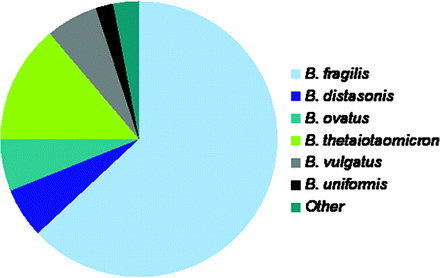
Looking at the typical distribution of bacterioides species [2007] and my recent post on IBS/IBD where B.fragilis figure prominently, I suspect IBS, possibly UC and even Crohn’s disease may occur over time. In that same post, I suggested discussing with your medical professional about taking one or more courses of  metronidazole,

bact

Otherwise, the reader follows the typical pattern


Care and Feeding of E.Coli – Baking Soda

A reader forwarded to me a PubMed article about bicarbonate (for example, sodium bicarbonate aka baking soda)

E. coli requires a supply of bicarbonate/CO2 as a metabolic substrate during normal growth. It is needed not only for biosynthesis of various small molecules but also for fatty acid biosynthesis and in central metabolism. The small molecules, which include arginine, pyrimidines, and purines, can be provided as supplements and, interestingly, certain mutants limited in the production of these nutrients can be suppressed with increased levels of CO2 (8). However, the need for CO2 in central metabolism cannot be replaced with supplements. The only known supply pathway for bicarbonate is via the hydration of CO2.” [2003]

This relates to two separate items which have been reported on CFS groups to help:

  • Various breathing techniques which increases CO2 levels, and also believed to change pH (acidity of the blood)
  • The use of sodium bicarbonate (baking soda) – which some take for acid stomach.

FYI:  “in DNA, the purines adenine (A) and guanine (G) pair up with the pyrimidines thymine (T) and cytosine (C), respectively.” [Wikipedia]

Model

We do not know precisely why CFS patients have a massive drop of the E.Coli population. The initial speculation would be toxins produced by bad bacteria. The alternative explanation is that they are starved  by changes caused by other bacteria. For example arginine:

  • During onsets, I found an urge to eat peanut butter as cited in my 2013 post, a source rich in arginine.
    • “Avoid arginine” is a frequent alternative recommendation(because it may encourage the herpes virus) – possibly making CFS worst.
  • “humans, develop L-arginine deficiency, which is associated with intestinal mastocytosis, elevated levels of histamine, and enhanced intestinal permeability.” [2013] from my 2015 post on histamines
  • “Patients with PVFS(i.e. CFS) had significantly low baseline arginine-vasopressin levels when compared with healthy subjects.” [1993]
  • I could not find any studies on the impact of arginine supplementation on CFS/IBS/fibromyalgia.

You may wish to also read my earlier post on feeding E.Coli.

Baking Soda – Sodium Bicarbonate

  • “If used in excessive amounts, baking soda has the potential to cause a variety of serious metabolic abnormalities. We believe this is the first reported case of hemorrhagic encephalopathy induced by baking soda ingestion.” [2016]
  • “…IC/BPS and common comorbidities (irritable bowel syndrome, fibromyalgia, chronic fatigue syndrome, neuropathic pain, vulvodynia, and headache) Current questionnaire-based data suggests…calcium glycerophosphate and sodium bicarbonate tend to improve symptoms.” [2012]
  • “Sodium bicarbonate [SB] supplementation increased blood pH, bicarbonate and base excess prior to every trial (all p ≤ 0.001); absolute changes in pH, bicarbonate and base excess from baseline to pre-exercise were similar in all SB trials (all p > 0.05)”[2015]
  • Sodium bicarbonate supplementation increased (P < 0.05) the final pH levels and concentrations of total volatile fatty acids and LPS, as well as the proportions of acetate, propionate, isobutyrate, isovalerate and valerate, and it decreased (P < 0.05) the proportion of butyrate and the levels of lactic acid, methylamine, tryptamine, tyramine, histamine and putrescine compared with the control…. increased (P < 0.05) the bacterial diversity index compared with the control…. also decreased (P < 0.05) the relative abundance of Streptococcus and Butyrivibrio and increased (P < 0.05) the proportions of Ruminococcus, Succinivibrio and Prevotella.” [2016]

Bottom Line

Supplementation with baking soda appears to be a rational action regardless of whether or not you have acid reflux. The rationale is:

  • it shifts pH which means that it will impact the microbiome
  • it improves symptoms
  • it reduces histamine (a problem in a subset of CFS patients)
    • Taking with L-arginine, would also be rational
  • it reduces lactic acid (a problem for a major subset of CFS patients)
  • it feeds E.Coli

Note: there have been no explicit studies reported on PubMed on the use of arginine or baking soda for CFS / fibromyalgia / Irritable Bowel Syndrome. There is a positive subjective study for baking soda with a co-morbid condition.