Dark-Field Microscopy and CFS/Lyme

A reader asked about this – is it helpful? is it worth the cost? Being a former general science teacher, there is really nothing to it. I taught it in my high school science classes. In fact, an ancestor was a favorite lens grinder for the early dutch microscope inventors. See wikipedia or Rice University page (where I borrowed the microscope image below from).

The main thing is that most MDs have stopped using microscopes and using one for dark-field is a bit of an alternative-fad.

  • “ME Medical Advisor Dr Andy Wright takes a look at new technology enabling ‘live’ blood analysis and asks ‘Could this help ME patients?” [Prohealth 2000] like 200 years new!
  • Below is a darkfield micrograph taken in 1910 [source]
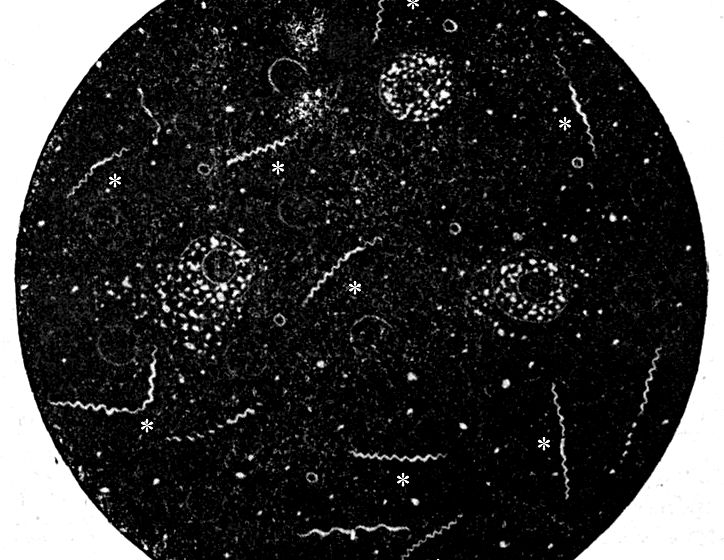
    syphilisdarkfieldmicrograph1910a

There are two ways that a specimen can be viewed in a normal microscope:

  • Light passes thru the specimen
  • Light is shone on the sample — often from the side.

highmagdf

Video of what it takes to make an ordinary microscope into a dark field microscope

Dark Field and CFS

On the web you will find links to articles about using dark field with CFS. So exactly what did they find?

  • “this is certainly not a diagnostic tool for any one condition.’” [Prohealth 2000]
  • “Using Dark field microscopy you see the red blood cells of these people clumping together. This reduces the oxygen that they can supply to the tissues of the body.” [site] – Low oxygen is a known for CFS patients  (hyper-coagulation)
  • “Bradford also claimed that the microscope was especially useful in detecting the spirochete that causes Lyme disease. Bradford promoted these methods through several publications as well as through symposia for medical doctors. Neither the device nor the three products had FDA approval, so they were not legal to market in interstate commerce..and admitted they were part of a conspiracy to commit mail fraud and to introduce misbranded drugs into interstate commerce. .” [devicewatch]

Bottom Line

Dark field microscopy is still used by medicine for certain conditions. It has been around for hundred of years (literally). Dark field video can produce an impressive presentation for a CFS patient when presented by a health professional well , “confirming a physical cause”. IMHO — it has no direct or indirect impact on remission. For the microbiome, dark field is not done — there are just two many species (over 2000 usually), many of which will die quickly when expose to oxygen. You cannot tell a bad strain from a good strain visually (or even identify the strain!)

If you look at the video below, which describes a healthy system and then imagine a dialog describing everything as evidence of infection and bacteria – you would be impressed and be a believer!

Does it have any apparent benefit to a CFS patient? None that I can identify- except reducing their savings.

Does it help with treatment?

A test helps with treatment only if it swings the decision to do a certain treatment from the normal default treatment. I can find no evidence that this alters (or authorizes) treatment. A Lyme tests known to produce false positives (because of reactivated EBV) does authorize/justify the use of antibiotics in CFS patients. This is now the system works.

Does it help with insurance and other claims?

If it is not accepted by traditional medical science, then it will be very unlikely to be significant for an insurance or benefit claim. If anything, it may cause the claim to be more critically (negatively) reviewed.


Probiotics: Mercola Complete Probiotics

A healthy individual response to probiotics is different than a person with CFS etc. What helps one may hurt the other. Dr. Mercola is well respected but does not focus on CFS, Crohn’s Disease or other autoimmune diseases.

This probiotic blend only specifies one specific strain, the rest are described at the family level (which means that we do not know exactly what their effects could be).

  • Lactobacillus acidophilus DDS-1

There were just 9 PubMed articles on this strain

Bottom Line

Do not take this probiotic because it will likely increase any symptoms associated with the increased TNF-alpha and interleukin-1 that is typical with CFS  patients.

Crohn’s Disease

This applies to likely all autoimmune conditions, for example:

  • “These consistently raised TNF-alpha, IL-1 beta and IL-6 secretions by normal appearing mucosa from patients with Crohn‘s disease provide evidence for a sustained immune stimulation in Crohn‘s disease even in the absence of patent inflammation.” [1996]


Probiotic Survey #2

Recently there has been some additional candidate probiotics. While these may be good in theory — the reality with human patients may be different. Human (with CFS) experience is needed, hence a new survey:

You will see the talleys when you do the survey.

Early results:

  • Prescript Assist Pro Better 75% Worst 0%
  •  Kyo Dophilus 9  Better: 50% Worst 0%
  • Kyo Dophilus  Better: 50% Worst 0%

If you are adventuresome, you may wish to try one of the probiotics that no one has reported on. These are all ones that in theory should be good for CFS in general, the following could be problematic for those that are histamine sensitive:

  • Perfect Pass

  • MegaSpore Biotic

  • Just Thrive


Feedback from some readers

I do not have a protocol. I do not have a treatment. I have a model of what causes CFS from which individual patients (with their medical professionals) must find their own path. I do post general suggestions, like my Updated Model and Treatment Suggestions. Some suggestions will work for many and be adverse to others. The model — a shift of bacteria — is in agreement with this. Your gut bacteria is unique before you got CFS/IBS/etc. How it shifts is also unique.

A lot of my suggestions are theoretical. This appears to be a good idea based upon available data. For example, taking an E.Coli probiotic because low or no E.Coli is seen consistently in the lab reports. Whether a specific E.Coli probiotic is right is one best answered by practical experience reported from people trying them. The two reports below both had problems with Symbioflor-2 (which is the easiest to obtain). Mutaflor (E.Coli Nissle 1917) and E.Coli Leve 1931 are two alternatives. E.Coli Leve 1931 is not sold as a living bacteria, but the metabolities from this bacteria (so no risk of taking up residence).

Your contribution to surveys help others and yourself. See this summary page with links to surveys.

A long term reader update report

Even though I have been out of touch I am still reading your blog and appreciating it greatly, and have shared it with others.

I wanted to give you another update….the last time I wrote you, I had just tried Symbioflor II, which really didn’t work for me, and I also asked you about how you defined “remission” and I followed your advice and got a really undemanding part-time temp job which lasted couple of months and which I enjoyed a lot but which let me know I didn’t have as much stamina as I thought I did because I got sick the first week in and then was back to sleeping whenever I wasn’t at work. There was also a lot of family upheaval ….

Anyway, all that is background to the fact that I am actually doing pretty well in many ways, much thanks to you, plus a couple of other things that I have started doing that seem to be shoring up my results. I would say that I am at 60 – 70 percent energy most days, with that being pretty steady. In other words, without the energy surges and crashes I used to have before I got sick. I’m not taking naps, and all in all I’d say I have enough energy to get by on except the one deficit I really still have is in drive and motivation and the ability to concentrate (I sort of think of those three combined as one thing)

Here’s what I am doing:

  1. Using the CFS Remission model – I will send you a detailed list of what I am taking in a day or two. I made changes based on your suggestion that I alternate between Prescript Assist and Equilibrium, which worked well. I also tweaked my herbs based on the results of your reader survey, and added in D-Ribose at the suggestion of a friend with fibromyalgia (and then I saw that you had written about it though I somehow missed it).
  1. I finally saw a naturopath in October who said the CFS/ME diagnosis was pretty obvious…She did look at my supplement list, though, and gave it the thumbs up. She also made some diet recommendations…What I noticed about food lists for me is that many of the foods were those I had already been avoiding from the histamine restricted diet. Also, I had noticed that I felt a lot better when I ate beef, which according to the BTD is probably the best source of protein for me. It also recommended against grain (which you have also) and dairy. So I just chose to interpret her recommendation primarily as keep avoiding histamines, keep eating beef, and cut out milk and most grains, and of course most sugar and that seems to be working for me. I would say it has made the difference between having steadier energy vs. surges and crashes, which I was still having up until I started eating this way. I have also lost a little bit of weight, which I am happy about though I wasn’t really trying to do that.
  1. I have gradually started exercising again. As you know it’s hard to exercise with CFS, not to mention contraindicated, so I had cut way back and was pretty inactive and deconditioned as a result of basically sleeping a whole year, and then when I got whooping cough you basically can’t exercise without triggering a fit that makes you feel like you are going to die. I literally once turned blue from doing the kind of yoga where you do nothing but lay on floor and breathe; it was terrifying. So despite the fact that exercise has always been my go-to for managing my depression, I was scared to start exercising again. I started with walking (since I have a dog) and using Audible, and I am enjoying it immensely, averaging about 8,000 steps a day, and sometimes a lot more – I got lost when I visited my husband (working away from home) and walked 11.5 miles and expected a crash afterwards, but none came. Yay! I have also started swimming twice a week (deliberately doing it *much* less strenuously and with less duration than I used to, because I think over-swimming was part of what triggered my CFS or mono or whatever my initiating event was) and rather than having to nap after a workout I feel energized. I want to do yoga again but the turning blue scare is still holding me back a bit even though I know I am recovered from whooping cough…if my heath holds up I will ease my way into that too.
  1. This is something that I haven’t mentioned before, I don’t think….I have had depression on an off since adolescence, sometimes acute, sometimes low-grade, and have been off and on antidepressants since my twenties. Most recently, I was on them for about 10 years, and at the time I got whooping cough I had three prescriptions going. While acutely ill with whooping cough, I was too sick to take them and thus went off them without intending to. I didn’t want to start them again without talking to my prescriber, but, meanwhile, between the herbs and probiotics etc., which I did restart when I was able,  my mood problems diminished drastically. I never did go see my prescriber and now have been off for almost a year, and feel better than I did when I was taking the meds (even though they helped and I am not an anti-med person at all). Often, if I go through a patch of getting tearful easily, adding in or increasing the Miyarisan takes care of it within 24 hours.

Anyhow….I wanted to let you know I am still around and still “working the program” and very grateful to you.

Happy Thanksgiving!!


Another Reader

I found your post today very interesting. I took Symbioflor 2 in February and unlike
your other reader has a dreadful reaction – very bad burning throughout my entire digestion
system. It made a bad situation even worse and I have not yet recovered. This would tally
with the significant survival time of the bacteria.

On a different note, as I mentioned I am currently in the middle of a very bad
period of digestion pain. So in desperation I tried my remaining Prescript Assist.
I find they only have an effect if taken at 2 or 3 times the dose.

2 days later I can feel my bowel inflammation lower

Comment: The remedy for adverse reaction to E.Coli probiotic is to take Lactobacillus probiotics. These suppresses E.Coli.   Lactobaccillus Gasseri is the preferred one.

Prebiotics – the care and feeding of Probiotics

I have intentionally avoid dealing with prebiotics in the past. Instead, I have advocated ‘raw appropriate seasonal food’. The microbiome has evolved with seasons, and having fresh strawberries or blueberries in January may contribute to microbiome dysfunctions (speculation). A reader forwarded a study that changed my perspective because the results of one specific prebiotic was very desirable!

  • “To explain why some E. coli mutants do not grow as well on mucus in vitro as their wild type parents yet are better colonizers, we postulate that each one resides in a distinct “Restaurant” where it is served different nutrients because it interacts physically and metabolically with different species of anaerobes.” [2015]
  • “When E. coli Nissle 1917 is the only E. coli strain in the streptomycin-treated mouse intestine, it appears to use arabinose, fucose, galactose, gluconate, mannose, N-acetylgalactosamine, and sialic acid to colonize (Table 2 and (58)). In contrast, E. coli Nissle 1917 does not appear to use ribose to colonize (Table 2).” [2015]
    • Dr Myhill states the same here and advises “Eat figs, hazelnuts, chickpeas!”

Below is what I could find on various types of prebiotics. For example, for mannan oligosaccharide – I could not find any suitable studies.

For most prebiotics, the results were less than ideal – increasing Bifidobacterium with a decrease of other bacteria.

Xylooligosaccharides and/or Pectin

“Purified xylooligosaccharides from Miscanthus × giganteus (M×G XOS) were used in an in vitro fermentation experiment inoculated with human fecal microbiota. A commercial XOS product and pectin were used as controls. Decreases in pH by 2.3, 2.4, and 2.0 units and production of short-chain fatty acids (SCFA; acetic acid, 7764.2, 6664.1, and 6387.9 μmol/g; propionic acid, 1006.7, 1089.5, and 661.5 μmol/g; and butyric acid, 955.5, 1252.9, and 917.7 μmol/g) were observed in M×G XOS, commercial XOS, and pectin medium after 12 h of fermentation, respectively. Titers of Bifidobacterium spp., Lactobacillus spp., and Escherichia coli increased when fed all three substrates as monitored by qPCR.” [2016]

Pectin is from fruit. Apple Pectin capsules are available from Now, Solgar etc. or buy in bulk and make your own capsules ($15 for 2 lbs on Amazon)

One source of Xylooligosaccharides.

Fructooligosaccharides (FOS)

“Fructooligosaccharides (FOS) are one of the most studied prebiotics, selectively stimulating the growth of health-promoting bacteria in the host. However, there is increasing evidence that commensal gut bacteria, such as Bacteroides fragilis, Clostridium butyricum, Enterobacter cloacae, and even the pathogenic Escherichia coli BEN2908, are also able to metabolize FOS in vitro, and in some cases, FOS displayed adverse effects.” [2015]

Inulin

“By stimulating bifidobacteria, …. These potential beneficial effects have been largely studied in animals but have not really been proven in humans.”[1999]

“All inulin-type prebiotics are bifidogenic – stimulating the growth of Bifidobacteria species. The effects they have on other gut organisms are less consistent….intra-individual response to an identical dose of the same inulin-type prebiotic, in terms of stimulation of total number of Bifidobacteria and individual Bifidobacteria species, can be variable.” [2008]

  • Inulin is typically made from chicory.

Galactooligosaccharides and Maltodextrins.

“a higher proportion of bifidobacteria (25.77%) was seen in the total bacterial population after cultivation on a prebiotic mixture than on the control medium (7.94%). The gram-negative anaerobe count significantly decreased …and the Escherichia coli count decreased” [2015]

“the galacto-oligosaccharide product was more bifidogenic(… much of this growth was attributed to growth of B. longum. …)  and potent in inhibiting E. coli than the other products tested.” [2014]

Almonds and Almond skins

“Significant increases in the populations of Bifidobacterium spp. and Lactobacillus spp. were observed in fecal samples as a consequence of almond or almond skin supplementation. However, the populations of Escherichia coli did not change significantly,” [2014]