Probiotics that can take up residency

The uniqueness of each person’s microbiome means that some probiotics may take up residency in one person and not the other. If the probiotic comes from a fish or an algae, it is unlikely that a compatible support community of friendly bacteria will be found in a human. Below are studies finding that a probiotic took up residency in at least some people in a study. Residency is defined as being found 7 days after last administration. The studies must be on humans.

  • Enterogermina – Four Bacillus clausii Strains
    • “Bacillus clausii was found alive in faeces for up to 12 days. In some volunteers, the recovered amount of OC, NR or SIN was higher than the number of administered spores.” [2015]
  • Symbioflor®2
    • “Stool analysis showed that the probiotic E. coli had colonised all five persons for a period of 10 to 30 weeks (mean: 18.7 weeks, median: 25.7 weeks). In two individuals there was evidence of competition between host E. coli and probiotic E. coli, while in two others total E. coli levels increased persistently with at least a factor of 10 as a result of the received dose.” [2014]
  • Probiotic preparation inVag(®) – women only
    • “Molecular typing revealed the presence of Lactobacillus strains originating from inVag in 82% of women taking the drug at visit III (21 days), and 47.5% at visit IV. (28 days)” [2015]
    • “opical application of an ointment containing Lactobacillus gasseri LN40, L. fermentum LN99 and L. rhamnosus LN113…Topical application of a probiotic ointment is feasible to achieve persistence of lactobacilli for at least 10 days.” [2016]
  • Lactobacillus rhamnosus GG (Culturelle)
    • “GG was also recovered in the faecal sample taken at the start of the intervention and at the time of the tissue sample collection, which indicates more persistent adherence of the probiotic” [2013]
  • L. rhamnosus CNCM I-4036 (Human origin)
    • “was identified after the intervention (t2) in fecal samples of volunteers that received this bacterial strain. This finding does not necessarily imply successful colonization but rather persistence of the strain at this time period. Detection of L. rhamnosus CNCM I-4036 for a much longer period would be needed to determine whether the strain does in fact colonize the gastrointestinal tract. [2013]
  • Lactobacillus rhamnosus (573L/1-3)
    • ” The examined strains were detected in 37/46 (80.43%) patients after 5 days and in 19/46 (41.3%) patients after 14 days since the start of the treatment. L. rhamnosus 573L/1 strain colonised the G.I. tract more persistently.” [2006]
  • L. plantarum  MF1298, DC13 (But not MF1291)
    • ” MF1298 and DC13 persisted in the same volunteer after ended intake, suggesting host-specific persistence behaviour.” [2006]

Does not Persist

  • “Lactobacillus casei strain Shirota (Yakult) was undetectable with culture after 2 weeks of ceasing its consumption.” [2013]
  • VSL#3
    • “Streptococcal population was detected after 3 days of administration and persisted for 6 days after the treatment suspension.” [2003] — did not make it to 7 days.

And the rest…

Assuming they do not take up residency is usually correct unless then are human sourced.

Soil Based Organism Probiotics – The Reality

I think the easiest way to start a discussion is to look at what is in Swanson Ultra Dynamic Balance Blend Soil-Based Organisms.

sbo

What! Those are “normal” probiotics!  What is going on???? If you go over to Primal Defence probiotics you see a similar list of probiotics with the comment “homeostatic soil organisms”.

The harsh reality is that most probiotics are obtained from non-human sources. A few life Mutaflor (E.Coli Nissle 1917), Colibiogen (E.Coli Laves 1931)  and BioGala L. Reuteri come from a human sources. If the manufacturer does not clearly state that it is human sourced,  it is soil, animal, marine or some other environment source. There is a big marketing value to have a human source.

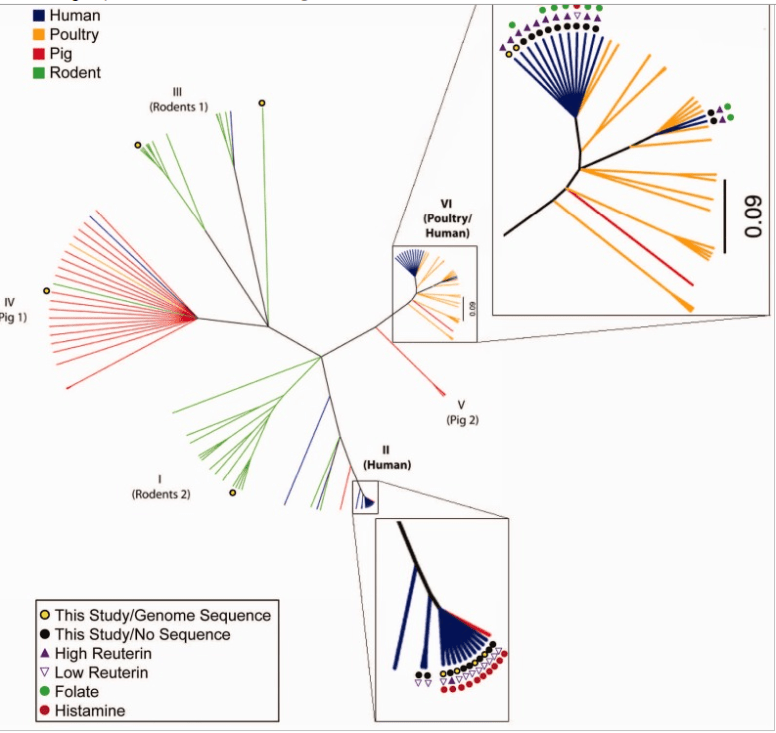
The diagram below shows the various strains for L.Reuteri. Note that almost all of the human L.Reuteri produces histamine — other species do not.

Reuteri

Why is the source important? Bacteria is like blood transfusion or organ transplants — foreigners will be rejected. For a commercial probiotic company — that makes economical sense! You want the customer to keep coming back. In reading many PubMed articles, I found that detecting any of a probiotic in stools after a week of consumption is a challenge resulting is different types of protection around the probiotic — while a suitable probiotic in water (Symbioflor-2) had no problem surviving (and taking up long term residence).

You can usually assume that 99% of probiotics that you buy are not from human sources. Most safety studies that I have seen filed with the FDA or EU’s equivalent, emphasis that the probiotic does not take up residence.

What is the use of taking probiotics then?

While these foreign bacteria are in your system, they are producing chemicals (metabolites) that favor your own missing bacteria reviving. This is the rationalize for  Colibiogen (E.Coli Laves 1931). The problem is that there are a large number of cross supporting interactions between both the good and the bad bacteria. It  unlikely that a single strain of any bacteria will be successful in correcting matters. A single strain may cause a dramatic result, but it’s ability to persist is fragile.

What can happen is a change, a new cross-supporting population – as illustrated by this report:

  • “Re-colonization of E. faecium after simultaneous probiotic plus vancomycin intake occurs mainly with strains without close genetic relationship to the strains harboured before treatment or to the ingested E. faecium strain.” [2002]

A reader wrote:

Hi Ken i Have report after using Symbioflor-2

I took it for nearly one and half week. Changes were awesome, colour of stool changed from yellow and loose(which I guess is from lactate excess) to well formed and brown. My sleep change from very little and disturbed to quiet and deep sleep

It looks like that the E.coli could be displacing the Enterococcus. I toke 20 drops, 3 times at day (with GOS and Fucoidan)

I stopped it for 4 days, and symptoms came back (even more aggressive)… I guess because bacterial resistance?. My point now is to get fucose (looks like fucoidan powder doesn’t have in it) to get the E.coli established after a period of several weeks.

I eat carbs with my meals(which is sued as fuel for lactate) and quite high amounts of GHEE (maybe overloading lactic acid as well)

I think that the only way to get E.coli stablished for sure is to feed it in high amounts. D-ribose, Fucose and Galactose (Gos prebiotic, Ribose and seaweed?).. What points more would you mark to proper feed this e.coli (i guess also the time of feeding and taking it matters).

I look at the above report in several ways:

  1. Probiotics can do a dynamic change of symptoms
  2. Establishing a persistent change is the challenge

So what would be some suggestions for this reader? First, we appear to have a bad enterococcus overgrowth according to the report. This post looks at this specific issue: vancomycin antibiotic is one route, or non-prescription monolaurin and/or neem (Azadirachta indica) would be suggested before trying E.Coli probiotic again.  Possibly between these, taking some Bioflorin – Enterococcus faecium SF 68 ( NCIMB10415)  probiotics in the hope that it would out complete the bad enterococcus. Another enterococcus probiotic Enterococcus faecalis TH10 is available in Dr.Ohhira’s Probiotics Original Formula. This probiotic is reviewed on John Brisson’s site “Fix  Your Gut”

Dr. Ohhita’s probiotics contain:
• Bifidobacterium breve ss. breve
• Bifidobacterium infantis ss. infantis
• Bifidobacterium longum
• Enterococcus faecalis TH10
• Lactobacillus brevis
• Lactobacillus acidophilus
• Lactobacillus bulgaricus
• Lactobacillus casei ss. casei
• Lactobacillus fermentum
• Lactobacillus helveticus ss. jagurti
• Lactobacillus plantarum
• Streptococcus thermophilus

This is not recommended for long term use because of the Lactobacillus in it — but it may be useful for clearing out the bad enterococcus.

Bottom Line

“Snogging healthy young humans” may actually be the best way of getting bacteria that may persist into you! If you are married, that creates problems….

In my next post I will be digging thru PubMed to identify which probiotics are known to take up some residence (i.e. detectable after 7 or more days).


Bacillus Probiotics – Update

Update:

  • “B. subtilis and CEBS supplementation caused a significant increase in the numbers of Lactobacillus and Bifidobacterium in the caecum, whereas the numbers of Escherichia coli and Staphylococcus decreased significantly compared with the control.” [2016]

Bacillus probiotics are now in my “use with caution” list.

ImmunoIn a recent post I suggested MegaSporeBiotic because it is full of different bacillus species [but only if you do not have histamine issues]. A reader pointed me at John Brisson’s blog on megaspore. He raises a valid question in his post “Why I Do Not Recommend MegaSporeBiotic or My Issues With Bacillus licheniformis”.

I reviewed this in a year ago with a do not take if you have histamine issues.

A reader tried it for two weeks and reported:

I have stopped my trial of Thrive after 2 weeks for the following reasons:

  1.  Definite histamine response / immune overstimulation
  2. Burning lactic acid sensations in muscles and increase in severe fatigue.

I will not be trying them again.

The Bacillus licheniformis strain is not identified nor it’s safety is unknown. John writes:

Bacillus licheniformis is one of the worst offending soil based “probiotics” and is known to cause food poisoning, 8 septicemia, 9 10 11 peritonitis, 12 and ophthalmitis. 13 Bacillus licheniformis is not native human flora but appears to be native flora in birds. 14 Bacillus licheniformis is a ubiquitous organism and likely enters the human digestive system many times a day. While data regarding its ability to survive in the human gastrointestinal tract is sparse, it is likely that the spores pass without activating. 15

John was kind enough to send me a followup draft. The manufacturer has launched a different version, Just Thrice, unfortunately it contains histamine producers still. A reader forwarded me a link to a Crohn’s Disease targeted probiot, Perfect Pass, which I have also added to the table below.

Histamines ProducersJust ThriveMegaSpore
Biotic
Perfect PassRestorfloraPrescript AssistEnterogermina
Bacillus Indicus HU36
Human sourced
XX
Bacillus CoagulansXXXX
Bacillus ClausiiXXXXX
Bacillus SubtilisX
Bacillus Subtilis HU58
Human Sourced
XXXXX
Bacillus LicheniformisXX
Bacillus Brevis unknownX
Bacillus Marcerans unknownX
Bacillus Pumilus weak [2009]X
Bacillus Polymyxa unknownX
Saccharomyces Boulardii ?????X

As a FYI, Bacillus Indicus HU36 was obtained from the ocean [2015] but marketing literature cites human source. While Bacillus Subtilis HU58 was from humans  [2012].  Enterogermina contains 4 strains of Bacillus Clausii only.

Immunosuppressed Patients

A reader wrote “Is it true that bacillus coagulans should not be taken by individuals immunosuppressed? I wanted to start with this probiotic for my child with ankylosing spondylitis and as you are taking immunomodulating wouldn’t know if its status would be compromised.”

I cannot give medical advise, I can provide education on what has been published else where (and the reader and their knowledgeable medical profession can draw their own conclusion).

  • Nothing found searching for immunosuppress bacillus on PubMed
  • A 1998 study on rare bacillus infections (not from taking probiotics) states: “Moreover, our finding of six B. cereus, three B. licheniformis, and two B. pumilus infections [in cancer patients] suggests that these species may be more pathogenic in immunosuppressed hosts than are other common species, such as B. subtilis or B. megaterium. ” [1987]
    • “Two cases of Bacillus cereus meningitis in immunocompromised children [in cancer patients] at our hospital within a 2-month period prompted us to review B. cereus-related invasive disease.” [2001], again — not from probiotics
  • “Despite the widespread distribution of Bacillus organisms they are rarely implicated with actual infections and are more frequently isolated as a culture contaminant.” [Antimicrobe.org]
  • “Live combined Bacillus subtilis and Enterococcus faecium ameliorate murine experimental colitis by immunosuppression manifested by downregulation of TLRs, macrophages, Th1, and Th2 but upregulation of Tregs.” [2014] So it appears to actually helps!
  • Recurrent septicemia in an immunocompromised patient due to probiotic strains of Bacillus subtilis [1998]. [Full Text] Patient was “73-year-old male with chronic lymphocytic leukemia”
    • “We conclude that, even if the septicemia due to the probiotic strains of B. subtilis could not be related directly to the patient’s death, high numbers of viable microorganisms (especially if polyantibiotic resistant) should not be given to any patient with severe immunodeficiency.”
    • Probiotic was “. Each dose contains a mixture of 109 spores of four distinct antibiotic-resistant derivatives of ATCC 9799 (Enterogermina; distributed by Sanofi Winthrop, Milan, Italy) (1, 4) per vial.”
    • “Moreover, probiotic products containing Bacillus species have been in the market for at least 50 years with the Italian product known as Enterogermina® registered in 1958 in Italy as an OTC medicinal supplement (Cutting, 2011). ” [2012]

So we have had one death reported associated with this in almost 60 years of OTC use.

Lactobacillus bacteremia (Lactobacillus infection) was found, very often — most of the reports below are within the last year! [80 reports for Lactobacillus bacteremia probiotic vs 5 for bacillus bacteremia probiotic ]

If you want to play it safe, then definitely no yogurt or any fermented foods of any type. IMHO, the apparent risk is very very small.

Bottom Line

John raises valid questions about safety with the assumption of no major illnesses [Future link to his updated post will be here]. In dealing with patients with CFS, we have two major choices

  • Avoid — and just accept CFS indefinitely
  • Try — knowing that there is likely a low risk of the issues that he is concerned about, and a major risk of a beneficial shift and thus improvement.
    • If there is a concern or adverse effect, then stop
    • Ideally, use a lower risk item if available and the cost is acceptable, for example Enterogermina

Ideal Lactobacillus Probiotics for CFS

A reader wrote earlier this month:

“I recently started taking high dose (about 150 billion) probiotics from Custom Probiotics. It’s their D Lactate-free probiotics made up of 5 different bacteria strains.

  • L. Salivarius
  • B. Lactis
  • B. Bifidum
  • B. Infantis
  • B. Longum
    The psoriasis has improved incredibly in the 16 days I’ve been taking it.”

I believe that the over production D-Lactate is likely a factor for many CFS patients (and excessive histamines for others). This lead to my recommendation to take  Miyarisan (Clostridium butyricum) because it converts lactic acid to butyric acid. An additional factor for some patients is the desired to be histamine-free. This is reasonable, one patient in the uBiome result had Morganella, a major histamine producer. In addition to the one from Custom Probiotics, there is BIFIDO|Maximus which adds Lactobacillus rhamnosus and Lactobacillus gasseri.

So based on their claims, we have three species, see The Dilemma of D-Lactate Free Probiotics – they do not work 😦

  • Lactobacillus Gasseri
  • Lactobacillus Rhamnosus
  • Lactobacillus Salivarius

Unfortunately evidence suggests they do not change d-lactate levels. https://atomic-temporary-42474220.wpcomstaging.com/2020/12/28/the-dilemma-of-d-lactate-free-probiotics/

In addition to this, the KyberKompakt Pro report found low levels of Hydrogen Peroxide producing Lactobacillus species. This adds an additional constraint to selection.

h202a

  • “several L. plantarum strains, have been shown to produce different antimicrobial agents such as organic acids, hydrogen peroxide” [2016]
  • Lactobacillus gasseri CRL1421 and Lactobacillusgasseri CRL1412, which share some probiotic properties, produce H2O2,” [2006]
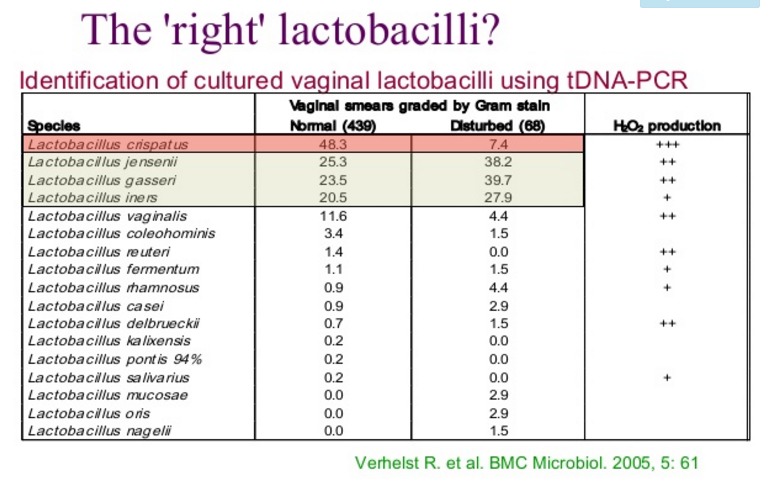
  • “Lactobacilli were identified in 215 (71%) of 302 women. The 3 predominant species identified were L. crispatus (32%), L. jensenii (23%), and lactobacillus 1086V (15%). Among these species, 95%, 94%, and 9%, respectively, produced H2O2. Surprisingly, L. acidophilus was not detected in any women. ” [1999] [2012]
  • Other H2O2-producing species or strains have been proposed to have probiotic properties, such as Bifidobacterium bifidum (6) and Lactobacillus johnsonii (7), or are prevalent in the commensal vaginal microbiota, such as Lactobacillus crispatus, Lactobacillus jensenii, and Lactobacillus gasseri (8). [2014]

The last constraint is not killing E.Coli

  • ” strains L. plantarum 106 and 107 were the most active microorganisms against E. coli” [2016]

Kyo Dophilus 9

This probiotic almost hits a sweet spot containing only L.Gasseri, L. rhamnosus (H2O2 producer) and Bifidobacteria:

  • L. gasseri B,
  • L. rhamnosus,
  • L. gasseri M,
  • B. bifidum,
  • B. longum M,
  • B. longum B,
  • B. infantis,
  • B. breve
  • B. lactis

An alternative is Kyo-Dophilus contains Lactobacillus gasseri, Bifidobacterium bifidum and Bifidobacterium longum. It is unclear if it contains one or two strains of L.Gasseri.

Bottom Line

Oral probiotics containing either Lactobacillus crispatusLactobacillus jensenii, Lactobacillus vaginalis could not be found.

  • Lactobacillus Reuteri – all human strains produce histamine 😦
  • Lactobacillus Delbrueckii — weak producer of histamine [1995] [1998]

Quasi-probiotics: Killed E.Coli Laves 1931

The strain used was discovered around 1931 by Prof. Dr. Ernst Laves. The company is still owned by the Laves and based in Germany.

“Colibiogen® is a cell- and protein-free preparation obtained from the metabolic products of the Escherichia coli strain Laves. Colibiogen® is a mucous membrane therapeutic with anti-inflammatory and immunoregulatory effects. The site of action is the mucosa as immunological unit.

As it contains no living organisms, it is not a means of symbiotic control and therefore not used for direct build-up of the bacterial flora of the intestine.” [From Site]

“Colibiogen® oral and Synerga® are identical in terms of concentration and active ingredient: They contain the highly purified metabolites of Escherichia coli strain Laves. However, Synerga® is free of any aroma additives and therefore particularly suitable for patients with allergic problems (citrus fruits), while Colibiogen® additionally contains natural orange flavour. (Colibiogen inject naturally contains no flavourings, because it is intended for injection!)” [faq]

PubMed

  • “The use of E. coli lysate is effective in the amelioration of murine colitis.” [2003]
  • “These results suggest a positive benefit-risk ratio of the additional application of lysed E. coli, Laves strain Extract to 5-FU in the treatment of advanced colorectal cancer” [2001]
  • “A pharmaceutical containing lysed cells of this strain initially isolated from human faeces, is commercially available (Colibiogen®; Laves-Arzneimittel GmbH, Schötz, Switzerland) for the treatment of intestinal inflammations, but its capacity to inhibit Salmonella has never been tested before. Genome sequencing analysis of E. coli L1000 (study name) was performed to identify the putative bacteriocin produced by this strain…E. coli L1000, a natural strain carrying the mcb-operon for microcin B17-production, inhibited a majority of tested Salmonella isolates (94%), as well as E. coli O157:H7 and Sh. sonnei. ” [2009] – it works against bad E.coli

Bottom Line

This will not result in E.Coli growth, however it may deliver some of the benefits of E.Coli  and can be taken with any probiotic. It should help to shift the balance (in theory).

Looking forward to feedback from anyone that tries it.