uBiome Results #4 The Order Level

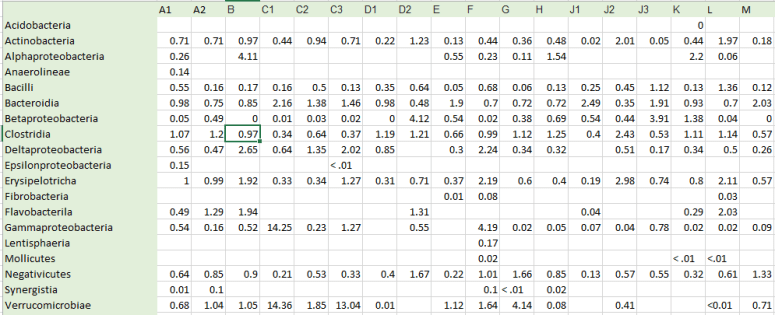
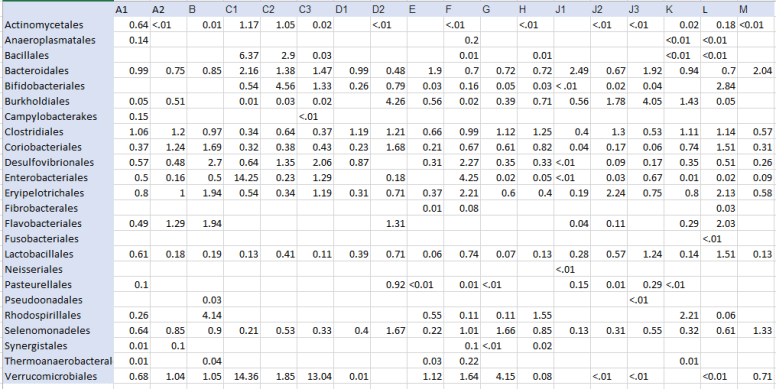
The Phylum levels had 12 items reported. The Class level had 19 items. The next level down, the Order level has 24 items. Some of the Class will be divided into several parts. For other, we have just one part of the class reported.
order

Common Items

I will not go thru every item, just the high points. For many of the items we have very limited knowledge on what they do. For “normal”, we would expect both an average and middle value between 90% (.9) and 110% (1.1). Using a wider range of 70% (.7) and 140% (1.4) could be describe as “slightly off”.  If the numbers are further off, then something is happening.

The 1998 report on the microbiome shift seen with CFS appears to be confirmed. Low BifidobacterialesLactobacillalesEnterobacteriales (which includes Escherichia, i.e. E.Coli). All of the patients have at least 2 of the three being very low.

Some details

Result C

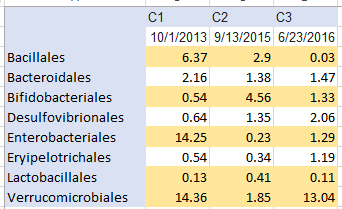
Result C illustrates that the microbiome can be changed. I suspect that prior to the second test, C2, there was significant intake of Bifidobacteria Probiotics, increasing lactobacillus and reducing verrucimicrobiales and what appears to a pathogenic enterobacteriales overgrowth.
changes

A high level of verrucimicrobiales is reported after antibiotics:

  • “Dramatic colonisation of the human gut microbiota by the Verrucomicrobia phylum following a broad-spectrum antibiotic regimen occurred without significant gastrointestinal manifestations, suggesting that influenced by external factors such as antibiotics, the gut repertoire remains partially unknown.” [2012]
  • ” Proteobacteria (including Escherichia coli), and Verrucomicrobia (including Akkermansia mucinophila) are typically present in smaller numbers in the healthy gut microbiota, but these organisms have considerable potential to influence health outcomes.” [2015]

Result L:

“at the time I took the test I had not taken any probiotics as pills for over a year, but was eating lacto fermented vegetables, yoghurts cultured from whatever was in the commercial greek and natural yoghurts that I had purchased as starter cultures and pseudonatto. I guess the yoghurts could have contained bifidobacteria but I had intentionally bought the old fashioned brands that do not boast any particular probiotic species. The ubiome test did pick up  87 l. delbruekii and  14 s. thermophilus  so I guess I have some idea of what was in the yoghurt.”

  • This is the highest level of Lactobacillales and second highest Bifidobacteriales seen in all of the tests. Unfortunately Enterobacteriales was still very low.
    • One model is that d-lactic acidosis is involved (heavily produced by Lactobacillales) and only a little by Enterobacteriales is the cause of ongoing symptoms. The Enterobacteriales are needed to get the amount lowered.
  • High levels of Erysipelotrichaceae
    • “The importance of Erysipelotrichaceae in inflammation-related disorders of the gastrointestinal tract is highlighted by the fact that they have been found to be enriched in colorectal cancer.” [2015]
      • Decrease (Toxoplasma gondii or Giardia muris infections) or increases (TNF Driven Crohn’s Disease) – see link for more details
      • Impacts obesity

Downloads

PDF: order

Excel: order

uBiome Results #3 The Class Level

The Phylum levels had 12 items reported. The Class level is the next layer down. Class level has 19 items reported for these people. The links are to Wikipedia articles with their [Phylum] after the name. Quotes are from the Wikipedia articles.

class

First starting with items that were seen by 75% or more of the results

The Rare Items

As I suggested in the prior post, these may be bad bacteria, so having none is good. Alternatively, some may be from having fermented foods regularly in the diet (although these bacteria will not persist, they may show up in the sample).

Having low levels may result in some symptoms.

  • Alphaproteobacteria  [Proteobacteria] – includes Rickettsidae.  25% have high values. may be a subset.
  • Anaerolineae [Chloroflexi] – likely just “noise” only in one patient, disappeared on the next test.
  • Epsilonproteobacteria [Proteobacteria] “Autotrophic Epsilonproteobacteria use the reverse Krebs cycle to fix carbon dioxide into biomass” likely just “noise”
  • Fibrobacteria [Fibrobacteres] likely just “noise”
  • Lentisphaeria [Lentisphaerae]  likely just “noise”
  • Mollicutes [Firmicutes]: “Mollicutes are parasites of various animals and plants, living on or in the host’s cells. Many cause diseases in humans, attaching to cells in the respiratory or urogenital tracts” – may be a tag along to other bacteria. 25% have low levels.
  • Synergistia [Synergistetes]: may be a tag along to other bacteria. 33% have low levels.

Bottom Line

I was actually surprised about the number of Classes that had distinct  shifts! Two classes appear to be “either/or”, that is people go high or people go low. I suspect we may find specific symptoms associated with the direction.

For the rare items, there is too much speculation to be comfortable. I would love to know the percentage of healthy individual that have these rare classes.

A comment from Result L who results were not typical (one of two people that are high when most people are low):

” I was eating about 1+/- 0.5 cup a day of pseudo-natto  at the time (ie natto made with legumes other than soy). Of course I was also eating yoghurt and other lacto fermented foods”

Downloads

PDF: class

Excel: class

uBiome Results #2 The Phylum Level

Overview

This is the second of six posts drilling down into uBiome results gracefully shared by my readers. Diagnosis and symptoms vary greatly, but all of them believe they are in the CFS/IBS spectrum. In preparing this series of posts, I was faced with several presentation challenges – brain fogged vs clear head, different education levels, different conditions etc.  My formal training include adult education and medical statistics. My solution is this:

  • Have the raw data available as both a PDF file and an Excel file (so readers may load it into Excel easily) – people can do their own thing
  • Give a simple high level summary of what I have concluded
  • Give a more detail explanation of how I came to my conclusion.

I will try to be conservative in conclusions — wanting to find something can result in selective picking of data.

Example:

  • By uBiome definition of microbiome diversity, these results do not show a lack of diversity (contrary to some studies conclusions),
  • I applied a simple test, what percentage of results fall between the 25%ile and the 75%ile. For controls, you would expect 50%. We had close to 50% of the results in this range, there was no statistical significant shift.

About the Readers Results

Results A

  • ME/CFS for 20 years, 90-100% functional for years 2-8, 60 – 80% functional for years 9-16, 10% – 70% functional for years 16-20 Currently about 50%-60% again. Main symptoms, fatigue, lack of energy, feeling crappy (flu-like), get sick easily and stay sick for months (I have 2 kids 8 – 10 now so they kept bring home infections) no brain fog now, but currently issues with a tired brain, IBS or dysbiosis, Urinary Issues
    • A1 – 9/18/2015
    • A2 3/17/2016

Results B

  • Sure, I got sick with ME after an infection I probably picked up on the airplane back from Asia. Probably lived in mold a few years prior to that that probably took my immune system down too, before the final straw with the infection. Major symptoms: fatigue, unable to do much physically, brainfog, get tired of concentrating too much and being social, my head “shuts down”, joint pain, muscle pain, headaches, swollen lymph nodes, feeling like a flu is coming on very frequently, everything is made worse by too much exertion I do not think I did much probiotics before the sample was done actually…
    • 4/12/2014

Results C:

  • Diagnosis: ME/CFS, POTS, MCAS, IBS-C, mold illness. No probiotics before test. I changed environments and had some health improvement between tests.
    • C1 10/1/2013
    • C2 9/13/2015
    • C3 6/23/2016

Results D:

  • IBS. No CFS
    • D2 1/16/2015
    • D1  3/26/2015

Results E:

  • My symptoms are ibs and exercise intolerance, joint pain, headaches (cfs). I’ve been taking a lot of the “goodbelly” brand of probiotic drinks. And the jarrow brand “ideal bowel support 299v” probiotic pills. These are two brands of the same probiotic. They significantly reduce my ibs symptoms. I came down with ibs 16 years ago, and the cfs started about 5 years after that.
    • 29/04/2016

Results F:

  • Background: 5’7″ 130 lbs, Female 65 yr old, no weight problems, CFS since 1995, omnivore
    • 9/25/2016

Results G:

  • Multi-year flu-like fatigue. Poor sleep onset. Sleep is non-restorative. Near constant brain fog, fatigue, and need for isolation. Proceeded by actual flu (trigger?). Intolerance to exercise despite good athletic conditioning. Unexplained skin rash covering upper arms. Lymph nodes near top of neck swell if antibiotics are discontinued. This is a relapse of episodes that have occurred for ~15 years. A combination of antibiotics and LDN seem to be currently controlling my symptoms. Life is tolerable with the addition of LDN. But I don’t feel like I’m actually healing… more just not getting worse or suffering as much. The antibiotics also cause stomach pain / intestinal upset (which I don’t have otherwise). Fairly normal blood work. No obvious thyroid issues.
    • 10/12/2015

Results H:

  • Spring 2010 began three years pf almost continuous illnesses on top of my flu like feeling.  Endless colds and flu, or at least the body acting like I had these.  9 months the first year, 10 months the 2nd, 10 1/2 the 3rd year.  Beneath these the constant flu like feeling throughout my body. Discomfort from wheat or gluten.
    • 4/16/2014

Results J:

  • This is a relapse of episodes that have occurred for ~15 years.No diagnosis Key symptoms: Severe 24/7 specific point pain in umbilical area Malaise and feeling unwell Some nausea Other key biomarkers Enlarged mesenteric lymph nodes on CT scan Elevated WCC (specifically neutrophils) Very high SIgA levels My own view is a chronic infection – see biomarkers above No probiotics when the change happened
    • J1 9/29/2015
    • J2 10/23/2015
    • J3 12/4/2015

Results K:

  • Lyme diagnosis, chronic fatigue, inability to exercise, and pain. My biggest complaints are neurological. My brain fog is so intense most days
    • K 3/29/2016

Results L:

  • on Canadian consensus criteria

    1) post-exertion fatigue and malaise I meet all criteria (A B and C)
    2) both unrefreshing sleep and a new pattern (trouble getting to sleep and staying asleep and some nights without sleep
    3) yes muscular aches and pains in legs and arms face neck and head, and headaches, forehead back of head and sides + of course the migraine
    4) A, B C (issues with noise and sound, re perhaps also anxiety I find it very hard to watch tv and often have to skip anxiety inducing bits or things that are too emotional.) D if vertigo and tinnitus count (but I had these before and associate them with migraines) . E  lots of brain fog type confusion.
    5)A: 2(POTS) 3 (Vertigo) 5 (IBS the alternate type but mostly D) 6 (palpitations), , 8 respiratory irregularities, I seem to overbreathe a lot and often find I am overinflated.
    B:I think 1 and 5, I have had low auxiliary basal body temperature clustering around 35C; and I do not handle stress at all.
    C:1 2 3 and 4
    6) yes 13 yrs

Results M:

  • I have diagnosis of ME/CFS, MCS and Eosinophilic Esophagitis. Symptoms: OI but not POTS, malabsorption (underweight), total food sensitivity (tube fed via PEG tube), severe brain hyperactivity, sensitive to light and sound, dystonia, persistent coat-hanger pain, persist sinus and mouth burning/pain, paralysed colon, housebound, severe muscle weakness most of the time.

The Phylum Results

The Phylum is a very high level overview with little likely to be revealed.

phylum2

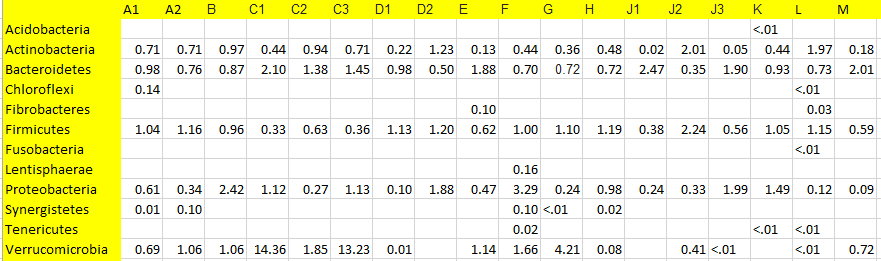
The average for each of the phylums that had results across all reports was effectively 100% except for Actinobacteria at 66%. For the following phylums there were effectively none in any results – which may be good. One is associated with disease, the others have just recently been identified.

“Actinobacteria, are recognized as the producers of many bioactive metabolites that are useful to humans in medicine, such as antibacterials,[7] antifungals,[8] antivirals, antithrombotics,..” Wikipedia. In other words, our police force to keep bad bacteria in control is understaffed at 66%.

A,F,G,H have some synergistetes. Those that gave a summary have digested issues. In particular A had an significant increase between the two uBiome tests.


Downloads:

PDF: phylum

Excel: phylum


uBiome results #1 Diversity and Overview

There is a delicate balance between abundant information and useful information. To me, useful information is something you can take action on. If you are low or high for some bacteria group, then there is something that can be done to correct it. uBiome results provide too much information for most people to digest (including most MDs).

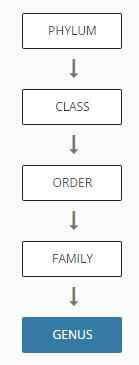
This is the first of a series of posts — each one will take a look at a different level of their reports. There are five levels as shown below:

phy

For those not familiar with biology. Phylum is the highest classification — think of fish, animals, reptiles, insects. Class is the next level down: Animal-omnivores, Animals-carnivorous, etc… and each level breaks into more and more groups.

 uBiome Laboratory Facilities

For a history of this 4 year old company, read this article. It’s clinical laboratory is accredited by its  College of American Pathologists (CAP) [source]. They upgrade their equipment often which does result in different lists of organism from tests done a few months apart. This is a side effect of being cutting-edge.

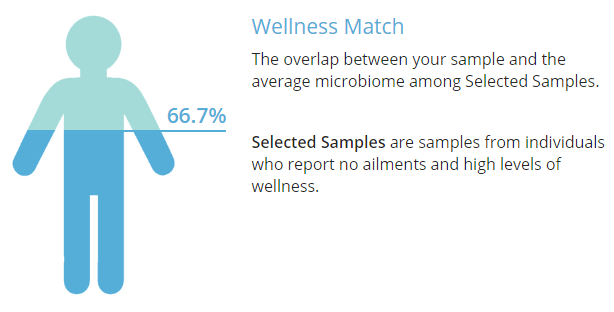
At the highest level, they give two general measures:

wellness

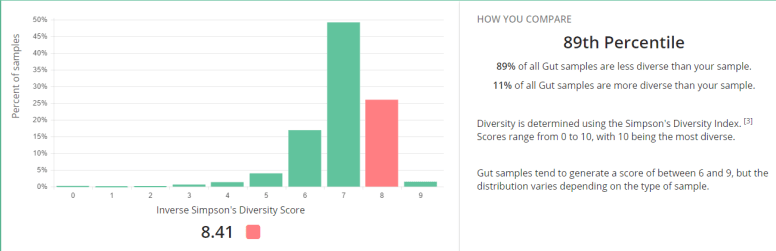
And Diversity percentile. This indicates where in a 100 people you rank. at 100% — you have more than anyone else. At 0% – you have less than anyone else.

diversity

So what are the results from our readers who share their results?

well

4/12/2014 10/1/2013 9/13/2015 6/23/2016 1/16/2015 3/26/2015 29/04/2016 9/25/2016 10/27/2015 4/16/2014 9/29/2015 10/23/2015 12/4/2015 3/29/2016
B C1 C2 C3 D2 D1 E F G H J1 J2 J3 K
Wellness Match 97.5 66.7 85.00% 66.7 97.8 93 83.3 96.9 97.7 98.5 67.2 97.3 79.6 98.7
Diversity Percentile 71% 89% 88% 63% 7% 51% 12% 97% 46% 46% 2% 26% 23% 68%
Simpson 7.98 8.41 8.38 7.82 6.03 7.6 8.8 7.52 7.5 4.86 7.09 6.97 7.92
  • We have over 50% appearing to be well (90 or better) by the definition used.
  • We have 50% in the middle 50% of diversity samples (25%-75%).

Bottom Line

Do not expect to have a uBiome result saying clearly that you are sick. We will see some distinct patterns as we dive down into details (and in some cases, also a lot of noise)

If you have done a uBiome on your gut, and willing to grant me access for a few days – send your login and password to me at Ken [at] Lassesen.com


Microbiome Test in Europe: KyberKompakt Pro

A reader forward the results of their test from KyberKompakt Pro. This is done by a German firm MVZ Institute for Micro Ecology GmbH and the testing appear to be available across Europe (the reader was not in Germany, with the test results in their language).

IMHO, this test shows the best collection of information for any tests that I have seen for CFS patients. I am working on a series of posts on uBiome.com tests (thanks to a lot of readers willing to share their results) which should start appearing later this week. This test gives better CFS specific information than uBiome.

If you are in Europe, this would be my first choice of microbiome tests.

Very low E.Coli, Bifidobacterium etc

The results follow the usual pattern reported since 1998 for CFS patients.

k1

  • H2O2-Lactobacillus are Hydrogen Peroxide producing Lactobacillus (I will explore those in a future post). Hydrogen peroxide eliminates some pathological bacteria.
  • E.Coli Biovare is a new species for me and I could not find anything on pubmed.
  • Faecalibacterium prausnitzii (Reported low for some CFS patients [2016])
  • Akkernansia muciniphia is new bacteria
    • A. muciniphila is a member of the Verrucomicrobia phylum and was isolated in 2004 in a quest to identify new mucus-degrading bacteria from human feces… provide colonization resistance to pathogenic bacteria that have to cross the mucus layer to reach the intestinal cells (Figure 4). It is likely that during infection or inflammation the mucus layer gets damaged and the growth of Akkermansia spp. is automatically inhibited, causing an inhibition of microbes that coexist with Akkermansia spp.” [2012]

The report also produces a nice graphic summary.

k2

For this patient, my suggestions to be discussed with their health professional are pretty much standard:

  • Escherichia Coli probiotics with Enterococcus probiotics (i.e. Symbioflor-2 or Mutaflor, with Symbioflor-1)
  • Bifidobacterium – As many species as possible.

Lactobacillus — hold off taking any until I can research which ones are Hydrogen Peroxide producing. Prescript Assist and Equilibrium are also likely beneficial.