Updated Model and Treatment Suggestions

Since I started this blog, some 530 posts ago, there have been significant changes in probiotics available and information available (for example uBiome results). My original model favored the reports from the University of Newcastle in Australia in 1998. The uBiome results from a sample of over a dozen readers of this blog confirmed parts of this report and also raise questions on other parts. In re-reading the report, there was only 4 controls to 27 patients — which may account for the differences they saw. I summarized below:

1998 Study uBiome Sample
Controls CFS Ratio  Ratio
Bifidobacterium 7% 2% 28% 21%
Bacteroides 93% 91% 98% 98%
Enterococcus 1% 24% 2400% 0%
Enterobacter 0% 3% 30000% 18%
E.Coli 92% 49% 53% 18% (parents)

In short, we do not see the overgrowth, but can confirm the undergrowth matches from the uBiome results.

There was a match up of the antibiotics used by Jadin with the overgrowth and undergrowths, which reinforced the model. There may a different reason that her antibiotics protocol works for many — for example, inhibiting “normal” bacteria allowing the undergrowth to increase. I do not have clarity on this.

My rotate rotate rotate was based on the belief that there was there was significant overgrowth that could become resistant. I have now diminish it’s importance (I have not abandoned it).

Suggestions for an updated Probiotic Protocol

All of the above resulted in my recommendations to discuss with your medical professional:

  • Start  with General Biotics Equilibrium – you will keep taking it while you have CFS symptoms
  • Add in Prescript Assist after 1-2 weeks – you will keep taking it while you have CFS symptoms
  • Add in Bifidobacteria Probiotics after 1-2 weeks — See this post for some possible brands.
    • You may (for cost reasons) to rotate thru different brands so you get as many species as you can find.
  • Add in MegaSporeBiotic or Just Thrive (for many Bacillus species) after 1 week – at this point you will be taking every Bacillus probiotic available.
  • After 2 weeks, rotate between Mutaflor and Symbioflor-2 every week – you will be taking every E.Coli probiotic available
  • After 6 weeks, stop the E.Coli and take the Lactobacillus Gasseri (explained in my next post).
    • You want D-Lactic free and H2O2 producing Lactobacillus species/strains
    • Lactobacillus usually kill E.Coli so it is one or the other.
  • After 6 weeks, stop the Lactobacillus and rotate back to the E.Coli

After 2 Lactobacillus/E.Coli cycles, if there is not significant improvement (or improvement has stopped), then consider a uBiome test. When you get the results, consider using herbs/antibiotics if appropriate. For example, one uBiome results had Rickettsia which would suggest antibiotics.

  • Propionibacterium freudenreichii (Securil) is not included because it depends on  Lactobacillus helveticus. It is suggested that you eat  Emmental cheese instead “An estimated one billion living cells of P. freudenreichii are present in one gram of Emmental.”[Wikipedia]

“Add in” – start with a low dosage (where practical) and increase to recommended dosage on the bottle or higher (2x — to be discussed with your medical professional).

WARNING: Prescript Assist  and Prescript Assist Pro are two different products made by two different companies.  Only Prescript Assist has had studies on PubMed, the other one is recent to the market and has less variety.

NOTE: This post has been updated by    https://atomic-temporary-42474220.wpcomstaging.com/2017/10/08/update-and-recap/ , which is now pinned to the home page.

 

uBiome Results #7 Summary

I took a dozen results from readers of this blog. Some have CFS diagnosis, some have IBS, some have something. There was no filtering to specific symptoms, diagnostic criteria, etc.  As a statistician, I would expect a need to cluster them to get meaningful results. To my surprise, these random people reading my blog had very consistent results showing the same general pattern. This pattern is summarized below.

A single uBiome results shared with me had a surprise, while the pattern was there — there was a Rickettsiales result (14%). This was the only Rickettsiales in all of the samples and hints that the items with only one or two results may be ‘bad bacteria’ infections.
The tree below shows where items were deemed significantly low in prior posts by being marked in red. In some cases the low values started at Phylum level, on other at the Genus level.

I have annotated with known probiotics available that may raise low levels (except for Lactobacillus amd Bifidobacteria which I will cover in future posts).   In some cases when probiotics are available, I rechecked the uBiome results and added notes. In my next post I will revisit what the model and this information would suggest for treatment.

If you know of additional probiotics not reported below, please email me with the details.

WARNING: Prescript Assist  and Prescript Assist Pro are two different products made by two different companies.  Only Prescript Assist has had studies on PubMed, the other one is recent to the market and has less variety.


Ø – Indicates not in uBiome Results (i.e. no information)
Þ – Indicates a Probiotic is available

  • Actinobacteria
    • Actinobacteria
      • Bifidobacteriales
        • Bifidobacteriaceae
          • Bifidobacterium
      • Coriobacteriales
        • Brevibacteriaceae (2 /12 had trace amounts)
          • Brevibacterium (2 /12 had trace amounts)
            • Ø Lipolyticum Þ Prescript Assist (USA) Þ Prescript Assist Pro (USA)
            • Ø Stationis Þ Prescript Assist (USA) Þ Prescript Assist Pro (USA)
        • Coriobacteriaceae
          • Eggerthella
    • Actinomycetales
      • Corynebacterineae
        • Corynebateriaceae
          • Corynebacterium
            • Kurtha zopfil  Þ Prescript Assist (USA) Þ Prescript Assist Pro (USA)
        • Ø Micrococcaceae
          • Arthrobacter
            • Agilis Þ Prescript Assist Pro (USA)
            • Citreus Þ Prescript Assist Pro (USA)
            • Globiformis Þ Prescript Assist Pro (USA)
            • Luteus Þ Prescript Assist Pro (USA)
            • Simplex Þ Prescript Assist Pro (USA)
            • Calcoaceticus Þ Prescript Assist Pro (USA)
            • Chroococcum Þ Prescript Assist Pro (USA)
            • Paspali Þ Prescript Assist Pro (USA)
        • Ø Streptomycetaceae
          • Ø  Streptomyces
            • Ø Fradiae Þ Prescript Assist (USA) Þ Prescript Assist Pro (USA)
            • Ø Celluslosae Þ Prescript Assist (USA) Þ Prescript Assist Pro (USA)
            • Ø Griseoflavus Þ Prescript Assist (USA) Þ Prescript Assist Pro (USA)
      • Propionibacteriaceae (1/12 had trace amount, rest none)
        • Propionibacterium (1/12 had trace amount, rest none )
  • Bacteroidetes
    • Bacteroidetes
      • Bacteroidales
        • Bacteroides
          • Ø Lipolyticum Þ Prescript Assist (USA) Þ Prescript Assist Pro (USA)
          • Ø Succinogenes Þ Prescript Assist (USA) Þ Prescript Assist Pro (USA)
        • Prevotellaceae
          • Prevotella
  • Firmicutes
    • Bacilli
      • Bacillales (only 4/12 with measurable amounts)
        • Bacillaceae (only 2/12 with measurable amounts)
          • Bacillus (only 1/12 with measurable amounts)
            • Ø Cereus
            • Ø Clausii Þ Enterogermina (Italy), Þ MegaSporeBiotic (USA)
            • Ø Brevis Þ Prescript Assist (USA) Þ Prescript Assist Pro (USA)
            • Ø Coagulans Þ MegaSporeBiotic, Þ Thorne (USA), Swanson (USA), Schiff (USA) etc
            • Ø Indicus Þ MegaSporeBiotic
            • Ø Licheniformis Þ MegaSporeBiotic
            • Ø Marcerans Þ Prescript Assist (USA) Þ Prescript Assist Pro (USA)
            • Ø Pumilis Þ Prescript Assist (USA) Þ Prescript Assist Pro (USA)
            • Ø  Polymyxa Þ Prescript Assist (USA) Þ Prescript Assist Pro (USA)
            • Ø  Substilis Þ Prescript Assist (USA), Þ MegaSporeBiotic Þ Prescript Assist Pro (USA)
      • Erysipelotrichia
        • Turicibacter
    • Lactobacillales
      • Enterococcaceae (4 low amount, rest none)
        • Enterococcus  (4 low amount, rest none)
          • Ø Faecalis Þ Symbioflor-1 (Germany),
            • Þ Biofermin+S+Tablet (Japan)
            • Also part of many mixtures
      • Lactobacillaceae
        • Lactobacillus
      • Streptococcaceae
        • Streptococcus Þ many providers
          • Ø Salivarius
          • Ø Thermophilus  Þ In some Yogurts
    • Clostridia
      • Clostridiales
        • Clostridiaceae
          • Clostridium
            • Ø Butyricum – Þ Miyarisan (Japan)
        • Clostridiales Family XI. Incertae Sedis
          •  Ø Myrothecium verrucaria Þ Prescript Assist (USA) Þ Prescript Assist Pro (USA)
        • Lachnospiraceae
          • Marvinbryantia
          • Shuttleworthia
        • Oscillospiraceae
          • Oscillibacter
        • Peptoniphilaceae
          • Finegoldia
        • Ruminococcaceae
          • Candidatus Soleaferrea
          • Oscillospira
    • Mollicutes
      • Anaeroplasmatales
        • Erysipelotrichaceae
          • Dielma
    • Negativicutes
      • Selenomonadales
        • Veillonellaceae
          • Megasphaera
    • Proteobacteria
      • Alphaproteobacteria
        • Rhodospirillales (3 high, 5 low, rest none)
          • Ø Azospirillum
            • Ø Brasiliense Þ Prescript Assist (USA)  Þ Prescript Assist Pro (USA)
            • Ø Lipoferum Þ Prescript Assist (USA) Þ Prescript Assist Pro (USA)
      • Betaproteobacteria (75% were low)
        •  Burkholderiales (75% were low)
          • Comamonadaceae (2 low amounts, rest none)
          •  Þ General Biotics Equilibrium (USA)
      • Deltaproteobacteria
        • Desulfovibrionales
      • Gammaproteobacteria
        • Ø Aeromonadales (3 with low amounts)
          •  Þ General Biotics Equilibrium (USA)
        • Pseudomonadales (only 1 with trace amount)
          • Þ General Biotics Equilibrium (USA)
          • Ø Arthrobacter
            • Ø Agilis Þ Prescript Assist (USA)
            • Ø Citreus Þ Prescript Assist (USA)
            • Ø Globiformis Þ Prescript Assist (USA)
            • Ø Luteus Þ Prescript Assist (USA)
            • Ø Simplex Þ Prescript Assist (USA)
            • Ø Calcoaceticus Þ Prescript Assist (USA)
            • Ø Chroococcum Þ Prescript Assist (USA)
            • Ø Paspali Þ Prescript Assist (USA)
          • Pseudomonas (one 1 with trace amounts)
            • Ø Calic Þ Prescript Assist Pro (USA)
            • Ø Dentrificans Þ Prescript Assist (USA)  Þ Prescript Assist Pro (USA)
            • Ø Flourescens Þ Prescript Assist (USA) Þ Prescript Assist Pro (USA)
            • Ø Glathei Þ Prescript Assist (USA) Þ Prescript Assist Pro (USA)
            • Ø Stutzeri Þ General Biotics Equilibrium (USA)
        • Enterobacteriales
          • Enterobacteriaceae Þ General Biotics Equilibrium (USA) – dozens of species
            • Kluyvera 
            • Ø Escherichia
              • Ø E.Coli – Þ Simbioflo-2 (Germany)
                • Ø Nissle 1917 – Þ Mutaflor (Germany)
  • Verrucomicroba
    • Verrucomicrobiae
      • Verrucomicrobiales

Letter to New Scientist

New Scientist’s issue of Nov 4th, 2016 had a commentary by Ester Crawley, below is my response that I sent to the New Scientist. Commentary is here.

new

Ester Crawley’s desire to recruit for online cognitive behavioural therapy is commendable; unfortunately, it is contributing to a deepening division in the CFS/ME community. CFS/ME has been a condition that keeps enticing specialists to hope that they have found an application for their expertise, with funding for this activity.

The root cause of CFS/ME and many co-morbid conditions was identified in Australia in 1998 by a team at the University of Newcastle [ http://www.ahmf.org/98access/98butt3.html  ]. The root cause is a dramatic shift of bacterial population in the gut. Dynamic evidence of the correctness of this cause had been demonstrated by the immediate remission of CFS/ME by fecal transplants which has been reported more than once in this journal. An older treatment for CFS using a Rickettsia antibiotic protocol had a significant remission rate but the long term use of antibiotics has ceased being politically correct.

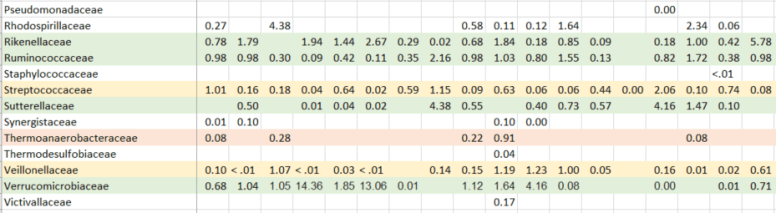
I recently examined the uBiome results of a dozen CFS patients and found that five Families had a median value below 20% of the reference range ( Bifodobacteriaceae, Enterbacteriaceae, Lactobacillceae, Peptococcaceae, Streptococcaceae). At the Genus level we found 16 of 120 Genus had a median value below 20%.

Standard medical practice for overgrowth of a bacteria is the use of antibiotics. For undergrowth there are very few probiotics. Most commercial probiotics are selected with the undesirable characteristics of not taking up residence, non-producers of toxins against other species and very susceptible to all antibiotics. “Here today, definitely gone tomorrow!”

In the US, there is an additional challenge – if a probiotic is demonstrated effective against a disease, it immediately becomes regulated. A probiotic that makes no claims is unregulated. Mutaflor (E.Coli Nissle1917) is not sold in the US despite being used in Europe for almost 100 years. This is unfortunate because most CFS/ME patients have very low or no E.Coli in their microbiome.

I am a citizen scientist with an M.Sc.(Operations Research) who has had CFS/ME three times over 40 years and recovered each time. The model of a microbiome dysfunction fits all of the studies but presents major treatment challenges. Bacteria strains are co-inherited with DNA which present challenges of rejection by the host, similar to organ transplants and blood transfusions. This rejection is often seen with CFS/ME patients about 6-9 months after a fecal transplant, when symptoms return.


Ken Lassesen

Seattle, WA
(ex-Amazon, ex-Microsoft, currently at Starbucks!)

https://atomic-temporary-42474220.wpcomstaging.com/

uBiome Results #6 The Genus Level

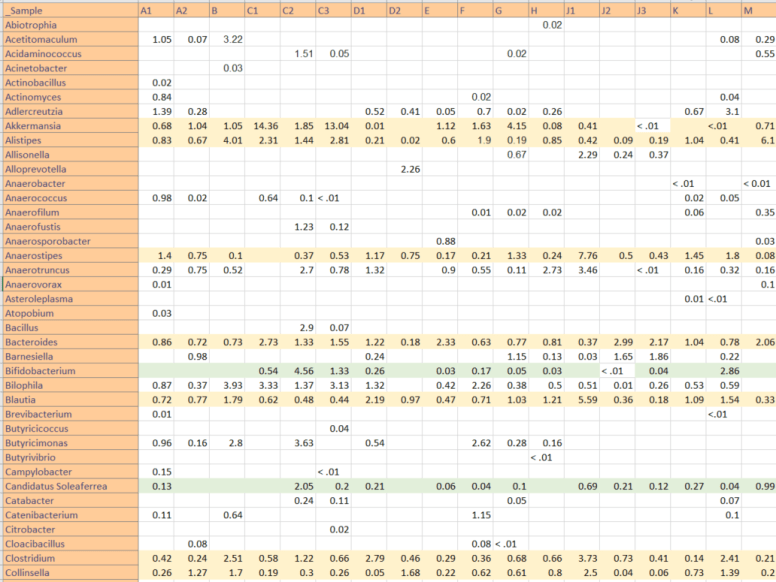
This is the lowest level usually reported by uBiome. At the Family level we had 52 families in the results. At the Genus level we have 128 Genus. Below the Genus level is the Species level. Below the Species level is the Strain level. A Strain level report will likely have over 2000 strains (if it was possible to identify all of the strains).

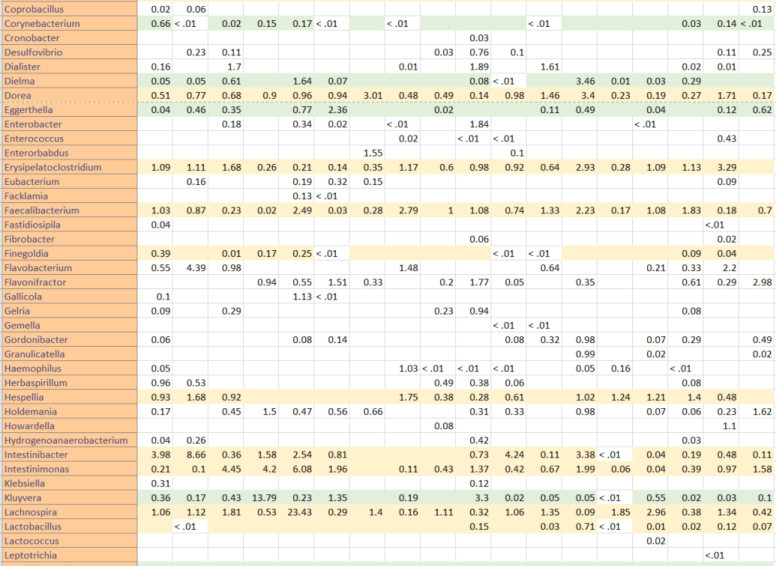
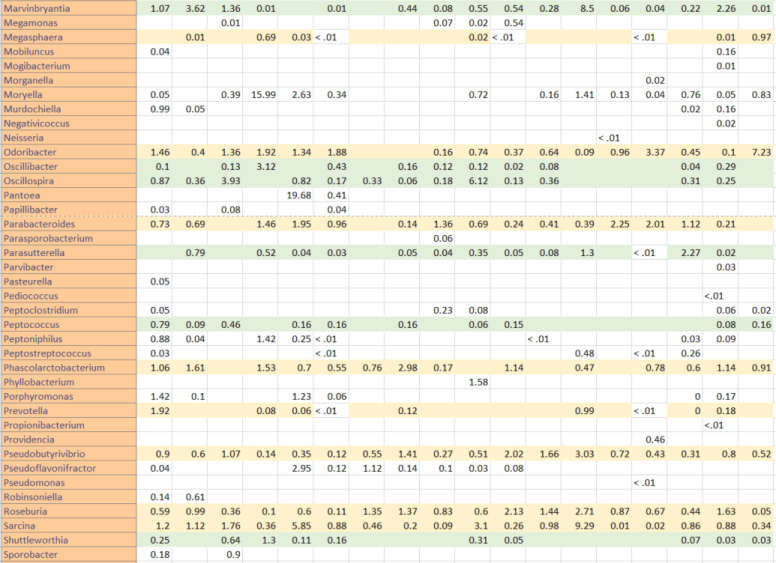
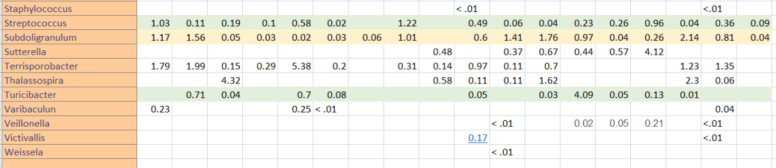
As with the prior post, I use some thumbnail algorithms to group items into groups. The complete data is available at the bottom for people to do their own analysis.

genus1genus2genus3genus4

Genus being skipped

Criteria: 5 or more (or 50+%) in mid range (60%-160%) OR a middle value inside of this range (60%-160%) with at least 10 results. Some are not on Wikipedia

Major Shift Genus

Criteria: Middle Value below 40% And less than 4 in the middle range with at least 9 results (i.e. < 40%)

The Noisy Genus

The rest of the Genus are difficult to  interpret. As before, I ascribed them as meaningless or connected with specific symptoms (but we do not have enough samples to dig into that).

Analysis

We have 20 Genus of 128 reported with severely low numbers for what appear to be common Genus. What is actually surprising is that there are no consistent pattern of high values for any Genus, just low or normal. 

The treatment issue is how to increase these 20 Genus when most are not available as probiotics.

Downloads

PDF: genus

Excel:genus


uBiome Results #5 The Family Level

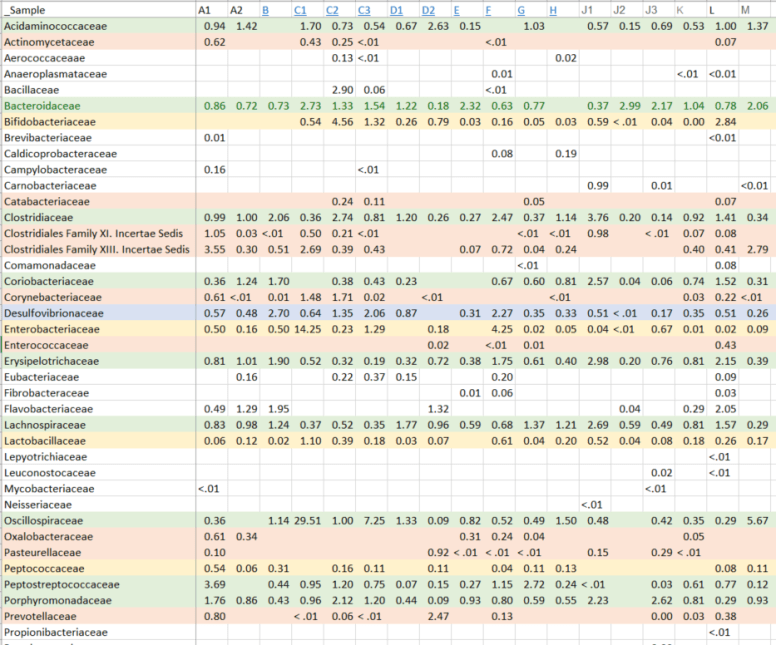
We have now exploded to 53 items to review when we examine the “Family Level” of bacteria in the gut. Our decomposition may reveal that while a higher Order is normal, specific families are not (usually underpopulated).

A few items are close enough to normal by one or another criteria that I will skip them entirely. Definition for normal that I used was 5 or more values in the 60% -166% range with middle value in the same range):

  • Acidaminococcaceae: Middle value 73%
  • Bacteroidaceae: Middle value 104%
  • Clostridiaceae: Middle value 95%
  • Coriobacteriaceae: Middle value 60%
  • Erysipelotrichaceae: Middle value 67%
  • Oscillospiraceae: Middle value 67%
  • Peptostreptococcaceae: Middle value 61%
  • Porphyromonadaceae: Middle value 86%
  • Verrucomicrobiaceae: Middle value 105%

While there may be some significant, the magnitude of this significance is much less than the items below

family1family2

Massive Shifts

Criteria is at least 11 values with 5 or less in the range (60% – 160%) and the middle value is outside of the range

Not Enough Information

If at least three different people have a family of bacteria, I deem it to be noise. It may apply to the person and their symptoms but is not revelant to a general CFS patient.

Possible Symptom Specific Shifts

Must be a clear pattern (i.e. at least 70% very low) and at least 3 results

Analysis

In looking at various families above, I noted a large number of them were first “discovered” in the last 20 years. They were discovered by modern lab methods such as real-time polymerase chain reaction (PCR) that amplifies RNA and DNA.  The downside of this is simple: we can identify the bacteria but we know very little about what is associated or caused with each. We know even less about how to correct shifts. Modern medicine knows how to treat overpopulation of bacteria (antibiotics) but really nothing beyond “eat yogurt”  for dealing with underpopulation — what is clearly seen above.

For four of the massive shift items, we have probiotics available in the world. The problem is that many species do not play well with other species. In terms of correction (in sequence), my best suggestions (which does evolve):

  1. High dosages of different Bifidobacteriaceae, rotating thru as many species as possible. We saw with results C that it does work to shift bacteria. The problem is their failing to take up residence.
  2.  Enterobacteriaceae probiotics — that is E.Coli probiotics from Germany (Mutaflor, Symbioflor-2) – the latter is known to take up residence.
    1. Should be taken with Enterococcaceae probiotic since they appear to support each other. E. faecium SF68, etc
  3. D-Lactic acid free and H2O2 producing Lactobacillaceae probiotics
  4. Streptococcaceae probiotics, for example Streptococcus salivarius K12

Downloads

Pdf: family

Excel: family