Herb: Butterbur and Migraines

In my earlier posts on migraines, I found this herb, butterbur (Petasites hybridus), listed in traditional treatments for migraines. Working with the assumption that most migraines are results of bacterial shifts, then this would likely be an antibacterial.

For Migraines

  • “Petasites hybridus, has emerged as a promising treatment. “[2014]
  • “11 prophylactic drugs received a strong recommendation for use (topiramate, propranolol, nadolol, metoprolol, amitriptyline, gabapentin, candesartan, butterbur, riboflavin, coenzyme Q10, and magnesium citrate)[2012]
    • Bold items are common for CFS

Impact on Bacteria

  • “exhibited significant antibacterial activity against B. subtilis. [but not against Escherichia coli, Staphylococcus aureus]” [2005]

That is it! Very little research on the mechanism of action.

Ecologic (Netherland) series of probiotics

In doing my last posts, I became aware of this Dutch probiotic company, http://consument.winclove.nl/, which does canned probiotic mixtures as well as custom formulations from 100 strains they have. They declare and document every strain used — which is ideal.

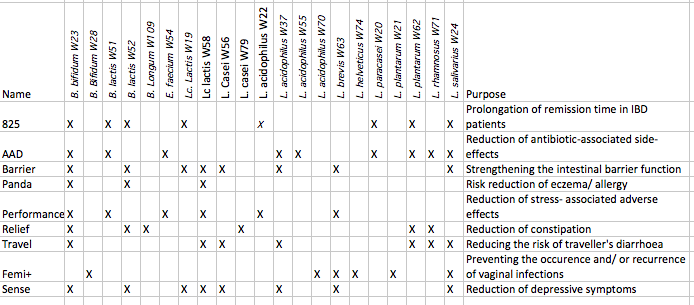
They have nine canned probiotic mixtures which I have extracted a matrix of strains below:

Screen Shot 2015-11-08 at 12.45.05 PM

Their literature is available at: http://b2b.winclove.nl/Our-formulations/ecologic.html

Some of their products are available via these online seller (all in the netherlands)

Supplementus

supplementus.nl

Sorgente

sorgente.nl

Medireva

hulpmiddelwereld.nl

Depression

My last post looked at depression, which the Sense probiotic above is targeted at. It contains:

  • B. bifidum W23,
  • B. lactis W52,
  • L. acidophilus W37,
  • L. brevis W63,
  • L. casei W56 – other L.casei are associated with reduction of depression, Lactobacillus casei strain Shirota (LcS) [Yakult]  significant decrease in anxiety symptoms among those taking the probiotic [2009] and Actimel (DanActive) appear to share a common ancestor [2013]
  • L. salivarius W24,
  • Lc. Lactis W19,
  • Lc. Lactis W58

This mixture is cited in this Aug 2015 study, A randomized controlled trial to test the effect of multispecies probiotics on cognitive reactivity to sad mood. There were a few studies on some of the other strains in combination — but nothing on the individual strains.

When to take probiotics? – an actual study

Today I came across an actual study on PubMed.

“Enumeration during and after transit of the stomach and duodenal models showed that survival of all the bacteria in the product was best when given with a meal or 30 minutes before a meal (cooked oatmeal with milk).Probiotics given 30 minutes after the meal did not survive in high numbers. Survival in milk with 1% milk fat and oatmeal-milk gruel were significantly better than apple juice or spring water….We conclude that ideally, non-enteric coated bacterial probiotic products should be taken with or just prior to a meal containing some fats. ” [2011]

“Food intake led to a delay in yeast release and a two-fold increase in strain survival. Whatever the dose, yeasts were particularly sensitive to the large intestinal environment.” [2012]

“our results indicate for the first time that low-fat spread is a suitable carrier for these probiotic strains.” [2009]

“The objective of the study was to compare oral and faecal recovery during and after administration of a combination of Lactobacillus rhamnosus GG and LC705, Propionibacterium freudenreichii subsp. shermanii JS, and Bifidobacterium animalis subsp. lactis Bb12 as capsules, yoghurt, or cheese…. Yoghurt yielded the highest faecal quantity of JS and Bb12 strains (8.01 and 9.89log(10) genome copies/g, respectively). The results showed that the administration matrix did not influence the faecal quantity of lactobacilli, but affected faecal counts of propionibacteria and bifidobacteria that were lower when consumed in cheese.” [2010]

“Taken together, our findings indicate that the manner in which a probiotic is delivered – whether in food or supplement form – could influence how effective that probiotic is in delivering the desired health benefits,” said Marco, an associate professor in the Department of Food Science and Technology at UC Davis…. They discovered that mice fed L. casei in milk exhibited fewer symptoms of IBD than did mice fed milk alone or the same probiotic strain in a nonfood supplement format.” [2015]


Bottom Line

Taking probiotics with milk (assuming no lactose intolerance) appears to be best. If lactose intolerance, it should be taken with some food that contains fat, for example rye crisp with olive oil.

CFS Depression, Diet and the Microbiome

Depression in CFS is different than conventional depression.

  • “Abnormal cerebral perfusion patterns in CFS subjects who are not depressed are similar but not identical to those in patients withdepressive illness…Depressed patients differed from those with CFS in having relatively less perfusion of the left prefrontal cortex.” [2000]
  • “Asymmetry (R > L) of tracer uptake at parietotemporal level is demonstrated in CFS as compared with Major Depression.” [1996]

In 1999, while reading up on antibiotic protocols for Chronic Fatigue Syndrome, I came across the reports of Dr. Philip Bottero, MD, who was doing a protocol of multiple rotating antibiotics very similar to Dr. Cecile Jadin, MD. The unusual thing was he was treating patients with psychopathies and obtaining a high rate of remission (Clinique de la Résidence du Parc, 1986) and “Chronic psychopathologies associated with persistent rickettsia and/or similar germs (chlamydiae)” Acta Mediterranea di Patologia Infettiva e Tropicale, 1987) – “For 60 cases of diseases that are called “Psychic” associated with persistent rickettsiae; we have: 55 good and excellent result, 5 failure,”

This caused me to suspect many psychological disturbances were the results of bacteria — more recently, gut bacteria. But what does PubMed says?

  • “several medications (pioglitazone, metformin, exenatide, atorvastatin, gram-negative antibiotics), which have traditionally been used to treat metabolic disorders showed a certain potential to treat depression in first randomized controlled clinical trials.” [2015]
  • L. rhamnosus (JB-1) …these findings highlight the important role of bacteria in the bidirectional communication of the gut-brain axis and suggest that certain organisms may prove to be useful therapeutic adjuncts in stress-related disorders such as anxiety and depression” [2011]
  • “The concept that intestinal microbial composition not only affects the health of the gut, but also influences centrally-mediated systems involved in mood, is supported by a growing body of literature…. Bifidobacterium infantis…Probiotic treatment resulted in normalization of the immune response, , and restoration of basal NA concentrations in the brainstem.[2010]
  • B. infantis ….provides encouraging evidence in support of the proposition that this probiotic may possess antidepressant properties” [2008]
  • “39 CFS patients were randomized to receive either 24 billion colony forming units of Lactobacillus casei strain Shirota (LcS) [Yakult] or a placebo daily for two months…. also a significant decrease in anxiety symptoms among those taking the probiotic [2009]
  • “a multispecies probiotic containing Bifidobacterium bifidum W23, Bifidobacterium lactis W52, Lactobacillus acidophilus W37, Lactobacillus brevis W63, Lactobacillus casei W56, Lactobacillus salivarius W24, and Lactococcus lactis (W19 and W58)  …. provide the first evidence that the intake of probiotics may help reduce negative thoughts associated with sad mood.[2015] Note: This is a Ecologic probiotic and should be available in Europe (soon)!
  • “we compared the effects of two different Bifidobacteria on anxiety and depression-like behavior; an antidepressant was also used as a comparator…  whereas B. longum 1714 induced antidepressant-like behavior in the tail suspension test.” [2014] [PDF-2015]
    • “these data suggest that B. longum 1714 had a positive impact on cognition and also that the effects of individual Bifidobacteria strains do not generalise across the species. ” [2015] i.e. not any B.Longum will have this effect.

Migraines, diet and the microbiome

In my last post I had discovered the migraine –> CFS pathway: Increased risk of chronic fatigue syndrome in patients with migraine: A retrospective cohort study [Oct 2015]. This suggests that migraines may be an indicator of the start of a dysfunction leading to CFS in some patients, see “evidence linking the migraine brain to various GI disorders” [What the Gut Can Teach Us About Migraine Jul 2015] and an even older study Migraine of gastrointestinal origin[1995].

In this post, I am going to attempt to drill into this because many CFSers suffers from migraines (just like they suffer from POTS and IBS very often).

  • “Several studies demonstrated significant associations between migraine and celiac disease, inflammatory bowel disease, and IBS.” [2014]
  • “probiotics [Ecologic(®)Barrier, 2.5×10(9) cfu/g] may decrease migraine supporting a possible role for the intestine in migraine management. Feasibility and lack of adverse reactions justify further placebo-controlled studies” [Oct 2015]
    • Bifidobacterium bifidum W23, Bifidobacterium lactis W52, Lactobacillus acidophilus W37, Lactobacillus brevis W63, L. casei W56, Lactobacillus salivarius W24, and Lactococcus lactis (W19 and W58).

  • “a trend of more frequent H. pylori infections in patients with migraine” [2014]
  • “it has been documented that at 6 and 12 months, bacterial eradication [of H. Pylori] is associated to disappearance of symptoms in 23% and 28% of cases, and to a significant decrease of intensity, frequency and duration of acute attacks in the remaining patients.”[2013] – note that the antibiotics used impacts many families of gut bacteria
  • There is a growing body of literature on the potential use of .. diet interventions for primary headache disorders. This review identified literature on the use of a variety of diet and nutraceutical interventions for headache. Most of the studies assessed the efficacy of these interventions for migraine, though some explored their role in tension-type headache and cluster headache. The quality of the evidence in this area is generally poor.” [Jun 2015]
  • “led to the identification of two potential compounds present in live green real veggies which could be considered for anti-migraine activity with better binding affinities than the reference drugs used and with liver-protective properties.” [2015]
    • “The product contains, among other constituents, glucosinolate (cabbage and broccoli), glutathione (cabbage, broccoli, parsley), sulforaphane (cabbage and broccoli), indole-3-carbinol (from cabbage), carnitine (carrots) and betaine (beetroot). The team points out that indole-3-carbinol and sulforaphane can cross the blood-brain barrier whereas other components cannot and many are not even absorbed by the body when taken by mouth.” [ScienceSpot] – Comment: these veggies are inline with the class of vegetables that I advocate are good for CFS.
  • “A significant inverse relation was observed between dietary folate equivalent consumption and migraine frequency.” [Feb 2015] — reduces frequency but does not eliminate.
  • “Migraineurs with aura were more likely to have low intake of chocolate, ice cream, hot dogs, and processed meats. Those who experience migraine at least once per week were more likely to have low intake of skim/low-fat milk and white and red wine.” [Aug 2015] –

  • effects of a low-fat plant-based diet intervention on migraine severity and frequency…A low-fat diet has been shown to reduce headache frequency, intensity, and duration, with subsequently lowered medication use..The most commonly reported triggers in these and other analyses include: chocolate, cheese, citrus, alcohol, and coffee’[2014]

  • “our results support the idea that sterile inflammation plays a role in migraine pathogenesis. ” [2011]

  • We also recommend the use of the following supplements in the preventative treatment of migraines, in decreasing order of preference: magnesium, Petasites hybridus, feverfew, coenzyme Q10, riboflavin, and alpha lipoic acid.” [2009]

Bottom Line

Hopefully someone will fund a study testing each of the probiotics in this post on Migraines. There is a single study so far using a mixture that included L.Casei. At the moment, there is no data on which probiotics would be effective. Similarly, there have been no studies on the use of H. Pylori antibiotics on migraines when there was not H. Pylori present — I expect similar remission and relief rates would occur (i.e. H Pylori is not the cause, but the antibiotics are the cure for some!  aka Wrong Model, Right Treatment!)

The probiotic that I reviewed in my last post, BIFIDO|MAXIMUS, while untested in clinical studies for migraines has the appropriate characteristics according to the model that I am using. Ecologic(®)Barrier is a dutch probiotic that may be challenging to get for many